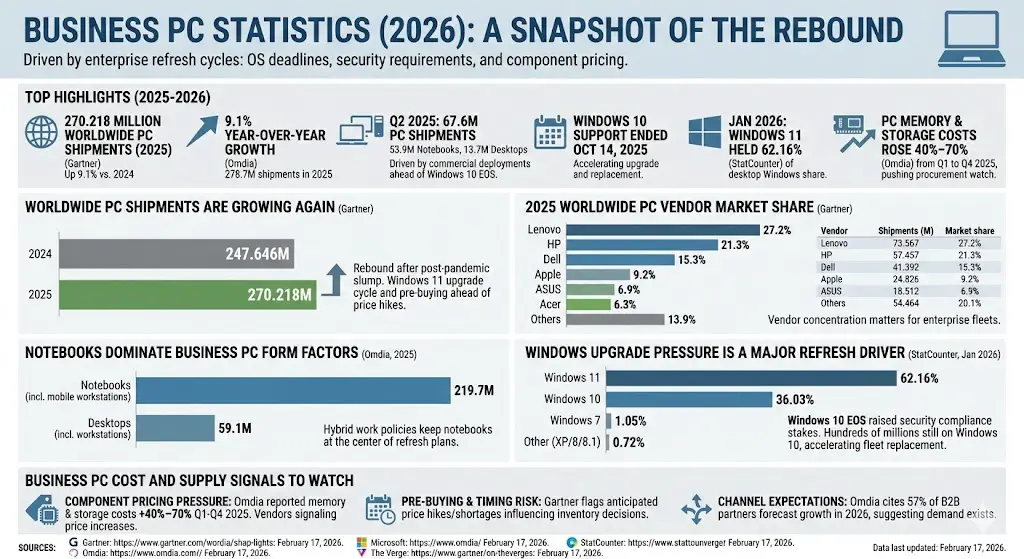
Business PC statistics matter because most “PC market” swings are driven by enterprise refresh cycles: OS deadlines, security requirements, fleet standardization, and component pricing.
Below is a data-first snapshot of what’s shaping business PC purchasing right now.
Gartner estimates 270.218 million PCs shipped worldwide in 2025, up 9.1% vs. 2024.
Omdia estimates 278.7 million PCs shipped worldwide in 2025 (also up 9.1% year over year).
In Q2 2025, Omdia tracked 67.6 million PC shipments: 53.9 million notebooks and 13.7 million desktops—driven by commercial deployments ahead of Windows 10 end of support.
Windows 10 support ended on October 14, 2025, accelerating upgrade and replacement decisions.
As of January 2026, Windows 11 held 62.16% of worldwide desktop Windows version share (StatCounter).
Omdia reports mainstream PC memory and storage costs rose 40%–70% from Q1 to Q4 2025, pushing procurement teams to watch pricing closely.
Worldwide PC shipments are growing again
After the post-pandemic slump, 2025 marked a clear rebound. Gartner’s preliminary totals show shipments rising from 247.646 million in 2024 to 270.218 million in 2025. Gartner also notes business demand was helped by the Windows 11 upgrade cycle and pre-buying ahead of expected memory price hikes.
Worldwide PC shipments (Gartner, 2024 vs 2025)
Label
Bar
Value
2024
247.646M
2025
270.218M
Max = 270.218M. Widths: 2024 91.65%, 2025 100.00%.
2025 worldwide PC vendor market share
For business buyers, vendor concentration matters (standard images, warranty coverage, docking ecosystems, and lifecycle programs). Gartner’s 2025 shipment estimates put Lenovo first, followed by HP and Dell.
Worldwide PC vendor market share (Gartner, 2025)
Label
Bar
Value
Lenovo
27.2%
HP
21.3%
Dell
15.3%
Apple
9.2%
ASUS
6.9%
Acer
6.3%
Others
13.9%
Max = 27.2%. Widths: Lenovo 100.00%, HP 78.31%, Dell 56.25%, Apple 33.82%, ASUS 25.37%, Acer 23.16%, Others 51.10%.
Top vendors by shipments (Gartner, 2025)
Vendor
Shipments (M)
Market share
Lenovo
73.567
27.2%
HP
57.457
21.3%
Dell
41.392
15.3%
Apple
24.826
9.2%
ASUS
18.512
6.9%
Others (incl. Acer and smaller vendors)
54.464
20.1%
Notebooks dominate business PC form factors
Omdia’s 2025 breakdown underscores how notebook-centric enterprise fleets have become: 219.7 million notebooks shipped vs 59.1 million desktops (both including workstations). Even with a return-to-office push, mobility and hybrid work policies keep notebooks at the center of business refresh plans.
2025 shipments by form factor (Omdia)
Label
Bar
Value
Notebooks (incl. mobile workstations)
219.7M
Desktops (incl. workstations)
59.1M
Max = 219.7M. Widths: Notebooks (incl. mobile workstations) 100.00%, Desktops (incl. workstations) 26.90%.
Windows upgrade pressure is a major refresh driver
Windows 10’s end of support on October 14, 2025 raised the stakes for security compliance. That pressure shows up in OS share trends: StatCounter’s worldwide desktop Windows version data for January 2026 puts Windows 11 at 62.16% and Windows 10 at 36.03%.
There’s also a hardware angle: Dell has argued that hundreds of millions of PCs are still on Windows 10 despite being capable of Windows 11, while another large cohort is too old to meet Windows 11 requirements—both factors that can translate into accelerated fleet replacement rather than simple in-place upgrades.
Desktop Windows version share (StatCounter, January 2026)
Label
Bar
Value
Windows 11
62.16%
Windows 10
36.03%
Windows 7
1.05%
Other (XP/8/8.1)
0.72%
Max = 62.16%. Widths: Windows 11 100.00%, Windows 10 57.96%, Windows 7 1.69%, Other (XP/8/8.1) 1.16%.
Business PC cost and supply signals to watch
Component pricing pressure: Omdia reported mainstream PC memory and storage costs increased 40%–70% from Q1 to Q4 2025, with vendors signaling price increases.
Pre-buying and timing risk: Gartner flags anticipated memory price hikes and shortages as factors influencing inventory and buying decisions.
Channel expectations: Omdia cites a B2B channel partner poll where 57% forecast growth in 2026—suggesting demand is there if supply and pricing cooperate.
OS compliance and security deadlines: Windows 10 end-of-support (and ESU considerations) can push orgs toward hardware replacement vs. extended patching.
Sources
Gartner (Jan 20, 2026). “Gartner Says Worldwide PC Shipments Increased 9.3% in Fourth Quarter of 2025 and 9.1% for the Full Year.” https://www.gartner.com/en/newsroom/press-releases/2026-1-20-gartner-says-worldwide-pc-shipments-increased-9-point-3-percent-in-fourth-quarter-of-2025-and-9-point-1-percent-for-the-full-year
Omdia (Jan 12, 2026). “Global PC shipments grew 9% in 2025 but memory and storage supply issues threaten 2026 outlook.” https://omdia.tech.informa.com/pr/2025/dec/global-pc-shipments-grew-9percent-in-2025-but-memory-and-storage-supply-issues-threaten-2026-outlook
Omdia (Jul 9, 2025). “Worldwide PC shipments up 7% in Q2 2025.” https://omdia.tech.informa.com/pr/2025/jul/worldwide-pc-shipments-up-7-percent-in-q2-2025
Microsoft Support. “Windows 10 support has ended on October 14, 2025.” https://support.microsoft.com/en-us/windows/windows-10-support-has-ended-on-october-14-2025-2ca8b313-1946-43d3-b55c-2b95b107f281
Microsoft Learn (Lifecycle). “Windows 10 reaching end of support.” https://learn.microsoft.com/en-us/lifecycle/announcements/windows-10-end-of-support
StatCounter Global Stats. “Desktop Windows Version Market Share Worldwide (January 2026).” https://gs.statcounter.com/windows-version-market-share/desktop/worldwide
The Verge (Nov 27, 2025). “Around 500 million PCs are holding off upgrading to Windows 11, says Dell.” https://www.theverge.com/news/831364/dell-windows-11-upgrade-numbers-earnings-call-q3-2025