
As remote work continues to evolve, having a reliable WiFi 7 router is essential for your home office setup in 2025. These routers offer impressive speeds, extensive coverage, and advanced features that can greatly enhance your productivity. With multiple options available, you might wonder which one is the best fit for your needs. Let’s explore the top contenders and what makes them stand out for workstations like yours.
TP-Link AXE5400 Tri-Band WiFi 6E Router (Archer AXE75)

If you’re looking for a robust solution to power your workstation, the TP-Link AXE5400 Tri-Band WiFi 6E Router (Archer AXE75) is an excellent choice. With speeds up to 5400 Mbps, it delivers lightning-fast performance through its 6 GHz, 5 GHz, and 2.4 GHz bands. The true tri-band design guarantees seamless connectivity for multiple devices, making it perfect for gaming and streaming. Plus, the OneMesh support allows you to expand coverage effortlessly. You’ll also appreciate the advanced security features like WPA3 and TP-Link HomeShield, keeping your network safe while you work or play. Enjoy reliable performance without interruptions.
Best For: Those seeking high-speed internet for gaming, streaming, and seamless connectivity across multiple devices.
Pros:
- True tri-band capabilities provide exceptional performance for simultaneous connections, ideal for busy households.
- Advanced security features like WPA3 and TP-Link HomeShield ensure robust protection for your network and IoT devices.
- OneMesh support allows for easy expansion of your home network coverage with compatible extenders.
Cons:
- Requires a modem for most ISPs, which may add to initial setup costs.
- Higher price point compared to dual-band routers, which may not be necessary for all users.
- Setup may be complex for users unfamiliar with networking equipment, despite overall ease of use.
NETGEAR Nighthawk AC1900 DOCSIS 3.0 WiFi Cable Modem Router Combo (C7000)

The NETGEAR Nighthawk AC1900 DOCSIS 3.0 WiFi Cable Modem Router Combo (C7000) is a perfect choice for users who need a robust and reliable internet connection for their workstations. Compatible with major cable providers like Xfinity, Spectrum, and COX, it delivers speeds up to 800 Mbps and covers 1800 sq ft, connecting up to 30 devices. By replacing both your cable modem and WiFi router, you’ll save up to $150 a year on rental fees. With four Gigabit Ethernet ports and USB support, you’ll enjoy versatile connectivity and strong security with WEP and WPA/WPA2 protocols.
Best For: Users seeking a reliable internet connection for high-speed cable plans and multiple devices in a home or small office environment.
Pros:
- Cost-effective: Saves up to $150 annually by replacing rental fees for modem and router.
- Strong performance: Supports internet speeds up to 800 Mbps, ideal for streaming and gaming.
- Wide coverage: Offers up to 1800 sq ft of wireless coverage and connects up to 30 devices.
Cons:
- Limited compatibility: Not compatible with Verizon, AT&T, CenturyLink, and DSL providers.
- DOCSIS 3.0 technology: May be less future-proof compared to DOCSIS 3.1 modems for very high-speed plans.
- No built-in voice support: Lacks the capability to support cable bundled voice services.
NETGEAR Nighthawk Pro Gaming WiFi 6 Router (XR1000)

For gamers seeking a router that minimizes lag and enhances online performance, the NETGEAR Nighthawk Pro Gaming WiFi 6 Router (XR1000) stands out with its powerful DumaOS 3.0. This router offers AX5400 wireless speeds, ensuring seamless gaming sessions with reduced ping rates by up to 93%. With four 1G Ethernet ports and a USB 3.0 port, it connects multiple devices effortlessly. While the DumaOS interface can be tricky, it supports a variety of devices, from PCs to consoles. Plus, built-in security features like NETGEAR Armor keep your network safe from threats. Get ready for an enhanced gaming experience!
Best For: Gamers who prioritize low latency and high-speed performance in their online gaming experiences.
Pros:
- High-speed performance with AX5400 wireless speeds, enabling seamless gaming sessions.
- DumaOS 3.0 optimizes connections, significantly reducing ping rates and lag spikes.
- Robust security features including NETGEAR Armor and automatic firmware updates protect against potential threats.
Cons:
- Complex setup process that may not be suitable for users unfamiliar with WiFi networking.
- DumaOS interface issues including bugs and navigation difficulties can hinder user experience.
- Mixed reviews on usability, with some features like ad blocking and QoS settings reported as problematic.
ASUS ROG Rapture GT-BE98 PRO Gaming Router and GT6 AX10000 Gaming Mesh System Bundle
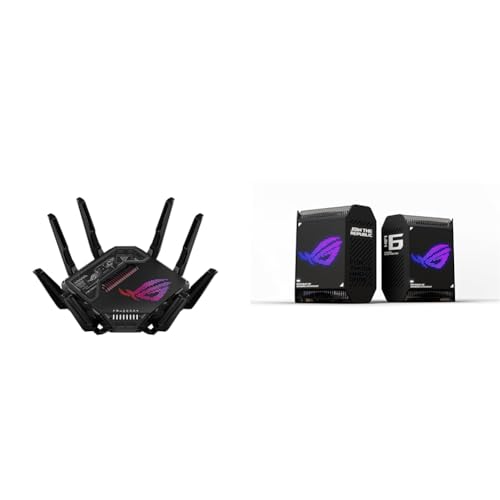
Designed for gamers and demanding workstation users, the ASUS ROG Rapture GT-BE98 PRO Gaming Router and GT6 AX10000 Gaming Mesh System Bundle delivers exceptional performance with WiFi 7 technology. With speeds up to 30 Gbps and 320MHz channels in the 6 GHz band, you’ll experience lightning-fast connectivity. Its expansive coverage spans up to 5,800 square feet, thanks to nine internal antennas and ASUS RangeBoost Plus technology. Plus, dual 10G ports and quad 2.5G ports offer flexible wired options. Enjoy peace of mind with a free lifetime subscription to AiProtection and ASUS Instant Guard for enhanced security on your devices.
Best For: Gamers and demanding workstation users seeking high-speed, reliable connectivity with extensive coverage.
Pros:
- Exceptional Speed: Offers speeds up to 30 Gbps with WiFi 7 technology.
- Wide Coverage: Covers up to 5,800 square feet, ideal for large homes or gaming setups.
- Enhanced Security: Includes a free lifetime subscription to AiProtection for device protection.
Cons:
- Price Point: May be considered expensive for casual users or non-gamers.
- Complex Setup: Advanced features may require technical knowledge for optimal configuration.
- Overkill for Basic Use: Performance capabilities may be unnecessary for users with standard internet needs.
Tenda Wi-Fi 6 Router AX1800 (RX3) – Dual Band Gigabit Wireless Internet Router
If you’re looking for a router that seamlessly handles multiple devices in a busy household or office, the Tenda Wi-Fi 6 Router AX1800 (RX3) is an excellent choice. With dual-band speeds reaching up to 1.8 Gbps, it’s designed to provide exceptional performance for streaming, gaming, and downloading. Its coverage spans up to 1200 square feet, ensuring strong signals even in multi-story homes. The advanced MU-MIMO and OFDMA technologies minimize latency, while WPA3 security keeps your network safe. Plus, the Tenda app allows you to manage your Wi-Fi remotely, making it a fantastic option for today’s connected environments.
Best For: Families or small offices that require robust Wi-Fi coverage and high-speed internet for multiple devices simultaneously.
Pros:
- Exceptional dual-band speeds of up to 1.8 Gbps for seamless streaming and gaming.
- Strong coverage of up to 1200 square feet, suitable for multi-story homes.
- Advanced security features with WPA3 protection and the convenience of remote management via the Tenda app.
Cons:
- Limited to 64 connected devices, which may not meet the needs of larger households or offices.
- Installation and setup may be more complex for users unfamiliar with router configurations.
- Performance may vary depending on the distance from the router and obstacles in the environment.
ASUS RT-BE58U WiFi 7 Extendable Router

The ASUS RT-BE58U WiFi 7 Extendable Router stands out as an ideal choice for professionals managing multiple devices and demanding tasks, thanks to its Multi-Link Operation (MLO) feature. With speeds reaching up to 3600 Mbps, it effortlessly supports 12-18 devices simultaneously. The dual-band design and adaptive QoS guarantee a smooth experience for gaming and streaming. Setup is straightforward using the ASUS app, while customer feedback praises its stability and performance. Plus, commercial-grade security through AiProtection Pro adds peace of mind. If you’re upgrading to WiFi 7, this router offers robust coverage and impressive features for your home office.
Best For: The ASUS RT-BE58U WiFi 7 Extendable Router is best for professionals and tech-savvy users managing multiple devices and high-bandwidth tasks in a home office environment.
Pros:
- High-speed performance with up to 3600 Mbps, supporting 12-18 devices simultaneously.
- User-friendly setup through the ASUS app and stable performance praised by customers.
- Advanced security features, including AiProtection Pro for enhanced safety.
Cons:
- Some users reported that the unit runs warm during operation.
- SSID naming options could be improved for better user experience.
- May require additional configuration for optimal performance in complex setups.
NETGEAR Nighthawk AC1900 WiFi Cable Modem Router Combo (Renewed)

For those seeking a reliable all-in-one solution, the NETGEAR Nighthawk AC1900 WiFi Cable Modem Router Combo is a standout option. It supports cable plans up to 800 Mbps, delivering speeds of up to 1900 Mbps with excellent coverage for up to 30 devices across 1800 sq ft. Weighing only 2.81 pounds, its compact design fits well in any workspace. With four Gigabit Ethernet ports and a USB port, connecting your devices is seamless. Plus, you’ll save up to $150 annually on rental fees. Rated 4.2 out of 5 stars, it’s a trusted choice for efficient home office connectivity.
Best For: Those looking for a reliable all-in-one cable modem and WiFi router solution for high-speed internet access in homes with multiple devices.
Pros:
- High Speed: Supports cable plans up to 800 Mbps with speeds up to 1900 Mbps for fast internet access.
- Extensive Coverage: Provides coverage for up to 1800 sq ft and can connect up to 30 devices simultaneously.
- Cost Savings: Eliminates rental fees, potentially saving users up to $150 annually.
Cons:
- Compatibility Limitations: Not compatible with certain providers like Verizon, AT&T, and CenturyLink.
- Weight: At 2.81 pounds, it may be slightly heavier compared to other compact modems.
- Renewed Product: As a renewed item, there may be concerns regarding its condition and longevity compared to new products.
NETGEAR Nighthawk Smart Wi-Fi Router (R7000-100NAS)
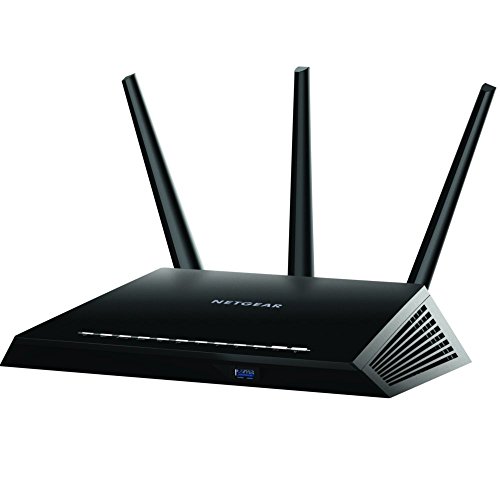
With AC1900 wireless speeds reaching up to 1900 Mbps, the NETGEAR Nighthawk Smart Wi-Fi Router (R7000-100NAS) stands out as an ideal choice for workstations that demand fast and reliable internet connectivity. It covers up to 1800 square feet and supports up to 30 devices, making it perfect for home offices. You’ll appreciate the 4 Gigabit Ethernet ports and 2 USB ports for versatile connectivity. Plus, NETGEAR Armor enhances security across your devices, while Smart Parental Controls help manage internet habits. With advanced features like Beamforming+, Dynamic QoS, and Amazon Alexa compatibility, your connectivity experience will be exceptional.
Best For: The NETGEAR Nighthawk Smart Wi-Fi Router (R7000-100NAS) is best for home office users who require fast, reliable internet connectivity for multiple devices.
Pros:
- High AC1900 wireless speeds of up to 1900 Mbps for seamless streaming and gaming.
- Extensive coverage of up to 1800 square feet, supporting up to 30 devices simultaneously.
- Advanced security features and parental controls enhance user safety and internet management.
Cons:
- May be more expensive compared to basic routers with lower specifications.
- Setup and configuration can be complex for non-technical users.
- The 30-day trial for NETGEAR Armor and Smart Parental Controls may lead to additional costs after the trial period.
Factors to Consider When Choosing Wifi 7 Routers for Workstations
When choosing WiFi 7 routers for your workstation, you need to take into account several key factors. Think about speed and performance metrics, coverage area, and how many devices you’ll connect. Don’t forget to evaluate security features and the ease of setup to guarantee a smooth experience.
Speed and Performance Metrics
Choosing the right WiFi 7 router for your workstation hinges on understanding its speed and performance metrics. WiFi 7 can achieve speeds up to 30 Gbps, dramatically enhancing your data transfer rates. Its use of 4096-QAM improves network capacity, allowing multiple devices to connect simultaneously without sacrificing performance. With support for 160 MHz bandwidth channels, these routers excel in busy environments, ensuring you stay productive. Multi-Link Operation (MLO) connects various bands at once, optimizing both speed and stability for your tasks. Additionally, advanced features like Target Wake Time (TWT) help reduce latency while extending battery life for your devices, making WiFi 7 routers an excellent choice for any home office setup.
Coverage Area Requirements
Understanding the coverage area is essential for ensuring your WiFi 7 router meets your workstation’s needs. Routers can vary greatly in range, with some covering up to 5,800 square feet. Consider the number of internal antennas and features like RangeBoost, which enhance signal strength, especially in larger or multi-story spaces. Since WiFi 7 typically supports 12-18 simultaneous connections without performance issues, it’s ideal for busy environments. Keep in mind that physical barriers and distance from the router can impact signal integrity, so align the router’s specs with your workspace layout. To minimize dead zones, look for features like Multi-Link Operation (MLO) and adaptive quality of service (QoS) for effective data distribution across your devices.
Device Connectivity Options
After evaluating coverage area requirements, it’s time to focus on device connectivity options that will enhance your workstation’s performance. Look for a WiFi 7 router with multiple Gigabit Ethernet ports to provide stable, high-speed wired connections for essential devices. Routers supporting Multi-Link Operation (MLO) allow simultaneous connections across multiple bands, improving overall network performance. A 2.5G port can further boost throughput for devices used in high-demand applications like video conferencing and large file transfers. Consider how many devices the router can support simultaneously, as WiFi 7 excels at maintaining speed and connectivity quality. Additionally, choose routers with QoS (Quality of Service) features to prioritize bandwidth for critical applications, ensuring reliable internet access for your workstation.
Security Features Overview
When it comes to securing your workstation’s network, several key factors stand out in the domain of WiFi 7 routers. First, look for routers that utilize advanced security protocols like WPA3, which offers enhanced protection against unauthorized access and superior encryption. Many models also come with commercial-grade security tools, such as real-time threat detection and automatic firmware updates, ensuring you’re protected against vulnerabilities. Additionally, consider routers with built-in security services that shield connected devices from malware, often available through subscription models. Multi-Link Operation (MLO) can further enhance security by distributing data across multiple channels. Ultimately, parental control features help you manage access to harmful content, promoting safer internet usage for everyone connected to your network.
Setup and Configuration Ease
Choosing the right WiFi 7 router for your workstation becomes much easier if you prioritize setup and configuration ease. Look for routers with user-friendly mobile apps or web interfaces that let you make quick adjustments and monitor network settings effortlessly. Automatic firmware updates are vital, ensuring your router stays secure and performs effectively without manual intervention. Consider models that support multi-link operation (MLO) for improved stability and data transfer efficiency. A straightforward installation process is essential, ideally with guided setup wizards that simplify connecting to the internet. Finally, opt for routers offering features like parental controls and guest networks that can be easily configured, enhancing your overall user experience without complex setups.
Advanced Technology Benefits
As you explore WiFi 7 routers for your workstation, understanding the advanced technology benefits can greatly impact your decision. WiFi 7 utilizes 4096-QAM and 160MHz channels, boosting data throughput for faster internet speeds. With Multi-Link Operation (MLO), it connects multiple frequency bands at once, ensuring a stable connection even in high-traffic environments. Features like Target Wake Time (TWT) reduce power consumption, enhancing battery life for your devices without sacrificing performance. You’ll also appreciate the ability to support numerous simultaneous connections with minimal latency, perfect for multi-user setups. Plus, enhanced security protocols like improved WPA3 standards offer stronger protection against unauthorized access, keeping your sensitive data safe. Choosing WiFi 7 means investing in a more efficient, reliable network.
Cost and Value Analysis
Investing in a WiFi 7 router for your workstation involves more than just understanding its advanced technology benefits; it’s also about assessing cost and value. Start by weighing the initial investment against long-term savings, as owning a router can save you from monthly rental fees. Look for a good price-to-performance ratio; faster speeds can greatly boost your productivity. Features like advanced security protocols and multi-device support might justify a higher upfront cost by enhancing network efficiency. Don’t forget to evaluate the total cost of ownership, including software updates and maintenance. Finally, check warranty and support options; a longer warranty and excellent customer service can provide better value and peace of mind over time.
Brand Reputation and Support
When selecting a WiFi 7 router for your workstation, considering brand reputation and support can greatly impact your overall experience. A strong brand often indicates reliable performance and user satisfaction, so stick with companies that have a proven track record in the router market. Check for customer support availability; timely assistance is crucial when troubleshooting connectivity issues. Warranty duration can also reflect a brand’s confidence in its products—longer warranties usually suggest better quality and care. Look at user reviews for insights into real-world performance and customer support effectiveness. Finally, choose brands that frequently update firmware and provide security patches, ensuring your workstation remains secure and performs at its best.
