
Stacking two monitors can free up desk space while keeping email, reference material, or a second workspace in view. The right stand makes that setup easier to position and more comfortable to use.
These 10 options cover free-standing bases, desk-mounted designs, ultrawide compatibility, and even a three-screen mount. Start with your monitors’ dimensions and weight, then choose the mounting style that fits your desk.
Best 10 Vertical Monitor Stands for PC Multitasking Picks for 2026
Best Glass-Base Option
MOUNTUP Free-Standing Dual Monitor Stand

- Two 13–32-inch screens, up to 33 lb each
- Portable tempered-glass base
- Tilt, swivel, rotation, and height adjustment
Best For: Desks where clamp mounting is impractical
Best for Heavier Large Screens
Pegzone Tall-Pole Dual Monitor Mount

- Fits two 17–34-inch monitors
- Supports up to 33 lb per arm
- Clamp and grommet mounting included
Best For: Larger, heavier displays on a mount-compatible desk
Most Flexible Arms
ErGear Clamp-Mount Stacked Monitor Stand

- Independent height and reach adjustment
- Wide tilt, swivel, and rotation ranges
- 19.8 lb capacity per arm
Best For: Frequently changing monitor positions
Highest Stated Load Capacity
Free-Standing Vertical Dual Monitor Stand
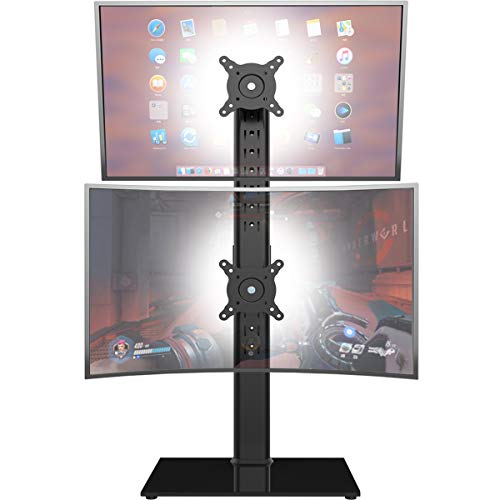
- Listed capacity of 44 lb per screen
- Fits two 13–34-inch monitors
- Supports three VESA hole patterns
Best For: Heavier screens without desk clamping
Best for Three Screens
MOUNT PRO Triple Stacked Monitor Mount

- Holds three 13–32-inch screens
- 17.6-pound limit per screen
- 31.7-inch adjustable pole
Best For: Three-screen vertical desk setups
Best for Adjustable Reach
monTEK Vertical Dual Monitor Stand

- Fits two 17–32-inch screens
- Up to 24.59 inches high
- Up to 19.96 inches of extension
Best For: Adjustable two-screen viewing distance
Best for a Tall Center Pole
Suptek MD6802 Dual Monitor Stand
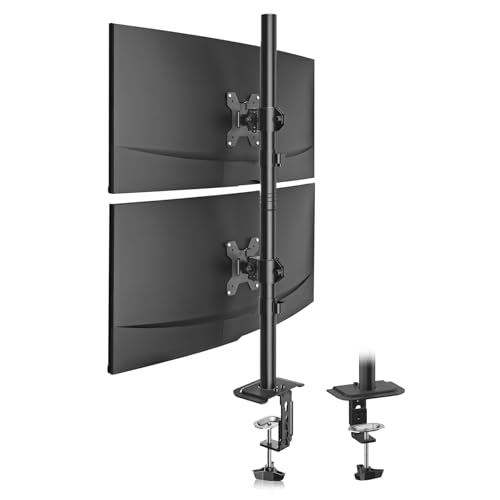
- 31.5-inch center pole
- Stated 22-pound capacity per screen
- Confirm conflicting screen-size specs
Best For: Height-adjustable two-screen stacking
Best for Compact Desks
HUANUO Vertical Dual Monitor Mount

- Stacks two 17–32-inch monitors
- 17.6 lb capacity per screen
- Clamp or grommet mounting
Best For: Two-screen setups with limited desktop space
Best for Ultrawide Screens
VIVO Freestanding Dual Monitor Stand

- Fits two screens up to 34 inches
- 22 lb capacity per screen
- Freestanding, padded base
Best For: Ultrawide stacking without a desk clamp
Best for Height Flexibility
MOUNT PRO Vertical Dual Monitor Mount

- 28-inch mounting column
- 11.4-inch arm height range
- Clamp or grommet mounting
Best For: Taller stacked layouts with flexible positioning
Best Glass-Base Option – MOUNTUP Free-Standing Dual Monitor Stand
Among vertical monitor stands for PC multitasking, this MOUNTUP model suits desks where drilling or clamping is not an option. Its tempered-glass base supports a stacked pair of 13- to 32-inch monitors, up to 33 pounds each, with 75 x 75 mm or 100 x 100 mm VESA mounts.
Best For: A portable stacked setup on a desk that cannot accommodate a clamp.
Pros:
- Free-standing base can be repositioned without remounting it to the desk.
- Offers 12.44 inches of height movement along the pole, plus tilt, swivel, and rotation.
- Quick-release VESA mounts and cable management simplify setup and tidying.
Cons:
- The 15.35 x 10.2-inch base still occupies desktop space.
- Swivel is limited to 25 degrees in either direction.
Choose this one if a movable, glass-base stand matters more than clearing every inch of desk surface. Check each monitor’s VESA pattern and weight before ordering.
Best for Heavier Large Screens – Pegzone Tall-Pole Dual Monitor Mount
If your search for vertical monitor stands for PC multitasking involves larger displays, the Pegzone accommodates two 17- to 34-inch monitors weighing up to 33 pounds each. Its 33.1-inch pole creates a stacked arrangement without a free-standing base taking up desk space.
Best For: Stacking larger, heavier monitors on a desk suited to clamp or grommet mounting.
Pros:
- All-metal construction and a 33-pound-per-arm capacity suit substantial displays.
- Separate upper and lower height settings provide 12 adjustment levels in total.
- Includes both desk-clamp and grommet mounting options.
- Supports tilt, swivel, and 180-degree screen rotation.
Cons:
- Requires a compatible desk edge or grommet opening for installation.
- Its ±15-degree tilt range is narrower than that of some more adjustable arms.
This is a practical choice when screen size and load capacity lead your decision. Confirm your desk thickness fits the clamp’s 0.39- to 3.1-inch range or the grommet mount’s 0.39- to 1.8-inch range.
Most Flexible Arms – ErGear Clamp-Mount Stacked Monitor Stand
For vertical monitor stands for PC multitasking, the ErGear stands out for positioning flexibility. Each arm adjusts independently, extends up to 20.6 inches, and supports a monitor weighing up to 19.8 pounds with a 75 x 75 mm or 100 x 100 mm VESA pattern.
Best For: Users who regularly reposition two monitors for different viewing angles and workflows.
Pros:
- Independent arms offer up to 25 inches of height adjustment and 20.6 inches of extension per arm.
- Wide tilt range, ±90-degree swivel, and 360-degree rotation support varied screen orientations.
- Padded C-clamp, larger VESA plates, and gap-free arm connections are designed for stability.
- Pre-installed cable clips help keep cords organized.
Cons:
- The 19.8-pound-per-arm limit rules out heavier monitors.
- Its C-clamp requires a suitable desk edge.
Pick this mount when adjustability matters more than maximum load capacity. Before buying, verify each monitor’s weight and VESA pattern, and make sure your desk can accept the clamp.
Highest Stated Load Capacity – Free-Standing Vertical Dual Monitor Stand
For buyers comparing vertical monitor stands for PC multitasking with heavier screens, this free-standing model lists support for two 13- to 34-inch monitors weighing up to 44 pounds each. It stacks both displays on one tempered-glass-base stand rather than requiring two separate monitor bases.
Best For: Heavier monitors and desks where clamp or grommet mounting is not preferred.
Pros:
- Listed 44-pound-per-screen capacity is the highest in this group.
- Supports 50 x 50 mm, 75 x 75 mm, and 100 x 100 mm VESA patterns.
- Offers 12 height levels, adjustable swivel and tilt, and removable VESA plates.
- Includes integrated cable management.
Cons:
- The 14.2 x 9.4-inch base occupies desk surface.
- Tilt is limited to +10 degrees and -15 degrees.
This stand is worth considering if load capacity and a clamp-free installation are your priorities. Its base saves space compared with two separate monitor bases, but it does not leave the desktop completely clear.
Best for Three Screens – MOUNT PRO Triple Stacked Monitor Mount
For vertical monitor stands for PC multitasking, this MOUNT PRO mount fits a three-screen setup: it supports three 13- to 32-inch flat or curved monitors, up to 17.6 pounds each, with 75 x 75 mm or 100 x 100 mm VESA patterns.
Best For: Users who want three monitors stacked above a desk rather than spread across it.
Pros:
- 31.7-inch pole provides room to adjust viewing height.
- Offers ±90° tilt, 180° swivel, and 360° rotation for flexible positioning.
- C-clamp or grommet mounting and cable clips help reclaim desk space.
Cons:
- Each screen must stay within the 17.6-pound limit.
- Desk thickness must fall between 0.59 and 3.15 inches.
Choose this one when the third display matters more than arm reach; check each monitor’s weight, VESA pattern, and desk thickness before ordering.
Best for Adjustable Reach – monTEK Vertical Dual Monitor Stand
Among vertical monitor stands for PC multitasking, the monTEK dual mount stands out for its stated 24.59-inch maximum height and 19.96-inch maximum extension. It supports two 17- to 32-inch flat or curved monitors weighing 4.4 to 19.8 pounds each, provided they have 75 x 75 mm or 100 x 100 mm VESA holes.
Best For: Two-screen users who want to fine-tune both viewing height and distance from the desk mount.
Pros:
- Extended height and reach allow more placement options.
- +90°/-45° tilt, ±90° swivel, and 360° rotation support angle and orientation changes.
- Reinforced steel construction is designed to limit wobble and sagging.
Cons:
- Monitors under 4.4 pounds or over 19.8 pounds each are outside the stated weight range.
- You need to confirm your desk’s mounting distance before purchase.
This is the more reach-focused two-monitor choice here, but verify the complete fit requirements rather than relying on screen size alone.
Best for a Tall Center Pole – Suptek MD6802 Dual Monitor Stand
The Suptek MD6802 is a straightforward option among vertical monitor stands for PC multitasking if you want two displays on an extra-tall 31.5-inch center pole. Its supplied bullets specify support for screens up to 32 inches and 22 pounds each with 75 x 75 mm or 100 x 100 mm VESA holes.
Best For: Two-screen setups that prioritize vertical height adjustment and a compact desk footprint.
Pros:
- 31.5-inch pole offers height adjustment for the stacked screens.
- 360° rotation, ±45° tilt, and ±45° swivel allow viewing-angle changes.
- C-clamp and optional grommet mounting are listed, along with a detachable cable holder.
Cons:
- Swivel and tilt are limited to ±45°.
- The supplied bullets say up to 32 inches, but the supplied product details list 27 inches as both the minimum and maximum supported size; confirm fit before buying.
The tall pole and stated 22-pound-per-screen capacity are useful on paper, but the conflicting screen-size specifications warrant an extra compatibility check.
Best for Compact Desks – HUANUO Vertical Dual Monitor Mount
For vertical monitor stands for pc multitasking, the HUANUO mount stacks two screens on one desk attachment instead of using separate monitor bases. It supports 17- to 32-inch monitors weighing up to 17.6 pounds each.
Best For: Desk setups that need two stacked screens without a large freestanding base.
Pros:
- Supports VESA 75×75 mm and 100×100 mm mounting patterns.
- Offers ±45° tilt, ±60° swivel, and 360° rotation.
- Includes clamp or grommet mounting for desks up to 3.14 inches thick.
Cons:
- Does not support screens larger than 32 inches or heavier than 17.6 pounds each.
- Requires a compatible desk edge or grommet location.
This is a practical choice when preserving desktop space matters more than accommodating oversized monitors; check both screens’ weight and VESA patterns before ordering.
Best for Ultrawide Screens – VIVO Freestanding Dual Monitor Stand
Among vertical monitor stands for pc multitasking, this VIVO model suits buyers with larger displays who prefer a freestanding base. It stacks two monitors from 13 to 34 inches, including ultrawides, at up to 22 pounds each.
Best For: Stacking two compatible ultrawide monitors without using a desk clamp.
Pros:
- Supports 75×75 mm and 100×100 mm VESA patterns.
- Adjustable brackets provide ±45° tilt, 360° swivel and rotation, and height adjustment along the pole.
- Includes removable VESA plates, cable management, and padding beneath the base.
Cons:
- The 15.4-by-12.4-inch base takes up desktop space.
- Each monitor must stay within the 34-inch and 22-pound limits.
The wider compatibility is useful for ultrawide setups, but measure your available desk surface before choosing a freestanding stand.
Best for Height Flexibility – MOUNT PRO Vertical Dual Monitor Mount
The MOUNT PRO is worth considering among vertical monitor stands for pc multitasking if you need more room to position stacked screens. Its 28-inch column and tension-adjustable arms offer an 11.4-inch arm height adjustment range.
Best For: Users who want a taller stacked layout with adjustable screen height and viewing angles.
Pros:
- Supports two 13- to 32-inch monitors weighing 4.4–17.6 pounds each.
- Offers 90° up/down tilt, 360° rotation, and ±90° swivel in horizontal orientation.
- Provides C-clamp and grommet mounting options.
Cons:
- Not compatible with 1000R, 1500R, or 1800R curved screens.
- Grommet mounting is limited to desks 0.39–1.97 inches thick.
Its adjustment range makes it a strong fit when screen positioning is the priority. Verify your monitor’s curvature, weight, VESA pattern, and desk thickness first.
How We Picked the Best Vertical Monitor Stands for PC Multitasking
We focused on the specifications that determine whether a stacked setup will actually work: supported screen size and weight, mounting method, height range, and positioning options. The selection includes free-standing stands for desks where a clamp may not fit, desk mounts for a smaller footprint, models advertised for 34-inch or ultrawide screens, and one three-monitor option. Listed capacities are a starting point, not a substitute for checking each monitor’s weight without its original stand and the mount’s VESA compatibility.
Quick Comparison: Match the Mount to Your Setup
For a two-screen stack, first decide between a free-standing base and a desk-mounted pole. Free-standing choices such as the MOUNTUP and VIVO stands avoid clamp-fit issues, but their bases use desktop space. Clamp-style options, including the ErGear model, leave more of the work surface clear but need a suitable desk edge. If you have a 34-inch display, look closely at models listing 34-inch support, including Pegzone and VIVO; screen size alone does not confirm weight or clearance. The MOUNT PRO triple mount is the option here for three screens rather than two.
Key Buying Factors for Vertical Monitor Stands for PC Multitasking
Screen Fit and Weight
Check the weight limit for each screen or arm, not just a combined figure. Confirm your monitors’ VESA hole pattern, and consider bezel width and screen curvature when judging whether two displays will fit comfortably in a stack.
Height and Viewing Comfort
The upper screen needs enough clearance above the lower one, but higher is not always better. If you use both screens for long sessions, plan to keep your primary work at a comfortable eye level and place less frequently viewed content above it. A taller pole helps with large displays, while tilt and swivel help aim each screen toward your seated position.
Desk and Mounting Compatibility
Measure the usable depth of your desk for a free-standing base. For a clamp, check desktop thickness, edge access, and whether an apron or support rail blocks installation. Also verify that the mount’s adjustment range accommodates your preferred screen orientation and cable routing.
Who Should Buy Which Vertical Monitor Stands for PC Multitasking?
Choose a free-standing stand if you cannot clamp to your desk and have room for its base. Choose a clamped desk mount if preserving work-surface space matters most and your desk supports it. For 34-inch or ultrawide monitors, narrow your search to explicitly compatible models and verify weight limits before buying. If your workflow needs a third display, consider the triple-screen mount, but measure the overall width and height first. For any setup, prioritize a secure fit and comfortable screen placement over the largest advertised size range.
