
Running out of USB ports is easy when your keyboard, storage drives, webcam, and other accessories all need a connection. The right hub gives those devices a convenient place to plug in without constantly swapping cables.
These 10 picks span slim four-port expanders, larger powered desktop hubs, and a USB-C option with extra connections. The best choice depends on what you plug in, where you work, and whether your devices need dedicated power.
Best 10 USB Hubs for Multiple Devices Picks for 2026
Desk Placement Pick
ABFCRTTW 7-Port Aluminum USB 3.0 Hub

- Seven USB-A data ports
- 4-foot cable for flexible placement
- Up to 5Gbps; no device charging
Best For: Desktop setups needing reach and seven data ports
Individual Control Pick
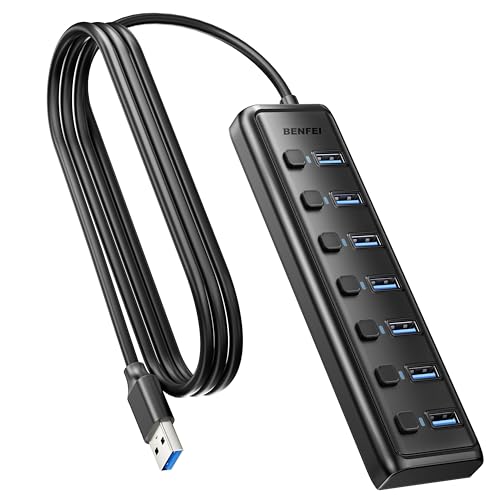
- Seven USB 3.0 ports
- Individual switches and LEDs
- 3.3-foot cable; data only
Best For: Keeping several peripherals plugged in with individual port control
Compact Four-Port Pick

- Four USB-A data ports
- Up to 5Gbps transfers
- Slim body; short 0.7-foot cable
Best For: Adding four nearby ports without a larger hub
Long-Cable Switch Pick

- Seven ports with switches and LEDs
- 4-foot cable; up to 5Gbps
- No charging; adapter not included
Best For: Seven switchable ports with extra cable reach
Travel-Friendly Pick
UGREEN Ultra-Slim 4-Port USB 3.0 Hub

- Four USB-A ports from one connection
- Up to 5Gbps transfer speed
- Compact 33g design
Best For: Travel with basic USB-A accessories
Powered Desk Pick
Atolla 7-Port Data Hub with Charging Port

- Seven USB 3.0 data ports
- Individual on/off switches
- Separate charging port up to 2.4A
Best For: Accessory-heavy desktop setups
Basic Peripheral Pick

- Four ports from one USB-A connection
- One port rated up to 5Gbps
- Slim design with status LED
Best For: Everyday low-power USB peripherals
Individual Port Control
JESWO 11-Port Powered USB 3.0 Hub

- 10 USB 3.0 data ports, up to 5Gbps
- Individual switches and LED indicators
- Dedicated charging port; 12V/3A adapter included
Best For: Desktop setups with many peripherals
Travel-Ready Connectivity
Denlane 8-in-2 USB-A/USB-C Hub

- USB-A and USB-C host connection options
- SD/TF reader and 3.5mm audio
- One 5Gbps USB-A port; four USB 2.0 ports
Best For: Portable laptop and tablet connectivity
Powered Desk Expansion

- 10 data ports rated up to 5Gbps
- Individual switches and status LEDs
- Dedicated charging port; adapter included
Best For: Mac or PC desks with many USB accessories
Desk Placement Pick – ABFCRTTW 7-Port Aluminum USB 3.0 Hub
If you need usb hubs for multiple devices at a desktop workstation, this seven-port aluminum model gives keyboards, mice, and storage drives room to connect. Its 4-foot cable lets you position the hub away from your computer.
Best For: Desktop setups that need seven USB-A data ports and flexible hub placement.
Pros:
- Seven USB-A ports support multiple peripherals at once.
- USB 3.0 data transfers are rated up to 5Gbps.
- Aluminum enclosure and 4-foot cable suit desk use.
Cons:
- Does not support device charging.
- USB-A ports only; the noted Type-C connection is not listed as an additional peripheral port.
Choose this one when reach and port count matter more than charging. Its long cable is particularly useful for a desktop tower tucked under a desk.
Individual Control Pick – BENFEI 7-Port USB 3.0 Hub
Among usb hubs for multiple devices, this BENFEI model stands out for its individual on/off switches and LED indicators. It expands one computer USB port into seven, with a 3.3-foot cable for positioning the hub within easy reach.
Best For: Users who want to switch connected USB peripherals on and off individually.
Pros:
- Seven USB 3.0 ports support simultaneous peripheral connections.
- Each port has its own on/off switch and LED indicator.
- Supports data transfers up to 5Gbps and older USB 2.0/1.0 devices.
Cons:
- Cannot charge connected devices.
- Plastic enclosure may not appeal to buyers seeking a metal hub.
This is a practical choice when you frequently leave peripherals plugged in but do not need every port active all the time. Its 3.3-foot cable also offers more placement flexibility than a short attached lead.
Compact Four-Port Pick – Anker Ultra Slim USB 3.0 Hub
If you are comparing usb hubs for multiple devices but only need four connections, this slim Anker hub keeps the expansion straightforward. It turns one computer USB-A port into four USB-A data ports and has a short 0.7-foot connector cable.
Best For: Laptop or desktop users who need a compact, four-port data hub close to the computer.
Pros:
- Adds four USB-A ports from one computer port.
- Supports USB 3.0 data transfers up to 5Gbps.
- Slim body measures 4.23 by 1.23 by 0.39 inches.
Cons:
- Not designed to charge devices.
- 0.7-foot cable gives limited placement reach.
Pick the Anker when four ports are enough and you can keep the hub near your computer. For a desk layout that needs longer reach or more connections, a seven-port alternative will be a better fit.
Long-Cable Switch Pick – PANPEO 7-Port USB 3.0 Hub
For shoppers looking at usb hubs for multiple devices, the PANPEO combines seven ports, individual on/off switches, and a 4-foot cable. That makes it useful when your computer is farther from where you want to plug in a mouse, keyboard, or flash drive.
Best For: Workstations that need seven switchable data ports positioned away from the computer.
Pros:
- Seven ports have individual on/off switches with LEDs.
- 4-foot cable offers flexible placement.
- USB 3.0 transfers are rated up to 5Gbps; older USB 2.0/1.0 devices are supported.
Cons:
- Does not support device charging.
- Power adapter is not included; the listed adapter connection requires a 5V DC 3.5 × 1.35mm power cord.
This is a sensible fit when both cable reach and per-port controls are priorities. Account for the separately supplied power connection if your setup calls for an adapter.
Travel-Friendly Pick – UGREEN Ultra-Slim 4-Port USB 3.0 Hub
For usb hubs for multiple devices that fit easily in a laptop bag, this UGREEN model adds four USB-A ports from one USB-A connection. Its compact body suits a mouse, keyboard, and flash drives on the go.
Best For: Travelers who need a small, plug-and-play hub for USB-A peripherals.
Pros:
- Four USB 3.0 ports support transfer speeds up to 5Gbps.
- Measures just 0.4 inches thick and weighs 33g.
- Works without additional drivers on Windows, macOS, Linux, and Chrome OS.
Cons:
- Requires a USB-A host connection.
- The attached cable is only 0.5 ft long.
Choose it when portability matters more than a long cable or a large port count.
Powered Desk Pick – Atolla 7-Port Data Hub with Charging Port
Among usb hubs for multiple devices, this Atolla hub is suited to a desk with several accessories. It provides seven USB 3.0 data ports, a separate charging port, and a 5V/4A power adapter.
Best For: Desktop setups that need many data connections and individual port controls.
Pros:
- Seven data ports support speeds up to 5Gbps.
- Individual on/off switches let you disable ports without unplugging devices.
- Dedicated charging port can supply up to 2.4A with the included adapter.
Cons:
- The eighth port is dedicated to charging, not data transfer.
- Requires the included power adapter for its stated charging capability.
Its switches and separate charging port make it a practical choice for an accessory-heavy workstation rather than a minimalist travel kit.
Basic Peripheral Pick – VIENON Slim 4-Port USB Hub
If you are comparing usb hubs for multiple devices for everyday peripherals, this VIENON splitter turns one USB-A port into four. Its slim design and status LED make it straightforward to use with a laptop or desktop.
Best For: Connecting a keyboard, mouse, printer, or flash drive without a bulky hub.
Pros:
- Adds four ports with no driver installation required.
- Includes one USB 3.0 data port rated for up to 5Gbps.
- Compact body fits easily in a laptop bag or desk drawer.
Cons:
- Only one port is specified as USB 3.0 at up to 5Gbps.
- Not intended to charge laptops, tablets, or other high-power devices.
It is a sensible option for low-power accessories, provided you do not need fast transfers on every port or device charging.
Individual Port Control – JESWO 11-Port Powered USB 3.0 Hub
For a desk full of peripherals, this JESWO model is a practical pick among usb hubs for multiple devices. It offers 10 USB 3.0 data ports, a separate smart-charging port, and individual switches so you can turn off unused connections without unplugging them.
Best For: Desktop setups that need many switched USB data ports and a dedicated charging port.
Pros:
- Ten USB 3.0 data ports support speeds up to 5Gbps.
- Each port has its own on/off switch and LED indicator.
- Includes a 12V/3A power adapter and a charging port rated up to 2.4A.
Cons:
- The included power adapter must be connected for full functionality.
- The charging port is separate from the 10 data-transfer ports.
Choose it when individual port control matters as much as capacity; plan for an outlet to power the hub.
If your laptop needs more than USB sockets, this Denlane option stands out among usb hubs for multiple devices. Its slim aluminum body combines USB-A and USB-C data connections with SD/TF card reading and a 3.5mm audio connection.
Best For: Laptop and tablet users who want portable peripheral, card, and audio connections.
Pros:
- Offers four USB 2.0 ports and one USB 3.0 port rated up to 5Gbps.
- Includes a USB-C data port, SD/TF card reader, and 3.5mm audio connection.
- Supports USB-A or USB-C host connections and requires no drivers.
Cons:
- Only one USB-A port supports USB 3.0 speeds; the other four are USB 2.0.
- The listed USB-C connection is for data transfer, not stated charging or video output.
It makes sense when connection variety and portability outweigh the need for several high-speed USB-A ports.
The Wenter is built for stationary setups comparing usb hubs for multiple devices: it provides 10 USB 3.0 data ports plus one dedicated smart-charging port. Individual switches and status LEDs help manage a crowded group of peripherals.
Best For: Mac or PC desks with numerous USB accessories and a device to charge.
Pros:
- Ten USB 3.0 data ports support speeds up to 5Gbps.
- Individual on/off switches and LEDs make port status easy to check.
- Includes a 12V/3A adapter, a roughly 3.3-foot USB cable, and a dedicated charging port.
Cons:
- Requires an outlet for its included power adapter.
- Only 10 of the 11 ports are designated for data transfer.
This is a straightforward choice for a fixed workspace where port count and per-port switches matter more than a compact travel design.
How We Picked the Best USB Hubs for Multiple Devices
We focused on practical differences buyers can check before ordering: host connector, number and type of ports, stated USB data standard, cable length, external power, and extras such as individual switches or card readers. The selection covers portable four-port models, seven-port desktop expanders, higher-capacity powered hubs, and a USB-C multiport option. Product names and listed specifications are a starting point, not a substitute for checking current seller details and device compatibility.
Quick Comparison: Which Hub Type Fits?
For a travel bag: A slim four-port USB-A hub, such as the Anker or UGREEN option, adds connections without taking much space. Check cable length if your laptop ports are awkwardly placed.
For a desk with several peripherals: Seven-port hubs from BENFEI, PANPEO, or the 4FT listing offer more room to leave devices connected. Switches on models that include them can help you disconnect a port without unplugging its cable.
For a crowded workstation: Powered Atolla, JESWO, and Wenter models provide more ports and an external power source. Their separately identified charging ports should not be assumed to work as data ports.
For mixed connections: The USB-C multiport option adds USB-A, card slots, and audio connectivity. Confirm that its host connector and each feature match your laptop.
Key Buying Factors for USB Hubs for Multiple Devices
Ports, Connectors, and Placement
Count the accessories you use at the same time, then leave a spare port or two. Most options here connect through USB-A, while the multiport model is aimed at USB-C setups; verify the exact connector before buying. Also check whether closely spaced ports can accommodate wide flash drives and whether the attached cable reaches your preferred desk position.
Speed and Shared Bandwidth
USB 3.0 hubs commonly advertise up to 5Gbps, but that is a theoretical connection speed, not a guaranteed rate for every port simultaneously. Multiple active drives share the hub’s connection to the computer. For frequent large transfers, connect your fastest drive directly when possible and confirm that the computer port, cable, and storage device support the speeds you need.
Power and Charging
Bus-powered hubs are convenient for low-power accessories, but several demanding devices may exceed the power available from one computer port. An externally powered hub is the safer choice for a desk with many connected peripherals. A dedicated charging port does not necessarily support laptop charging or the fast-charging protocol your phone uses; check its stated output.
Who Should Buy Which USB Hubs for Multiple Devices?
Choose a compact four-port hub if you mainly need a keyboard, mouse, headset adapter, or occasional flash drive on the go. Pick a seven-port model if you want more permanent connections but not a large workstation hub. Choose a powered eight- or 11-port model when port count and external power matter most, especially with several accessories connected at once. Consider the USB-C multiport choice when you also need card-reader or audio connections, but verify its exact features before relying on it as a full dock.
