
The best trail cameras make it easier to monitor wildlife, scout hunting areas, secure property, or observe remote locations without constant visits. This roundup covers cellular, Wi-Fi, and traditional models across several budgets and use cases.
We selected options with different combinations of image quality, trigger speed, night vision, connectivity, durability, and camera count so you can match the setup to your location and monitoring goals.
Best 10 Trail Cameras Picks for 2026
Best Value 4K Trail Camera

- 64MP photos and 4K video
- 0.2-second trigger with 120° detection
- No-glow night vision and LCD preview
Best For: Wildlife scouting and property monitoring
Best Multi-Camera Bundle

- Includes three 14MP cameras
- Three 32GB cards and card reader included
- Quick-set options and burst shooting
Best For: Monitoring multiple game-trail locations
Best Cellular Trail Camera

- Auto-connects to AT&T or Verizon LTE
- GPS and onboard storage included
- Sub-half-second trigger with 3-shot burst
Best For: Remote monitoring and smartphone alerts
Best Wi-Fi Trail Camera

- Direct app access within about 45 feet
- 64MP photos and 1296P video
- No-glow night vision with live view
Best For: On-site smartphone viewing without monthly fees
Connected Scouting

- 36MP photos and 1080p video with audio
- Auto Connect 4G LTE across major U.S. networks
- 100-foot range with app alerts and cloud storage
Best For: Remote wildlife scouting with app control
Budget Two-Pack

- Two cameras with included 16GB SD cards
- 48MP photos and 1080p video
- 0.3-second trigger with 60-foot range
Best For: Local wildlife monitoring on a budget
Smart Deer Scouting
- AI buck detection with real-time alerts
- 40MP photos, 1080p video, and 100-foot range
- Live Aim, GPS mapping, and four-carrier connectivity
Best For: Remote deer scouting across multiple locations
Easy-Setup Pick

- Beginner-friendly controls and integrated front-facing setup
- 36MP photos, 2K video, and 850nm night vision
- IP66 outdoor housing with motion detection and time-lapse
Best For: Beginners and general backyard or property monitoring
Fast-Trigger Choice
GardePro E5S Non-Cellular Trail Camera

- 64MP photos and 1296P video with sound
- 0.1-second trigger with three PIR sensors
- No-glow night vision, IP66 housing, and 512GB SD support
Best For: Wildlife scouting where fast capture and discreet night use matter
Multi-Camera Value
WOSODA Mini Trail Camera 4-Pack

- Four compact cameras for coverage across multiple locations
- 30MP photos, 1080P video, and 0.3-second motion triggering
- Includes four 16GB SD cards and 16 AA batteries
Best For: Multi-area wildlife, garden, farm, and property monitoring
Best Value 4K Trail Camera – WOSPORTS G600
For shoppers comparing trail cameras for wildlife scouting or property monitoring, the WOSPORTS G600 combines high-resolution imaging, a fast trigger, and flexible power options without cellular fees. Its no-glow night vision and built-in color screen make it practical for discreet, on-site use.
Best For: Wildlife observation, deer scouting, farm surveillance, and backyard security.
Pros:
- Captures adjustable photos up to 64MP and 4K video.
- Fast 0.2-second trigger with 120-degree detection coverage and burst shooting.
- No-glow 940nm infrared LEDs and an included 2-inch color LCD for discreet monitoring and on-camera previews.
- Supports AA batteries, a separate rechargeable battery, or a compatible solar panel.
Cons:
- Batteries, rechargeable battery, and solar panel are sold separately.
- It is non-cellular and non-Wi-Fi, so footage must be accessed at the camera or via storage media.
The G600 is a strong all-around choice when image detail and stealth matter more than remote connectivity. Its IP66 waterproof rating and multiple mounting options add flexibility for outdoor deployments.
Best Multi-Camera Bundle – Stealth Cam Browtine 3-Pack
Stealth Cam Browtine 14MP Trail Camera Bundle | 32GB Memory Card, Card Reader, (5 items)
Check Price On AmazonThe Stealth Cam Browtine bundle is a practical option for covering several locations at once. It includes three 14MP cameras, memory cards, and a card reader, while quick-set configurations and burst mode help simplify game-camera deployment.
Best For: Hunters and landowners who need multiple cameras for game trails or several outdoor vantage points.
Pros:
- Three-camera bundle helps monitor multiple areas simultaneously.
- Includes three 32GB SDHC cards and a USB 2.0 card reader.
- Quick Set options allow fast setup, while custom configuration offers additional control.
- Burst mode records multiple exposures per trigger, with 18 IR LEDs for nighttime illumination.
Cons:
- Requires 8 AA batteries and a Class 10 SD card in each camera.
- Its 14MP still resolution and 60-foot night-vision range are more modest than some newer trail cameras.
- The listed IP54 rating provides less weather protection than higher-rated alternatives.
This bundle stands out for coverage and included accessories rather than maximum resolution. It is well suited to straightforward, multi-location scouting where quick deployment is a priority.
Best Cellular Trail Camera – Tactacam REVEAL X 3.0
For remote properties and hunting areas without Wi-Fi, the Tactacam REVEAL X 3.0 adds cellular connectivity to trail-camera monitoring. Its automatic AT&T and Verizon carrier selection, app alerts, GPS, and built-in storage are designed for hands-off access from a smartphone.
Best For: Remote wildlife scouting, rural property monitoring, farms, ranches, and equipment or gate surveillance.
Pros:
- Multi-carrier LTE automatically selects between AT&T and Verizon based on signal strength.
- Built-in GPS and onboard storage reduce the need for a separate SD card.
- Sub-half-second trigger and three-shot burst mode help capture fast-moving game.
- Rated IP66 and designed for up to 6 or more months of battery life, with optional power accessories available.
Cons:
- Cellular operation depends on network availability and app-based use.
- The listed 60-degree viewing angle is narrower than several wide-angle trail cameras.
- Remote monitoring requires a compatible smartphone and cellular service arrangement.
The REVEAL X 3.0 is the most convenient pick here for receiving images away from the camera. It is especially compelling when checking a distant property regularly would otherwise require frequent trips.
Best Wi-Fi Trail Camera – GardePro E6
The GardePro E6 offers a convenient middle ground for trail cameras: you can connect directly to a smartphone on site without removing the memory card or paying a monthly fee. Its live view, 64MP photos, and no-glow infrared night vision make positioning and wildlife observation easier.
Best For: Nearby wildlife observation and users who want smartphone access within roughly 45 feet of the camera.
Pros:
- Direct Bluetooth and Wi-Fi connection to the GardePro app without a monthly fee.
- 64MP photos, 1296P video, and a 110-degree viewing angle.
- Live View helps check framing and observe wildlife without opening the camera.
- 940nm no-glow infrared night vision reaches up to 75 feet, with optional solar-panel support.
Cons:
- It does not connect to home Wi-Fi routers or cellular networks.
- Direct smartphone access is limited to about 45 feet in open areas.
- Batteries and memory card are not included.
The E6 is a useful choice when you can visit the camera and remain within its short-range wireless connection. It delivers convenient on-site access, but it is not intended for remote, off-property alerts.
Connected Scouting – Moultrie Edge 2 Cellular
The Moultrie Edge 2 is one of the more convenient trail cameras for remote scouting, using Auto Connect 4G LTE coverage across major U.S. networks. Its app-based controls, high-resolution imaging, and long detection range make it practical for monitoring wildlife without frequent trips to the property.
Best For: Hunters and property owners who want app-controlled cellular scouting with broad network coverage.
Pros:
- 36MP photos and 1080p video with audio capture detailed day and night footage.
- Auto Connect uses major U.S. networks without requiring a separate SIM card.
- 100-foot detection range, low-glow infrared, and IP65 waterproofing support outdoor use.
- Built-in 8GB memory and unlimited cloud storage eliminate the need for an SD card.
Cons:
- An active Moultrie data plan is required for cellular features.
- Power accessories such as solar panels and battery packs are sold separately.
The Edge 2 is a strong choice if remote access matters more than a simple local-recording setup. Its Moultrie Mobile features add useful tools such as activity charts, maps, and alerts, while the cellular service introduces an ongoing cost.
Budget Two-Pack – WOSODA G200 Trail Cameras
This WOSODA two-pack offers a straightforward, non-Wi-Fi option for shoppers who need multiple trail cameras at a lower-complexity setup. With 48MP photos, 1080p video, motion activation, and included memory cards, it is ready for basic wildlife monitoring, outdoor scouting, or security use.
Best For: Buyers who want two self-contained trail cameras with local SD-card recording and included accessories.
Pros:
- Two cameras include 16GB SD cards and mounting hardware.
- 48MP still images and 1080p video provide detailed daytime recordings.
- 0.3-second trigger speed and a detection range of up to 60 feet help capture moving subjects.
- 850nm low-glow infrared LEDs provide concealed nighttime operation.
Cons:
- Non-Wi-Fi design requires retrieving the SD cards to review recordings.
- Night vision range is limited to 60 feet.
- Eight AA batteries per camera are included, but ongoing battery replacement is still required.
Choose the WOSODA G200 two-pack when coverage and value are more important than cellular alerts. It lacks remote app access, but the included cards, batteries, and mounts make it an accessible starting point for local trail-camera monitoring.
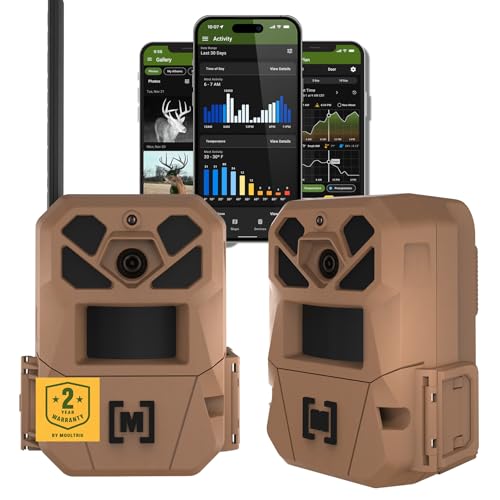
Smart Deer Scouting – Moultrie Edge 3 Two-Pack
The Moultrie Edge 3 two-pack is designed for hunters who want real-time information from multiple locations. These cellular trail cameras combine 40MP photos, 1080p video, AI buck detection, GPS mapping, and a 100-foot detection range to make remote deer scouting more targeted and responsive.
Best For: Deer hunters seeking cellular alerts, AI-assisted buck identification, and coordinated two-camera property coverage.
Pros:
- AI buck detection can reduce false alerts and identify bucks in incoming images.
- Four-carrier Auto Connect supports cellular delivery without manual SIM-card setup.
- 40MP photos, 1080p video, low-glow infrared, and a 0.5-second trigger capture detailed activity.
- Live Aim, built-in GPS, and remote feeder controls simplify camera placement and management.
Cons:
- An active Moultrie camera plan is required and sold separately.
- Rechargeable battery packs and solar panels are optional accessories.
- The IP55 rating is lower than the Edge 2’s listed IP65 rating.
The Edge 3 two-pack is the most feature-rich option here for data-driven deer scouting. Its cellular and AI tools can save time in the field, but the required subscription and optional power accessories should be included in the ownership budget.
Easy-Setup Pick – CEYOMUR 36MP 2K Trail Camera
For shoppers seeking straightforward trail cameras, the CEYOMUR combines simple controls with 36MP photos, 2K video, and motion activation. Its integrated front-facing design makes it easier to preview and adjust the camera during installation, while 850nm infrared LEDs support brighter black-and-white nighttime images.
Best For: Beginners, backyard wildlife monitoring, hunting, farm monitoring, and home-security use.
Pros:
- Simple operation suited to first-time users.
- Captures 36MP photos and 2K videos day and night.
- IP66-rated housing and integrated setup design support outdoor use.
- Includes useful features such as time-lapse, motion detection, audio recording, and in-camera playback.
Cons:
- 8 AA batteries and an SD card are not included.
- Its 850nm infrared illumination may be more visible than no-glow systems.
This is a practical entry-level option when ease of installation matters more than wireless access. The lack of included batteries and storage adds to the initial setup cost, but the rugged construction and broad feature set make it versatile for routine outdoor monitoring.
Fast-Trigger Choice – GardePro E5S Non-Cellular Trail Camera
The GardePro E5S is one of the more capable non-cellular trail cameras for users who want sharp captures without Wi-Fi or cellular service. It records 64MP photos and 1296P video, uses three PIR sensors for a stated 0.1-second trigger, and offers up to 100 feet of no-glow night vision.
Best For: Deer scouting, remote wildlife monitoring, and users who prefer low-power SD-card operation.
Pros:
- High-resolution 64MP photos and 1296P HD video with sound.
- 0.1-second trigger speed and three PIR sensors help capture fast-moving wildlife.
- IP66 weather resistance and a 1/4-inch-20 mounting thread support secure outdoor placement.
- Supports motion detection, time-lapse, hybrid mode, and SD cards up to 512GB.
Cons:
- It is non-cellular and non-Wi-Fi, so footage must be retrieved from the SD card.
- Eight AA batteries and the SD card are not included.
Choose the E5S if image detail, rapid triggering, and discreet night monitoring are priorities. It requires physical visits to review footage, but its efficient non-wireless design can reduce power demands and avoid connectivity-related setup.
Multi-Camera Value – WOSODA Mini Trail Camera 4-Pack
This four-pack gives shoppers a compact way to cover multiple locations with trail cameras. Each mini WOSODA camera records 30MP photos and 1080P video, uses motion activation with a stated 0.3-second trigger, and includes a 16GB SD card and four AA batteries.
Best For: Monitoring several areas at once, including backyards, gardens, farms, and wildlife zones.
Pros:
- Four compact cameras provide broad coverage from one purchase.
- Each unit captures 30MP photos and 1080P video in day and night modes.
- Includes four 16GB SD cards and 16 AA batteries for easier initial deployment.
- Camouflage housing, IP65 water resistance, and low power consumption suit outdoor placement.
Cons:
- No phone, Wi-Fi, or cellular connectivity; footage requires removing the SD card.
- Night vision range is listed at 65 feet, and supported storage is limited to 32GB per camera.
- Each unit uses a 0.3-second trigger, slower than the GardePro E5S listed here.
The WOSODA set is especially useful when quantity and compact placement outweigh advanced connectivity. Included batteries and cards make deployment simpler, while the SD-card workflow means reviewing footage requires visiting each camera.
How We Picked the Best Trail Cameras
We focused on the features that have the greatest effect on real-world performance: trigger speed, image and video resolution, nighttime illumination, detection range, weather resistance, storage, battery demands, and ease of setup. We also included both connected and non-connected cameras because the best choice depends on whether you need remote access or prefer a simpler, subscription-free setup.
Cellular models are useful for properties that are difficult to visit regularly, while Wi-Fi cameras can make nearby downloads easier. Conventional Trail Cameras remain practical for basic wildlife observation, hunting, and security when a phone connection is unnecessary.
Quick Comparison
- Best overall flexibility: A cellular model with remote image delivery and dependable weather protection.
- Best for remote monitoring: The Tactacam REVEAL X 3.0 or Moultrie Edge series.
- Best Wi-Fi option: The GardePro E6 for nearby wireless access.
- Best simple setup: The WOSPORTS, GardePro E5S, or CEYOMUR cameras.
- Best for covering multiple locations: A two-pack or four-pack configuration.
Key Buying Factors for Trail Cameras
Cellular, Wi-Fi, or Standard Connectivity
Cellular Trail Cameras can send photos or videos to an app from remote locations, but they typically require a compatible network and data plan. Wi-Fi models are more convenient when you can get close to the camera. Non-cellular cameras avoid subscription costs and generally have fewer connection-related setup issues.
Image Quality and Trigger Performance
Higher megapixel ratings can produce more detailed still images, but sensor quality, lens performance, and nighttime illumination matter just as much. A fast trigger helps capture animals before they leave the detection zone, while recovery time affects how quickly the camera can take another image.
Night Vision and Detection Range
No-glow infrared is preferable when minimizing visible flashes matters, particularly for cautious wildlife or security applications. Check the stated detection range and consider how the camera will be positioned relative to trails, feeders, gates, or entry points.
Power, Storage, and Weather Protection
Battery life varies with temperature, image frequency, video length, signal strength, and transmission settings. Confirm whether the camera uses removable batteries, supports an external power source, and includes or requires a microSD card. Waterproof construction and a secure latch are essential for year-round outdoor use.
Who Should Buy Which Trail Cameras?
Choose a cellular camera if you need updates without visiting the site frequently. Choose a Wi-Fi model for a property where you can approach the camera and want easier file transfers. Choose a non-cellular camera for affordable, straightforward monitoring with no recurring service fee.
For broad coverage, multi-packs can be more economical than buying individual units, especially when monitoring several trails or property boundaries. For a single observation point, prioritize reliable triggering, night performance, weather sealing, and battery efficiency over headline resolution alone.
