
If you need professional results but don’t have room for bulky gear, space-saving 3D scanners are an easy win. Today’s compact models can handle everything from small parts to larger objects while fitting neatly on a desktop or into a carry case.
This roundup focuses on scanner designs that are practical for home workshops, maker spaces, and small studios, with an emphasis on portability, ease of use, and real-world scanning performance.
Best 10 Space-Saving 3D Scanners Picks for 2026
Entry-Level Precision Pick
3DMakerpro Fox Medium-Format Scanner

- 0.07mm accuracy for detailed scans
- Markerless AI tracking relocks quickly
- JMStudio handles scan, edit, optimize
Best For: Beginners and hobbyists needing practical scan quality
Wireless Versatility Pick
EINSTAR 2 Wireless Dual-Mode Scanner

- 17-line blue laser for detail capture
- Wireless battery lasts up to 3 hours
- Laser and IR modes fit mixed object sizes
Best For: Mixed-size scanning and cable-free portability
Mobile Workflow Pick
Creality CR-Scan Ferret Pro Wireless Scanner

- 0.1mm accuracy with 30FPS scanning
- WiFi 6 bridge improves wireless transfer
- Anti-shake tracking helps beginners
Best For: Compact wireless scanning across multiple devices
Premium Pocket Scanner
Creality Pika Portable Dual-Mode Scanner

- 0.03mm accuracy in a 260g body
- Dual-mode scanning for small to full-body jobs
- AI body completion, retexturing, hole filling
Best For: Portable advanced scanning with strong detail and AI tools
Portable Beginner Pick
Creality Ferret Pro Wireless Handheld Scanner

- 105g lightweight body
- Wi-Fi 6 wireless scanning
- Up to 0.1mm accuracy
Best For: Beginners and makers who want a compact wireless scanner
Precision Portable Upgrade
Creality Otter Lite Wireless Scanner
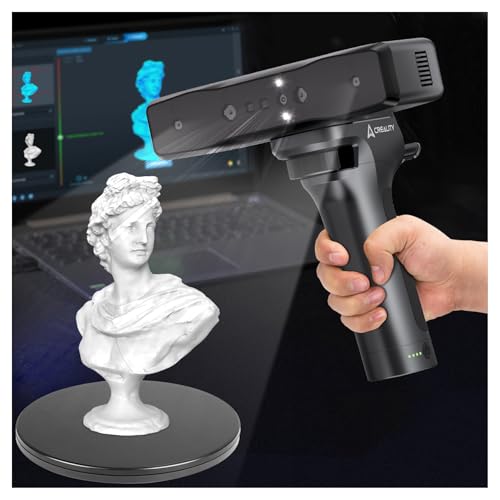
- 0.05mm accuracy
- Wi-Fi and mobile control
- Portable case included
Best For: Users who want a compact scanner with higher precision
Pro Field Scanner
Revopoint POP 4 AI Segmentation
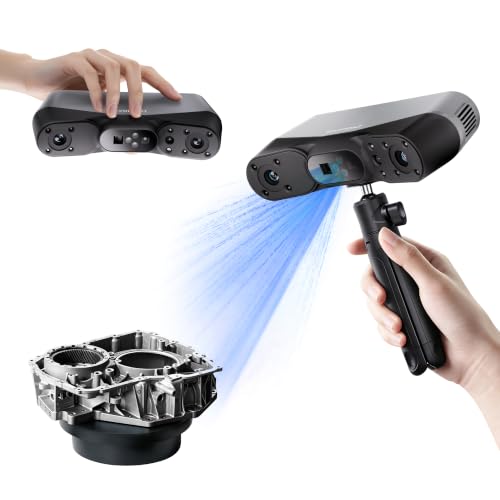
- WiFi 6 and battery grip
- Five scanning modes
- AI segmentation support
Best For: Professionals needing wireless versatility and outdoor scanning
Compact Precision Starter
Creality CR-Ferret SE 3D Scanner

- 105g ultralight and easy to carry
- Anti-shake capture for steadier scans
- 24-bit color plus dark/metal scanning
Best For: beginners and portable everyday scanning
Wireless Pocket Scanning
Creality Pika Portable 3D Scanner

- Pocket-sized 260 g wireless design
- Dual light system for tiny to large objects
- AI tools for retexturing and cleanup
Best For: mobile users who want wireless compact scanning
Fast Wireless Detail Pro
Creality Raptor Pro with Scan Bridge

- 0.02 mm accuracy for fine detail
- Wireless Scan Bridge accessory included
- Up to 60 FPS and 660,000 points/sec
Best For: advanced users needing precision and wireless convenience
Entry-Level Precision Pick – 3DMakerpro Fox Medium-Format Scanner
If you want space-saving 3D scanners that still feel serious about detail, the 3DMakerpro Fox is a strong entry point. It targets beginners and hobbyists who need reliable scans for 3D printing, modeling, measurement, and inspection without a complicated workflow.
Best For: Beginners and hobbyists who want an accessible handheld scanner with solid accuracy for practical projects.
Pros:
- 0.07mm accuracy and 0.10mm resolution for detailed scanning.
- Markerless AI visual tracking helps relock onto an object after movement.
- JMStudio combines scanning, editing, and optimization in one workflow.
- Compact handheld design with a beginner-friendly setup.
Cons:
- Best suited to medium-format work rather than very large capture jobs.
- Requires learning software workflow to get the most from processing tools.
The Fox focuses on making accurate scanning approachable. If you want a space-saving 3D scanner that balances ease of use with dependable results, it offers a practical mix of tracking, software support, and fine detail capture.
Wireless Versatility Pick – EINSTAR 2 Wireless Dual-Mode Scanner
The EINSTAR 2 is a flexible option for buyers who want space-saving 3D scanners that can move between small, medium, and large objects. Its dual scanning systems and wireless battery design make it useful when you need portability without giving up range or adaptability.
Best For: Users who need one scanner for mixed object sizes, outdoor use, and cable-free scanning.
Pros:
- 17 parallel blue laser lines for detailed small-object scanning.
- VCSEL infrared mode supports larger objects and black surfaces.
- Built-in swappable battery provides up to 3 hours of wireless scanning.
- Works in bright environments and handles reflective or dark surfaces without spray.
Cons:
- Best performance depends on choosing the right mode for the job.
- Wi-Fi interference can require switching to cable connection.
This is a practical all-rounder for users who need mobility and broader scanning coverage. If your shortlist of space-saving 3D scanners needs outdoor support, wireless operation, and flexible material handling, the EINSTAR 2 stands out.
Mobile Workflow Pick – Creality CR-Scan Ferret Pro Wireless Scanner
The Creality CR-Scan Ferret Pro is built for people who want space-saving 3D scanners with strong mobile flexibility. It combines wireless transmission, anti-shake tracking, and fast scanning so beginners and casual users can capture detailed models with less setup fuss.
Best For: Users who want a compact scanner for wireless scanning across phones, tablets, and PCs.
Pros:
- Up to 0.1mm accuracy and 30FPS scanning for detailed models.
- WiFi 6 bridge enables faster, more stable wireless transfer.
- Anti-shake tracking improves success when hand movement is unavoidable.
- Supports outdoor scanning and exports OBJ, STL, and PLY files.
Cons:
- Reflective, transparent, or extremely dark surfaces are not ideal.
- Wireless features depend on compatible devices and setup.
The Ferret Pro is a good fit if you value convenience and broad device support. For shoppers comparing space-saving 3D scanners, its mix of wireless operation, portability, and beginner-friendly tracking makes it easy to recommend.
Premium Pocket Scanner – Creality Pika Portable Dual-Mode Scanner
If you want space-saving 3D scanners with premium features in a truly compact body, the Creality Pika is the most advanced option here. It is designed for everything from small parts to full-body scanning, while keeping the device lightweight and portable.
Best For: Users who want a highly portable scanner with advanced accuracy, AI tools, and broad scanning range.
Pros:
- Ultra-compact 260g design with wireless PC mode and a 3-inch touchscreen.
- 0.03mm accuracy and 0.1mm resolution for fine detail capture.
- Dual-mode scanning covers both small objects and full-body scans.
- AI tools handle body completion, retexturing, and hole filling.
- Scans black and metal surfaces without spray and supports outdoor use.
Cons:
- Feature set is more advanced than a simple entry-level scanner.
- Large accessory bundle may be more than casual users need.
The Pika is the strongest pick when compact size and capability both matter. Among space-saving 3D scanners, it stands out for combining pocketable hardware with high precision, AI assistance, and a wide scanning range.
Portable Beginner Pick – Creality Ferret Pro Wireless Handheld Scanner
If you want a space-saving 3D scanner that’s easy to move around and simple to get started with, the Creality CR-Scan Ferret Pro is built for practical everyday use. Its 105g body, wireless Wi-Fi 6 scanning, and included carry kit make it a handy choice for home, studio, or travel scanning, while still offering up to 0.1mm accuracy for general 3D printing work.
Best For: Beginners, DIY makers, and 3D printing users who want a lightweight wireless scanner with portable accessories.
Pros:
- Very lightweight at 105g, making it easy to carry and store
- Wireless scanning with Wi-Fi 6 and cross-platform support for Windows, macOS, Android, and iOS
- Up to 0.1mm accuracy with full-color 24-bit scanning
- Includes a WiFi box, tripod, power bank, phone holder, and carrying case
Cons:
- Not intended for very small or highly detailed items like jewelry or precision parts
- Best results avoid reflective, transparent, or very dark surfaces
- Requires compatible system specs and app versions for each platform
Overall, this is a practical space-saving 3D scanner for users who value portability and wireless convenience over ultra-fine detail capture. It fits well as a grab-and-go option for general scanning tasks and 3D printing workflows.
Precision Portable Upgrade – Creality Otter Lite Wireless Scanner
The Creality Otter Lite is a strong space-saving 3D scanner for buyers who want higher precision without giving up portability. With a handheld wireless design, smartphone-based real-time display, and a portable case, it’s aimed at users who need a scanner that moves easily between workspaces while still handling small-to-large objects.
Best For: Engineers, designers, and hobbyists who want a portable scanner with better accuracy and wireless control.
Pros:
- 0.05mm accuracy for detailed scan work
- Built-in Wi-Fi and Lite Bridge battery handle remove cable clutter
- Supports objects from tiny screws to large automotive parts
- Works in low light or bright outdoor conditions up to 30,000 lux
Cons:
- Still a handheld system, so scanning is best when you can comfortably move around the subject
- Recommended specs are noted separately for Windows and macOS users
- Advanced features may be more than casual users need
For shoppers comparing space-saving 3D scanners, the Otter Lite stands out for pairing compact wireless convenience with stronger precision. It’s a good fit when you want a portable scanner that can still support more demanding modeling tasks.
Pro Field Scanner – Revopoint POP 4 AI Segmentation
For buyers looking at space-saving 3D scanners with professional flexibility, the Revopoint POP 4 brings a lot of capability in a wireless setup. It combines built-in WiFi 6.0, a 5500mAh battery grip, and cross-screen phone or tablet interaction, so it can move from desktop work to outdoor scanning without being tied down by cables.
Best For: Professional users who need wireless scanning, outdoor performance, and multiple capture modes in one system.
Pros:
- Built-in WiFi 6.0 and a battery grip for up to 4 hours of outdoor scanning
- Five scanning modes cover small parts, large objects, dark surfaces, and reflective materials
- AI object segmentation helps filter background noise and streamline post-processing
- Designed for outdoor work with strong ambient light tolerance up to 100,000 lux in supported modes
Cons:
- Feature set is more advanced than basic home-use scanners
- Some AI segmentation features are Windows only
- May be more scanner than casual users need for simple projects
As a space-saving 3D scanner, the POP 4 is best for users who want a portable, wireless system that still handles demanding capture scenarios. Its strength is breadth: multiple modes, outdoor flexibility, and strong precision in a compact workflow.
Compact Precision Starter – Creality CR-Ferret SE 3D Scanner
If you want a space-saving 3D scanner for desk use or travel, the Creality CR-Ferret SE focuses on simplicity and portability without giving up useful scan quality. Its anti-shake capture helps steady handheld scanning, and the 24-bit full-color camera adds realistic texture for 3D printing and modeling workflows.
Best For: Beginners, small studios, and anyone who wants a lightweight scanner that is easy to carry and quick to use.
Pros:
- 105g ultralight body makes it easy to pack and move around.
- Anti-shake technology helps reduce tremor interference during scanning.
- Scans black, dark, and metallic objects without spray or markers.
- 24-bit full-color capture adds more realistic model detail.
Cons:
- Designed around ease of use, so it is less specialized than high-end lab scanners.
- Best suited to handheld workflows rather than fixed desktop setups.
Overall, this is a practical space-saving 3D scanner for users who need portability, straightforward operation, and good everyday versatility in a compact package.
Wireless Pocket Scanning – Creality Pika Portable 3D Scanner
The Creality Pika is built for users who want a space-saving 3D scanner that can move with them. Its pocket-sized body, wireless Wi‑Fi 6 connection, and dual light system make it a flexible choice for scanning everything from tiny parts to larger objects, while AI tools help speed up model cleanup and color work.
Best For: Mobile creators, mixed-size scanning projects, and users who want wireless convenience with compact hardware.
Pros:
- Very compact 260 g design with a pocket-sized body.
- Wireless Wi‑Fi 6 lets you scan without a cable or laptop.
- Dual light system covers fine-detail parts and larger full-body scans.
- AI features handle retexturing, body completion, and hole-filling.
Cons:
- Recommended device specs are relatively demanding for smooth performance.
- Best wireless convenience depends on compatible phones, PCs, or batteries.
For buyers prioritizing mobility, this is one of the most space-efficient 3D scanners in the group, especially if you want wireless scanning and broad object-size coverage in a compact form.
Fast Wireless Detail Pro – Creality Raptor Pro with Scan Bridge
For buyers comparing space-saving 3D scanners, the Raptor Pro stands out for pairing high precision with a wireless accessory setup. It is built for detailed capture, fast scanning, and broad object-size coverage, while the Scan Bridge adds more convenience for untethered workflows.
Best For: Advanced users who want high-precision scanning, fast capture, and wireless flexibility in a professional workflow.
Pros:
- 0.02 mm accuracy in laboratory conditions for intricate detail capture.
- Up to 60 FPS and 660,000 points per second for fast scanning.
- Wireless scanning support via Scan Bridge adds convenience.
- Handles objects from 5 mm to 2000 mm with full-color mapping support.
Cons:
- Much heavier than the other options at 12.17 pounds.
- Marker-based alignment may require more setup for multi-scan stitching.
This is the least space-efficient option physically, but it still earns a place in a compact-scanner roundup for users who want wireless operation and top-end detail capture in a more professional package.
How We Picked These Space-Saving 3D Scanners
We prioritized models that balance a compact footprint with useful scanning performance. That means manageable size, wireless or simplified cabling where possible, and features that reduce setup time in tight work areas. We also looked for scanner types that suit common buyer needs, from quick object capture to higher-precision work for 3D printing and reverse engineering.
Quick Comparison: What Matters Most
When comparing Space-Saving 3D Scanners, the biggest differences usually come down to accuracy, tracking stability, scan speed, and how easily the scanner fits your workflow. Some models are better for small-to-medium objects and desktop use, while others are more portable and flexible for moving between jobs. Wireless support can be a major advantage if you want a cleaner setup and fewer desk clutter issues.
Key Buying Factors for Space-Saving 3D Scanners
Footprint and Portability
Look at the scanner itself, but also consider accessories, bridges, tripods, and cables. A truly space-saving setup should be easy to store and quick to deploy without taking over your workspace.
Accuracy and Object Range
Choose the level of precision that matches your projects. Fine-detail work and 3D printing parts benefit from tighter accuracy, while general-purpose scanning may favor broader object coverage and faster capture.
Tracking, Light Sources, and Speed
Good tracking helps maintain scan quality in smaller work areas where repositioning is common. Blue laser, structured light, and infrared-based systems each have trade-offs, so pick the one that best fits your materials, object size, and lighting conditions.
Software and Ease of Use
In compact studios, setup simplicity matters. Straightforward software, reliable alignment tools, and built-in cleanup features can save time and reduce the need for extra hardware.
Who Should Buy Which Space-Saving 3D Scanners?
If you want an easy entry into scanning for 3D printing, look for a compact, user-friendly model that keeps the learning curve low. Creators who scan larger objects or move between locations may prefer a wireless handheld design. Users who need tighter precision for product work, modeling, or inspection should lean toward higher-accuracy Space-Saving 3D Scanners with strong tracking and flexible scan modes.
For most buyers, the best choice is the scanner that fits both your workspace and your project type. A smaller scanner is only an advantage if it still gives you the speed, accuracy, and software support you need day to day.
