
Indoor air can change quickly with cooking, cleaning, outdoor pollution, humidity, and poor ventilation. The best smart air quality monitors for home use make those changes easier to see, helping you decide when to ventilate, filter, or investigate a potential problem.
This roundup compares 10 monitors with different strengths, including carbon monoxide detection, CO2 tracking, particulate measurements, VOC sensing, app alerts, portable designs, and large at-a-glance displays.
Best 10 Smart Air Quality Monitors for Home Use Picks for 2026
Best Alexa Integration
Amazon Smart Air Quality Monitor

- Tracks five key indoor air factors
- Alexa app score, alerts, and color-coded LED
- Supports routines for compatible devices
Best For: Alexa households wanting simple monitoring and automation
Best CO Safety Focus

- Combines CO detection with humidity and TVOC monitoring
- Low-level and dangerous-CO alert patterns
- Plug-in design with AA battery backup
Best For: Homes prioritizing connected carbon monoxide protection
Best Detailed Air Analysis

- Measures CO2, particles, TVOC, formaldehyde, and climate
- Includes alerts, 90-day history, and data export
- Offers up to six hours of portable use
Best For: Users wanting comprehensive readings and historical analysis
Best for Govee Automation
GoveeLife Smart Air Quality Monitor

- Fast two-second PM2.5, temperature, and humidity updates
- Works with selected GoveeLife appliances
- Offers graphs and up to two years of data export
Best For: Govee households focused on PM2.5 and automation
Most Comprehensive Readings
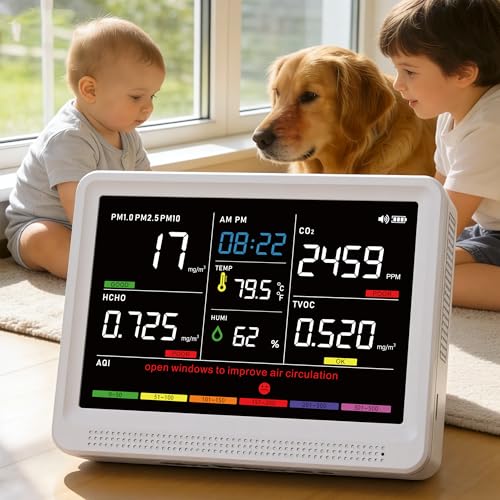
- Tracks gases, particulates, temperature, humidity, and AQI
- Large 5.5-inch HD screen with brightness adjustment
- Rechargeable USB-C design with seven AQI alerts
Best For: Families wanting broad indoor air readings at a glance
Best Portable Battery Life

- Up to 20 hours of monitoring on a 2000mAh battery
- Tracks pollutants, particulates, temperature, and humidity
- Color screen, voice alerts, and one-button controls
Best For: Portable monitoring across rooms, vehicles, and offices
Best App-Connected Option
AprilAire 5-in-1 Wi-Fi Monitor
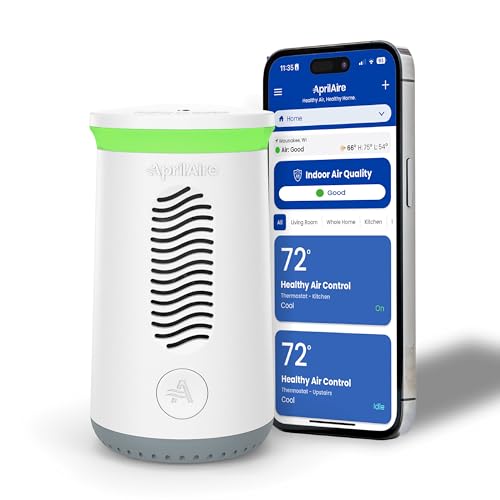
- App tracks CO2, VOCs, PM2.5, humidity, and temperature
- Remote notifications and trend information
- Three-year warranty and three selectable light settings
Best For: Homeowners wanting app-based alerts and air-quality trends
Best Portable Pick
10-in-1 Smart Air Quality Monitor

- Tracks gases, particles, temperature, humidity, and AQI
- Color-changing display supports quick visual checks
- Portable design with Bluetooth time calibration
Best For: Portable whole-room and on-the-go air-quality checks
Best Large-Display Pick
16-in-1 Monitor with 7-Inch Screen

- Shows numerous readings on a large 7-inch display
- Includes real-time buzzer alerts with mute control
- Offers brightness and temperature-format adjustments
Best For: Stationary home monitoring where readability matters most
Best Connected Pick
Wi-Fi Smart Air Quality Monitor

- Works with Smart Life and Tuya Smart apps
- Stores historical readings and sends real-time updates
- 3000mAh battery supports approximately 7–15 hours
Best For: Remote monitoring and app-based air-quality history
Best Alexa Integration – Amazon Smart Air Quality Monitor
For shoppers comparing smart air quality monitors for home use, the Amazon Smart Air Quality Monitor offers a straightforward way to track five indoor conditions: PM2.5, VOCs, carbon monoxide, temperature, and humidity. Its color-coded LED and Alexa app provide an easy-to-understand air quality score, while alerts can reach your phone or Echo devices.
Best For: Alexa households that want simple monitoring and smart-home automations.
Pros:
- Tracks PM2.5, VOCs, carbon monoxide, humidity, and temperature.
- Provides color-coded status information and an air quality score in the Alexa app.
- Can send alerts and trigger compatible Alexa routines for purifiers, fans, or dehumidifiers.
- Simple plug-in setup through the Alexa app.
Cons:
- Requires the Alexa app for detailed readings and setup.
- Smart-home automation is centered on compatible Alexa devices.
This is a practical choice if you already use Echo products and want an uncomplicated monitor with broad sensor coverage. It is especially useful for connecting air-quality changes to everyday Alexa routines.
Best CO Safety Focus – Kidde Smart CO Detector + IAQ
Among smart air quality monitors for home use, the Kidde Smart CO Detector stands out for combining indoor air-quality tracking with dedicated carbon monoxide protection. It monitors humidity and TVOC levels, sends app notifications without a subscription, and includes low-level CO alerts alongside an 85-dB alarm for dangerous concentrations.
Best For: Households prioritizing connected carbon monoxide detection with added air-quality insights.
Pros:
- Provides real-time app alerts and monitors humidity and TVOC levels.
- Uses distinct alerts for low-level CO exposure and dangerous CO levels.
- Plug-in operation includes two AA backup batteries for power outages.
- Works with Alexa-enabled devices and Google Home, with a 10-year limited warranty.
Cons:
- The Advanced Home Health subscription is optional but required for additional insights such as weekly trends and mold-risk information.
- Uses 2.4 GHz Wi-Fi.
This model is less of a broad environmental monitor and more of a connected CO safety device with supporting IAQ data. Its backup power and low-level detection make it a strong fit for families, older adults, pets, or anyone wanting extra CO awareness.
Best Detailed Air Analysis – BREATHE Airmonitor Plus Gen 2
For detailed indoor tracking, the BREATHE Airmonitor Plus Gen 2 is one of the more comprehensive smart air quality monitors for home use. It measures CO2, three particle sizes, TVOC, formaldehyde, temperature, and humidity, then pairs those readings with app alerts, 90-day history, and data export.
Best For: Users who want broad pollutant coverage, historical graphs, and portable monitoring.
Pros:
- Tracks eight measurements, including NDIR CO2, PM1, PM2.5, PM10, TVOC, and formaldehyde.
- Offers configurable CO2 and PM2.5 alerts through the app.
- Stores up to 90 days of history and supports data export.
- Provides up to six hours of portable battery use and can operate over USB-C power.
Cons:
- App connectivity requires 2.4 GHz Wi-Fi.
- Portable battery life is limited to up to six hours.
- Its broader sensor set may be more than casual users need.
The Airmonitor Plus Gen 2 is a strong analytical option for comparing rooms, investigating changes from cooking or cleaning, and reviewing longer-term patterns. Choose it when historical data and pollutant detail matter more than a minimal display.
Best for Govee Automation – GoveeLife Smart Air Quality Monitor
The GoveeLife Smart Air Quality Monitor is a practical pick among smart air quality monitors for home use if PM2.5, temperature, and humidity are your main priorities. It provides fast two-second refreshes, a visible LED display, remote monitoring, and compatibility with selected GoveeLife appliances for automatic responses to changing air conditions.
Best For: Govee users who want quick PM2.5 readings and appliance automation.
Pros:
- Measures PM2.5, temperature, and humidity with fast two-second updates.
- Offers a switchable display, night mode, and four-level air-quality indicator.
- Can automate compatible GoveeLife purifiers, humidifiers, and fans.
- Supports remote viewing, 13-day graphs, and exporting data from the past two years.
Cons:
- Does not include sensors for CO2, VOCs, or carbon monoxide.
- Requires continuous Type-C power and has no built-in battery.
- Wi-Fi features require a 2.4 GHz network.
This monitor makes the most sense for a Govee-centered setup or for shoppers focused on particulate matter and basic comfort readings. Its fast refresh rate and long data-export window add useful context, but it is not designed as a full-spectrum pollutant monitor.
Most Comprehensive Readings – 16-in-1 Air Quality Monitor
For shoppers comparing smart air quality monitors for home use, the YNAK 16-in-1 monitor stands out for its broad coverage and large display. It tracks CO2, particulate matter, formaldehyde, TVOC, temperature, humidity, and AQI, while providing multiple alerts and portable, rechargeable operation.
Best For: Families wanting a broad set of indoor readings on a large, easy-to-read screen.
Pros:
- Monitors CO2, PM1.0, PM2.5, PM10, HCHO, TVOC, temperature, humidity, and AQI.
- 5.5-inch HD display offers three brightness levels.
- Provides seven AQI alert functions with a mute option.
- USB-C charging and up to 10 hours of runtime support portable use.
Cons:
- Its stated “16-in-1” count combines nine detected parameters with seven alert types.
- Sensors should not be touched or exposed to perfumes and strong odors.
- Up to 10 hours of battery life is shorter than some portable alternatives.
This is a feature-rich choice for bedrooms, offices, vehicles, and other indoor spaces. Its detailed readings and visible alerts make it useful when you want more than a basic temperature or CO2 monitor.
Best Portable Battery Life – 10-in-1 Air Quality Monitor
The QXZFFF 10-in-1 is a practical option among smart air quality monitors for home use, especially if you want a compact unit that can move between rooms or travel with you. It measures common household pollutants, uses a color screen and voice alerts, and offers up to 20 hours of continuous monitoring.
Best For: Users who want a lightweight, rechargeable monitor with extended battery life and simple controls.
Pros:
- Measures CO2, formaldehyde, TVOC, benzene, AQI, PM1.0, PM2.5, PM10, temperature, and humidity.
- Up to 20 hours of monitoring from the built-in 2000mAh rechargeable battery.
- Color-coded screen and voice alerts highlight abnormal readings.
- One-button operation includes temperature-unit, alarm, calibration, and screen-sleep controls.
Cons:
- Its compact display may provide less viewing space than larger-screen models.
- Voice alerts may be unsuitable for users who prefer silent monitoring unless disabled.
- The supplied accuracy specification is an error margin below plus or minus 5 percent, rather than a more detailed parameter-by-parameter rating.
With its long stated runtime and lightweight build, this monitor is well suited to homes, cars, offices, grow rooms, and other locations where portability matters. Auto-calibration and straightforward controls add convenience for routine checks.
Best App-Connected Option – AprilAire 5-in-1 Wi-Fi Monitor
The AprilAire ZAWTHCPV takes a connected approach to smart air quality monitors for home use. It sends readings, trends, notifications, and educational guidance through the AprilAire Healthy Air App, making it a good fit for shoppers who prefer remote monitoring over a standalone handheld meter.
Best For: Homeowners who want app-based alerts, air-quality trends, and guidance for responding to changing conditions.
Pros:
- Monitors PM2.5, VOCs, TVOC, CO2, humidity, and temperature.
- Healthy Air App provides notifications, readings, trends, explanations, and practical tips.
- Simple color status scheme makes conditions easy to interpret at a glance.
- Includes three light settings and a three-year manufacturer warranty.
Cons:
- Requires the AprilAire Healthy Air App to function.
- It is corded electric rather than battery powered.
- Healthy Air Mode requires a compatible AprilAire Wi-Fi thermostat sold separately.
This is the strongest choice here for connected, ongoing oversight rather than grab-and-go testing. Its app ecosystem is particularly useful if you already use, or plan to add, compatible AprilAire ventilation and filtration equipment.
Best Portable Pick – 10-in-1 Smart Air Quality Monitor
For shoppers comparing smart air quality monitors for home use, this compact Lwyinp model provides a broad set of readings in a portable format. It tracks CO2, formaldehyde, TVOC, particulate matter, temperature, humidity, and AQI in real time, with a color-changing display for quick visual checks.
Best For: Homes, bedrooms, offices, vehicles, and other spaces where portability and multi-metric monitoring matter.
Pros:
- Measures CO2, HCHO, TVOC, PM1.0, PM2.5, PM10, AQI, temperature, and humidity.
- Three-color visualization helps flag changing air conditions from a distance.
- Bluetooth connection supports automatic time calibration, and the device offers smart calibration for readings.
- Compact design suits use in rooms, cars, hotels, schools, and travel settings.
Cons:
- The supplied notes do not indicate Wi-Fi, app-based historical tracking, or remote monitoring.
- Operation relies on multi-press button controls that may take some familiarization.
This is a versatile choice if you want many measurements without committing to a large display unit. Its portable build and visual alerts make it especially practical for checking air in multiple locations.
Best Large-Display Pick – 16-in-1 Monitor with 7-Inch Screen
This Lecoolife model stands out among smart air quality monitors for home use with a large 7-inch display designed to show multiple readings at once. Its 16-in-1 monitoring setup covers CO2, particulate matter, HCHO, TVOC, temperature, humidity, AQI, and additional conditions, while adjustable brightness supports daytime and nighttime viewing.
Best For: Bedrooms, home offices, and shared living spaces where an at-a-glance display is a priority.
Pros:
- Large 7-inch full-view screen presents air-quality information in one place.
- Monitors CO2, PM1.0, PM2.5, PM10, HCHO, TVOC, temperature, humidity, AQI, and more.
- Real-time alerts include a built-in buzzer with a mute option.
- Supports brightness adjustment, 12/24-hour time formats, and Celsius/Fahrenheit selection.
Cons:
- The larger 1.47-pound device is less portable than compact monitor designs.
- The notes advise avoiding perfumes, strong odors, or touching the sensors to help maintain accuracy.
- The supplied information does not mention app connectivity or remote alerts.
If readability is more important than portability, the 7-inch display is this monitor’s main advantage. It is a practical fit for a stationary location where you want comprehensive readings visible at a glance.
Best Connected Pick – Wi-Fi Smart Air Quality Monitor
For buyers seeking smart air quality monitors for home use with remote access, this Sacnahe detector adds 2.4GHz Wi-Fi and Smart Life or Tuya Smart app support. It monitors AQI, CO2, particulate matter, HCHO, TVOC, temperature, and humidity while storing historical data and providing remote status updates.
Best For: Households that want app-based tracking, remote checks, and flexible placement at home or in an office.
Pros:
- Wi-Fi connectivity enables remote monitoring through Smart Life and Tuya Smart apps.
- App features include historical data storage, real-time updates, and custom settings.
- Dual-chip design separates sensor processing from display and controls for responsive operation.
- Built-in 3000mAh battery provides approximately 7–15 hours of continuous use.
Cons:
- Wi-Fi connection is limited to 2.4GHz and may require compatibility mode on Wi-Fi 6 or newer routers.
- The notes recommend keeping it plugged in for long-term data recording.
- Only one phone can be connected at a time when pairing a new phone.
This is the strongest option of the three for connected monitoring and historical data. Its battery supports portable checks, while wall-mounting and app access make it suitable for ongoing home air-quality oversight.
How We Picked the Best Smart Air Quality Monitors for Home Use
We focused on monitors that measure useful indoor conditions rather than displaying a single generalized air-quality score. Our comparison considers sensor coverage, measurement clarity, alert and connectivity options, display readability, portability, power requirements, and suitability for common rooms such as bedrooms, nurseries, offices, and living areas.
We also separated air-quality monitoring from life-safety protection. A monitor that measures trends in CO2, particles, or VOCs can support better ventilation decisions, but it should not automatically be treated as a replacement for a code-compliant smoke or carbon monoxide alarm unless the product is specifically designed and certified for that purpose.
Quick Comparison
The Amazon and AprilAire options are the most natural fits for connected homes that prioritize app-based monitoring. Kidde is the more safety-focused choice for shoppers who specifically want carbon monoxide detection alongside indoor air-quality information. BREATHE, GoveeLife, and the portable 10-in-1 models emphasize accessible displays and everyday tracking, while the 16-in-1 and Lecoolife units appeal to buyers who want broad measurement coverage and larger screens.
Before buying, check the exact sensor list and whether each measurement is direct, estimated, or based on an air-quality index. Product names can use similar “10-in-1” or “16-in-1” language while measuring different combinations of gases, particles, temperature, and humidity.
Key Buying Factors for Smart Air Quality Monitors for Home Use
Sensor Coverage
CO2 is particularly useful for judging ventilation and occupancy. PM2.5 and PM10 help identify fine and larger airborne particles from smoke, dust, cooking, and outdoor pollution. TVOC or VOC readings can indicate changes associated with products, furnishings, and cleaning agents, but they are usually broad indicators rather than identification of a specific chemical. Carbon monoxide detection is a separate priority because it concerns immediate safety.
Accuracy and Calibration
Look for stated sensor technologies, calibration guidance, update intervals, and operating ranges. NDIR CO2 sensors are generally preferred for more dependable CO2 readings. Place the monitor away from vents, windows, direct sunlight, stoves, and people’s faces, since local airflow can distort readings.
Connectivity and Alerts
Wi-Fi or app support is valuable if you want remote notifications or historical trends. A local display is better for quick checks without opening an app. Confirm whether alerts require a subscription, a specific smart-home platform, or an internet connection.
Placement and Power
Plug-in models work well in fixed locations, while battery or portable units are easier to move between rooms. A large display suits shared living spaces; a compact monitor is less intrusive on a nightstand or desk.
Who Should Buy Which Smart Air Quality Monitors for Home Use?
Choose a connected monitor if you want phone alerts and long-term trends. Choose a CO2-centered model if ventilation is your main concern. Choose a particle-focused unit for smoke, dust, or wildfire monitoring. A large-screen multi-sensor monitor suits households that want readings visible from across a room, while a portable model is better for renters, travelers, or people comparing several rooms. For carbon monoxide protection, prioritize a dedicated, properly placed detector and use air-quality monitoring as a supplement—not a substitute.
