
As 3D rendering demands escalate, choosing the right RAM becomes essential for maximizing your performance in 2025. With options boasting speeds of 6000MHz and above, along with low CAS latencies, you can enhance your multitasking and rendering efficiency. From sleek designs to impressive specs, the top contenders can elevate your setup considerably. But which ones truly stand out in this competitive landscape? Let’s explore the best RAM options available for your 3D rendering needs.
CORSAIR VENGEANCE RGB DDR5 RAM 32GB (2x16GB) 6000MHz

If you’re a 3D rendering enthusiast looking to boost your system’s performance, the CORSAIR VENGEANCE RGB DDR5 RAM 32GB (2x16GB) 6000MHz is an excellent choice. With a speedy 6000MHz and low latency of CL30-36-36-76, it delivers outstanding performance for demanding applications. The onboard voltage regulation guarantees stable overclocking using CORSAIR’s iCUE software, giving you control over frequency and RGB lighting. Plus, its ten individually addressable RGB LEDs let you customize your setup’s look. Compatible with AMD EXPO and Intel XMP, this RAM is optimized for the latest technology, making it a standout option for your rendering needs.
Best For: 3D rendering enthusiasts and gamers looking for high-performance memory with customizable RGB lighting.
Pros:
- High Speed: Offers a fast 6000MHz speed for improved performance in demanding applications.
- Dynamic RGB Lighting: Features ten individually addressable RGB LEDs for personalized aesthetic customization.
- Stable Overclocking: Onboard voltage regulation ensures reliability during overclocking with CORSAIR iCUE software.
Cons:
- Latency: Higher latency (CL30) compared to some lower-speed options may not appeal to all users.
- Price Point: Premium pricing may not fit all budgets, especially for casual users.
- Compatibility Limitations: While optimized for the latest technology, it may not be compatible with older motherboards.
Acer Predator Pallas II DDR5 RAM 32GB (16GBx2) 6400MHz CL32

For professionals and enthusiasts engaged in 3D rendering, the Acer Predator Pallas II DDR5 RAM 32GB (16GBx2) 6400MHz CL32 stands out as an exceptional choice. With a frequency of 6400MHz and low CL32 latency, you’ll experience minimal FPS drops during intense workloads. Its compatibility with Intel XMP 3.0 and AMD Expo guarantees seamless integration with your system. This new-gen DDR5 RAM boasts enhanced capacity and two independent subchannels for faster processing. Plus, the high-quality ICs provide stability and overclocking potential. With a solid customer rating and warranty, it’s a reliable option for boosting your rendering performance.
Best For: Professionals and enthusiasts engaged in 3D rendering seeking high-performance RAM for minimal FPS drops.
Pros:
- High speed of 6400MHz with low latency (CL32) for optimal performance during intense workloads.
- Compatible with both Intel XMP 3.0 and AMD Expo, ensuring easy integration with various systems.
- Built with high-quality ICs for stability and strong overclocking capabilities.
Cons:
- Higher cost compared to standard DDR4 RAM options.
- Limited to DDR5 compatible motherboards, which may restrict upgrade options for some users.
- Warranty coverage may incur additional fees for misrepresented returns.
Kingston Fury Beast 32GB DDR5 Desktop Memory (Kit of 2)

The Kingston Fury Beast 32GB DDR5 Desktop Memory (Kit of 2) is a game-changer for 3D rendering enthusiasts who demand speed and reliability. With a lightning-fast speed of 6000MT/s and a low CAS latency of CL30, it delivers exceptional performance for your rendering tasks. This memory kit features on-die ECC for enhanced reliability and support for overclocking via Intel XMP 3.0 and AMD EXPO, ensuring you maximize efficiency. Weighing just 1.31 ounces and designed for next-gen gaming platforms, it’s perfect for both 4K+ livestreaming and intensive animation projects. Achieve outstanding results with this reliable RAM solution!
Best For: The Kingston Fury Beast 32GB DDR5 Desktop Memory is best for gamers and creative professionals who require high-speed memory for demanding tasks like 3D rendering and livestreaming.
Pros:
- Exceptional speed of 6000MT/s enhances performance for gaming and rendering.
- On-die ECC provides improved reliability and stability during intensive tasks.
- Supports overclocking with Intel XMP 3.0 and AMD EXPO for maximum efficiency.
Cons:
- Higher price point compared to standard DDR4 memory options.
- Limited compatibility with older motherboards that do not support DDR5.
- Some users may find the 15% restocking fee for misrepresented returns cumbersome.
G.SKILL Trident Z5 RGB Series DDR5 RAM (32GB)

As a powerful choice for 3D rendering enthusiasts, the G.SKILL Trident Z5 RGB Series DDR5 RAM (32GB) delivers exceptional speed with its 6000 MT/s performance. This memory kit includes two 16GB modules, ensuring smooth multitasking and efficient rendering. With a CAS latency of CL36, it strikes a balance between speed and responsiveness. Compatible with Intel and AMD platforms, it supports XMP 3.0 and EXPO overclocking profiles for those looking to push their system further. Plus, its striking matte white design adds a sleek touch to your setup. Rated 4.7 out of 5 stars, it’s a reliable choice for serious creators.
Best For: 3D rendering enthusiasts and gamers seeking high-performance memory for multitasking and efficient rendering.
Pros:
- High Speed: Delivers impressive performance with DDR5-6000 MT/s, ideal for demanding applications.
- Overclocking Support: Compatible with Intel XMP 3.0 and AMD EXPO profiles for enhanced performance tuning.
- Aesthetic Design: Features a sleek matte white finish that enhances the visual appeal of gaming setups.
Cons:
- Price Point: May be more expensive compared to lower-speed DDR4 options.
- Compatibility Limitations: Requires compatible motherboards and CPUs for optimal performance.
- Latency: CAS latency of CL36 may not be as competitive as some higher-end memory options.
Corsair Vengeance 16GB DDR3 Desktop Memory

Delivering impressive performance for 3D rendering tasks, Corsair Vengeance 16GB DDR3 Desktop Memory is an excellent choice for creative professionals and enthusiasts alike. With a speed of 1600 MHz and a timing of 10-10-10-27, it guarantees smooth multitasking and efficient rendering. This dual-channel memory kit, featuring two 8GB modules, is compatible with both Intel and AMD processors, making it versatile for various systems. Weighing just 1.12 ounces, it’s easy to install and fits seamlessly in your setup. Plus, with a solid customer rating of 4.8 out of 5 stars, you can trust its reliability for your demanding projects.
Best For: Creative professionals and enthusiasts looking for high-performance memory for multitasking and 3D rendering tasks.
Pros:
- High Speed: Operates at 1600 MHz, ensuring fast data transfer and improved performance.
- Dual Channel Kit: Comes with two 8GB modules, maximizing bandwidth and efficiency.
- Wide Compatibility: Works with both Intel and AMD processors, making it suitable for various systems.
Cons:
- Limited to DDR3: May not be compatible with newer motherboards that only support DDR4 or DDR5 memory.
- Speed Limitations: Although fast, it may not meet the needs of extreme gamers or professionals requiring higher speeds.
- Physical Size: The 240-pin configuration may require specific motherboard slots, limiting compatibility with some compact builds.
CORSAIR VENGEANCE RGB DDR5 64GB Computer Memory

For 3D rendering enthusiasts who demand high performance and reliability, the CORSAIR VENGEANCE RGB DDR5 64GB memory is a standout choice. With a blazing speed of 6000MHz and advanced performance features, it facilitates faster processing and rendering capabilities. The onboard voltage regulation guarantees stable overclocking, while the custom PCB enhances signal quality. Plus, the dynamic ten-zone RGB lighting adds a vibrant touch to your setup, easily customizable through iCUE software. Rated 4.6 out of 5 stars, this memory not only meets but exceeds expectations, making it a worthy investment for your rendering needs.
Best For: 3D rendering enthusiasts and gamers seeking high performance and reliability in their computer memory.
Pros:
- Superior speed of 6000MHz enhances processing and rendering capabilities.
- Customizable RGB lighting adds aesthetic appeal to any setup.
- Onboard voltage regulation ensures stable overclocking for improved performance.
Cons:
- Higher price point compared to standard memory options.
- Requires compatible AMD or Intel motherboards for optimal performance.
- May be overkill for casual users or basic computing tasks.
Kingston Fury Beast 64GB DDR5 Desktop Memory (Kit of 2)
The Kingston Fury Beast 64GB DDR5 Desktop Memory (Kit of 2) stands out as an exceptional choice for serious 3D rendering enthusiasts and professional animators. With a speed of 6000MT/s and CAS latency of CL30, this RAM guarantees smooth performance for demanding applications. Designed for next-gen gaming platforms, it excels in 4K+ livestreaming and 3D rendering projects. The dual 32-bit subchannels enhance efficiency, while on-die ECC boosts stability. Supporting Intel XMP 3.0 and AMD EXPO, it also offers overclocking capabilities for fine-tuning. With a 4.8-star rating, this kit is a reliable investment for your creative needs.
Best For: This product is best for serious 3D rendering enthusiasts, professional animators, and gamers seeking top-tier performance.
Pros:
- High speed of 6000MT/s ensures smooth performance for demanding applications.
- Supports Intel XMP 3.0 and AMD EXPO for easy overclocking and performance tuning.
- On-die ECC improves stability, making it reliable for intensive tasks.
Cons:
- Higher price point compared to standard DDR4 memory options.
- Limited to specific motherboards that support DDR5 technology.
- May require manual tuning for optimal performance in some setups.
Kingston Fury Beast 64GB DDR5 Desktop Memory (Kit of 2)
Engineered for enthusiasts and professionals alike, the Kingston Fury Beast 64GB DDR5 Desktop Memory (Kit of 2) stands out with its impressive speed of 6400MT/s and low latency of CL32. This memory is compatible with Intel XMP 3.0 and AMD EXPO, making it perfect for next-gen gaming platforms. You’ll appreciate its improved stability for overclocking and enhanced efficiency thanks to dual 32-bit subchannels. With on-die ECC for better reliability and customizable profiles, you can tailor speeds and timings to your needs. Backed by a solid average rating of 4.4 stars, it’s a reliable choice for boosting your 3D rendering performance.
Best For: Enthusiasts and professionals seeking high-performance memory for next-gen gaming and demanding applications.
Pros:
- High Speed: Operates at an impressive 6400MT/s for fast data transfer.
- Enhanced Stability: Improved stability for overclocking ensures reliable performance under stress.
- Customizable Profiles: Allows users to tailor speeds and timings to meet specific needs.
Cons:
- Price Point: Higher cost compared to lower-speed memory options.
- Voltage Requirements: Requires 1.4 Volts, which may not be compatible with older systems.
- Limited Availability: Potential difficulty in sourcing due to high demand for DDR5 memory.
G.SKILL Ripjaws DDR4 SO-DIMM 8GB RAM (F4-3200C22S-8GRS)

When seeking reliable performance for 3D rendering, the G.SKILL Ripjaws DDR4 SO-DIMM 8GB RAM (F4-3200C22S-8GRS) stands out with its impressive DDR4-3200 speed. This unbuffered, non-ECC SO-DIMM module runs at a voltage of just 1.20V, guaranteeing efficiency and stability. With a timing of CL22-22-22-52, it’s designed specifically for laptops and notebooks, making it a great choice for portable workstations. Remember to avoid mixing memory kits to prevent compatibility issues. Always check the G.SKILL memory QVL to verify your motherboard supports this RAM for peak performance in your 3D rendering tasks.
Best For: Those seeking high-performance RAM for laptops, particularly for 3D rendering and other resource-intensive tasks.
Pros:
- High Speed: Rated at DDR4-3200 MT/s, ensuring quick data transfer and improved performance.
- Low Voltage: Operates at just 1.20V, contributing to energy efficiency and system stability.
- Designed for Laptops: The SO-DIMM format is specifically tailored for use in portable devices, making it ideal for mobile workstations.
Cons:
- Single Module: Only available as a single 8GB module, which may limit memory expansion options for some users.
- Potential Compatibility Issues: Mixing memory kits can cause instability, requiring careful selection to ensure compatibility.
- Timing Limitations: The CL22 timing may not be optimal for all applications, potentially affecting performance in certain scenarios.
Kingston FURY Beast 16GB DDR5 Desktop Memory (Kit of 2)
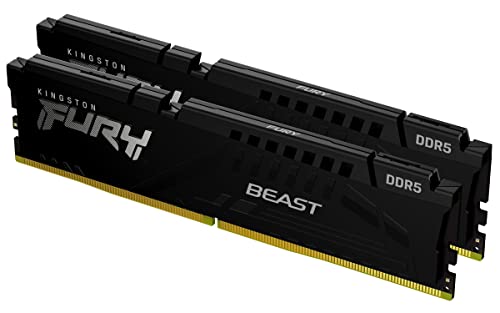
For those looking to enhance their 3D rendering capabilities, the Kingston FURY Beast 16GB DDR5 Desktop Memory (Kit of 2) stands out with its impressive speed of 5200MT/s. With Intel XMP 3.0 support, you can easily overclock for peak performance. Its dual 32-bit subchannels increase efficiency, while on-die ECC guarantees stability during demanding tasks. Weighing just 0.64 ounces and featuring sleek black aesthetics, this kit fits seamlessly into any setup. Rated 4.6 out of 5 stars by users, it’s a top choice among memory options. Plus, enjoy peace of mind with a 30-day return policy and manufacturer’s warranty.
Best For: Those seeking to boost their gaming and 3D rendering performance with high-speed, reliable desktop memory.
Pros:
- High Speed: Offers a fast 5200MT/s speed for improved performance.
- Stability: Features on-die ECC and enhanced overclocking stability.
- User-Friendly: Intel XMP 3.0 support allows for easy customization of profiles.
Cons:
- Limited Return Window: Returns are not accepted after 30 days of shipment.
- Dual Kit Requirement: Sold only as a kit of 2, which may not suit all setups.
- Specific Voltage: Operates at 1.25 Volts, which may require compatible motherboards.
Factors to Consider When Choosing RAM for 3D Rendering
When you’re choosing RAM for 3D rendering, several key factors come into play. You’ll want to evaluate memory capacity requirements, speed, and compatibility with your hardware. Additionally, think about overclocking potential and whether a dual channel configuration will benefit your setup.
Memory Capacity Requirements
Choosing the right memory capacity is vital for efficient 3D rendering, and aiming for a minimum of 32GB of RAM is a solid starting point. This amount helps you handle complex models and high-resolution textures effectively. However, if you plan to work on larger projects or run multiple applications simultaneously, consider upgrading to 64GB or more. This can greatly improve your performance and provide smoother multitasking. Remember, while capacity is important, make certain your RAM is also reliable. Look for options with on-die ECC to prevent data corruption during long rendering sessions. Investing in the right memory capacity will enhance your overall rendering experience and boost your productivity in 3D projects.
Speed and Latency
Speed and latency are vital factors that can make or break your 3D rendering performance. RAM speed, measured in megahertz (MHz), directly influences how quickly data is read from and written to memory. Higher speeds, ideally 6000MHz or more, lead to better performance during rendering tasks. Latency, shown as CAS latency (CL), indicates the delay in data access; lower values like CL30 or CL32 offer quicker response times. Striking a balance between high speed and low latency is essential to minimize bottlenecks in complex calculations. Additionally, using dual-channel or multi-channel configurations can enhance data throughput, further boosting efficiency during intensive rendering workloads. Upgrading these aspects of your RAM can greatly reduce rendering times, making your workflow smoother.
Compatibility With Hardware
Compatibility with hardware is essential for optimizing your 3D rendering setup, as it guarantees that all components work seamlessly together. First, confirm the RAM type—like DDR4 or DDR5—matches your motherboard and CPU to prevent performance bottlenecks. Check your motherboard’s specifications for the maximum supported memory speed and capacity; this confirms peak performance during rendering tasks. Additionally, look at the RAM’s CAS latency (CL); lower latency improves responsiveness in rendering software. Consider the number of memory channels your motherboard supports; dual-channel or quad-channel configurations can enhance data throughput. Finally, verify that the RAM modules fit within the voltage range your motherboard supports to maintain stability and avoid potential damage during operation.
Overclocking Potential
When you’re looking to maximize your 3D rendering performance, considering the overclocking potential of your RAM can make a significant difference. Overclocking allows your memory to run at higher speeds than its rated specifications, boosting performance during intensive tasks. Look for RAM with low CAS latency values, as this can enhance responsiveness in memory-heavy applications. The quality of memory chips and adequate cooling solutions also play an essential role in achieving stable overclocking. Verify compatibility with technologies like Intel XMP or AMD EXPO, which simplify configuration for peak performance. Additionally, a robust power supply and motherboard are vital to provide the necessary voltage for stable high-frequency operation. Prioritize these factors to access your RAM’s full potential.
Dual Channel Configuration
While many factors influence your 3D rendering performance, utilizing a dual channel configuration can greatly enhance your system’s efficiency. By using two matched memory modules simultaneously, you can nearly double your memory bandwidth compared to single channel setups. This boost is especially beneficial when rendering complex graphics and animations. To achieve this, you’ll want to confirm your memory kit consists of pairs that match in size, speed, and timings. Modern memory types like DDR4 and DDR5 thrive on dual channel configurations, maximizing data throughput. Don’t forget to install your RAM in the correct motherboard slots designated for dual channel operation, as this is essential for activating the full potential of your setup.
Power Consumption Considerations
After optimizing your RAM configuration with dual channel setups, it’s time to contemplate power consumption. High-performance RAM can draw more voltage, affecting your system’s energy efficiency, especially during intensive 3D rendering tasks. DDR5 RAM shines here, operating at lower voltages (1.1V to 1.4V) compared to DDR4, which means reduced power consumption without sacrificing speed. Efficient memory management also plays a key role, helping to lower thermal output and reducing the need for extra cooling solutions that consume additional power. Be cautious with overclocking; while it may boost performance, it can greatly increase power consumption. Finally, consider RAM with on-die ECC to minimize wasted power on error correction during demanding rendering processes.
Stability and Reliability
Stability and reliability are paramount in 3D rendering, as they directly impact your workflow and the integrity of your projects. Choosing RAM that offers consistent performance is essential; it prevents crashes or data loss during intense rendering tasks. Look for high-quality, hand-selected integrated circuits (ICs) that enhance reliability and can withstand demanding applications. On-die ECC (Error Correcting Code) technology is vital for detecting and correcting memory errors, ensuring data integrity during complex processes. Additionally, RAM with dual 32-bit subchannels improves efficiency, allowing better data handling under high load. Finally, compatibility with advanced memory profiles like Intel XMP or AMD EXPO can help achieve stable overclocking, boosting both reliability and performance tailored to your specific needs.
