
Choosing a rackmount GPU server for deep learning is mostly about balancing compute, cooling, expansion, and reliability. The right setup can handle training workloads, large datasets, and multi-GPU scaling without wasting rack space.
In this roundup, we focus on options that make sense for AI and machine learning builds, including chassis with strong airflow, GPU-friendly layouts, and platforms suited for demanding inference or training environments.
Best 10 Rackmount GPU Server for Deep Learning Picks for 2026
Best GPU-Capable 4U Chassis
Rosewill 4U Rackmount GPU Server Chassis

- Supports up to 4 GPUs for AI and ML workloads
- 8 hot-swap SATA/SAS bays for flexible storage
- Includes rail kit plus strong multi-fan cooling
Best For: Builders who need a rack-ready 4U chassis for custom deep learning servers.
Best for Enterprise AI Scaling

- 32GB HBM2 ECC memory for large AI models
- Passive PCIe design suits rack server airflow
- NVLink enables paired-GPU scaling to 96GB
Best For: Enterprise teams upgrading rack servers for AI training, inference, and HPC.
Best for Dense 2U Storage
RackChoice 2U 12-Bay Rackmount Chassis

- 12 hot-swap bays for dataset and scratch storage
- Micro-ATX/Mini-ITX support with 4 low-profile slots
- Sliding rails included for easier rack installation
Best For: Teams building a compact 2U rack server with lots of local storage and simple rack deployment.
Best for Local AI Clusters
Acer Veriton AI Mini Workstation GN100

- 1 PFLOPS FP4 Blackwell performance
- 128GB unified memory for large local models
- Dual 200Gbps ConnectX-7 ports for clustering
Best For: Teams that want local large-model development and small AI clusters with server-class networking.
Best for Chassis-Only Builds
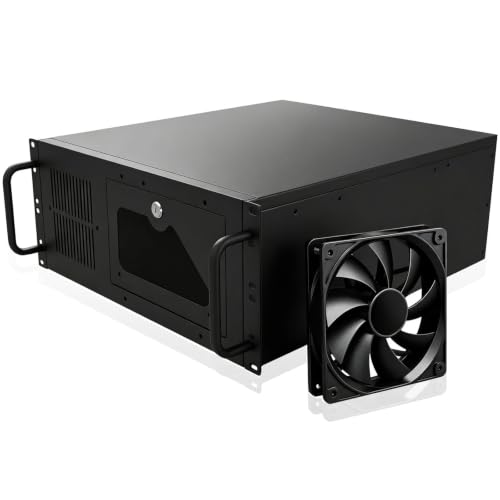
- 7 PCI slots for expansion
- Lockable front door for security
- Supports ATX, Micro-ATX, and Mini-ITX boards
Best For: DIY builders assembling a secure 4U rack case around their own GPU or server hardware.
Best Barebone 1U Pick
ASUS ExpertCenter Pro ER100A B6 1U Barebone

- AMD EPYC 4004/4005 support with DDR5 ECC
- PCIe 5.0 x16 and single RTX A1000/A400 support
- IPMI/BMC remote management and dual 2.5Gb LAN
Best For: SMBs and labs building a compact, configurable AI-ready 1U system.
Best for Dense Multi-Drive Builds
4U Rackmount Server Chassis with 8 HDD Bays

- 7 PCIe slots and E-ATX/CEB/ATX support
- 7 included fans for strong airflow
- Up to 10x 3.5" drives plus 3x 5.25" bays
Best For: Builders who need a roomy rackmount case for deep learning and storage-heavy servers.
Best for Compact 1U Builds
Silverstone RM100 1U Rackmount Chassis

- ATX motherboard support in 1U
- Reversible front I/O and modular layout
- 1 HDD, 2 SSDs, and one PCIe slot
Best For: Builders who need a compact 1U rackmount chassis with flexible front-panel orientation.
Best 2U Rackmount Starter
Rosewill RSV-Z2600U 2U Rackmount Chassis

- 2U rackmount case with included mounting hardware
- 4 internal 3.5" bays plus 1 5.25" expansion slot
- 3 pre-installed PWM fans for steady airflow
Best For: Builders who want a compact, rack-ready chassis for an entry-level deep learning server.
Best for GPU Builds
RackChoice 3U Rackmount Server Chassis

- Supports ATX, Micro-ATX, and Mini-ITX builds
- Short 420mm depth fits tighter rack spaces
- Flexible PSU support for ATX or SFX units
Best For: Builders who want a compact 3U rack chassis for GPU-focused servers and homelabs.
Best GPU-Capable 4U Chassis – Rosewill 4U Rackmount GPU Server Chassis
If you want a rackmount gpu server for deep learning without building around a bare-bones chassis, this Rosewill 4U case is a practical starting point. It gives you room for up to 4 GPUs, hot-swap drive bays, and enough cooling to support sustained training workloads in a standard 19-inch rack.
Best For: Builders who need a rack-ready 4U chassis with GPU support, hot-swap storage, and included rail kit for AI and ML servers.
Pros:
- Supports up to 4 GPUs, making it suitable for multi-card AI and inference builds
- 8 hot-swap 3.5″/2.5″ SATA/SAS bays with 12Gbps support for flexible storage expansion
- Includes 3 hot-swap 12038 fans plus 2 rear 8038 fans for stronger airflow under load
- Comes with a rail kit for easier rack installation in server environments
Cons:
- Chassis-only purchase means you still need to source the motherboard, PSU, GPUs, and other components
- 4U size is more compact than full tower builds, but still takes significant rack space
- Hot-swap and rack features add value, but this is not a turnkey deep learning server
For buyers assembling a rackmount gpu server for deep learning, this Rosewill chassis stands out as a balanced enclosure that prioritizes expandability, cooling, and storage flexibility over flashy extras. It makes sense for teams that want a rack-friendly foundation for a custom AI build.
Best for Enterprise AI Scaling – HPE Tesla V100 32GB PCIe GPU
If you need a proven accelerator for a rackmount gpu server for deep learning, this renewed HPE NVIDIA Tesla V100 is built around the Volta GV100 architecture with 32GB HBM2 and passive cooling for data center chassis. It’s a strong fit for training, inference, and HPC workloads where memory bandwidth, ECC protection, and server compatibility matter more than consumer-GPU extras.
Best For: Teams building or upgrading HPE ProLiant, Dell PowerEdge, or Supermicro rack servers for AI training, large-model inference, and scientific compute.
Pros:
- 32GB HBM2 ECC memory and 900 GB/s bandwidth handle large datasets and model workloads well.
- Passive 250W PCIe design is made for enterprise rackmount airflow and deployment.
- NVLink support can scale paired GPUs to 96GB unified memory for bigger jobs.
- Strong mixed-precision performance for FP64, FP32, FP16, and INT8 workloads.
Cons:
- Renewed hardware may not suit buyers who want brand-new components with full retail warranty.
- Requires a server chassis with solid cooling and PSU headroom.
- Older PCIe 3.0 platform limits compared with newer GPU generations.
For buyers prioritizing server-ready reliability over cutting-edge efficiency, this V100 remains a practical accelerator for a rackmount gpu server for deep learning. It’s especially compelling when compatibility with established enterprise platforms and high-memory workloads is the main goal.
Best for Dense 2U Storage – RackChoice 2U 12-Bay Rackmount Chassis
If you want a rackmount gpu server for deep learning that prioritizes drive capacity and straightforward 2U integration, this RackChoice chassis is a practical base. It supports Micro-ATX or Mini-ITX boards, standard ATX power supplies, and includes sliding rails, making it easier to assemble a compact rack server around your own compute hardware.
Best For: Builders who need a 2U chassis with lots of hot-swap storage for datasets, scratch space, and local training workflows.
Pros:
- 12 hot-swap 3.5-inch/2.5-inch SATA/SAS bays for dense local storage
- Supports Micro-ATX and Mini-ITX builds with 4 low-profile expansion slots
- Includes sliding rails and fits 600mm cabinets for easier rack deployment
Cons:
- Only 4 low-profile slots, so it is not ideal for large multi-GPU setups
- 2U depth and airflow are more limited than larger training server chassis
- Fans are basic 80mm units, so cooling headroom may be modest under heavy loads
This is a solid choice if your rackmount gpu server for deep learning needs more storage and rack-friendly assembly than maximum GPU count. It makes the most sense for small to mid-scale labs that value hot-swap flexibility and a compact 2U footprint over expansive accelerator capacity.
Best for Local AI Clusters – Acer Veriton AI Mini Workstation GN100
If you need a rackmount gpu server for deep learning but want workstation-style simplicity, the Acer Veriton AI Mini Workstation GN100 brings data-center-class AI hardware to a compact desktop footprint. Its NVIDIA GB10 Grace Blackwell Superchip, 128GB of unified memory, and DGX OS make it a strong fit for local model prototyping, inference, and small-scale clustering without a lot of setup overhead.
Best For: University labs, AI teams, and advanced developers who want to run large models locally and scale into small multi-node clusters.
Pros:
- 1 PFLOPS FP4 performance with Blackwell Tensor Cores for serious AI workloads
- 128GB coherent unified memory helps handle 200B+ parameter models locally
- Two 200Gbps ConnectX-7 ports enable fast direct-attach or clustered setups
- DGX OS and NVIDIA AI stack support simplify development and deployment
Cons:
- Not a traditional rackmount chassis, so it may not fit standard server racks directly
- Premium hardware means it will be expensive for smaller budgets
- Best value depends on whether you actually need local large-model performance
As a compact alternative to a rackmount gpu server for deep learning, the GN100 is most compelling when you care about local privacy, fast iteration, and cluster-ready networking more than raw rack density. It’s a specialized buy, but an unusually powerful one for teams building and testing advanced AI workflows.
Best for Chassis-Only Builds – 4U Rackmount Server Chassis
If you need a basic enclosure for a rackmount gpu server for deep learning, this 4U chassis is a practical starting point. It gives you standard rackmount compatibility, 7 PCI slots, and support for common motherboard sizes, making it useful when you want to build around your own components rather than buy a fully configured system.
Best For: DIY builders who want a lockable 4U case for GPU-focused or mixed server installations in a standard rack.
Pros:
- 7 PCI slots for expansion and add-in cards
- Lockable front door adds basic physical security
- Foam front filter helps reduce dust buildup
- Compatible with ATX, Micro-ATX, and Mini-ITX boards
Cons:
- Case-only product, so GPUs, PSU, and cooling must be sourced separately
- Deep learning builds may require careful planning for airflow and internal clearance
As a chassis-first option, it makes sense for builders who already know their hardware layout and want a secure rack enclosure. It is not a turnkey rackmount gpu server for deep learning, but it can be a solid shell for a custom GPU workstation or server project.
Best Barebone 1U Pick – ASUS ExpertCenter Pro ER100A B6 1U Barebone
If you need a compact rackmount gpu server for deep learning and edge AI, the ASUS ExpertCenter Pro ER100A B6 is a barebones 1U platform built around AMD EPYC 4004/4005 support, DDR5 ECC, and PCIe 5.0. It is designed for buyers who want server-grade reliability in a small chassis, but are comfortable sourcing and installing the CPU, memory, storage, GPU, and cooling themselves.
Best For: SMBs and labs that want a configurable 1U base system for AI inference, light training, and GPU-accelerated workloads.
Pros:
- Supports AMD EPYC 4004/4005 CPUs with DDR5 ECC for reliable 24/7 operation
- PCIe 5.0 x16 and support for an NVIDIA RTX A1000/A400 make it suitable for AI and rendering
- Dual 2.5Gb LAN plus IPMI/BMC remote management improve deployability
- Flexible storage with hot-swap SATA bays and internal SATA or NVMe U.2 options
Cons:
- Not a complete server; CPU, RAM, drives, GPU, OS, and cooling are sold separately
- Only supports a single low-profile workstation GPU, so it is not built for multi-GPU training
- 1U thermals and power limits may constrain heavier deep learning builds
This is a practical rackmount gpu server for deep learning if your priority is a dependable, space-efficient foundation rather than a preconfigured AI box. It makes the most sense for teams that want control over every component and value remote management, ECC memory, and compact rack integration.
Best for Dense Multi-Drive Builds – 4U Rackmount Server Chassis with 8 HDD Bays
If you need a rackmount gpu server for deep learning and also want plenty of room for storage, this 4U chassis is built for exactly that kind of mixed workload. It combines broad motherboard support, 7 expansion slots, and strong airflow, making it a practical base for a home lab, SMB server, or entry-level GPU workstation.
Best For: Builders who want a roomy rackmount case for deep learning, storage-heavy servers, and multi-purpose compute setups.
Pros:
- Supports E-ATX, CEB, and ATX boards with 7 PCIe slots for flexible builds
- Strong cooling layout with 7 included fans helps manage heat from GPUs and drives
- Generous storage capacity with up to 10x 3.5″ drives and 3x 5.25″ bays
- Front-panel lock and dust filter add security and basic system protection
Cons:
- Case-only product, so you still need to source the PSU, motherboard, and GPUs separately
- Large 4U footprint may be too bulky for smaller racks or desks
- Not a turnkey deep learning server; assembly and cable management are on the buyer
This chassis is a solid value pick if your rackmount gpu server for deep learning also needs serious drive expansion and dependable airflow. It’s less about premium refinement and more about giving builders a flexible, high-capacity enclosure that can grow with the project.
Best for Compact 1U Builds – Silverstone RM100 1U Rackmount Chassis
If you want a compact enclosure for a rackmount gpu server for deep learning, the Silverstone RM100 is a practical 1U chassis focused on dense, server-style builds. It supports ATX motherboards, 1U redundant or Flex power supplies, and a reversible layout that helps with integration in tight rack environments.
Best For: Builders who need a 1U rackmount chassis with ATX support, basic expansion, and flexible front-panel orientation for compact GPU-oriented workloads.
Pros:
- Supports ATX motherboards in a 1U rackmount chassis
- Reversible front I/O, rail kit, handles, and power module design
- Includes 1 x 3.5" HDD and 2 x 2.5" SSD bays
- Works with 1U redundant or Flex power supplies
Cons:
- Only one standard PCI/PCIe expansion slot
- 1U form factor limits cooling and GPU sizing flexibility
- Storage capacity is modest without upgrades
For a rackmount gpu server for deep learning, this chassis makes more sense as a compact foundation than a feature-packed workstation case. Its strength is density and layout flexibility, not maximum GPU expandability, so it suits builds that prioritize rack fitment and clean integration.
Best 2U Rackmount Starter – Rosewill RSV-Z2600U 2U Rackmount Chassis
If you need a practical enclosure for a rackmount gpu server for deep learning, the Rosewill RSV-Z2600U is a straightforward 2U chassis that prioritizes airflow, expansion, and easy rack installation. It gives you room for storage and add-in cards without overcomplicating the build, making it a solid fit for entry-level to midrange lab or workstation setups.
Best For: Builders who want an affordable 2U rackmount case for a compact deep learning server with room to expand.
Pros:
- 2U rackmount design with included mounting hardware for clean server-rack installation
- 4 internal 3.5″ drive bays plus 1 extra 5.25″ slot for storage flexibility
- 3 pre-installed 80mm PWM fans help maintain airflow in dense builds
- Micro-ATX support and 4 PCI slots leave room for expansion cards
Cons:
- 2U clearance can limit GPU size and cooler height compared with larger chassis
- Micro-ATX compatibility is more restrictive than full tower or 4U server cases
- Best suited to compact builds rather than high-end multi-GPU deep learning rigs
Overall, this chassis makes sense if you want a simple, rack-ready starting point for a rackmount gpu server for deep learning and value storage capacity, cooling, and ease of deployment over maximum internal space.
Best for GPU Builds – RackChoice 3U Rackmount Server Chassis
If you want a compact rackmount gpu server for deep learning without jumping to a full tower, this 3U RackChoice chassis is built around practical compatibility: ATX, Micro-ATX, and Mini-ITX boards, front fan support, and enough room for serious expansion in a short 420mm depth.
Best For: Builders who need a space-efficient 3U chassis for GPU training rigs, homelab servers, or workstation-style rack installs.
Pros:
- Supports larger GPU lengths when the HDD bracket is removed, making it more flexible for accelerator-based builds.
- Front cooling support and pre-installed fans help with airflow in a dense 3U enclosure.
- Works with standard ATX or SFX power supplies, which broadens PSU options.
- Short 420mm depth is easier to fit in tighter racks than many deeper server cases.
Cons:
- ATX motherboards can sit partially under the PSU, which may limit access to some components.
- The PSU takes up two PCI slot spaces, so expansion planning matters.
- GPU clearance is tight if you keep the HDD bracket installed.
Overall, this is a smart pick if you need a practical rackmount gpu server for deep learning and value compact rack dimensions over maximum internal freedom.
How We Picked the Best Rackmount GPU Server for Deep Learning
We selected hardware that fits real deep learning deployment needs: GPU clearance, airflow, power delivery, storage expandability, and motherboard compatibility. For a Rackmount GPU Server for Deep Learning, physical design matters as much as raw specs, because heat and cabling can limit performance long before the CPU does.
We also looked for options that support practical build paths, from bare chassis for custom configurations to server and workstation platforms that can reduce integration work.
Quick Comparison
Use chassis-first options if you already have CPUs, GPUs, and storage, and choose integrated platforms when you want a more complete starting point. Compact 1U and 2U systems save rack space but usually trade away GPU count and cooling headroom. Larger 4U designs are generally the better fit for multi-GPU deep learning workloads.
Key Buying Factors for a Rackmount GPU Server for Deep Learning
GPU Support and Slot Layout
Check how many full-height cards the chassis can physically accept, whether the slot spacing supports double-width GPUs, and whether the chassis can handle passive accelerators that depend on strong case airflow.
Cooling and Airflow
Deep learning workloads can run at high utilization for long periods, so fan placement, intake path, and hot-swap bay design all matter. Larger 3U and 4U cases usually provide better thermal stability for multiple GPUs than dense 1U systems.
Power and Motherboard Compatibility
Make sure the rackmount case supports your PSU form factor, motherboard size, and cabling needs. If you plan to use modern accelerators or multiple PCIe cards, check for adequate PCIe lane availability and enough power connectors.
Storage and Serviceability
AI workflows often benefit from fast local storage for datasets, scratch space, and checkpoints. Hot-swap bays and easy drive access can save time during upgrades or maintenance, especially in shared lab or production racks.
Who Should Buy Which Rackmount GPU Server for Deep Learning?
If you need maximum flexibility, a GPU-ready 4U chassis is usually the best starting point. If you want a compact rack footprint for lighter AI workloads, look at 1U or 2U systems. If you want faster deployment with less assembly, a barebone rack workstation or AI workstation may be the better choice. For accelerator-focused builds, ensure the platform is compatible with passive GPUs and the cooling requirements of sustained deep learning use.
