
When it comes to professional audio work, the right studio monitor speakers can make all the difference. You want clarity, precision, and reliability in your sound equipment. With options like the Yamaha HS series and PreSonus Eris, you’ve got plenty of choices to evaluate. But what should you prioritize in your search? Understanding the features and specifications of these top contenders will help you find the perfect fit for your sound needs.
YAMAHA Hs5 Powered Studio Monitor, Pair

If you’re a music producer or audio engineer seeking precise sound reproduction, the Yamaha HS5 Powered Studio Monitor is an excellent choice. This 2-way bass reflex bi-amplified studio monitor features a 5-inch cone woofer and a 1-inch dome tweeter, delivering a frequency response from 54 Hz to 30 kHz. With a total power amplification of 70 watts, it guarantees accurate stereo sound. Designed for sonic purity, the HS5 emphasizes clarity without altering the original audio. Its compatibility with XLR and TRS inputs makes it versatile for various devices, making it a top pick among audio professionals, reflected in its impressive customer reviews.
Best For: Music producers and audio engineers seeking precise sound reproduction for mixing and mastering.
Pros:
- Accurate sound reproduction with a flat response, ideal for professional audio work.
- Versatile connectivity options with XLR and TRS inputs for compatibility with various devices.
- High customer satisfaction, reflected in a rating of 4.8 out of 5 stars from 391 reviews.
Cons:
- May require additional space due to its dimensions (24D x 20W x 32H inches).
- Weighs 32.5 pounds, which might be cumbersome for some users to move.
- Limited low-end response (54 Hz), which might necessitate a subwoofer for bass-heavy applications.
Yamaha HS4 Powered Studio Monitor in Black, Pair (HS4 B)

The Yamaha HS4 Powered Studio Monitor is an excellent choice for music producers and audio engineers seeking high-quality sound in a compact design. With a 4.5-inch cone woofer and 1-inch dome tweeter, it delivers a frequency response of 60 Hz to 22 kHz, ensuring crisp audio clarity. Its 26 W output power and versatile connectivity options, including XLR/TRS and RCA inputs, make it perfect for various setups. The compact housing fits seamlessly into limited spaces while the room control features enhance sound quality. Trusted by professionals, the HS4 offers reliable performance for music production and video editing.
Best For: Music producers, audio engineers, and artists looking for high-quality sound in a compact studio monitor.
Pros:
- Exceptional audio clarity with a frequency response of 60 Hz to 22 kHz.
- Versatile connectivity options including XLR/TRS, RCA, and stereo mini inputs.
- Compact design ideal for limited spaces while maintaining high performance.
Cons:
- Limited bass response due to the smaller 4.5-inch woofer size.
- Corded electric power source may restrict placement options.
- Warranty coverage is only available through authorized retailers in the U.S.
Sony MDR7506 Professional Large Diaphragm Headphone

For audio professionals seeking an accurate and reliable monitoring experience, the Sony MDR7506 Professional Large Diaphragm Headphone stands out with its dynamic 40-millimeter drivers and a frequency response that spans from 10 Hz to 20 kHz. Weighing just 8 ounces, these headphones offer a closed-ear design that guarantees comfort while minimizing external noise. The rugged construction and 9.8-foot gold-plated cord make them durable for various applications, from studio recording to DJing. Plus, with a 90-day warranty and high customer ratings, you can trust that they’ll deliver powerful, detailed sound every time you plug them in.
Best For: Audio professionals and enthusiasts looking for precise sound monitoring in studio and live environments.
Pros:
- Dynamic 40mm drivers deliver powerful and detailed sound across a wide frequency range.
- Lightweight and closed-ear design provides comfort while effectively reducing external noise interference.
- Rugged construction with a long gold-plated cord ensures durability and stable signal transmission.
Cons:
- Non-detachable cord may limit replacement options if damaged.
- May not be suitable for casual listening due to their studio-oriented sound profile.
- Limited warranty period of 90 days could be a concern for long-term use.
PreSonus Eris 3.5 Studio Monitors (Powered Active Monitor Speakers)

Designed for both aspiring producers and seasoned audio professionals, the PreSonus Eris 3.5 Studio Monitors deliver exceptional sound quality in a compact form. With woven-composite woofers and 50 Watts of Class AB amplification, you’ll enjoy tight bass and balanced audio. The 1-inch silk-dome tweeters provide a wide listening sweet spot for superior stereo imaging. Connectivity is a breeze with ¼-inch TRS and RCA inputs, plus an aux input for your devices. You can customize sound with high- and low-frequency tuning controls, ensuring clear audio in any space. Plus, the front-panel headphone output adds convenience for media reference.
Best For: Aspiring producers and seasoned audio professionals seeking compact, high-quality studio monitors for accurate sound reproduction.
Pros:
- Studio-quality sound with woven-composite woofers and 1-inch silk-dome tweeters for clear audio and wide stereo imaging.
- Versatile connectivity options including TRS, RCA, and aux inputs for easy integration with various audio devices.
- Customizable audio output with high- and low-frequency tuning controls for optimal performance in different environments.
Cons:
- Limited low-frequency response without a subwoofer for those who prefer deeper bass.
- Compact size may not provide the same volume or power as larger studio monitors for more extensive setups.
- Potentially lower output power compared to other models in the same price range, which may affect performance in larger spaces.
YAMAHA HS8 8-Inch Powered Studio Monitor Pair – Black

Looking for studio monitor speakers that deliver exceptional audio clarity? The YAMAHA HS8 8-Inch Powered Studio Monitor Pair is your answer. With a frequency response of 38Hz to 30kHz and powerful bi-amplification, these monitors optimize audio performance while minimizing distortion. The 8-inch cone woofer and 1-inch dome tweeter work together to provide stunning transparency. Plus, their 2-way bass reflex design enhances overall sound quality. Compatible with various devices through XLR connectivity, they’re perfect for studio recording and mixing. Weighing 56 pounds, they’re built to last, making them a solid choice for serious audio professionals.
Best For: The YAMAHA HS8 8-Inch Powered Studio Monitor Pair is best for audio professionals seeking high-quality sound reproduction in studio environments.
Pros:
- Exceptional audio clarity with a frequency response of 38Hz to 30kHz.
- Bi-amplification system minimizes distortion and optimizes performance.
- Robust build quality and sophisticated design reduce unwanted vibrations.
Cons:
- Not waterproof, limiting use to indoor studio settings.
- Weighing 56 pounds, they may be cumbersome to move.
- Requires XLR connectivity, which may not be compatible with all devices without adapters.
Audio-Technica ATH-M20x Professional Studio Monitor Headphones, Black

The Audio-Technica ATH-M20x Professional Studio Monitor Headphones are perfect for audio professionals seeking exceptional sound isolation and comfort during long sessions. With a circumaural design, they contour around your ears, providing excellent isolation in noisy environments. Weighing just 210 grams, these over-ear headphones are comfortable for extended use. The 40 mm drivers deliver enhanced low-frequency performance, while the 9.8-foot tangle-free cable guarantees flexibility. Rated 4.6 out of 5 stars, they’re highly regarded among users. Plus, you’ll enjoy a 2-year warranty, making them a reliable choice for your studio or on-the-go music production needs.
Best For: Audio professionals and music enthusiasts seeking high-quality sound isolation and comfort during extended listening sessions.
Pros:
- Excellent Sound Isolation: The circumaural design effectively contours around the ears, minimizing sound bleed and providing exceptional isolation in loud environments.
- Comfortable for Long Use: Weighing only 210 grams, these headphones are designed for extended sessions, making them ideal for studio work or music production.
- Durable Construction: Made from pro-grade materials, they are built to withstand the rigors of daily use, ensuring longevity.
Cons:
- Wired Connectivity Only: These headphones come with a 3.5 mm jack, limiting mobility compared to wireless options.
- Limited Frequency Response: The frequency range of 15 – 20,000 Hz may not satisfy audiophiles seeking wider ranges for more nuanced sound.
- No Noise Cancellation Feature: While they provide sound isolation, they do not have active noise cancellation capabilities.
PreSonus Eris E5 Pair 2-Way 5.25” Near Field Studio Monitors
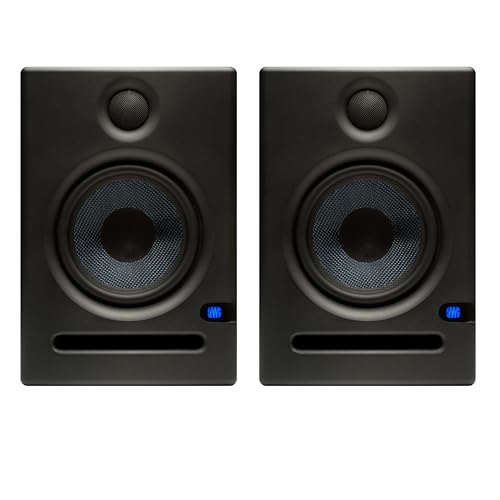
For anyone seeking accurate sound reproduction in a compact package, the PreSonus Eris E5 Pair delivers exceptional performance with its 5.25-inch woven composite woofer and ultra-low-mass silk-dome tweeter. Capable of 80 watts through Class AB bi-amplification, these monitors achieve a maximum SPL of 102 dB, ensuring you hear every detail in your mix. With balanced XLR, 1/4-inch TRS, and unbalanced RCA inputs, connectivity is versatile. The front-firing acoustic port enhances bass reproduction, while acoustic tuning controls help contour your sound. Plus, you get peace of mind with a 2-year warranty and reliable protection features for long-lasting performance.
Best For: Audio professionals and enthusiasts seeking compact studio monitors that deliver accurate sound reproduction for mixing and monitoring.
Pros:
- Exceptional sound clarity with a 5.25-inch woven composite woofer and ultra-low-mass silk-dome tweeter.
- Versatile connectivity options including balanced XLR, 1/4-inch TRS, and unbalanced RCA inputs.
- Front-firing acoustic port and tuning controls enhance bass response and sound customization.
Cons:
- May not provide enough low-end response for bass-heavy genres without additional subwoofer support.
- Relatively heavier than some compact studio monitors, making placement more challenging.
- Limited maximum SPL may not suit larger studio spaces or environments requiring very high volume levels.
Yamaha HS8 Studio Monitor Powered Speaker, Slate Gray

Ideal for audio engineers and music producers, the Yamaha HS8 Studio Monitor Powered Speaker offers exceptional sound quality and accuracy, ensuring you hear every detail in your mix. With an 8-inch woofer and a 1-inch tweeter, it delivers a broad frequency response from 38Hz to 30kHz. You’ll appreciate the low distortion sound and well-defined bottom end, even at high volumes. The HS8 features level control, an EQ high trim switch, and a room control switch for tailored sound. With XLR and TRS inputs, this speaker is versatile enough for any studio setup. Its sleek slate gray finish complements your workspace beautifully.
Best For: Audio engineers and music producers seeking accurate sound reproduction for mixing and mastering.
Pros:
- Exceptional sound quality with low distortion and well-defined bass.
- Broad frequency response range from 38Hz to 30kHz.
- Versatile connectivity options with XLR and TRS inputs.
Cons:
- Not waterproof, limiting placement options in certain environments.
- The speaker may require acoustic treatment for optimal performance in untreated rooms.
- Higher price point compared to entry-level studio monitors.
Ortizan C7 Dual-Mode Studio Monitors (Pair, Black)

Designed with versatility in mind, Ortizan C7 Dual-Mode Studio Monitors are perfect for music producers, gamers, and movie enthusiasts alike. With Bluetooth 5.3, you can easily connect your smartphone or tablet for hassle-free audio streaming. The built-in 24-bit DAC guarantees high-fidelity sound while the 3.5-inch carbon fiber speaker and 0.75-inch silk dome tweeter deliver precise mid-low frequencies and smooth highs. The professional tuning achieves a flat response curve, providing balanced audio across all frequencies. Plus, multiple input options, including RCA and TRS, make these monitors ideal for any compact music production setup. Enjoy unmatched audio quality with Ortizan C7!
Best For: Music producers, gamers, and movie enthusiasts seeking versatile and high-quality audio performance.
Pros:
- Bluetooth 5.3 allows for seamless wireless connectivity with smartphones and tablets.
- High-fidelity audio is ensured with a built-in 24-bit DAC and professionally tuned flat response curve.
- Multiple input options including RCA, TRS, and AUX provide versatility for various audio setups.
Cons:
- May not be suitable for larger studio spaces due to their near-field design.
- Limited low-frequency response might not satisfy bass-heavy music lovers without additional subwoofers.
- The design may not appeal to all aesthetics, as it is focused primarily on functionality.
Edifier MR3 Powered Studio Monitor Speakers (Hi-Res Audio Certified)

The Edifier MR3 Powered Studio Monitor Speakers stand out as an excellent choice for musicians and audio professionals seeking high-resolution sound without breaking the bank. With a frequency response of 52Hz to 40kHz and 18W output power, you’ll enjoy precise audio reproduction. The Bluetooth V5.4 connectivity allows for seamless multi-device pairing, while the EDIFIER ConneX app gives you control over sound modes and EQ settings. Weighing just under 10 pounds, their MDF cabinet minimizes distortion, making them perfect for everything from audio production to casual listening. With a solid 4.7-star rating, these monitors deliver exceptional value and performance.
Best For: Musicians, audio professionals, and casual listeners seeking high-resolution sound at an affordable price.
Pros:
- Hi-Res Audio certification ensures precise sound quality for monitoring and music creation.
- Bluetooth V5.4 connectivity allows for seamless multi-device connections.
- Customizable sound modes and EQ settings via the EDIFIER ConneX app enhance user experience.
Cons:
- Limited to corded electric power source, which may restrict placement options.
- Some users may find weight (9.92 pounds) slightly cumbersome for portability.
- The MDF cabinet, while reducing distortion, may not appeal to those preferring a more premium look.
Factors to Consider When Choosing Professional Studio Monitor Speakers
When you’re choosing professional studio monitor speakers, several key factors come into play. You’ll want to contemplate the speaker size and type, along with the frequency response range that best suits your needs. Additionally, think about power and amplification, connectivity options, and the overall design and build quality to guarantee you make the right choice.
Speaker Size and Type
Choosing the right speaker size and type is essential for achieving accurate sound reproduction in your studio. Larger woofers deliver better bass, while smaller woofers shine in high-frequency clarity. Consider the type of monitor, too—near-field monitors are perfect for close listening in smaller spaces, while far-field monitors suit larger environments.
Driver configurations matter as well; 2-way systems typically offer simple designs for accurate lower-frequency reproduction, while 3-way systems can enhance overall sound quality. Pay attention to enclosure design, as materials like MDF or polypropylene reduce distortion and resonance, improving sonic purity. Finally, consider power output; higher wattage allows for greater sound pressure levels and dynamic range without distortion, ensuring a more immersive listening experience.
Frequency Response Range
How do you guarantee your studio monitors deliver the sound accuracy you need? Start by considering the frequency response range, which indicates the audio frequencies your monitors can reproduce. A wider range, like 38 Hz to 30 kHz, captures both deep bass and high-frequency details, essential for professional audio work. Aim for monitors with a flat frequency response to ascertain no frequencies are emphasized or diminished, giving you an accurate sound representation. Additionally, make certain the monitors cover the critical listening range of 20 Hz to 20 kHz, the average human hearing range. Finally, check the decibel (dB) measurements at specific frequencies to understand any variations in sound output across the spectrum. Choose wisely to enhance your audio experience.
Power and Amplification
Understanding power and amplification is essential for achieving the clarity and volume needed in professional studio monitors. The power output considerably influences sound quality; for example, the Yamaha HS5 offers 70 watts, while the HS8 delivers 120 watts. Consider monitors with bi-amplification systems, which provide separate amplification for low and high frequencies, reducing distortion—like the HS8’s 75W LF and 45W HF. The woofer size also matters; larger woofers, such as an 8-inch cone, generally require more power for deep bass compared to smaller 5-inch cones. Pay attention to continuous power (RMS) ratings, like the PreSonus Eris E5’s 80 watts, as they indicate sustained performance without distortion. Finally, peak power ratings affect transient response and overall dynamics in your audio production.
Connectivity Options Available
When it comes to professional studio monitor speakers, connectivity options play a significant role in your setup. You’ll find that studio monitors typically offer various inputs, including XLR, TRS, RCA, and AUX, giving you the flexibility to connect multiple audio devices. Balanced inputs like XLR and TRS are essential for minimizing noise and signal interference, ensuring high-quality sound transmission. If you prefer wireless convenience, some monitors come with Bluetooth capabilities, allowing you to connect your smartphone or tablet effortlessly. Additionally, many models include a headphone output for private listening, which is perfect for monitoring without disturbing others. The ability to switch between different audio sources quickly through RCA and AUX inputs enhances your workflow, making your setup more versatile.
Design and Build Quality
While choosing professional studio monitor speakers, it is vital to focus on design and build quality, as these factors directly impact sound accuracy and durability. Look for designs that prioritize sonic purity, ensuring accurate sound reproduction without coloration. The enclosure materials, like MDF and polypropylene, are significant; they help minimize distortion and enhance durability. If you’re working in a limited space, opt for compact and lightweight models, which offer flexibility in placement and ease of transport. Additionally, high-resolution tweeters and woofers provide a concise sound image and flat frequency response, essential for mixing and mastering. Consider features like room control and high trim response controls to tailor the sound to your specific environment for peak performance.
Room Adaptability Features
Selecting studio monitor speakers that adapt well to your room’s unique acoustics is key for achieving ideal sound quality. Look for monitors with acoustic tuning controls that let you adjust high and low frequencies based on your space and speaker placement. Room control switches can also help counteract bass buildup and reflections, enhancing clarity. Front-firing acoustic ports improve bass response, allowing flexible placement without sacrificing quality. Additionally, consider models with multiple input options for easy integration with various audio sources. Furthermore, pay attention to the design and enclosure materials, as they influence vibration reduction and resonance, ensuring sound reproduction is tailored to your listening environment. These features enhance your studio experience greatly.
Budget and Value Considerations
Establishing a budget for professional studio monitor speakers is fundamental, particularly since prices can vary widely based on features and specifications. Consider how much you’re willing to invest based on your audio production needs. Investing in monitors with a flat frequency response is essential, as it guarantees accurate sound reproduction for mixing and mastering. Look for models that balance performance and cost—those with customer ratings of 4.6 stars or higher usually indicate quality. Evaluate power output, too; higher wattage can offer better sound clarity and volume without distortion, justifying a higher price. Remember, while budget-friendly options exist, skimping on important features like driver quality can lead to dissatisfaction and the need for upgrades down the line.
