
The right PoE switch can simplify a business network by delivering data and power through one Ethernet cable. However, port count, PoE budget, management features, uplink speed, and installation requirements vary widely between models.
We selected 10 professional PoE network switches for different workloads, from compact deployments and basic surveillance systems to high-density networks with VLANs, advanced security, and 10Gbps uplinks.
Best 10 Professional PoE Network Switches Picks for 2026
Best for UniFi-managed backbones

- 48 Gigabit PoE+ ports
- Four 10G SFP+ uplinks
- UniFi centralized management
Best For: UniFi offices and larger PoE deployments
Best plug-and-play value

- 24 Gigabit Ethernet ports
- 16 PoE+ ports with 190W budget
- Fanless desktop or rack design
Best For: Simple small-office PoE expansion
Best for high-power UniFi edge devices
48-Port Etherlighting PoE Switch
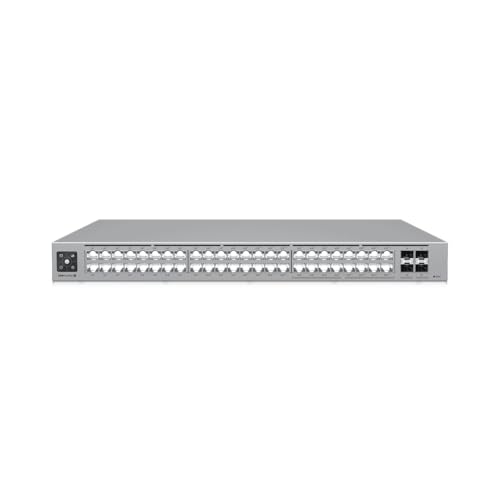
- Sixteen 2.5GbE ports
- 720W total PoE availability
- Four 10G SFP+ uplinks
Best For: UniFi networks with 2.5GbE and PoE++ devices
Best for high-power mixed deployments

- 740W PoE power budget
- Four 10G SFP+ uplinks
- QoS, VLAN, routing, and security features
Best For: Large surveillance and access-control networks
Best Managed Value

- 24 Gigabit PoE+ ports with a 250W budget
- Two SFP slots for high-speed uplinks
- VLAN, QoS, and configurable auto-recovery
Best For: Small and midsize managed PoE networks
Best Plug-and-Play Power

- 400W budget across 24 PoE/PoE+ ports
- Two Gigabit uplink ports
- Plug-and-play with VLAN isolation support
Best For: High-power camera and access-point installations
Best for Large Managed Networks

- 48 Gigabit PoE+ ports with a 384W budget
- Four SFP slots and Omada SDN integration
- L2+ routing and advanced security controls
Best For: Large offices and centrally managed deployments
Best for Advanced Network Control

- Layer 3 managed switching
- Six PoE+ and two PoE++ ports
- Two 10G SFP+ uplinks
Best For: Small professional networks needing advanced management and fast uplinks
Best Heavy-Duty Pick

- 16 Gigabit PoE+ ports
- 120W total PoE budget
- Fanless with Extend and Isolation modes
Best For: Small offices and surveillance systems needing simple PoE expansion
Best for Large Small-Business Deployments
TP-Link Festa FS352GP 52-Port PoE

- 48 PoE+ ports with 384W budget
- Four Gigabit SFP slots
- Free Festa cloud management
Best For: Small businesses with many PoE devices and centralized management needs
Best for UniFi-managed backbones – 48-Port Layer 2/3 PoE+ Switch
For professional PoE network switches in a UniFi deployment, the USW-PRO-48-POE combines 48 Gigabit PoE+ ports with four 10G SFP+ uplinks. Its managed Layer 2/3 feature set suits networks that need VLANs, authentication, traffic controls, and centralized administration.
Best For: UniFi-based offices, surveillance installations, and larger deployments needing plentiful PoE ports and fast backbone connectivity.
Pros:
- 48 RJ-45 Gigabit ports support IEEE 802.3af/at PoE and PoE+ devices.
- Four SFP+ 10G uplinks, 176 Gbps switching capacity, and 88 Mpps throughput support demanding network backbones.
- Managed Layer 2/3 features include VLANs, spanning tree, 802.1x, RADIUS, DHCP server, and port mirroring.
- Integrates with the UniFi Network application for centralized management.
Cons:
- Its advanced management features may be more than a simple plug-and-play network requires.
- It is a 1U rack-mountable design, so it may be less convenient for compact desktop installations.
This is a strong professional choice when centralized UniFi management, extensive PoE capacity, and 10G uplinks matter more than a basic setup.
Best plug-and-play value – 24-Port Unmanaged PoE+ Switch
The NETGEAR GS324P is a practical option among professional PoE network switches when straightforward connectivity is the priority. It provides 24 Gigabit ports, including 16 PoE+ ports with a 190W power budget, without requiring software or configuration.
Best For: Small offices, camera systems, access points, and other installations that need simple PoE expansion with desktop or rack mounting.
Pros:
- 24 auto-negotiating 1Gbps Ethernet ports work with existing Cat5e or Cat6 cabling.
- Sixteen PoE+ ports share a 190W budget with dynamic power allocation.
- Plug-and-play unmanaged operation requires no software or configuration.
- Fanless, energy-efficient design supports silent operation.
Cons:
- As an unmanaged switch, it does not provide VLAN, QoS, or authentication controls.
- Only 16 of the 24 ports provide PoE+ output.
The GS324P is best when installation simplicity and quiet operation outweigh the need for detailed network management.
Best for high-power UniFi edge devices – 48-Port Etherlighting PoE Switch
The USW-Pro-Max-48-PoE brings modern port speeds and high PoE capacity to professional PoE network switches. It combines 48 ports with sixteen 2.5GbE connections, PoE++ output, four 10G SFP+ ports, and UniFi Network management.
Best For: UniFi environments with newer 2.5GbE clients, higher-power devices, and a need for visual port status indicators.
Pros:
- Sixteen 2.5GbE ports include eight PoE+ and eight PoE++ connections.
- Thirty-two additional GbE ports include 24 PoE+ and eight PoE++ ports.
- Provides four 10G SFP+ uplinks and 720W total PoE availability.
- Etherlighting indicates port location, speed/link, and native VLAN/network.
Cons:
- Managed operation requires UniFi Network 8.0.24 or later.
- The feature set may be excessive for networks using only standard Gigabit devices.
Choose this model for a forward-looking UniFi installation where 2.5GbE access, PoE++, and a substantial power budget justify the upgrade.
Best for high-power mixed deployments – 48-Port Managed PoE+ Switch
The Linksys LGS352MPC is designed for professional PoE network switches that must support many powered endpoints and advanced traffic controls. It offers 48 Gigabit ports, a 740W PoE budget, four 10G SFP+ uplinks, and managed features such as QoS, VLANs, static routing, IGMP, and MAC-based security.
Best For: Surveillance, access-control, office, and other installations connecting numerous PoE devices while requiring traffic prioritization and network access controls.
Pros:
- 48 Gigabit ports provide broad capacity for cameras, access points, and door-control systems.
- 740W maximum power supports a large collection of PoE devices.
- Four 10G SFP+ uplinks provide dedicated high-speed connections to the core network.
- Managed features include QoS, VLAN, static routing, IGMP, and MAC-based port security.
Cons:
- Its managed feature set requires more planning and administration than an unmanaged switch.
- The supplied specifications list a 1Gbps data transfer rate for the switch, despite its 10G SFP+ uplinks.
This Linksys model is a compelling fit for power-hungry, device-dense deployments where network segmentation, prioritization, and security controls are important.
Best Managed Value – TP-Link TL-SG1428PE
The TP-Link TL-SG1428PE is a practical choice among professional PoE network switches for small and midsize installations that need 24 Gigabit PoE+ ports, basic management, and fiber uplink options. Its 250W power budget supports cameras, access points, and other compatible devices, while VLAN, QoS, and auto-recovery features add useful control.
Best For: Managed office, surveillance, and access-point networks needing 24 PoE+ ports and SFP expansion.
Pros:
- Provides 24 Gigabit PoE+ ports with up to 30W per port and a 250W total budget.
- Includes two Gigabit non-PoE ports and two SFP slots for high-speed connections.
- Offers VLAN features, web-based management, QoS, and configurable PoE auto-recovery.
Cons:
- Its 250W budget is lower than some high-capacity alternatives.
- PoE auto-recovery requires configuration.
Choose this model when you want a rack-mountable managed switch with straightforward controls and a balanced port layout. It is less suited to very large deployments that require 48 powered ports.
Best Plug-and-Play Power – Yuanley 24-Port PoE Switch
The Yuanley 24-Port PoE Switch is a straightforward option among professional PoE network switches when high power capacity and simple deployment matter more than advanced management. It combines 24 PoE/PoE+ ports with two Gigabit uplinks, a 400W budget, and a plug-and-play design.
Best For: IP camera, wireless access point, and IP phone installations requiring substantial PoE capacity without configuration.
Pros:
- Offers 24 PoE/PoE+ ports and a generous 400W total power budget.
- Provides two Gigabit uplink ports and up to 16Gbps switching bandwidth.
- Plug-and-play operation, metal construction, rackmount hardware, and VLAN isolation support.
Cons:
- The 24 PoE ports operate at 10/100Mbps rather than Gigabit speeds.
- It is unmanaged, so advanced centralized configuration is not available.
- Extended 250m transmission requires the extend mode.
This switch makes sense for installations where powered endpoints are the priority and simple setup is desirable. Consider another model if Gigabit access-port speeds or detailed management controls are essential.
Best for Large Managed Networks – TP-Link TL-SG3452P
The TP-Link TL-SG3452P is built for larger professional PoE network switches deployments, with 48 Gigabit PoE+ ports, four SFP slots, and Omada SDN integration. Its L2+ feature set includes static routing, VLANs, ACLs, 802.1X authentication, and multiple management methods for more demanding networks.
Best For: Larger offices, multi-device installations, and managed networks needing 48 PoE+ ports and centralized control.
Pros:
- Delivers 48 Gigabit PoE+ ports with up to 30W per port and a 384W PoE budget.
- Includes four Gigabit SFP slots for uplinks and network expansion.
- Supports Omada SDN, cloud access, static routing, ACLs, VLANs, and 802.1X authentication.
- Offers web, CLI, SNMP, RMON, Telnet, and SSH management options.
Cons:
- Its feature set may be more extensive than needed for a simple network.
- Omada cloud and SDN features require compatible controllers or software.
- The listed upper temperature rating is 40°C.
This is the strongest fit of the three for organizations that need port density, segmentation, security controls, and centralized administration. Its advanced capabilities are best matched with a planned managed-network deployment.
Best for Advanced Network Control – Ubiquiti Professional 8 PoE
The Ubiquiti USW-Pro-8-PoE is a compact choice for professional PoE network switches when you need managed Layer 3 features, PoE+ and PoE++ support, and faster uplink options. It provides six Gigabit PoE+ ports, two Gigabit PoE++ ports, two 10G SFP+ ports, and a 120W total PoE budget.
Best For: Small professional networks, offices, and installations needing advanced management features with 10G SFP+ connectivity.
Pros:
- Managed Layer 3 design supports more advanced network control.
- Includes six PoE+ ports and two higher-power PoE++ ports.
- Two 10G SFP+ ports provide high-speed uplink options.
- Offers 120W of total PoE availability.
Cons:
- Eight total Ethernet ports may be limiting for larger deployments.
- Its advanced features may be more than a basic plug-and-play network requires.
The USW-Pro-8-PoE is a strong fit when port count is modest but network flexibility matters. Its Layer 3 management and 10G SFP+ interfaces make it more suitable for expandable professional setups than a basic unmanaged switch.
Best Heavy-Duty Pick – TP-Link TL-SG116P 16-Port PoE
The TP-Link TL-SG116P is a practical option among professional PoE network switches for expanding wired connections without a complex setup. It has 16 Gigabit PoE+ ports, a 120W power budget, fanless operation, and features such as Extend, Priority, Isolation, QoS, and IGMP Snooping modes.
Best For: Small offices and surveillance installations that need multiple Gigabit PoE+ ports with simple operation.
Pros:
- Provides 16 PoE+ ports with up to 30W per port.
- 120W total PoE budget supports several powered devices.
- Extend Mode supports data and power transmission up to 250m, with speed reduced to 10 Mbps.
- Fanless metal design and PoE Auto Recovery simplify everyday use.
Cons:
- It does not provide SFP or faster-than-Gigabit uplink ports.
- Extend Mode reduces transmission speed to 10 Mbps.
- Configuration is required for PoE Auto Recovery.
Choose the TL-SG116P when you want a straightforward 16-port PoE+ switch with useful deployment modes and no fan noise. It is better suited to conventional Gigabit networks than installations requiring advanced routing or high-speed fiber uplinks.
Best for Large Small-Business Deployments – TP-Link Festa FS352GP 52-Port PoE
The TP-Link Festa FS352GP is built for larger installations that need many powered devices and centralized management. This smart-managed switch combines 48 Gigabit PoE+ ports, a 384W PoE budget, four Gigabit SFP slots, static routing, VLAN, ACL, and free cloud access through the Festa platform.
Best For: Small businesses, offices, and surveillance deployments with many PoE devices and rack-mounted network equipment.
Pros:
- Offers 48 PoE+ ports and a substantial 384W total power budget.
- Four Gigabit SFP slots support fiber uplink connectivity.
- Festa cloud management provides remote access through the app or web interface.
- Includes static routing, VLAN, ACL, storm control, and port isolation features.
Cons:
- Its three-fan design may be less suitable for noise-sensitive spaces.
- Festa devices do not work with TP-Link Omada Controllers.
- Rack-mountable hardware is likely excessive for very small networks.
The FS352GP is the most scalable option in this group for deployments with dozens of PoE endpoints. Its cloud management and security features simplify administration, but buyers should plan around the Festa ecosystem rather than Omada.
How We Picked the Best Professional PoE Network Switches
We compared these switches by looking at the features that matter most in business installations: total port count, supported PoE standards, available power budget, uplink capacity, management options, rack-mount practicality, and network expansion potential. We also included a range of designs, from unmanaged plug-and-play hardware to managed Layer 2 and Layer 3 models with VLAN, QoS, routing, monitoring, and centralized administration features.
Because requirements differ, no single switch is best for every deployment. A small office with a few access points needs a different solution from a security installation powering dozens of cameras or a multi-tenant network with strict traffic separation.
Quick Comparison
- Best for advanced UniFi networks: Ubiquiti UniFi Pro and Pro Max models provide strong integration with compatible UniFi hardware.
- Best for simple installations: NETGEAR GS324P and TP-Link TL-SG116P offer straightforward PoE expansion without complex configuration.
- Best for high-power deployments: The Linksys LGS352MPC and other high-budget 48-port models suit installations with many powered devices.
- Best for managed business networks: TP-Link Omada and Festa smart-managed switches add VLAN, QoS, monitoring, and administrative controls.
- Best for compact managed networks: The Ubiquiti USW-Pro-8-PoE works well where a smaller footprint and Layer 3 capability are priorities.
Key Buying Factors for Professional PoE Network Switches
PoE Standard and Power Budget
Check whether the switch supports 802.3af PoE, 802.3at PoE+, or a higher-power standard required by your devices. Add the maximum wattage of your cameras, phones, access points, and other endpoints, then leave headroom for startup loads and future expansion. A high port count does not necessarily mean every port can deliver maximum power simultaneously.
Port Count and Uplinks
Count current connections, then add spare capacity for growth. Gigabit access ports are suitable for most endpoints, while SFP or SFP+ uplinks can connect the switch to a faster core network, another rack, or a fiber run. Multi-gigabit support may be worthwhile for newer wireless access points and high-throughput workstations.
Management and Security
Unmanaged switches are easy to deploy, but managed models provide VLANs, QoS, link monitoring, storm control, access controls, and configuration backups. Choose centralized management when you operate multiple switches or need consistent policies across a larger site. Layer 3 features can reduce dependence on a separate router for certain internal routing tasks.
Installation, Noise, and Reliability
Confirm rack-mount dimensions, cooling requirements, fan noise, warranty coverage, and power protection before buying. A switch installed in an office may need quieter operation than one placed in a dedicated network closet.
Who Should Buy Which Professional PoE Network Switches?
Choose an unmanaged NETGEAR, Yuanley, or compact TP-Link model for a simple camera, phone, or access-point installation where configuration is minimal. Select a managed TP-Link, Festa, or Linksys switch when you need VLANs, traffic prioritization, monitoring, or a larger PoE budget. UniFi users should favor a compatible Ubiquiti model for centralized visibility and streamlined administration. For larger deployments, prioritize 48 or more ports, generous power reserves, faster uplinks, and clear room for expansion rather than choosing solely by purchase price.
