
A reliable overhead rig turns top-down photography and video from a balancing act into a repeatable workflow. The right setup keeps your camera level, controls vibration, and leaves enough room for lights, props, and hands.
We selected 10 professional overhead camera rigs ranging from compact desk mounts to heavy-duty C-stand and modular systems, so you can match stability, reach, portability, and payload to your production needs.
Best 10 Professional Overhead Camera Rigs Picks for 2026
Versatile Height
K&F Concept 90-Inch Overhead Tripod

- 90-inch maximum height with compact folded size
- 22-pound load capacity and 28mm ball head
- Detachable monopod plus panoramic rotation
Best For: Tall overhead compositions and portable multi-angle shooting
Studio Strength
Kupo 40-Inch C-Stand Overhead Kit

- 40-inch Master C-Stand with Turtle Base
- Steel baby boom and grip hardware included
- Supports overhead loads up to 22 pounds
Best For: Studio flat lays and professional production workflows
High-Capacity Flexibility
SmallRig CT200 Overhead Tripod

- 33-pound overall load capacity
- 180-degree tilt and 360-degree rotation
- Counterweight bag and monopod conversion included
Best For: Flexible overhead, panoramic, and low-angle camera work
Desktop Efficiency
NEEWER NK002 Overhead Mount Rig

- Height and width adjust for tabletop setups
- Dual ball heads support flexible overhead angles
- Includes phone holder and accessory adapters
Best For: Tabletop streaming, unboxing, and product photography
Long-Reach Pick

- Adjusts from 4 to 12 feet
- Supports up to 20 pounds at 4 feet
- Mounts cameras, lights, and accessories
Best For: Large overhead studio setups and extended shooting distances
Tabletop Workhorse

- Steel frame supports up to 10 pounds
- Adjusts from 24 to 39 inches high
- Offers 12 crossbar mounting points
Best For: Flat lays, cooking videos, tutorials, and desk-based filming
Compact Desk Mount

- 29.53-inch adjustable arm
- Supports up to 4.41 pounds
- Clamps to desks up to 1.96 inches thick
Best For: Lightweight desk-based streaming and top-down recording
Flexible Heavy-Duty Pick
EMART Adjustable Overhead Camera Rig

- 26.5-pound maximum load
- Telescoping height and width adjustment
- Phone holder and expansion-friendly frame
Best For: Large, expandable desktop studio setups
Expandable Studio Choice

- 22.05-pound maximum load
- Segmented, DIY-adjustable pole system
- Includes super clamp for added equipment
Best For: Multi-device tabletop video studios
Compact Articulating Option
DNSbabi 3-Section Overhead Arm
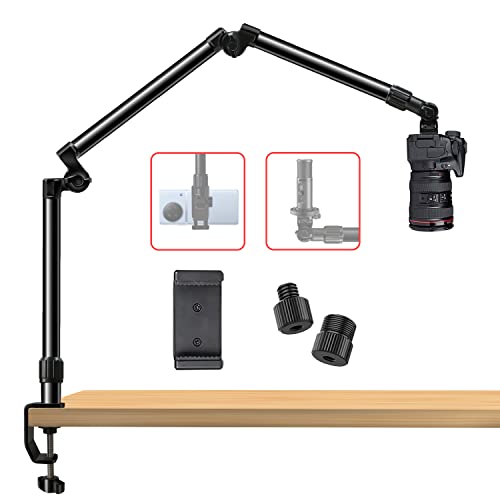
- Folds to 13.8 inches for storage
- 360-degree top and bottom rotation
- Supports cameras, phones, lights, and microphones
Best For: Flexible overhead filming in compact workspaces
Versatile Height – K&F Concept 90-Inch Overhead Tripod
For photographers comparing professional overhead camera rigs, the K&F CONCEPT 90-inch tripod combines substantial height with a horizontal center-column design. Its flexible legs, gimbal head, and detachable monopod support overhead, panoramic, and confined-space shooting.
Best For: Tall overhead compositions, DSLR or camcorder work, and photographers who want a portable tripod with multiple positioning options.
Pros:
- Reaches up to 90 inches while folding to about 21 inches and weighing roughly 4.4 pounds.
- Supports up to 22 pounds with a 28mm ball head and enlarged 28mm center column.
- Offers 180-degree leg adjustment, 360-degree panoramic rotation, and a detachable monopod.
Cons:
- Aluminum construction is not water resistant.
- The horizontal configuration and tall maximum height may require careful setup for stability.
This is a flexible choice when reach and portability matter equally. The included bag and 1-year manufacturer warranty add practicality for photographers moving between locations.
Studio Strength – Kupo 40-Inch C-Stand Overhead Kit
The Kupo Overhead Shooting Kit 4 is a professional overhead camera rig built around a 40-inch Master C-Stand, Turtle Base, steel baby boom, and grip hardware. It is designed for controlled studio and location workflows where secure overhead positioning is more important than lightweight transport.
Best For: Studio flat lays, video production, and crews that need a sturdy boom-based overhead setup with counterweight support.
Pros:
- Includes the C-Stand, Turtle Base, 2.5-inch grip head, steel baby boom, mounting plate, and safety shot bag.
- Supports overhead camera loads up to 22 pounds with balanced boom positioning.
- Turtle Base design enables quick leg deployment and secure locking.
Cons:
- At 38.7 pounds, it is substantially heavier than travel-oriented tripod rigs.
- The listed folded length is about 134cm, making transport less compact.
This kit favors dependable production handling over portability. Its included grip and safety components make it a strong fit for repeatable overhead work in studios or properly equipped locations.
High-Capacity Flexibility – SmallRig CT200 Overhead Tripod
The SmallRig CT200 is a strong contender among professional overhead camera rigs, pairing a horizontal center column with a 33-pound stated maximum load. It adds 180-degree tilt, 360-degree rotation, reversible-column shooting, and a counterweight bag for more adaptable camera positioning.
Best For: Photographers and creators needing a compact overhead tripod for cameras, smartphones, panoramic work, and low-angle or macro shooting.
Pros:
- Provides 180-degree tilt and 360-degree horizontal rotation for overhead and panoramic views.
- Supports up to 33 pounds overall, with the tripod head rated for 22 pounds.
- Includes a counterweight bag, carrying bag, smartphone holder, and accessory thread holes.
Cons:
- The maximum height is 72.8 inches, shorter than some taller overhead tripods.
- Its higher load capacity still requires proper balancing when the column is extended horizontally.
With three leg-angle settings, quick lever locks, concealed spikes, and monopod conversion, the CT200 is particularly versatile. It offers a useful blend of load capacity, accessory support, and transportability.
Desktop Efficiency – NEEWER NK002 Overhead Mount Rig
For tabletop creators, the NEEWER NK002 offers a space-saving alternative to full-size professional overhead camera rigs. Its dual desktop stands, adjustable crossbar, C-clamp mounting, and dual ball head support overhead views for streaming, product photography, unboxing, and online meetings.
Best For: Desk-based top-down shooting with cameras, phones, webcams, microphones, or compact LED lights.
Pros:
- Adjusts from 27.2 to 48 inches in height and 25.2 to 47.2 inches in width.
- Supports up to 26.5 pounds through the stand structure, while the dual ball-head mount is rated for 3.3 pounds.
- Includes a phone holder, mini ball head, super clamp, two desktop stands, and two 1/4-inch adapters.
Cons:
- The dual ball-head mounting point has a 3.3-pound maximum load.
- Optional telescopic crossarms and other listed accessories are sold separately.
This rig is best viewed as a dedicated desktop platform rather than a portable floor stand. Its quick three-step assembly and accessory mounting options make it practical for repeatable tabletop content creation.
Long-Reach Pick – Glide Gear OH 150
For creators who need professional overhead camera rigs with substantial reach, the Glide Gear OH 150 offers a modular 4- to 12-foot platform. It supports cameras, lights, and other accessories while mounting to a C-Stand, Junior Stand, or tripod.
Best For: Large overhead setups, product photography, and studio video work requiring adjustable reach.
Pros:
- Adjusts from 4 to 12 feet for flexible shooting distances.
- Supports up to 20 pounds at a 4-foot setup, with capacity varying by length.
- Includes a camera riser, ball head, stand adapters, spacers, and multiple mounting holes.
- Modular click-in design simplifies setup, takedown, and storage.
Cons:
- Payload decreases to 10 pounds at the full 12-foot extension.
- At 17.6 pounds and approximately 53 inches folded, it is less portable than compact desk mounts.
- Requires a compatible stand or tripod for mounting.
The OH 150 is a strong choice when reach and accessory flexibility matter more than minimal size. Its changing payload limits should be matched carefully to the selected extension length.
Tabletop Workhorse – NEEWER ST100
The NEEWER ST100 is a practical option for creators comparing professional overhead camera rigs for a desk or floor setup. Its steel frame, adjustable columns, and accessory-ready crossbar suit flat lays, cooking videos, tutorials, and similar top-down work.
Best For: Stable tabletop overhead filming, flat-lay photography, cooking demonstrations, crafts, and unboxing videos.
Pros:
- Steel construction supports up to 10 pounds.
- Height adjusts from 24 to 39 inches using spring-loaded positioning points.
- Crossbar provides 12 mounting points for accessories.
- Rubberized bases improve stability and help protect desk surfaces.
Cons:
- Requires a desk at least 39.4 inches wide for tabletop use.
- Super clamps, phone clamp, and backdrop are sold separately or not included.
- Its tabletop design offers less reach than a full-length modular rig.
Choose the ST100 when a stable, self-contained tabletop platform is the priority. The 10-pound limit and accessory options cover many creator workflows, though expansion hardware may add to the overall cost.
Compact Desk Mount – ULANZI Flexible Arm Stand
For lightweight professional overhead camera rigs, the ULANZI desk stand combines a padded clamp with a flexible aluminum arm. Its adjustable reach and ball head make it suitable for top-down recording without the footprint of a freestanding platform.
Best For: Desk-based streaming, baking, crafts, online lessons, document displays, and lightweight camera or light setups.
Pros:
- 29.53-inch arm offers three stages of adjustment.
- Center shaft reaches up to 27.56 inches and supports varied shooting angles.
- 360-degree ball head and 1/4-inch screw support flexible positioning and expansion.
- Padded clamp fits desks up to 1.96 inches thick.
Cons:
- Maximum load is 2 kilograms, or 4.41 pounds.
- Phone clamp, webcam, lights, and camera are not included.
- Its single-arm design is intended for lighter setups than larger overhead platforms.
The ULANZI is the most space-conscious choice of the three, especially for creators working at a desk. Keep the total equipment weight within its 2-kilogram capacity for a dependable overhead angle.
Flexible Heavy-Duty Pick – EMART Adjustable Overhead Camera Rig
For creators comparing professional overhead camera rigs, the EMART mount stands out for its large adjustable frame, high load rating, and edge-of-desk installation. Its telescoping height and width make it practical for top-down photography, cooking demonstrations, unboxings, and multi-device studio setups.
Best For: DSLR users and creators who need a spacious, adjustable overhead setup with room for lights or other accessories.
Pros:
- Adjusts from 27.2 to 48 inches high and 25.2 to 47.2 inches wide.
- Supports up to 26.5 pounds with an aluminum alloy structure.
- Includes a phone holder, dual 1/4-inch screws, and a 5/8-inch stud.
- C-clamp fits desks up to 3.5 inches thick and uses rubber pads for protection.
Cons:
- Additional magic arms and tablet holders are sold separately.
- The broad frame may be more setup than needed for compact desks.
Choose this EMART rig if stability, generous adjustment range, and expansion space matter more than having the smallest possible footprint. It is particularly well suited to fixed desktop studios.
Expandable Studio Choice – JUSMO LS15 Pro Overhead Mount
The JUSMO LS15 is one of the more expandable professional overhead camera rigs in this group. Its segmented aluminum pole system supports flexible height and length adjustments, while the included super clamp makes it easier to add lights, microphones, or another device to a desktop production setup.
Best For: Multi-device creators making recipe videos, demonstrations, streaming content, crafts, or overhead studio footage.
Pros:
- Aluminum alloy construction supports up to 22.05 pounds.
- Segmented poles allow DIY adjustment of length and height.
- Includes a super clamp for expanding the rig with cameras, lights, or microphones.
- Enlarged 3.54-inch C-clamps suit most desktops while conserving workspace.
Cons:
- The listed warranty is 3 months.
- Extra poles and some expansion clamps must be purchased separately.
- The segmented design may require more assembly than a simple single-arm mount.
The LS15 makes the most sense when you expect your setup to grow. Its included poles, fixed bases, and super clamp provide a solid starting point for a modular tabletop studio.
Compact Articulating Option – DNSbabi 3-Section Overhead Arm
Among professional overhead camera rigs, this DNSbabi stand is the compact articulating option. Its three-section metal arm folds for storage, rotates 360 degrees at both ends, and supports several common mounting screw sizes for cameras, phones, lights, microphones, and projectors.
Best For: Creators who want flexible angle control and a foldable desk-mounted arm for filming, streaming, lessons, baking, or vlogging.
Pros:
- Three-section arm extends to 35.4 inches and folds to 13.8 inches.
- Top and bottom rotate 360 degrees for flexible positioning.
- Supports up to 22.1 pounds, with a stated 16-pound horizontal load capacity.
- Includes 1/4-, 3/8-, and 5/8-inch screws plus a spring-loaded phone holder.
Cons:
- The 2.4-inch clamp extension may not fit thicker desks.
- Its shorter reach is less suitable for wide overhead scenes than a large-frame rig.
This stand is a practical fit for smaller workspaces where quick angle changes and storage matter. Its articulating arm offers useful flexibility without requiring a large overhead frame.
How We Picked These Professional Overhead Camera Rigs
We focused on the factors that matter most during real top-down shoots: load capacity, horizontal reach, height adjustment, mounting compatibility, base stability, vibration control, portability, and ease of repositioning. The selection includes desk-mounted arms for compact workspaces, tripod-style systems for larger cameras, and professional C-stand or modular platforms for demanding photo and video production.
We also considered how easily each design accommodates accessories such as lights, microphones, monitors, phones, and secondary cameras. A rig should not only hold a camera; it should support a repeatable shooting position without obstructing the working surface.
Quick Comparison
| Rig type | Best for | Main advantage | Watch for |
|---|---|---|---|
| Desk mount | Small studios and tutorials | Compact setup and quick access | Desk thickness, clamp strength, and arm flex |
| Horizontal tripod | Flat lays and product photography | Dedicated overhead reach | Footprint and transport size |
| C-stand or boom kit | Professional studio work | Strong support and accessory options | Weight, setup time, and counterbalancing |
| Modular platform | Large scenes and mixed equipment | Long reach and high payload potential | Requires careful leveling and securing |
Key Buying Factors for Professional Overhead Camera Rigs
Camera and Accessory Weight
Check the advertised capacity against the combined weight of your camera, lens, cage, monitor, microphone, and any adapter. Leave a safety margin rather than operating at the stated limit, especially when the camera is extended horizontally.
Reach, Height, and Working Area
Measure the surface you need to cover and compare it with the rig’s usable horizontal span. A longer arm is not automatically better: greater reach increases leverage and may require a heavier base, counterweight, or additional support.
Stability and Vibration Control
Look for wide bases, locking joints, strong clamps, and solid hardware. For video, avoid touching the arm during recording and use remote controls where possible. Desk mounts should attach to a substantial, stable surface rather than a lightweight folding table.
Mounting and Adjustment Options
Standard 1/4-inch and 3/8-inch threads improve compatibility with cameras and accessories. Ball heads make framing faster, while fixed or geared adjustments can provide better repeatability. Confirm that the included head or clamp supports your camera’s orientation.
Portability and Setup
Choose a desk stand for frequent short sessions, a folding tripod for mobile flat-lay work, or a C-stand and modular system when maximum stability matters more than convenience.
Who Should Buy Which Professional Overhead Camera Rigs?
- For compact desks: Choose a desk-mounted arm such as the ULANZI, JUSMO, EMART, or bearing-equipped articulating stand.
- For tutorials and phone content: Look for flexible adjustment, a phone holder, and fast repositioning, making the NEEWER clamp systems practical choices.
- For flat lays with a dedicated camera: A horizontal tripod such as the K&F CONCEPT or SmallRig offers a cleaner overhead workspace.
- For studio photography and video: The Kupo C-Stand kit provides a more production-oriented support system with a boom and turtle base.
- For large scenes or heavier builds: Consider the Glide Gear modular rig or another high-capacity platform, provided you can secure and level the support properly.
Before buying, confirm thread sizes, maximum payload, clamp or base dimensions, and the total reach required by your camera position. Those details determine whether a rig feels secure and repeatable or becomes a source of unwanted movement.
