
The best professional network switches give businesses a dependable way to connect computers, access points, cameras, phones, and servers while adding the speed and management features modern networks require.
This roundup compares 10 options across managed, unmanaged, PoE, Gigabit, and 10GbE categories, so you can match port capacity and control features to your network today and its likely growth.
Best 10 Professional Network Switches Picks for 2026
Best Overall
Ubiquiti UniFi Pro 48-Port PoE+ Switch

- 48 Gigabit PoE+ ports for access points, cameras, and phones
- Four 10G SFP+ uplinks with 176 Gbps switching capacity
- Layer 2/3 management with UniFi centralized control
Best For: Larger managed networks needing broad PoE coverage and 10G uplinks
Best 10G Fiber-Focused Option
MikroTik CRS317 16-Port Managed Switch

- 16-port managed Layer 3 switch
- 10 Gbps connectivity for servers and storage
- 1U metal rack-mount chassis with console port
Best For: Rack-based server, storage, and SFP+ backbone networks
Best Plug-and-Play 10G
TP-Link TL-SX1008 8-Port Multi-Gig Switch

- Eight RJ-45 ports with speeds up to 10G
- Auto-negotiates 100M, 1G, 2.5G, 5G, and 10G
- Unmanaged plug-and-play setup
Best For: Simple high-speed copper links for NAS, servers, PCs, and Wi-Fi gear
Best Compact PoE Value
Ubiquiti UniFi USW-24-POE Switch

- 24 Gigabit ports for mixed network devices
- PoE+ support for cameras, phones, and access points
- Layer 2 switch with SFP and RJ-45 interfaces
Best For: Smaller UniFi networks needing PoE-powered endpoints
High-Capacity PoE Core

- 48 Gigabit ports for dense deployments
- 740W PoE+ power budget
- Four 10G SFP+ uplink slots
Best For: Large PoE installations with demanding capacity and uplink requirements
Compact 10G Specialist

- Four 10 Gigabit Ethernet ports
- Compact metal design with silent operation
- Multiple powering and mounting options
Best For: Small high-speed desktop or workstation networks
Easy-Managed PoE Value

- 24 PoE+ ports with a 250W budget
- Two SFP slots for uplinks
- VLAN, QoS, IGMP, and PoE auto recovery
Best For: Small and midsize managed PoE deployments
Reliable Wired Expansion
NETGEAR GS324 24-Port Gigabit Switch

- 24 auto-negotiating 1Gbps RJ45 ports
- Plug-and-play, fanless operation
- Desktop, wall, or rack mounting
Best For: Large wired networks that do not need managed controls
Compact 10GbE Flexibility

- Four SFP+ ports support up to 10 Gbit each
- RouterOS or SwOS dual-boot flexibility
- Fanless metal design with redundant DC inputs
Best For: Advanced users and labs needing compact SFP+ connectivity
Managed PoE Connectivity
NETGEAR GS316EP 16-Port PoE Switch
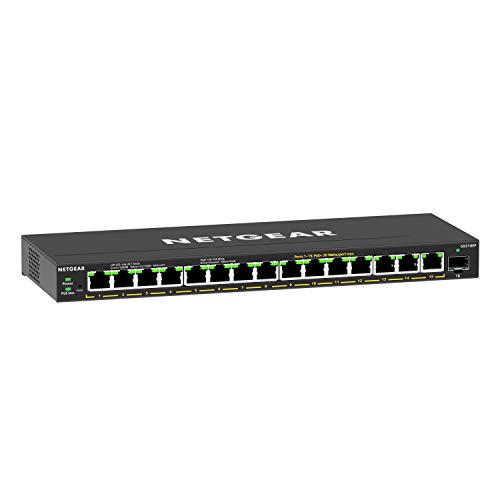
- 15 PoE+ ports with a 180W power budget
- Easy Smart VLAN, QoS, and monitoring tools
- 1G SFP port plus desktop or wall mounting
Best For: Small businesses powering and managing compatible network devices
Best Overall – Ubiquiti UniFi Pro 48-Port PoE+ Switch
For professional network switches serving a larger office or managed infrastructure, the Ubiquiti UniFi Pro USW-PRO-48-POE combines 48 Gigabit Ethernet ports with PoE+ support and four 10G SFP+ uplinks. Its Layer 2/3 management features and UniFi Network integration make it a strong choice for centrally managed deployments.
Best For: Growing businesses that need extensive PoE capacity, VLAN support, and high-speed backbone connectivity.
Pros:
- 48 Gigabit RJ-45 ports with IEEE 802.3af/at PoE and PoE+ support
- Four SFP+ 10G uplinks and 176 Gbps switching capacity
- Managed Layer 2/3 features including VLANs, 802.1x, RADIUS, and port mirroring
- Integrates with the UniFi Network application for centralized management
Cons:
- May provide more ports and management capability than smaller networks require
- Rack-mountable 1U design is less suited to simple desktop installations
This is the most capable all-around option in the group for organizations already using UniFi or needing a substantial PoE-enabled rack switch with 10G uplinks.
Best 10G Fiber-Focused Option – MikroTik CRS317 16-Port Managed Switch
The MikroTik CRS317-1G-16S+RM is a rack-mount managed Layer 3 switch built around 16 ports and 10 Gbps connectivity. With a metal 1U chassis and an RJ-45 console port, it suits server, storage, and backbone environments where SFP+ connections are central to the design.
Best For: Server rooms and storage networks that need a managed 16-port 10G switch in a rack-mount form factor.
Pros:
- 16-port managed Layer 3 design
- 10 Gbps data transfer rate for high-speed network links
- 1U rack-mount format with a durable metal case
- RJ-45 console port and IEEE 802.1Q support
Cons:
- Does not provide standard RJ-45 Ethernet switch ports for general endpoint connections
- No PoE support is listed
- Requires compatible SFP+ infrastructure and transceivers
The CRS317 is a specialized professional network switch rather than an all-purpose access switch, making it most appropriate when high-speed SFP+ connectivity is the priority.
Best Plug-and-Play 10G – TP-Link TL-SX1008 8-Port Multi-Gig Switch
The TP-Link TL-SX1008 offers eight RJ-45 10G/multi-gig ports for upgrading high-throughput devices without complicated setup. Its ports auto-negotiate between 100 Mbps, 1G, 2.5G, 5G, and 10G, making this unmanaged switch a practical fit for mixed-speed offices, NAS systems, Wi-Fi access points, and workstations.
Best For: Users who want simple 10G and multi-gig connectivity for computers, servers, NAS devices, or Wi-Fi equipment.
Pros:
- Eight 10G/multi-gig RJ-45 ports
- Supports automatic negotiation across five link speeds
- Plug-and-play operation requires no software installation or configuration
- Metal desktop/rack-mount design with flow control and an adjustable-speed fan
Cons:
- Unmanaged, so it lacks VLAN and other advanced network controls
- Does not include PoE support
- Provides fewer ports than larger rack switches
This is a straightforward choice for adding fast copper connectivity, especially where ease of deployment matters more than centralized management or segmentation features.
Best Compact PoE Value – Ubiquiti UniFi USW-24-POE Switch
The Ubiquiti UniFi USW-24-POE is a 24-port Gigabit Layer 2 switch designed for networks connecting a mix of computers, servers, cameras, VoIP phones, access points, and storage devices. Its PoE+ and SFP interfaces provide useful deployment flexibility for a smaller managed network.
Best For: Small offices and UniFi installations needing 24 Gigabit ports with PoE support for network devices.
Pros:
- 24 Gigabit Ethernet ports
- PoE+ support for compatible access points, cameras, and VoIP phones
- Includes PoE+, SFP, and RJ-45 interfaces
- Metal chassis with a rack-friendly 1.7-inch height
Cons:
- Limited to Gigabit data transfer rates
- Layer 2 rather than Layer 3 functionality
- Supplied notes do not specify the number of SFP ports or PoE budget
The USW-24-POE is a sensible middle-ground option for a compact professional network switch, particularly when PoE-powered endpoints are more important than 10G uplinks.
High-Capacity PoE Core – Linksys LGS352MPC
For installations that need substantial device capacity and centralized power, the Linksys LGS352MPC is a professional network switch with 48 Gigabit ports, a 740W PoE+ budget, and four 10G SFP+ uplinks. Managed features such as VLANs, QoS, static routing, IGMP, and MAC-based port security make it suitable for more controlled deployments.
Best For: Larger offices, surveillance systems, access points, and door access control installations that need many PoE connections and fast uplinks.
Pros:
- 48 Gigabit ports support a high number of connected devices.
- 740W PoE+ budget provides substantial power capacity for compatible endpoints.
- Four 10G SFP+ uplink slots support dedicated high-speed connections.
- Includes QoS, VLAN, static routing, IGMP, and MAC-based port security features.
Cons:
- Its 48-port design may be more switch than a smaller installation requires.
- Managed networking features may require more configuration than a plug-and-play switch.
The LGS352MPC is a strong choice when port count, PoE capacity, and uplink speed matter more than compact size. Its metal housing and 5 1/2-year warranty also suit long-term business deployments.
Compact 10G Specialist – MikroTik CRS304-4XG-IN
The MikroTik CRS304-4XG-IN is a compact professional network switch focused on 10 Gigabit connectivity. Its four ports, metal enclosure, silent operation, multiple powering options, and versatile mounting make it a practical fit where fast wired links are needed without a larger rack-oriented chassis.
Best For: Small desktop networks, workstations, gaming setups, and other installations requiring four 10 Gigabit connections.
Pros:
- Four 10 Gigabit Ethernet ports provide high-speed wired connectivity.
- Compact 0.7 kg metal design is easy to position.
- Silent operation suits desktop or noise-sensitive environments.
- Offers versatile mounting and multiple powering options.
Cons:
- Four ports limit expansion compared with larger professional switches.
- It does not provide the large PoE capacity or port density of the other options here.
- The supplied warranty is one year.
The CRS304-4XG-IN is best viewed as a focused 10G switch rather than an all-purpose access switch. Choose it when compact dimensions and four fast connections are the priority.
Easy-Managed PoE Value – TP-Link TL-SG1428PE
The TP-Link TL-SG1428PE combines 24 Gigabit PoE+ ports with two additional Gigabit non-PoE ports and two SFP slots. As a professional network switch for straightforward deployments, it adds web-based management, VLAN support, QoS, IGMP, and configurable PoE auto recovery without the complexity of a fully advanced enterprise platform.
Best For: Small and midsize offices, cameras, access points, and other PoE installations that need manageable expansion and 250W of total power.
Pros:
- 24 PoE+ ports support up to 30W per port, with a 250W total budget.
- Two SFP slots provide options for high-speed connections.
- Web-based management and a smart configuration utility simplify setup.
- PoE auto recovery can detect and reboot dropped or unresponsive powered devices after configuration.
Cons:
- The 1Gbps data rate is less suited to installations centered on 10G uplinks.
- The 250W power budget is lower than the Linksys model’s capacity.
- PoE auto recovery requires configuration.
The TL-SG1428PE is a balanced option for buyers who want PoE density and useful management features without moving to a more specialized high-capacity switch. Its rackmount-ready design and VLAN tools add flexibility for growing networks.
Reliable Wired Expansion – NETGEAR GS324 24-Port Gigabit Switch
The NETGEAR GS324 is a straightforward choice for expanding a wired network with 24 Gigabit Ethernet ports. As a professional network switch, it focuses on dependable plug-and-play connectivity rather than advanced configuration, making it practical for offices, workspaces, and equipment areas with many Ethernet devices.
Best For: Offices, home labs, and installations needing many wired Gigabit connections without managed-switch configuration.
Pros:
- Provides 24 auto-negotiating 1Gbps RJ45 ports.
- Plug-and-play setup requires no software or configuration.
- Fanless, energy-efficient design supports quiet operation.
- Can be placed on a desktop, wall-mounted, or rack-mounted.
Cons:
- Unmanaged design does not provide VLAN, QoS, or traffic-management controls.
- Supplied regional compatibility is limited to the U.S. and Canada.
The GS324 is a solid capacity-focused option when you need more Gigabit ports and simple installation. Choose another model if your network requires managed features or higher-speed uplinks.
Compact 10GbE Flexibility – MikroTik CRS305-1G-4S+ Switch
The MikroTik CRS305-1G-4S+ is a compact professional network switch built around four SFP+ ports supporting connections up to 10 Gbit per port. Its dual-boot RouterOS and SwOS options make it suited to users who want either simplified switching or access to routing and Layer 3 capabilities.
Best For: Small labs, network uplinks, and advanced users working with SFP+ connections and configurable MikroTik software.
Pros:
- Offers four SFP+ ports for high-speed connections up to 10 Gbit per port.
- Includes a 1Gbps copper Ethernet port for management access.
- Dual-boot support allows a choice between RouterOS and SwOS.
- Fanless metal housing is compact and silent, with two DC jacks for power redundancy.
Cons:
- Only five total ports are provided.
- SFP+ connectivity may require compatible transceivers or cables.
- Its advanced software options may be more involved than a basic plug-and-play switch.
The CRS305 stands out when compact size and 10GbE-ready SFP+ connectivity matter more than a large number of copper ports. Its dual operating systems add useful flexibility for experienced network users.
Managed PoE Connectivity – NETGEAR GS316EP 16-Port PoE Switch
The NETGEAR GS316EP combines Gigabit switching, PoE+ power delivery, and easy smart management in one compact unit. For professional network switch installations supporting powered devices, its 15 PoE+ ports, 180W power budget, and 1G SFP port provide a practical blend of connectivity and control.
Best For: Small businesses and workspaces powering compatible network devices while using VLANs, QoS, port monitoring, or basic security controls.
Pros:
- Provides 15 PoE+ Gigabit ports with a 180W total power budget.
- Includes uninterrupted PoE and per-port PoE controls.
- Easy Smart interface supports VLANs, QoS, port monitoring, and network-security management.
- Offers a 1G SFP port for fiber connectivity or network expansion.
Cons:
- Only 15 of the 16 ports provide PoE+.
- The 180W budget limits the total power available across connected devices.
- Management features are positioned as Easy Smart rather than a fully advanced enterprise platform.
The GS316EP is a strong middle ground for installations that need both powered endpoints and practical management tools. It is more capable than an unmanaged switch but remains focused on accessible small-business networking.
How We Picked the Best Professional Network Switches
We selected these switches based on the features that matter most in business and advanced home networks: port count, Ethernet speed, PoE support, management capability, uplink capacity, installation flexibility, and overall suitability for different workloads. The list includes fully managed Layer 2/3 models, easy-smart switches, unmanaged options, and compact 10GbE equipment.
We also considered whether each switch fits a practical use case. A high-power PoE switch may be ideal for cameras and wireless access points, while a compact SFP+ model can serve as a fast server or workstation aggregation switch.
Quick Comparison
| Best For | Recommended Type | What to Look For |
|---|---|---|
| Large office or campus | Managed PoE switch | 48 ports, VLANs, QoS, routing, and 10GbE uplinks |
| Access points, cameras, and VoIP | PoE+ managed switch | Enough power budget and per-port controls |
| 10GbE servers or workstations | Multi-Gig or SFP+ switch | Native 10GbE ports and suitable cabling |
| Simple wired expansion | Unmanaged Gigabit switch | Correct port count, quiet operation, and easy placement |
Key Buying Factors for Professional Network Switches
Port Count and Speed
Count current devices, then leave room for expansion. Gigabit ports remain suitable for general desktops, printers, phones, and access points, while 10GbE or Multi-Gig ports help connect servers, storage, editing systems, and high-performance workstations without creating a bottleneck.
PoE Power Budget
PoE switches can power compatible cameras, access points, and phones through Ethernet cabling. Check both the standard supported—such as PoE or PoE+—and the total wattage budget. Add the expected draw of every powered device and retain a safety margin for upgrades.
Management and Security
Unmanaged switches are simple plug-and-play choices, but managed models provide VLANs, QoS, monitoring, port controls, link aggregation, and sometimes static routing. These features are valuable when separating guest Wi-Fi, voice, surveillance, staff, and server traffic.
Uplinks, Installation, and Noise
Look for SFP+ or other 10GbE uplinks when connecting switches or servers over longer distances. Rack-mount hardware suits wiring closets, whereas compact desktop models work better near users. Fan noise, power consumption, mounting depth, and included accessories can also affect placement.
Who Should Buy Which Professional Network Switches?
Choose a managed 48-port PoE model for a growing office, school, retail site, or surveillance-heavy installation that needs centralized control and ample power. An easy-smart PoE switch is a practical middle ground for smaller businesses that need VLANs and monitoring without full enterprise complexity.
Choose a 10GbE MikroTik or TP-Link model for server, NAS, workstation, or backbone connections. For a straightforward desktop network with no need for configuration, a NETGEAR unmanaged switch is the simplest option. Buyers building around a UniFi environment may prefer a UniFi switch for centralized ecosystem management, while MikroTik models suit users comfortable with detailed network configuration.
