
When it comes to finding the right multimeter for your electrical projects, you need tools that deliver accuracy and reliability. The market offers a range of professional-grade options that stand out for their advanced features and durable designs. From true RMS capability to auto-ranging functions, these multimeters are built to meet the demanding needs of electrical engineers. Let’s explore some of the top choices that might just become your next go-to instruments.
Fluke 17B+ Digital Multimeter for Electrical Applications

The Fluke 17B+ Digital Multimeter stands out as an essential tool for electrical engineers due to its impressive measurement capabilities, including AC/DC voltage up to 1000V and current up to 10A. You’ll appreciate its versatility with functions for resistance, continuity, and capacitance, making it perfect for various electrical tasks. The CAT III 600V safety rating guarantees you can work confidently in residential, commercial, and industrial settings. Plus, the diode test feature allows you to quickly identify faulty diodes, streamlining diagnostics. With temperature measurement up to 400°C, using a type K thermocouple, this multimeter truly meets all your electrical application needs.
Best For: Electrical engineers and technicians who require a reliable and versatile multimeter for various electrical applications.
Pros:
- Highly accurate measurements for AC/DC voltage and current up to 1000V and 10A.
- Multiple functions including resistance, continuity, capacitance, and diode testing for comprehensive diagnostics.
- CAT III 600V safety rating ensures safe use in a variety of electrical environments.
Cons:
- Limited temperature range up to 400°C may not be suitable for all applications.
- No advanced features like data logging or Bluetooth connectivity for remote monitoring.
- Thermocouple included may require additional purchases for other types of temperature probes.
Fluke 15B+ Digital Multimeter for Electrical Applications

For electrical engineers seeking a reliable tool, the Fluke 15B+ Digital Multimeter stands out with its impressive ability to measure AC/DC voltage up to 1000V and current up to 10A. With a CAT III 600V safety rating, you can confidently work on both residential and commercial electrical systems. This multimeter also measures resistance, continuity, diode, and capacitance, making it versatile for various applications such as automotive systems and electrical panels. Its quick diagnostic features allow you to identify issues like overloading, short circuits, and faulty wiring efficiently. Trust the Fluke 15B+ for precision and safety in your electrical tasks.
Best For: Electrical engineers and technicians who need a reliable and versatile multimeter for diagnosing electrical issues in residential and commercial settings.
Pros:
- High voltage and current measurement capabilities (up to 1000V and 10A) for a wide range of applications.
- CAT III 600V safety rating ensures safety during use in various electrical environments.
- Multiple measurement functions (voltage, resistance, continuity, diode, and capacitance) provide versatility for quick diagnostics.
Cons:
- Limited current measurement capacity (max 10A) may not be suitable for high-power applications.
- No advanced features such as data logging or wireless connectivity compared to higher-end models.
- Basic display may lack advanced graphical features found in more premium multimeters.
Klein Tools Electrical Test Kit with Digital Multimeter
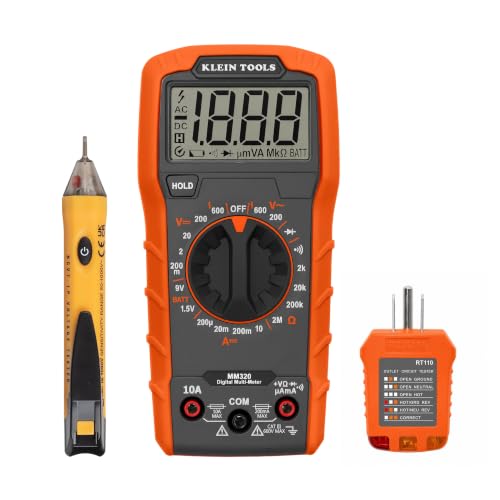
Designed with versatility in mind, the Klein Tools Electrical Test Kit with Digital Multimeter is an ideal choice for electrical engineers who need reliable testing solutions. This kit measures up to 600V AC/DC voltage, 10A DC current, and resistance up to 2MOhms. You’ll appreciate the continuity testing feature with visual and audible indicators. The non-contact voltage tester detects voltages from 50 to 1000 VAC, while the receptacle tester helps you identify wiring configurations and faults. With included leads and batteries, this all-encompassing kit guarantees you’re well-equipped for troubleshooting any electrical issue efficiently.
Best For: Electrical engineers and technicians seeking a comprehensive and reliable kit for electrical testing and troubleshooting.
Pros:
- Versatile measurements for voltage, current, and resistance make it suitable for a wide range of applications.
- The non-contact voltage tester enhances safety by allowing users to detect voltage without direct contact.
- Includes essential components like leads and batteries, ensuring immediate usability right out of the box.
Cons:
- May be more complex for beginners who are unfamiliar with electrical testing tools.
- The multimeter’s maximum current measurement of 10A may not suffice for high-power applications.
- Requires regular battery replacements, which can be inconvenient during extensive testing sessions.
Klein Tools Circuit Breaker Finder Kit (4-Piece)

Klein Tools’ 4-Piece Circuit Breaker Finder Kit stands out as an essential toolset for both seasoned electrical engineers and dedicated DIY enthusiasts. This kit includes a Digital Multimeter, Non-Contact Voltage Tester, GFCI Receptacle Tester, and leads, making it a complete solution for your testing needs. You can measure voltage up to 600V, test continuity, and easily find circuit breakers with the GFCI Tester. The Non-Contact Voltage Tester even features a handy flashlight. With this kit, you’ll enjoy accurate diagnostics and enhanced safety, ensuring your electrical projects run smoothly and efficiently. It’s a must-have for anyone serious about electrical work.
Best For: This product is best for electrical professionals and DIY enthusiasts who require accurate testing tools for electrical diagnostics and safety.
Pros:
- Comprehensive Kit: Includes multiple essential tools for a variety of electrical testing applications.
- User-Friendly: The digital multimeter and testers are easy to use, making it suitable for both professionals and novices.
- Convenient Features: The Non-Contact Voltage Tester comes with a flashlight, enhancing usability in low-light conditions.
Cons:
- Limited Current Measurement: The digital multimeter only measures up to 10A DC, which may not suffice for some high-current applications.
- Learning Curve: New users may require some time to familiarize themselves with the functionalities of each tool.
- Price Point: As a complete kit, it may be more expensive compared to purchasing individual tools separately.
AstroAI Digital Multimeter and Analyzer TRMS 6000 Counts Volt Meter

The AstroAI Digital Multimeter and Analyzer TRMS 6000 Counts Volt Meter stands out for its True RMS capability, making it an excellent choice for electrical engineers who need accurate readings for both AC and DC measurements. With its auto-ranging feature, you won’t have to worry about setting the range manually. The large backlit LCD screen guarantees visibility even in dim environments, while the data hold function lets you capture readings easily. Safety’s a priority, too, with double ceramic fuses preventing overloads. Whether you’re troubleshooting automotive or household electrical issues, this multimeter is a reliable tool you can trust.
Best For: Electrical engineers and DIY enthusiasts who require accurate and reliable measurements for both AC and DC electrical tasks.
Pros:
- True RMS capability ensures accurate readings for non-sinusoidal waveforms.
- Auto-ranging feature simplifies the measurement process by automatically selecting the appropriate range.
- Large backlit LCD screen provides clear visibility of readings in low-light conditions.
Cons:
- The device may feel bulky for users looking for a more compact multimeter.
- Limited advanced features for professional use compared to higher-end models.
- Requires manual consultation for advanced functions, which may be cumbersome for some users.
Klein Tools CL120VP Electrical Voltage Test Kit

For professionals in the electrical engineering field, the Klein Tools CL120VP Electrical Voltage Test Kit stands out as an essential toolset. This kit includes a clamp meter, three testers, test leads, a pouch, and batteries, ensuring you have everything you need. The clamp meter measures AC current and features auto-ranging technology for precise readings. You’ll appreciate the GFCI receptacle tester that identifies wiring issues, and the non-contact voltage detector with dual-range capabilities adds versatility. Plus, the built-in flashlight illuminates your work area, ensuring you can test AC and DC voltages accurately and efficiently anytime.
Best For: Professionals in the electrical engineering field who require accurate and versatile testing tools for electrical systems.
Pros:
- Comprehensive Kit: Includes a clamp meter, multiple testers, and essential accessories for a wide range of applications.
- Accurate Measurements: Auto-ranging technology ensures precise readings for AC current, voltage, resistance, and continuity.
- Convenient Features: Built-in flashlight and optional magnetic hanger enhance usability in various work environments.
Cons:
- Learning Curve: New users may need time to familiarize themselves with all the features and functions of the kit.
- Size and Portability: The kit may be bulkier compared to individual tools, which could affect portability for some users.
- Battery Dependency: Requires batteries for operation, which may need to be replaced periodically, adding to maintenance.
Digital Multimeter Premium Electrical Test Kit

Engineers seeking a reliable and extensive electrical testing solution will find the Digital Multimeter Premium Electrical Test Kit to be an ideal choice. This kit features a CATIII 600V rated digital multimeter that measures up to 600V AC/DC, 10A DC current, and 2MOhms resistance. You can test batteries, diodes, and continuity effortlessly. The included Non-Contact Voltage Tester detects voltages from 12 to 1000 VAC, complete with an integrated flashlight for enhanced visibility. Additionally, the GFCI Receptacle Tester provides a large backlit LCD readout, indicating wiring conditions. With all necessary batteries included, this kit is ready for immediate use.
Best For: Engineers and technicians seeking a comprehensive and reliable electrical testing solution for a variety of applications.
Pros:
- Versatile Measurements: Capable of measuring voltage, current, resistance, and testing batteries and diodes.
- Safety Features: CATIII 600V safety rating ensures safe operation in various electrical environments.
- User-Friendly Tools: Includes a Non-Contact Voltage Tester with flashlight and a GFCI Receptacle Tester with a clear LCD display for easy reading.
Cons:
- Manual Ranging: The manual-ranging feature may be less convenient for users who prefer automatic ranging multimeters.
- Limited Current Measurement: Maximum current measurement is limited to 10A, which may not be sufficient for some high-power applications.
- Size and Portability: The kit may be bulkier than standalone testers, making it less portable for on-the-go use.
AstroAI Digital Multimeter Tester (2000 Counts)
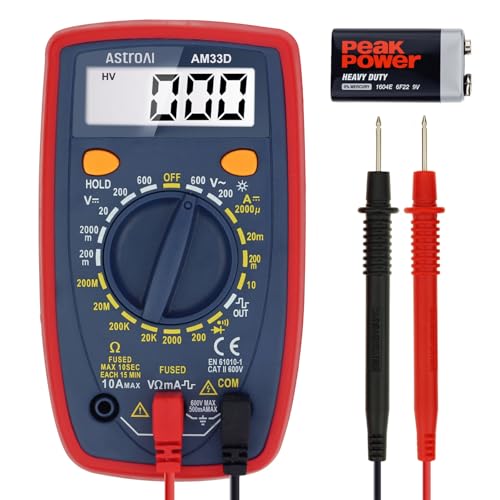
Measuring up to 2000 counts, the AstroAI Digital Multimeter Tester stands out as an essential tool for electrical engineers and DIY enthusiasts alike. It measures AC/DC Voltage, DC Current, Resistance, Continuity, and Diodes, making it perfect for various applications like household outlets and automotive troubleshooting. With a sampling speed of two times per second and a backlit LCD display, you’ll easily read both positive and negative values. Safety features like a double fuse and silicone cover enhance protection, while convenient functions like Data Hold and Auto Shutoff improve usability. Plus, professional support is available within 24 hours when needed.
Best For: The AstroAI Digital Multimeter Tester is best for electrical engineers and DIY enthusiasts looking for a reliable tool for measuring voltage, current, and resistance in various applications.
Pros:
- Versatile Measurements: Measures AC/DC Voltage, DC Current, Resistance, Continuity, and Diodes, suitable for multiple applications.
- User-Friendly Features: Includes a backlit LCD display, Data Hold, and Auto Shutoff for enhanced usability and convenience.
- Safety Protection: Equipped with a double fuse and silicone cover to protect against overloads and reduce the risk of electric shock.
Cons:
- Limited AC Current Testing: Cannot test all AC current and is restricted to below 100mV AC voltage.
- Sampling Speed: The sampling speed of two times per second may be slower compared to higher-end models.
- Requires Correct Usage: Incorrect operations can lead to inaccurate results, necessitating careful handling and reference to the user manual.
Fluke 117 Digital Multimeter

The Fluke 117 Digital Multimeter stands out for its non-contact AC voltage detection feature, making it an essential tool for professionals who need safety and efficiency in their electrical work. You’ll appreciate its ability to measure resistance, continuity, frequency, and capacitance with ease. The automatic AC/DC voltage selection saves you time, while True RMS guarantees accurate measurements on non-linear loads. With VoltAlert technology, you can detect voltage without contact, and its low input impedance helps prevent false readings. The large white LED backlight enhances visibility in dim environments, and you’ll enjoy an impressive battery life of 400 hours.
Best For: The Fluke 117 Digital Multimeter is best for electricians and technicians who require a reliable and efficient tool for electrical measurements and safety checks.
Pros:
- Accurate True RMS measurements for non-linear loads.
- Non-contact AC voltage detection enhances safety during electrical work.
- Long battery life of 400 hours ensures extended usage without frequent replacements.
Cons:
- May be more expensive than basic multimeters.
- Some users may find the automatic voltage selection feature confusing.
- The large size may not be ideal for those needing a compact device.
Klein Tools CL120 Digital Clamp Meter
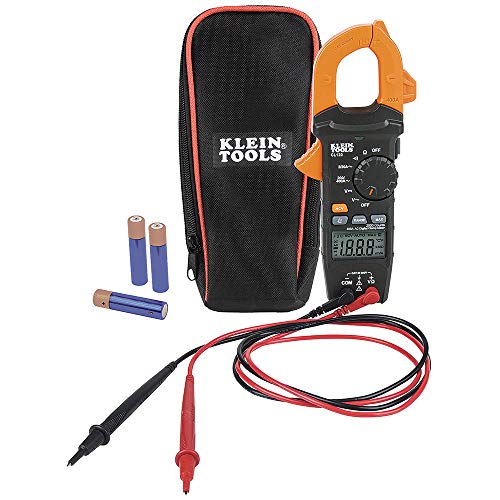
For those in the electrical field, the Klein Tools CL120 Digital Clamp Meter stands out with its impressive ability to measure AC current up to 400 Amps directly from the clamp. With auto-ranging technology, you’ll enjoy accurate measurements every time. The integrated non-contact voltage testing adds convenience, while the backlit LCD display guarantees you can read measurements in low-light conditions. Plus, the test lead holder and optional magnetic hanger enhance usability. The meter also features Max and Data Hold capabilities, auto-power off after 10 minutes, and comes complete with a carrying case, test leads, and batteries for immediate use.
Best For: Electricians and professionals in the electrical field seeking a reliable and accurate clamp meter for measuring AC current, voltage, and resistance.
Pros:
- Auto-ranging technology ensures accurate measurements without manual adjustments.
- Backlit LCD display allows for easy reading in low-light conditions.
- Compact design with test lead holder and optional magnetic hanger enhances usability and convenience.
Cons:
- Limited to measuring AC current up to 400 Amps, which may not be sufficient for all applications.
- The auto-power off feature may be inconvenient for users who frequently use the meter for extended periods.
- Requires 3 x AAA batteries, which may need to be replaced regularly.
Factors to Consider When Choosing Professional Multimeters for Electrical Engineers
When you’re selecting a professional multimeter, several key factors come into play. You’ll want to evaluate measurement range capabilities, safety ratings, and any additional testing functions that might enhance your work. Don’t forget about user interface design, portability, and durability, as these can greatly impact your day-to-day tasks.
Measurement Range Capabilities
Selecting the right professional multimeter involves understanding its measurement range capabilities, as this can greatly impact your work as an electrical engineer. You’ll want a multimeter that measures AC/DC voltage up to 1000V and current up to 10A to guarantee compatibility with various systems. Resistance measurement, typically up to 2MΩ, is essential for diagnosing circuit issues and verifying component functionality. Additionally, look for capacitance measurement features for thorough circuit troubleshooting. If you work with heating and cooling systems, temperature measurement up to 400°C adds versatility. Finally, choosing a multimeter with true RMS capabilities is critical for accurate readings, especially when dealing with non-linear loads commonly found in modern applications.
Safety Ratings Importance
Understanding measurement range capabilities is just the start of choosing a reliable multimeter. Safety ratings, like CAT III or CAT IV, play an essential role in protecting you while working on electrical systems. A higher safety rating indicates that the multimeter can handle voltage spikes, making it suitable for more hazardous environments, such as industrial settings. By selecting a multimeter with the appropriate safety rating, you minimize the risk of electrical shock or equipment damage. Multimeters rated for CAT III or CAT IV often include additional safety features, like fuses and insulation. Choosing the right safety rating guarantees not just compliance, but also long-term reliability and durability during demanding tasks. Don’t overlook this significant aspect in your decision-making process.
Additional Testing Functions
While it’s essential to take into account basic measurement capabilities, additional testing functions can greatly enhance your multimeter’s versatility and efficiency. Features like diode testing allow you to quickly identify faulty diodes, streamlining diagnostics and repairs. Capacitance measurement capabilities let you assess capacitors in circuits, which is vital for troubleshooting. Frequency measurement functions help analyze signal behavior in electronic devices, giving you insights into performance and efficiency. Temperature measurement features enable you to monitor heating and cooling systems, ensuring safe operation. Finally, continuity testing with visual and audible indicators improves your ability to verify circuit connections and spot wiring breaks swiftly. These additional functions make a significant difference in your daily tasks as an electrical engineer.
User Interface Design
A well-designed user interface is essential when choosing a professional multimeter for electrical engineering tasks. You should look for a clear and organized layout of buttons and dials that makes navigation straightforward and guarantees quick access to essential functions. A large, backlit display enhances visibility in low-light conditions, allowing you to read measurements accurately without straining your eyes. Auto-ranging features simplify your work by automatically selecting the right range, minimizing the chance of error. Intuitive indicators, like icons or color codes, provide immediate feedback on measurement status and alerts, streamlining your workflow. Finally, data hold and max/min recording functions enable you to capture critical values without constantly monitoring the display, making your job easier and more efficient.
Portability and Durability
When it comes to selecting a professional multimeter, portability and durability play a significant role in your decision-making process. You’ll want a lightweight device that you can easily carry around without sacrificing functionality. A compact design allows you to tuck it into your tool bag or pocket for quick access during fieldwork. Durability is equally important; choose multimeters with rugged casings that can withstand harsh job site conditions. Look for waterproof and dustproof ratings, like IP ratings, to guarantee longevity in challenging environments. Additionally, consider battery life and power management features, such as auto shut-off, to keep your multimeter operational for extended periods without frequent recharging or battery changes.
Price Versus Performance
Choosing the right multimeter often hinges on balancing price and performance, as investing in a higher-end model can provide significant advantages. You’ll notice that pricier multimeters typically offer features like true RMS measurement and enhanced accuracy across various applications. When weighing options, consider performance metrics such as measurement range and additional functions like capacitance and frequency measurement, which can justify a higher price point. Don’t overlook safety ratings; models rated CAT III or CAT IV guarantee compatibility with specific electrical environments, often at a premium. Additionally, durability and build quality improve with cost, providing better protection against drops. Features like auto-ranging, non-contact voltage detection, and data logging can enhance usability, making the investment worthwhile for professional tasks.
