
Choosing the right CO2 monitor can make a real difference in classrooms, offices, labs, homes, and other occupied spaces where indoor air quality matters.
Below, we break down 10 professional carbon dioxide monitors to help you compare accuracy, sensor type, logging features, alarms, and ease of use before you buy.
Best 10 Professional Carbon Dioxide Monitors Picks for 2026
Industrial-Grade CO2 Alarm Monitor
PureAire 99174 Carbon Dioxide Monitor

- 0-50,000 ppm CO2 range
- Self-calibrating, no-maintenance sensor
- Audible horn and LED alarms
Best For: Facilities and workspaces needing continuous CO2 alerts
Data-Logging Environmental Monitor
Extech SD800 CO2, Humidity and Temperature Datalogger

- CO2, humidity, and temperature monitoring
- SD card logging with date/time stamps
- Excel-format export for PC review
Best For: Trend tracking and recordkeeping
Smart Indoor Air Quality Monitor

- 8-in-1 monitoring including CO2 and PM
- Wi-Fi app with 90-day history
- Rechargeable with up to 6 hours portable use
Best For: Multi-sensor indoor air tracking with app history
Plug-In CO2 Room Monitor
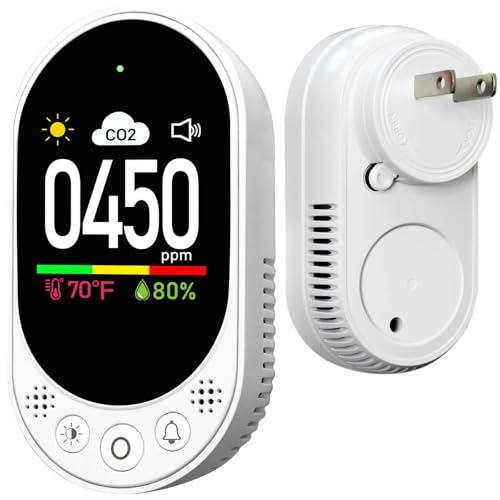
- Plug-in wall design with instant use
- CO2, temperature, and humidity readings
- 2-second refresh with threshold reminder
Best For: Easy plug-in monitoring for bedrooms and offices
Professional Indoor Air Quality Logger
Extech EA80 EasyView Multi-Parameter CO2 Meter

- Measures CO2, temp, humidity, dew point, and wet bulb
- NDIR sensor supports stable long-term monitoring
- Logs up to 20,000 data sets for PC transfer
Best For: Detailed indoor air quality tracking in offices, schools, labs, and HVAC settings
Multi-Sensor CO2 Analyzer
Temtop M2000 2nd Generation Multi-Function Monitor

- Measures CO2, PM2.5, PM10, HCHO, temp, and humidity
- Includes audio alarm, color indicator, and calibration
- Supports USB data export and 3+ months of logging
Best For: Portable monitoring when you need CO2 plus broader air quality data
Home CO2 Comfort Monitor
U UNNI Photoacoustic CO2 Detector
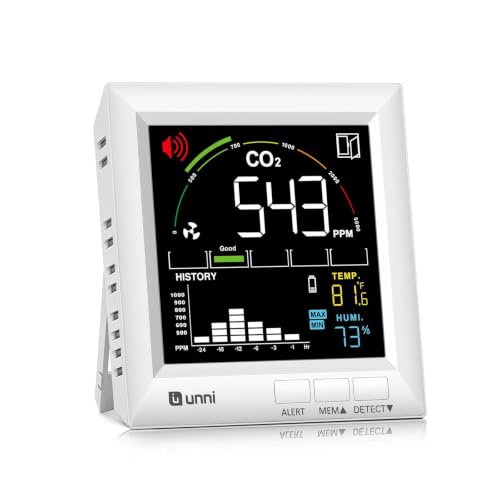
- Real-time CO2, temp, humidity, and history chart
- Adjustable alarm volume and backlight levels
- USB power with AAA battery backup and wall/table use
Best For: Households that want simple, readable CO2 monitoring and ventilation alerts
Portable Accuracy Pick
Handheld CO2 Meter with NDIR Sensor

- 0 to 9999 ppm CO2 range
- Measures temp, humidity, dew point, wet bulb
- Battery or 9V adapter power
Best For: Portable air quality checks across offices, classrooms, and other indoor spaces
Compact Visual Alert Pick
Thin Indoor CO2 Monitor with Alerts

- Small, thin design with foldable stand
- Three-color visual and sound alarms
- Tracks CO2, temperature, and humidity
Best For: Small spaces where easy placement and clear alerting matter
High-Range Alarm Pick
CO2 Monitor with Large Backlit LCD

- 0 to 9999 ppm CO2 range
- Audible and visual alarm function
- Large backlit screen shows multiple readings
Best For: Users who want a wide-range alarm monitor with an easy-to-read display
Industrial-Grade CO2 Alarm Monitor – PureAire 99174 Carbon Dioxide Monitor
If you need one of the more professional carbon dioxide monitors for continuous indoor tracking, the PureAire 99174 is built around straightforward alarm-focused monitoring. It covers a wide CO2 range, shows readings on a local backlit display, and adds both audible and visual alerts for spaces where quick awareness matters.
Best For: Facilities, labs, and work areas that need always-on CO2 monitoring with built-in alarms.
Pros:
- No-maintenance, long-life CO2 sensor
- Self-calibrating sensor with no drift from environmental or temperature changes
- Local backlit concentration display
- Built-in audible horn and visual LED alarm indicators
Cons:
- Focused on CO2 monitoring rather than broader air quality metrics
- Requires 24V DC power supply
- No logging or app-based history features listed
The PureAire 99174 is a practical pick if you want dependable CO2 alerting without routine sensor upkeep. Its strength is simple, stable monitoring with clear alarms rather than extra smart features.
Data-Logging Environmental Monitor – Extech SD800 CO2, Humidity and Temperature Datalogger
Among professional carbon dioxide monitors, the Extech SD800 stands out for users who want readings they can store and review later. It combines CO2, humidity, and temperature monitoring with SD card datalogging, making it a better fit when documentation matters as much as the live display.
Best For: Users who need logged CO2, humidity, and temperature data for analysis or reporting.
Pros:
- Measures CO2, humidity, and temperature in one unit
- Datalogger stores readings on SD card with date/time stamps
- Exports data in Excel format for easy PC transfer
- Large backlit LCD and auto/manual ranging
Cons:
- Does not include alarm-focused features like a horn or LED indicators
- More geared toward data capture than quick at-a-glance alerts
- CO2-specific range and accuracy details are not listed in the supplied notes
If you want a monitoring tool that can support trend review and recordkeeping, the SD800 is a solid choice. Its main advantage is making environmental data easier to move, store, and analyze.
Smart Indoor Air Quality Monitor – BREATHE Airmonitor Plus Gen 2
If you want professional carbon dioxide monitors that do more than measure CO2 alone, the BREATHE Airmonitor Plus Gen 2 offers a much broader indoor air picture. It tracks CO2 alongside particles, VOCs, formaldehyde, temperature, and humidity, while the app adds history, alerts, and data export for longer-term review.
Best For: Homes, offices, and classrooms that need multi-parameter air quality monitoring with app history.
Pros:
- Tracks CO2, PM1, PM2.5, PM10, TVOC, HCHO, temperature, and humidity
- Wi-Fi app support with remote readings and configurable alerts
- Up to 90-day app history plus data export
- Portable rechargeable design with up to 6 hours of battery life
Cons:
- Shorter battery life than always-plugged-in monitors
- More complex than a basic CO2-only meter
- Best value comes from using the app and historical features
The Airmonitor Plus Gen 2 is a strong option when you want CO2 context, not just a single number. It is especially useful for spotting how ventilation, occupancy, cooking, and cleaning affect overall indoor air quality.
Plug-In CO2 Room Monitor – LSENLTY Upgraded CO2 Detector
For buyers looking for professional carbon dioxide monitors in a simple plug-in format, the LSENLTY upgraded detector keeps the setup easy. It measures CO2, temperature, and humidity, refreshes quickly, and adds a threshold reminder that makes it well suited to bedrooms, offices, and other enclosed spaces.
Best For: Bedrooms, offices, RVs, and other spaces where plug-in CO2 monitoring is preferred.
Pros:
- Plug-and-play wall design with no standby time
- Measures CO2, temperature, and humidity
- Fast 2-second refresh rate with stated CO2 accuracy of ±5%
- Threshold reminder and manual calibration support
Cons:
- CO2 range tops out at 5000 ppm
- Does not detect carbon monoxide, smoke, or combustible gases
- Less feature-rich than monitors with logging or app connectivity
This LSENLTY monitor is a practical choice if you want a compact, always-ready room sensor. Its strengths are simplicity, quick updates, and a ventilation reminder when CO2 rises.
Professional Indoor Air Quality Logger – Extech EA80 EasyView Multi-Parameter CO2 Meter
If you need professional carbon dioxide monitors for detailed indoor air quality checks, the Extech EA80 stands out as a practical all-in-one option. It measures CO2, temperature, humidity, dew point, and wet bulb, while the NDIR sensor and 20,000-point datalogger make it suitable for ongoing monitoring in offices, schools, labs, and HVAC work.
Best For: Buyers who want a professional-grade CO2 meter with long-term logging and multiple environmental readings.
Pros:
- Measures CO2 plus temperature, humidity, dew point, and wet bulb for broader air quality analysis.
- NDIR sensor is designed for reliable, stable, long-term CO2 monitoring.
- Stores up to 20,000 data sets for extended logging and PC reporting.
- Backlit LCD and min/max/average/hold functions support field or lab use.
Cons:
- Less focused on consumer-friendly extras than multifunction air quality units.
- Requires either battery or AC adapter operation depending on use case.
Overall, this is a strong choice if you care more about dependable CO2 tracking and data collection than flashy features. Its combination of NDIR sensing and deep logging makes it especially useful when the goal is documentation, not just a quick reading.
Multi-Sensor CO2 Analyzer – Temtop M2000 2nd Generation Multi-Function Monitor
For shoppers comparing professional carbon dioxide monitors, the Temtop M2000 2nd Generation brings together CO2, PM2.5, PM10, formaldehyde, temperature, and humidity monitoring in one handheld unit. Its SenseAir NDIR CO2 sensor, audio alarm, data export, and built-in calibration tools make it a versatile pick for home, office, lab, or travel use.
Best For: Users who want a portable, feature-rich air quality monitor with CO2 logging and export.
Pros:
- Tracks CO2 plus PM2.5, PM10, formaldehyde, temperature, and humidity.
- SenseAir NDIR CO2 sensor and built-in calibration support confidence in readings.
- Audio alarm and color display make air quality easy to check at a glance.
- USB data export and more than 3 months of continuous logging add reporting flexibility.
Cons:
- More complex than a basic CO2-only meter.
- Best suited to users who will actually use the extra sensors and export features.
This model makes sense when you want more than just CO2 numbers and prefer a handheld monitor that can document a wider range of pollutants. The added logging and alarm features give it a professional edge for routine checks and troubleshooting.
Home CO2 Comfort Monitor – U UNNI Photoacoustic CO2 Detector
If you want a straightforward option among professional carbon dioxide monitors for home use, this U UNNI model focuses on the essentials: real-time CO2, temperature, humidity, and history tracking. The photoacoustic sensor, adjustable alarms, and adjustable backlight make it practical for kitchens, bedrooms, RVs, or grow tents where ventilation changes matter.
Best For: Home users who want an easy-to-read CO2 monitor with alarms and simple ventilation guidance.
Pros:
- Shows real-time CO2, temperature, humidity, and a CO2 history chart.
- Photoacoustic sensor is described as high-precision for reliable readings.
- Three alarm volume settings and three backlight levels add convenience.
- USB powered with battery backup and wall-mount or tabletop placement.
Cons:
- Less advanced than higher-end professional meters with data export.
- Calibration requires following the included manual steps carefully.
As a practical home monitor, this unit is built to help you notice rising CO2 levels and respond by opening a window or door. It prioritizes readability, alarms, and everyday usability over advanced reporting tools.
Portable Accuracy Pick – Handheld CO2 Meter with NDIR Sensor
If you’re comparing professional carbon dioxide monitors for spaces that need reliable spot checks, this handheld unit stands out for its wide measuring range and detailed environmental readouts. It tracks CO2, temperature, humidity, dew point, and wet bulb values, making it useful for indoor air quality checks across offices, classrooms, factories, hospitals, and hotels.
Best For: Users who want a portable CO2 monitor for broader air quality checks and on-the-go measurements.
Pros:
- CO2 range runs from 0 to 9999 ppm for broad coverage
- High-accuracy readings with a stable NDIR sensor
- Measures temperature, humidity, dew point, and wet bulb data
- Portable handle design with battery or 9V adapter power options
Cons:
- 9V adapter is not included
- Manual calibration is required for CO2 and humidity
Overall, this is a practical choice if you need a flexible monitor for repeated checks in different rooms or work sites. Its strong range and multi-metric display make it more versatile than a basic CO2 alarm alone.
Compact Visual Alert Pick – Thin Indoor CO2 Monitor with Alerts
For buyers looking at professional carbon dioxide monitors in a smaller format, this compact model focuses on easy placement and clear alerts. It combines CO2, temperature, and humidity monitoring with a three-color visual warning system and adjustable sound alerts, which is handy for spaces where you want quick status checks at a glance.
Best For: People who want a small, easy-to-place CO2 monitor with visual and audible alerts.
Pros:
- Small, thin body with a foldable stand for flexible placement
- Three-color visual alarm plus adjustable sound alert levels
- CO2, temperature, and humidity monitoring in one unit
- Manual calibration supported, with automatic calibration over time
Cons:
- CO2 range is limited to 400 to 5000 ppm
- Accuracy spec is less detailed than some higher-end monitors
This is a strong pick if you care more about convenience and alert visibility than maximum measurement range. It fits well in homes, offices, meeting rooms, and other monitored indoor areas where simple status feedback matters.
High-Range Alarm Pick – CO2 Monitor with Large Backlit LCD
Among professional carbon dioxide monitors, this model is built for users who want a broad measurement range and simple alarm-based monitoring. It displays CO2, temperature, humidity, dew point, and wet bulb readings on a large backlit LCD, making it useful when you need quick, readable indoor air quality checks.
Best For: Buyers who want a wide-range CO2 monitor with a large screen and alarm function.
Pros:
- CO2 measurement spans 0 to 9999 ppm
- Audible and visual alarms help flag high CO2 levels
- Large LCD with backlight shows multiple readings at once
- Includes temperature, humidity, dew point, and wet bulb measurements
Cons:
- Manual calibration details are not highlighted in the notes
- Bulky multi-function display may be more than some buyers need
This monitor makes sense if your priority is readable data and a straightforward alarm setup for ongoing IAQ checks. It offers the kind of broad range and multi-reading display that fits offices, classrooms, factories, hospitals, and hotels.
How We Picked These Professional Carbon Dioxide Monitors
We focused on monitors that offer practical CO2 measurement for real-world use, with attention to sensor technology, reading stability, display clarity, alarms, and data logging. We also favored models that add useful environmental metrics such as temperature and humidity, since those can help explain ventilation and comfort conditions.
Because Professional Carbon Dioxide Monitors are used in different settings, we included a mix of stationary, plug-in, portable, and logging-focused options. That gives buyers a better chance of matching the device to the space and workflow instead of overpaying for features they will not use.
Quick Comparison
If you need long-term recordkeeping, choose a model with onboard logging or SD-card support. If your priority is fast spot checks, a portable handheld unit may be enough. For continuous monitoring in a room, a plug-in or desktop monitor with alarms is often the best fit. Buyers who need broader air-quality context should consider models that also track PM, temperature, and humidity.
Key Buying Factors for Professional Carbon Dioxide Monitors
Sensor Type and Accuracy
Look for NDIR or photoacoustic sensing when accuracy and repeatability matter. These technologies are commonly preferred for CO2 monitoring because they are more reliable than basic low-cost estimates. Also check the stated measurement range so the device can handle the CO2 levels expected in your environment.
Logging, Alarms, and Connectivity
Logging is valuable for trend analysis, compliance, and troubleshooting ventilation issues. Alarm functions are useful in occupied rooms where prompt alerts matter. If you need reports, exportability through SD card, app connectivity, or built-in memory can save time.
Form Factor and Placement
Desktop and wall-plug units work well for continuous room monitoring, while handheld monitors are better for portable checks across multiple spaces. If you need to monitor a larger facility, consider whether the display can be read from a distance and whether power options fit the installation.
Extra Environmental Readings
Temperature and humidity are helpful add-ons because they influence comfort, ventilation, and perceived air quality. Some buyers may also want PM or formaldehyde readings for a broader indoor air picture, especially in schools, offices, and renovation-sensitive environments.
Who Should Buy Which Professional Carbon Dioxide Monitors?
Choose a logging-focused monitor if you need documentation, trend tracking, or professional oversight. Pick a simple plug-in or desktop model if you want continuous awareness in one room. Go with a handheld unit if you move between spaces or need fast inspections. If your goal is broader indoor air management, select one of the more feature-rich Professional Carbon Dioxide Monitors that combines CO2 with humidity, temperature, or particle data.
In short, match the monitor to your workflow first, then compare accuracy, alarms, and logging features last. That approach usually leads to the best value and the most useful day-to-day results.
