
Choosing among professional air quality monitoring systems can be difficult when sensors measure different pollutants, use different calibration methods, and target different environments. The right monitor should match your priorities, from workplace compliance and ventilation management to home health tracking.
We compared 10 selected systems and multi-sensor meters for measurement coverage, usability, portability, connectivity, and practical monitoring features. Use the guide below to narrow the list based on the pollutants and workflow that matter most.
Best 10 Professional Air Quality Monitoring Systems Picks for 2026
Best Overall

- Tracks radon, PM2.5, CO2, VOCs, humidity, temperature, and pressure
- Battery-powered with a customizable eInk display
- App-based alerts and historical trend analysis
Best For: Comprehensive indoor monitoring with radon detection
Best for Formaldehyde

- Measures HCHO/formaldehyde and TVOC simultaneously
- Fuel-cell formaldehyde sensor technology
- Backlit LCD with high/low alarms
Best For: Targeted formaldehyde and VOC testing
Best Indoor-Outdoor Bundle

- Includes indoor and weatherproof outdoor monitoring
- Tracks PM1, PM2.5, PM10, AQI, and environmental data
- Wi-Fi app access with customizable alerts
Best For: Comparing indoor conditions with outdoor pollution
Best for Particle Testing

- Measures particles above 0.5 and 2.5 microns
- Useful for testing filtration and air purifiers
- Stores seven days of data with PC connectivity
Best For: Particle diagnostics and filtration checks
Best Open-Source Pick
AirGradient ONE Indoor Air Quality Monitor
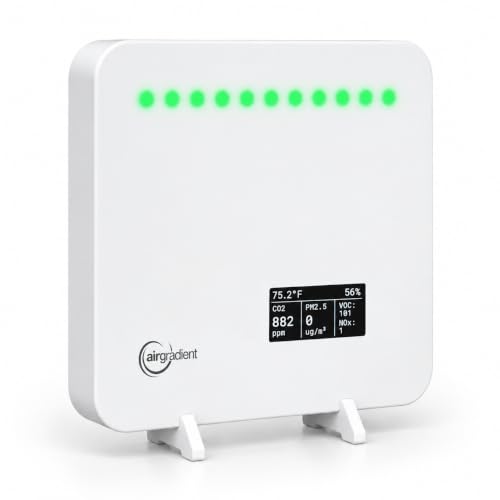
- Tracks PM2.5, CO2, TVOCs, NOx, temperature, and humidity
- Open-source with Home Assistant support and free API access
- Individually PM2.5-calibrated with a digital test report
Best For: Smart-home users and facilities wanting flexible, subscription-free monitoring
Best for Workshops and Garages
POWERTEC AD1001 Air Quality Monitor

- Tracks CO2, particles, HCHO, TVOC, AQI, temperature, and humidity
- Uses a large 7-inch LCD with color indicators and alarms
- Rechargeable battery provides up to 6 hours of cordless use
Best For: Woodworking shops, garages, and spaces with dust or finishing fumes
Best All-Around Coverage
YNAK 16-in-1 Air Quality Monitor
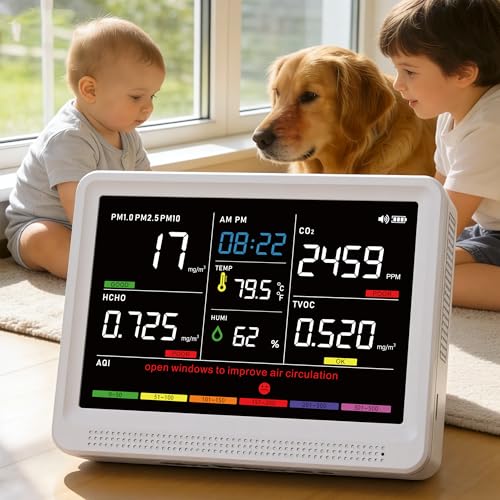
- Tracks CO2, particles, HCHO, TVOC, temperature, humidity, and AQI
- 5.5-inch HD display with adjustable brightness
- Up to 10 hours of runtime with USB-C charging
Best For: Homes, offices, bedrooms, and vehicles needing broad, screen-based monitoring
Best for Data Tracking

- Eight-parameter monitoring with NDIR CO2 measurement
- App offers alerts, graphs, 90-day history, and CSV export
- Up to six hours portable use or continuous USB-C operation
Best For: Trend analysis and connected monitoring in homes, offices, and classrooms
Best Simple Portable Option
AK16C 16-in-1 Air Quality Monitor

- Measures particles, CO2, TVOC, HCHO, temperature, and humidity
- Updates readings every 1.5 seconds on an HD color screen
- Lightweight design with simple controls and USB-C charging
Best For: Quick, portable air checks in bedrooms, offices, cars, and classrooms
Best Overall – Airthings View Plus
For shoppers comparing professional air quality monitoring systems, the Airthings View Plus offers broad indoor coverage in a compact, cable-free design. It continuously tracks radon, PM2.5, CO2, VOCs, humidity, temperature, and air pressure, with readings and trend analysis available through the Airthings app.
Best For: Homes and workspaces needing continuous, multi-parameter indoor monitoring with radon detection.
Pros:
- Monitors radon, PM2.5, CO2, VOCs, humidity, temperature, and pressure.
- Battery-powered design supports flexible placement, with an average battery life of two years.
- App notifications, cloud tracking, historical trends, and a customizable eInk display support ongoing monitoring.
Cons:
- The monitor and app require internet access.
- An Airthings account and app are required for operation.
- The optional five-year warranty requires registration within 30 days.
The View Plus is a strong all-around choice when radon awareness and detailed indoor trend tracking matter more than standalone operation.
Best for Formaldehyde – Triplett FM260
The Triplett FM260 is a focused option among professional air quality monitoring systems for measuring formaldehyde and total volatile organic compounds. Its fuel-cell formaldehyde sensor, dual LCD, and simultaneous real-time display make it suited to targeted indoor testing in residential or commercial environments.
Best For: Users who specifically need real-time HCHO/formaldehyde and TVOC measurements.
Pros:
- Displays formaldehyde and TVOC concentrations simultaneously in real time.
- Uses fuel-cell formaldehyde sensor technology and offers ppm or mg/m³ units.
- Backlit display and audible and visual high/low formaldehyde alarms improve usability.
Cons:
- It focuses on HCHO and TVOC rather than a broad range of air-quality parameters.
- Its stated measurement accuracy is 5% of full scale.
- Warranty coverage is listed as one year.
Choose the FM260 when formaldehyde and VOC screening are the priority; it is less suited to buyers seeking radon, particulate, or CO2 monitoring in the same device.
Best Indoor-Outdoor Bundle – IQAir AirVisual Bundle
The IQAir AirVisual bundle stands out among professional air quality monitoring systems by combining indoor and outdoor monitoring. The indoor unit tracks common contaminants plus temperature and humidity, while the weatherproof outdoor monitor measures particulate and environmental data and connects to the IQAir platform over Wi-Fi.
Best For: Homes, offices, and users who want indoor readings alongside local outdoor pollution and weather data.
Pros:
- Combines indoor monitoring with an outdoor unit that can measure PM1, PM2.5, PM10, temperature, humidity, pressure, and AQI.
- Outdoor sensor uses two professional-grade laser sensors for added accuracy and reliability.
- App access, customizable alerts, and mounting options support remote and flexible monitoring.
Cons:
- CO2 measurement for the outdoor monitor requires an optional sensor module.
- The outdoor unit uses a power adapter and a 12-meter cable rather than battery power.
- The bundle is larger and more involved to install than a single indoor monitor.
This bundle is a compelling choice for tracking pollution entering from outside, including traffic, smoke, and wildfire-related conditions, while also monitoring indoor air.
Best for Particle Testing – DC1700 Particle Counter
The DC1700 is a practical choice among professional air quality monitoring systems for users focused on airborne particle concentration. Its true laser particle counter measures particles above 0.5 and 2.5 microns, making it useful for checking home or neighborhood conditions and evaluating air-cleaning equipment.
Best For: Testing particle levels and checking the performance of air purifiers, HEPA filters, or home and office filtration systems.
Pros:
- Uses a true laser particle counter across two particle-size ranges.
- Supports comparisons with AQI or PM2.5 readings.
- Stores seven days of data and includes a PC interface, USB cable, and international wall adapter.
Cons:
- Its supplied specifications focus on particles rather than gases such as CO2 or VOCs.
- Rechargeable battery operation is listed at six hours.
- The device weighs 1.5 pounds, making it less compact than lighter handheld monitors.
The DC1700 makes the most sense for particle-focused diagnostics and filtration checks, especially when data storage and AC operation are useful.
Best Open-Source Pick – AirGradient ONE Indoor Air Quality Monitor
For buyers seeking professional air quality monitoring systems with flexible integrations, the AirGradient ONE combines broad pollutant coverage with open-source hardware and firmware. It measures PM2.5, CO2, TVOCs, NOx, temperature, and humidity, while providing a local display, subscription-free dashboard access, and Home Assistant compatibility.
Best For: Homes, offices, classrooms, gyms, workshops, and commercial buildings where detailed readings, local control, and smart-home integration are priorities.
Pros:
- Measures PM2.5, CO2, TVOCs, NOx, temperature, and humidity.
- Includes a subscription-free dashboard, free API access, and Home Assistant support.
- Individually calibrated for PM2.5 and supplied with a digital test report.
- Can sit on a surface or mount to a wall, with readings shown on an OLED display and LED bar.
Cons:
- The 1.3-inch OLED display is relatively compact.
- Its advanced features may be more than needed for simple, occasional checks.
The AirGradient ONE is a strong choice when measurement breadth, documented calibration, and integration flexibility matter more than a large built-in screen. Its open-source approach also suits users who want local or self-hosted monitoring without a required subscription.
Best for Historical Tracking – CF-60PP Smart Professional Air Quality Monitor
The CF-60PP is a practical option among professional air quality monitoring systems for users who want both live readings and documented trends. Its large display shows up to 12-hour curves locally, while Wi-Fi connectivity enables remote alerts, cloud history, and USB data export for longer-term review.
Best For: Offices, classrooms, schools, bedrooms, and facility-management applications that benefit from on-screen trends, threshold alarms, and reportable data.
Pros:
- Displays PM1.0, PM2.5, PM10, CO2, TVOC, HCHO, AQI, temperature, and humidity.
- Shows 4-minute, 6-minute, 2-hour, and 12-hour on-screen historical curves.
- Supports custom CO2, PM2.5, and VOC thresholds with local and phone alerts.
- Offers USB export and up to one year of stored history.
Cons:
- Remote features require Wi-Fi and app setup.
- The unit weighs about 1 pound and is less compact than a basic portable monitor.
- Its broad feature set may be unnecessary for buyers seeking only a single measurement.
Choose the CF-60PP when trend visibility and data documentation are central to your buying decision. It is especially useful for spotting pollution spikes, reviewing ventilation conditions, and maintaining records without relying solely on a phone.
Best for Workshops and Garages – POWERTEC AD1001 Air Quality Monitor
For workshops and garages, the POWERTEC AD1001 offers a large-screen approach to professional air quality monitoring systems. It combines NDIR CO2 sensing with particle, formaldehyde, and TVOC measurements, then adds color-coded indicators and audible alarms to help identify changing conditions during woodworking, painting, sanding, or finishing.
Best For: Woodworking shops, garages, finishing areas, warehouses, greenhouses, and other spaces where a readable display, alarms, and cordless operation are useful.
Pros:
- Measures CO2, PM1.0, PM2.5, PM10, HCHO, TVOC, AQI, temperature, and humidity.
- Uses an NDIR CO2 sensor and laser particle sensors for broad workshop coverage.
- Provides color-coded readings and audible alarms for CO2, VOCs, particulate matter, and formaldehyde.
- Has a 7-inch LCD and a rechargeable battery rated for up to 6 hours of cordless use.
Cons:
- Continuous plugged-in use can add slight heat that may minimally affect temperature readings.
- The initial sensor warm-up takes about two minutes.
- At 1.46 pounds, it is less lightweight than a small handheld monitor.
The AD1001 is a sensible fit when visibility and immediate alerts matter in a working environment. Its large screen and rechargeable battery make it convenient for moving around a shop, while its formaldehyde and particle readings address common workshop concerns.
Best All-Around Coverage – YNAK 16-in-1 Air Quality Monitor
For shoppers comparing professional air quality monitoring systems, the YNAK offers broad indoor coverage in a portable format. It displays CO2, particulate matter, HCHO, TVOC, temperature, humidity, AQI, and time on a large 5.5-inch HD screen, with audible AQI alerts for changing conditions.
Best For: Households, bedrooms, offices, cars, and other indoor spaces where an easy-to-read display and wide parameter coverage matter.
Pros:
- Monitors nine key air-quality and environmental parameters, including CO2, PM1.0, PM2.5, PM10, HCHO, and TVOC.
- Large 5.5-inch HD display includes three brightness levels.
- Offers seven AQI alert functions, a mute button, and up to 10 hours of runtime.
- USB-C charging and included AC adapter support flexible use.
Cons:
- Its advertised “16-in-1” count combines nine detectable parameters with seven alert types.
- Sensor accuracy can be affected by touching the sensors or exposing them to perfumes and strong odors.
The YNAK is a practical choice when you want extensive readings and clear alerts without relying on an app. Its longer stated battery life and bright screen make it especially convenient for moving between rooms or monitoring a vehicle.
Best for Data Tracking – BREATHE Airmonitor Plus Gen 2
The BREATHE Airmonitor Plus Gen 2 stands out among professional air quality monitoring systems for connected monitoring and historical analysis. It combines NDIR CO2 measurement, laser particle sensing, TVOC and formaldehyde detection, plus app-based alerts, graphs, 90-day history, and CSV export.
Best For: Users who want to review trends, export readings, and understand how cooking, cleaning, occupancy, HVAC use, and ventilation affect indoor air.
Pros:
- Monitors CO2, PM1, PM2.5, PM10, TVOC, formaldehyde, temperature, and humidity.
- App supports configurable CO2 and PM2.5 alerts, graphs, 90-day history, and data export.
- Uses an NDIR CO2 sensor and laser particle sensing.
- Can run from USB-C power and provides up to six hours of portable use.
Cons:
- Portable battery life is shorter than the 10-hour option offered by some competing models.
- App features require pairing with 2.4 GHz Wi-Fi.
Choose this model if your priority is not just seeing current readings but identifying patterns over time. Its app history and CSV export provide more useful documentation for ongoing home, office, classroom, or bedroom monitoring.
Best Simple Portable Option – AK16C 16-in-1 Air Quality Monitor
The AK16C is a straightforward choice for shoppers seeking professional air quality monitoring systems without a complicated setup. Its sensor array updates readings every 1.5 seconds, while the HD color screen shows PM1.0, PM2.5, PM10, CO2, TVOC, HCHO, temperature, and humidity in a compact, portable design.
Best For: Users who want quick, readable readings in bedrooms, offices, cars, classrooms, and other indoor spaces.
Pros:
- Tracks particulate matter, CO2, TVOC, HCHO, temperature, and humidity.
- Provides continuous updates approximately every 1.5 seconds.
- Single-tap controls and adjustable audio prompts make operation simple.
- Includes USB-C cable and AC adapter, with a lightweight 14.4-ounce design.
Cons:
- Stated runtime is approximately four to five hours per charge.
- Its feature set is centered on the device display rather than app-based history or exports.
The AK16C favors accessibility and portability over advanced data management. It is a sensible fit for frequent spot checks and everyday indoor monitoring, particularly when simple controls and a quiet sampling mode are useful.
How We Picked These Professional Air Quality Monitoring Systems
We focused on the measurements professionals and serious home users are most likely to need: particulate matter such as PM2.5 and PM10, carbon dioxide, total volatile organic compounds, formaldehyde, radon, temperature, and humidity. We also considered whether each device is designed for continuous indoor monitoring, spot checks, portable inspections, or broader indoor-and-outdoor tracking.
Other factors included display readability, battery operation, alarms, sensor breadth, app or smart-home support, data visibility, and suitability for offices, classrooms, workshops, and residential spaces. Because no monitor measures every pollutant equally well, the best choice depends on the job rather than the highest parameter count.
Quick Comparison
- Best for broad home coverage: Airthings View Plus, especially where radon monitoring is important.
- Best for connected indoor and outdoor tracking: IQAir AirVisual, with professional-oriented real-time data features.
- Best for smart-home integration: AirGradient ONE, particularly for Home Assistant users.
- Best for formaldehyde and TVOC checks: Triplett FM260.
- Best for portable or budget-focused measurements: the DC1700 and multi-parameter handheld meters.
- Best for visible workplace monitoring: larger-screen options such as the CF-60PP SMART and POWERTEC 7-inch monitor.
Key Buying Factors for Professional Air Quality Monitoring Systems
Pollutants and Sensor Scope
Start with the contaminants you need to identify. CO2 is useful for evaluating ventilation, while PM2.5 and PM10 help track particles from smoke, dust, cooking, and outdoor pollution. TVOC and formaldehyde readings can support investigations of cleaning products, furnishings, and off-gassing. Radon requires a dedicated sensor, so a general air-quality meter cannot substitute for a radon monitor.
Accuracy, Calibration, and Data Use
Look for clearly stated accuracy ranges, measurement intervals, calibration guidance, and operating limits. A live display is adequate for quick checks, but longer-term investigations benefit from logging, alerts, exportable data, or an app. Treat low-cost multi-sensor readings as screening information unless the manufacturer provides appropriate validation.
Installation and Operation
Choose mains power for fixed displays and continuous workplace use, or battery operation when you need room-to-room surveys. Consider screen size, audible alarms, remote access, wireless requirements, and whether the device can operate without an account or cloud connection. Place monitors away from windows, vents, kitchens, and direct sunlight for more representative readings.
Who Should Buy Which Professional Air Quality Monitoring Systems?
Homeowners and families should prioritize straightforward displays, continuous logging, and coverage of CO2, particles, humidity, and—where relevant—radon. Facility managers, schools, and offices will usually benefit from visible alarms, dependable continuous operation, and data that can support ventilation decisions across multiple rooms.
HVAC professionals and inspectors should favor portable meters with the specific sensors needed for diagnostic work, while smart-home users should check integration compatibility before buying. If you need to investigate a suspected formaldehyde or VOC source, select a device designed for those measurements rather than relying solely on a broad AQI score.
