
When you’re looking for the best professional 8-bay NVMe RAID systems, it’s essential to understand what truly elevates performance and storage solutions. These systems not only promise impressive data transfer speeds but also offer extensive storage capacities tailored to your needs. As you weigh your options, consider features that enhance reliability and efficiency. Let’s explore some standout choices that might just meet your demands and elevate your workflow.
CENMATE Aluminum 8 Bay Hard Drive RAID Enclosure

If you’re looking for a robust solution to manage large data, the CENMATE Aluminum 8 Bay Hard Drive RAID Enclosure is an excellent choice. It supports both 2.5” and 3.5” SATA HDDs/SSDs and features a tool-free design for hassle-free installation. With 8 RAID modes, including RAID0 and RAID5, you can tailor your setup for personal or enterprise use. Just remember, it supports a maximum of 160TB, but not WD’s 20TB drives. Cooling is efficient thanks to dual fans, though they can generate noise. Plus, it’s compatible with major operating systems and offers reliable plug-and-play functionality.
Best For: Individuals or enterprises needing a reliable and flexible RAID solution for managing large amounts of data.
Pros:
- Tool-free design allows for easy installation of 2.5” and 3.5” SATA HDDs/SSDs.
- Supports 8 RAID modes, providing flexibility for different data management needs.
- Compatible with major operating systems and features plug-and-play functionality.
Cons:
- Maximum capacity of 160TB, incompatible with WD 20TB hard drives.
- Cooling fans can generate noise levels of 40-50 decibels, which may not suit noise-sensitive environments.
- Changing RAID configurations may lead to data loss, requiring careful backup procedures.
CENMATE Aluminum 8 Bay Hard Drive Enclosure with Cooling Fan
The CENMATE Aluminum 8 Bay Hard Drive Enclosure is an ideal choice for those seeking an efficient and flexible storage solution without the complexities of RAID or NAS functionalities. Supporting both 2.5” and 3.5” SATA HDDs/SSDs, it offers a massive capacity of up to 160TB. With its tool-free, hot-swappable design, you can easily swap drives without hassle. The dual cooling fans keep your drives secure, although they do generate some noise. You’ll benefit from impressive data transfer speeds of up to 5Gbps, making file transfers quick and efficient. Plus, it’s compatible with multiple operating systems for added convenience.
Best For: Individuals or businesses looking for a high-capacity, easy-to-use storage solution without RAID or NAS complexities.
Pros:
- Tool-free, hot-swappable design allows for easy drive swaps.
- Supports high data transfer speeds of up to 5Gbps, enhancing efficiency.
- Compatible with multiple operating systems, including Windows, Mac, and Linux.
Cons:
- Fan noise levels of 40-50 decibels may not be suitable for quiet environments.
- Lacks RAID or NAS functionality, limiting advanced storage options.
- Maximum capacity per drive is 20TB, which may not meet the needs of all users.
ORICO 4 Bay RAID Hard Drive Enclosure (9848RU3)

For professionals working on large-scale projects or handling high-definition video footage, the ORICO 4 Bay RAID Hard Drive Enclosure (9848RU3) stands out with its impressive support for multiple RAID configurations, including RAID 0, 1, 3, 5, and 10. You’ll appreciate the 88TB maximum capacity and USB 3.0 interface, achieving transmission speeds up to 235 MB/s for efficient file backups. The built-in 150W power supply guarantees smooth data transfers without bulky adapters, while the aluminum design and cooling fan promote stable operation. Plus, independent safety locks keep your drives secure and prevent unexpected ejections.
Best For: Professionals working on large-scale projects or handling high-definition video footage who require reliable data storage and fast transfer speeds.
Pros:
- Supports multiple RAID configurations for enhanced data security and backup flexibility.
- High transmission speeds of up to 235 MB/s facilitate efficient file backups and video transfers.
- Built-in cooling fan and aluminum design ensure long-term stable operation and effective heat dissipation.
Cons:
- Maximum capacity of 88TB may not be sufficient for extremely large-scale data needs.
- The unit’s weight may be cumbersome for users who need portability.
- Requires a power source, limiting its use in mobile or remote settings without power access.
ACASIS Dual-Bay M.2 NVMe Raid SSD Enclosure
Designed for high-performance users, the ACASIS Dual-Bay M.2 NVMe RAID SSD Enclosure stands out with its USB4/40Gbps compatibility, making it perfect for those who demand speed and efficiency in data storage. You’ll appreciate its tool-free design that simplifies setup and an aluminum dock that supports dual monitors. With multiple connectivity options, including HDMI and USB-C, you can expand your workspace effortlessly. It supports RAID configurations for peak performance or data protection, and with speeds soaring up to 2800 MB/s in RAID 0, your tasks will fly. Plus, built-in fans guarantee everything stays cool during heavy use.
Best For: High-performance users seeking fast and efficient data storage solutions with versatile connectivity options.
Pros:
- Tool-free design for easy setup and installation.
- Supports multiple RAID configurations for enhanced performance and data protection.
- High read/write speeds of up to 2800 MB/s in RAID 0, ideal for intensive tasks.
Cons:
- Limited compatibility with JBOD mode, available only on macOS.
- Requires M.2 NVMe SSDs, which may necessitate additional purchases.
- Potential for increased noise from built-in fans during operation.
Hybrid SATA HDD/SSD Enclosure with Fan and USB A/C 3.2 Gen 2

Offering a robust solution for data-intensive users, this Hybrid SATA HDD/SSD enclosure supports an impressive total capacity of up to 90TB. You can easily accommodate two HDDs and up to four RAID modes, including RAID 0 and RAID 1. With USB 3.2 Gen 2, enjoy lightning-fast data transfer speeds of up to 10Gbps. The aluminum alloy construction and dual silent fans guarantee your drives stay cool, though keep in mind that the fan noise might bother some. Plus, it’s plug-and-play compatible with various operating systems, making installation a breeze. Cenmate also provides lifetime technical support for your peace of mind.
Best For: Data-intensive users requiring high capacity and fast data transfer for HDDs and SSDs.
Pros:
- Supports up to 90TB total capacity with compatibility for multiple HDD and NVMe SSD configurations.
- Fast data transfer speeds of up to 10Gbps through USB 3.2 Gen 2, enhancing efficiency for large file transfers.
- Tool-free installation with plug-and-play functionality, making it user-friendly across various operating systems.
Cons:
- RAID configuration can lead to data loss if not handled carefully, requiring caution during setup.
- Fan noise may be bothersome for users sensitive to sound, despite the cooling benefits.
- No RAID software available for Mac OS, limiting RAID management options for Mac users.
Dual Bay M.2 SSD Enclosure and Reader Adapter

With its dual bay functionality and support for RAID configurations, the Dual Bay M.2 SSD Enclosure and Reader Adapter is ideal for tech enthusiasts and professionals who need fast, reliable data storage. You can choose between RAID 0, RAID 1, JBOD, and Offline Clone features, ensuring data mirroring, speed enhancement, and cloning without a computer. It supports NVMe and SATA protocols, accommodating various SSD sizes, and boasts high-speed data transfer rates up to 20Gbps. With a compact design, cross-platform compatibility, and intelligent power management, this enclosure is perfect for mobile users needing robust storage solutions.
Best For: Tech enthusiasts and professionals seeking fast, reliable, and versatile data storage solutions.
Pros:
- Supports multiple RAID configurations for enhanced data management and performance.
- High-speed data transfer rates of up to 20Gbps, suitable for large file transfers.
- Compact and portable design with cross-platform compatibility for seamless connectivity.
Cons:
- The need for a DC power adapter for high-performance drives may limit portability slightly.
- Tool-free installation may not be suitable for users unfamiliar with hardware setups.
- Limited to M.2 SSD sizes, which may not accommodate other types of storage devices.
MAIWO Dual M.2 NVMe RAID Enclosure (K2023R)
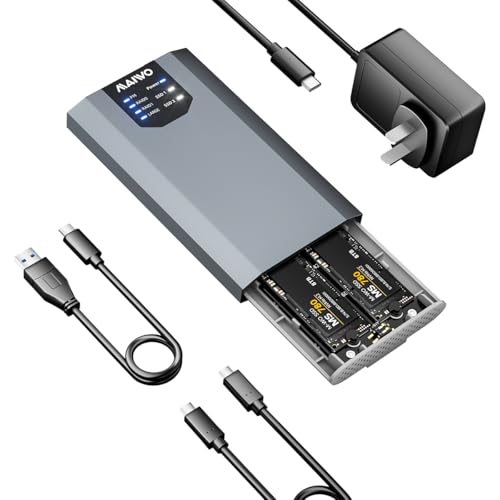
The MAIWO Dual M.2 NVMe RAID Enclosure (K2023R) stands out for those seeking high-speed storage solutions with versatility in configuration. With support for up to 8TB across two M.2 NVMe SSDs, you can choose from RAID 0, 1, PM, or large configurations. Enjoy impressive data transfer rates of up to 20Gbps via USB 3.2 Gen 2×2 Type-C. The plug-and-play design makes setup effortless, while its robust ABS and aluminum construction guarantees durability. Weighing just 8 ounces and measuring 3.2L x 2.5W x 4H inches, it’s a compact powerhouse that fits seamlessly into your workstation.
Best For: Users seeking a high-speed, versatile storage solution for data-intensive tasks and backup needs.
Pros:
- High Data Transfer Rate: Achieves speeds of up to 20Gbps for efficient data management.
- Flexible RAID Configurations: Supports multiple RAID options (0, 1, PM, Large) to suit various storage needs.
- Durable Build: Constructed from ABS and aluminum for longevity and reliability.
Cons:
- Limited Customer Reviews: Only 10 reviews with a moderate rating of 3.9 out of 5 stars may indicate mixed user experiences.
- Initial Cost: Depending on the SSDs used, the overall investment may be higher compared to single SSD enclosures.
- Weight Consideration: While compact, some users may prefer lighter alternatives for portability.
CENMATE Aluminum 4 Bay Hard Drive RAID Enclosure

For those seeking a reliable storage solution that balances capacity and efficiency, the CENMATE Aluminum 4 Bay Hard Drive RAID Enclosure stands out. It supports both 2.5 and 3.5-inch HDDs and SSDs, offering a maximum capacity of 80TB. Built with aluminum-alloy and equipped with 2-inch fans, it effectively dissipates heat, although the fan noise may not suit noise-sensitive users. You’ll enjoy fast data transfers up to 5Gbps via USB 3.0 and eSATA. With eight RAID modes available, this enclosure meets various needs while remaining compatible with multiple operating systems. Plus, technical support is just a message away!
Best For: Users seeking a high-capacity and efficient storage solution, ideal for both personal and enterprise use.
Pros:
- Supports up to 80TB of storage with compatibility for both 2.5 and 3.5-inch HDDs and SSDs.
- Fast data transfer speeds of up to 5Gbps through USB 3.0 and eSATA connections.
- Offers eight versatile RAID modes to meet various storage needs.
Cons:
- Fan noise levels of 40-50 decibels may be disruptive for noise-sensitive environments.
- Switching RAID modes requires caution to prevent potential data loss and involves specific reset steps.
- Requires power disconnection for RAID mode switching, which may be inconvenient for users.
CENMATE Aluminum 8 Bay Hard Drive Enclosure with Cooling Fan
Designed for professionals and enthusiasts alike, the CENMATE Aluminum 8 Bay Hard Drive Enclosure excels in providing a high-speed, versatile storage solution. With support for both 2.5″ and 3.5″ SATA HDDs/SSDs, you can achieve impressive transfer speeds of up to 10Gbps. The tool-free, hot-swappable design simplifies your workflow, while dual cooling fans keep your drives secure and prevent overheating. Compatible with various operating systems, this enclosure allows daisy chaining for up to 480TB of storage. Plus, with a stable power supply and responsive technical support, you’ll have everything you need for peak performance.
Best For: Professionals and enthusiasts seeking a high-speed, reliable storage solution for multiple HDDs and SSDs.
Pros:
- High-speed transfer rates of up to 10Gbps under UASP control, allowing for quick data transfers.
- Tool-free, hot-swappable design makes it easy to manage drives without the need for additional tools.
- Dual cooling fans ensure optimal performance by preventing overheating and maintaining data integrity.
Cons:
- No RAID/NAS functionality, limiting options for data redundancy or network storage.
- Fan noise levels can reach up to 50 decibels, which may be noticeable in quiet environments.
- Maximum capacity of 160TB per enclosure may require multiple units for larger storage needs.
Hybrid SATA HDD/SSD Enclosure with Fan and USB A/C 3.2 Gen 2

Combining the massive storage capacity of traditional HDDs with the high-speed performance of SSDs, this hybrid SATA HDD/SSD enclosure is perfect for professionals and enthusiasts who demand both speed and space. Supporting RAID 0, RAID 1, JBOD, and Normal modes, you can tailor your setup to fit your needs. With a maximum capacity of 68TB and data transfer rates up to 10Gbps via USB 3.2 Gen 2, performance is impressive. Plus, the built-in aluminum alloy and silent fans guarantee efficient cooling. Installation is tool-free, making it a breeze to swap drives, while lifetime tech support keeps you covered.
Best For: Professionals and enthusiasts who require a combination of high-speed performance and massive storage capacity in their data solutions.
Pros:
- Supports multiple RAID configurations (0, 1, JBOD, Normal) for tailored setups.
- High data transfer rates of up to 10Gbps with USB 3.2 Gen 2 for fast performance.
- Tool-free installation allows for easy drive swapping without additional tools.
Cons:
- Designing RAID may lead to potential data loss if not managed properly.
- MAC OS lacks RAID software support, limiting RAID functionality for Mac users.
- The fans operate continuously, which may cause noise in quiet environments.
Factors to Consider When Choosing Professional 8 Bay NVMe RAID Systems
When you’re choosing a professional 8-bay NVMe RAID system, consider several key factors that will impact performance and usability. You’ll want to evaluate storage capacity options, RAID configuration flexibility, and cooling system efficiency. Don’t forget to check data transfer speeds and compatibility with your operating systems to guarantee a seamless experience.
Storage Capacity Options
Selecting an 8-bay NVMe RAID system means considering various factors that directly impact your storage capacity. First, verify the system supports high-capacity SSDs, with many accommodating up to 8TB per drive, offering a total of 64TB or more. Evaluate the maximum aggregate storage capacity, as some systems can exceed 160TB with the latest drives. It’s also essential to check compatibility with different M.2 NVMe sizes (like 2230, 2242, 2260, and 2280), as this will determine the SSD types you can install. Finally, be aware that RAID configurations can influence usable storage space; certain modes may limit capacity while enhancing data protection. Make informed choices to balance performance and storage based on your needs.
RAID Configuration Flexibility
After evaluating storage capacity options, it’s important to contemplate how RAID configuration flexibility can affect your overall system performance and data security. With options like RAID 0, RAID 1, RAID 5, and JBOD, you can tailor your setup to meet specific performance or redundancy needs. Some systems even support software RAID configurations, giving you more optimization choices. Advanced RAID setups can enhance data security through redundancy, allowing recovery in case of drive failures. However, remember that switching RAID modes often requires specific procedures and can lead to data loss if backups aren’t in place. Hot-swappable bays also offer operational flexibility, letting you change drives without powering down, which keeps your system running smoothly.
Cooling System Efficiency
To guarantee your 8-bay NVMe RAID system performs at its best, paying close attention to cooling system efficiency is crucial. An efficient cooling system prevents overheating, which can compromise performance and data integrity during heavy operations. Look for systems that utilize aluminum alloy construction with built-in fans to enhance heat dissipation while keeping noise levels between 40-50 decibels. Good ventilation designs promote airflow, maintaining low operating temperatures for reliability. Effective cooling can also extend the lifespan of NVMe SSDs, which are sensitive to heat. Additionally, consider systems featuring thermal management solutions, like thermal conduction slots and advanced cooling technologies, to guarantee consistent performance even under heavy workloads. Prioritizing cooling efficiency is imperative for peak operation.
Data Transfer Speed
When choosing a professional 8-bay NVMe RAID system, understanding data transfer speeds is essential for optimizing your workflow. These systems can reach speeds up to 20Gbps, vastly improving file transfer efficiency compared to traditional HDDs. With advanced protocols like USB 3.2 Gen 2×2, you can expect read/write speeds between 1000-1800 MB/s per drive. If you opt for RAID 0 configurations, you might even double that performance. Plus, the ability to handle high-capacity SSDs means you can store up to 16TB across two slots, allowing quick access to large files. RAID configurations also provide not only enhanced speed but also data redundancy, ensuring both performance and safety. Don’t overlook thermal management features for sustained high speeds during extended use.
Compatibility With Operating Systems
Choosing an 8-bay NVMe RAID system that’s compatible with various operating systems is crucial for maximizing your workflow flexibility. Make certain it supports Windows, macOS, and Linux to guarantee usability across your devices. Pay attention to specific OS versions, as some systems only work with newer releases, like Windows 7 and above or macOS 9.1 and higher. Look for plug-and-play functionality; this means you won’t need extra drivers for a quick setup. Additionally, check that the system supports multiple protocols, such as USB 3.0, 3.1, 3.2, and Thunderbolt, for versatile connectivity. Finally, verify extensive technical support and documentation are available to help tackle any compatibility issues that may come up during use.
Installation Process Ease
Since a seamless installation process can greatly influence your overall experience with an 8-bay NVMe RAID system, it’s crucial to contemplate several factors that simplify setup. Look for a tool-free installation design, which lets you easily insert and remove drives without extra tools, making the process quicker. Hot-swappable capabilities allow you to replace or add drives while the system is running, reducing downtime considerably. Clear user instructions and intuitive setup procedures can ease the learning curve, speeding up deployment. Additionally, systems with LED indicators provide visual feedback on drive status, assisting with both installation and troubleshooting. Finally, verify compatibility with various operating systems to integrate the RAID system smoothly into your existing workflow.
Noise Level Considerations
Understanding noise level considerations is essential if you’re working in a noise-sensitive environment. Professional 8-bay NVMe RAID systems typically range from 40 to 50 decibels, which might not suit your needs. Pay attention to the cooling fans; they greatly impact noise levels. Larger, more efficient fans tend to run quieter than smaller, high-speed ones. Look for RAID systems with silent operational features, like sound-dampening materials or adjustable fan speeds, to maintain a calm workspace. Additionally, consider how noise output fluctuates during heavy data transfers, as higher loads can increase sound levels. Choosing the right system will help you balance performance and a peaceful environment, ensuring you get the most from your investment.
Power Supply Stability
While noise level considerations are important for maintaining a calm workspace, power supply stability plays a significant role in the performance and reliability of 8-bay NVMe RAID systems. A stable power supply is essential, as fluctuations can lead to data corruption or drive failures. Look for systems with dedicated power supplies rated at 12V or higher to guarantee consistent power delivery to all drives. Including power management features, like overcurrent and overvoltage protection, enhances safety by preventing damage from electrical surges. Higher wattage power supplies, around 150W or more, are recommended for peak read/write operations. Additionally, efficient cooling systems integrated with the power supply help maintain safe operating temperatures, prolonging the lifespan of your drives.
