
The right enclosure can make a professional 3D printing setup safer, quieter, and more consistent. It can also help control dust, retain heat, manage odors, and organize essential tools and filament.
This roundup compares 10 professional 3D printer enclosures, from compact printer-specific covers to large-format cabinets and insulated tents. Use the buying guide below to match enclosure size, ventilation, filtration, and storage features to your workflow.
Best 10 Professional 3D Printer Enclosures Picks for 2026
Large-Format Pick

- Purpose-built for the Original Prusa XL
- Includes enclosure parts; no printing required
- Lifetime technical assistance from Prusa Research
Best For: Original Prusa XL owners needing an integrated enclosure
Versatile FDM Pick

- Thermal, quiet, and dustproof design
- Large window with integrated LED light
- Expandable for fans, purifiers, heaters, or power modules
Best For: Large FDM printers and accessory-focused workspaces
Filtration Pick
BD-60A Smoke-Purifying Enclosure
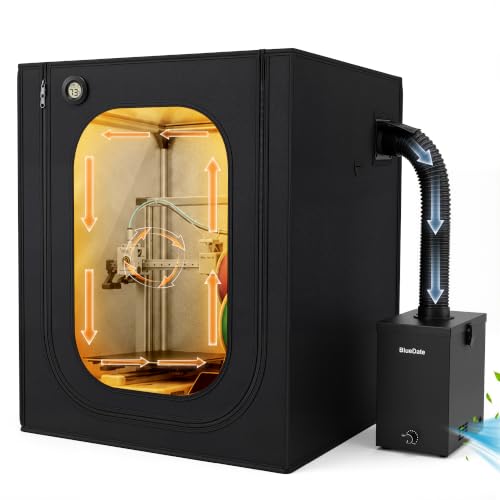
- Four-stage HEPA and activated-carbon filtration
- Adjustable airflow with a brushless DC motor
- Compatible with many open-style and resin printers
Best For: Users seeking integrated smoke, odor, and particulate filtration
Resin Value Pick

- UV-blocking window for resin-print monitoring
- Adjustable-speed fan with three-layer filter
- Designed for many small LCD and resin printers
Best For: Compact resin-printing setups needing ventilation and UV shielding
Best Integrated Filtration
SainSmart x WonderMaker ZR Enclosure
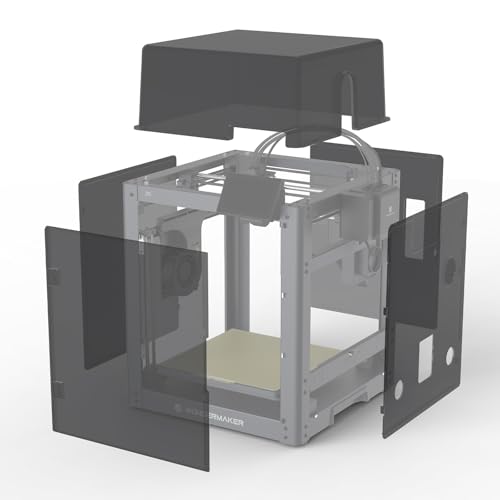
- Built-in filtration with replaceable filter module
- Supports stable temperatures for ABS, ASA, and PETG-CF
- Noise reduction to as low as 46 dB in Silent Mode
Best For: ZR owners printing high-performance filaments
Best for Everyday Use
Phrozen Foldable Enclosure Mega

- Fits large-format printers, resin machines, or curing stations
- Insulated interior helps regulate printing temperature
- Folds flat and assembles without tools
Best For: Large printers and multi-machine workspaces
Best Large Resin Setup
Extra-Large Resin Printer Enclosure

- Fits a printer, curing machine, and cleaning machine
- Transparent window with dust and noise protection
- Flame-retardant fabric and sturdy metal frame
Best For: Large resin-printing workstations
Best DIY IKEA Setup
Modular Lack Table Enclosure Kit

- Plexiglass panels, hardware, and LED light included
- Ventilation-ready with fan, HEPA, and duct options
- Printed parts and IKEA Lack table are not included
Best For: Custom IKEA Lack table workstations
Best Storage Cabinet
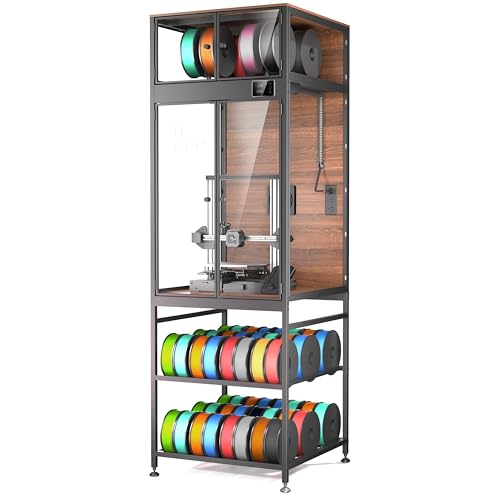
- Stores up to 48 standard filament spools
- Supports four filament feed-throughs
- Includes LED light, thermo-hygrometer, and manual fan
Best For: Multi-filament printing and organized storage
Large-Format Pick – Prusa XL Enclosure
For owners of the Original Prusa XL, this professional 3D printer enclosure is designed for seamless integration with the machine. Its included kit components make setup more straightforward, and the enclosed environment can make printing with certain materials easier.
Best For: Original Prusa XL users who want a purpose-built enclosure and manufacturer support.
Pros:
- Designed specifically for seamless integration with the Original Prusa XL.
- Can make printing with certain materials easier.
- Package includes the plastic parts, so nothing needs to be printed separately.
- Includes lifetime technical assistance and 24-hour professional customer service from Prusa Research.
Cons:
- Ships disassembled as a kit, so assembly is required.
- Its dedicated XL design may be less suitable for other printer models.
The Prusa XL Enclosure is a strong fit when compatibility and manufacturer backing matter more than universal flexibility. Its large footprint also makes it important to confirm available workspace before ordering.
Versatile FDM Pick – Creality Enclosure L
The Creality Enclosure L is a spacious professional 3D printer enclosure for compatible FDM machines, including the CR-10 Smart Pro. It combines thermal retention, dust protection, visibility, and accessory expansion in a large-format design.
Best For: FDM users who want a roomy enclosure with lighting, monitoring, and expansion options.
Pros:
- Helps retain heat and may reduce cracking, warping, and shrinkage.
- Large transparent window and LED light support progress monitoring.
- Fire-resistant and waterproof materials provide added protection.
- Supports add-ons such as an exhaust fan, air purifier, power module, or heater.
Cons:
- Its large 700 × 750 × 900 mm size requires substantial space.
- Accessory expansion components may need to be purchased separately.
With temperature and humidity monitoring, ventilation openings, and a tool bag, this enclosure is practical for a more organized workspace. Verify your printer dimensions and accessory requirements before buying.
Filtration Pick – BD-60A Smoke-Purifying Enclosure
The BD-60A stands out among professional 3D printer enclosures for its integrated smoke and fume purification system. Its enclosure combines noise reduction, heat retention, fire-resistant construction, and multi-stage filtration for compatible open-style and resin printers.
Best For: Users prioritizing built-in particulate and odor filtration across several printer types.
Pros:
- Four-stage filtration uses pre-filters, HEPA, and activated carbon layers.
- Rated to capture 99.97% of particles as small as 0.3 microns, according to the supplied product information.
- Stepless speed control lets users adjust airflow and noise.
- Listed as compatible with numerous Bambu Lab, Creality, ELEGOO, Anycubic, and Flashforge models.
Cons:
- At 55 dB, the purifier is not silent.
- Filter replacement and maintenance will be part of ongoing use.
- Compatibility should still be checked against the printer’s dimensions.
The BD-60A is the most filtration-focused option in this group, with a 22-watt purifier, LED light, smoke pipe, and replacement pre-filters included. Its broad compatibility is useful, but model fit and ventilation setup should be confirmed first.
Resin Value Pick – Ventilated Resin Printer Tent
This multifunctional tent is a compact professional 3D printer enclosure option for many LCD and resin printers. It pairs a UV-blocking viewing window with adjustable ventilation and a three-layer filter system to help manage smoke, fumes, dust, and odors.
Best For: Small resin printers and wash machines such as compatible Photon Mono, Mars, and Halot models.
Pros:
- UV-blocking window allows monitoring while helping protect resin prints from harmful UV rays.
- Adjustable-speed 12V fan system supports customizable ventilation.
- Three-layer filtration is designed to absorb larger dust particles and harmful gases.
- Stainless-steel frame pipes and a larger viewing window improve the updated design.
Cons:
- Requires printing a plastic adapter to replace the steel fan bracket.
- Not water resistant and has no manufacturer warranty listed.
- Printer is not included, and fit must be checked by measuring the full machine.
This enclosure offers a practical tent-style solution for resin-printing setups where UV shielding and adjustable exhaust are priorities. It is especially appealing for smaller machines, provided you are comfortable printing the required adapter.
Best Integrated Filtration – SainSmart x WonderMaker ZR Enclosure
For ZR owners seeking professional 3D printer enclosures, this custom-fit kit combines noise reduction, filtration, and temperature control in a purpose-built cover. Its enclosed design is suited to high-performance filaments such as ABS, ASA, and PETG-CF.
Best For: ZR users printing temperature-sensitive materials in home studios, classrooms, or workshops.
Pros:
- Built-in filtration fan and replaceable filter module help remove odors and fine airborne particles.
- Helps maintain stable heat for ABS, ASA, and PETG-CF printing.
- Reduces operating noise to as low as 46 dB in Silent Mode.
- Magnetic top cover and front door provide convenient access.
Cons:
- Designed specifically for the SainSmart x WonderMaker ZR, limiting compatibility.
- Installation uses a screw-in setup rather than being entirely tool-free.
This is a focused choice for ZR owners who want filtration and a more controlled printing environment without sacrificing easy printer access.
Best for Everyday Use – Phrozen Foldable Enclosure Mega
This oversized Phrozen enclosure is a practical pick among professional 3D printer enclosures when you need room for a large-format FDM printer, resin machine, or curing station. Its insulated, foldable tent design also suits shared workspaces where odor and noise control matter.
Best For: Makerspaces, workshops, and home studios with large printers or multiple machines.
Pros:
- Generous 39.4 x 27.6 x 35.4-inch size fits many large-format printers and equipment.
- Aluminum-lined insulation helps regulate temperature in cold or air-conditioned rooms.
- UV-filtering viewing window supports monitoring while helping prevent premature resin curing.
- Tool-free hook-and-loop assembly folds flat for storage or transport.
Cons:
- Its 20.7-pound weight and large footprint require substantial floor or workspace area.
- The enclosed structure helps control odors and noise but does not list a built-in filtration system.
Choose this model when capacity and portability are more important than a compact, printer-specific fit. The insulated interior is especially useful for maintaining steadier conditions in cooler environments.
Best Monitoring Features – YOOPAI Ender 3 Enclosure
For users comparing professional 3D printer enclosures for an Ender 3-style setup, the YOOPAI combines an LED strip, temperature and humidity monitoring, ventilation, and a six-sided cover. Its broad compatibility makes it useful for several popular FDM printers, provided the dimensions fit.
Best For: Ender 3 and similarly sized FDM printers where visibility, environmental monitoring, and dust protection are priorities.
Pros:
- Built-in LED lighting improves visibility during printing and troubleshooting.
- Temperature and humidity readings help users monitor printing conditions.
- Fire-resistant, dustproof construction helps protect the printer and prints.
- Quick installation and a sturdy structure support long-term use.
Cons:
- Compatibility is limited to printers smaller than 21.6 x 25.6 x 29.5 inches, including spool-holder height.
- Users should measure carefully before ordering because the listed dimensions are a firm size limit.
- The supplied notes do not specify a replaceable air-filter system.
This enclosure stands out for hands-on monitoring: the light and environmental readouts make it easier to inspect prints, while the enclosed structure helps reduce noise and dust.
Best Large Resin Setup – Extra-Large Resin Printer Enclosure
For shoppers comparing professional 3D printer enclosures for resin equipment, the Creality enclosure stands out for its generous footprint and enclosed workspace. Its 1000 × 500 × 1000 mm interior can accommodate a UV curing machine and resin cleaning machine alongside a compatible printer, though measuring your equipment first is essential.
Best For: Resin-printing workstations that need room for a printer, curing machine, and cleaning machine.
Pros:
- Extra-large interior supports multiple resin-processing devices.
- Transparent viewing window lets you monitor prints without opening the enclosure.
- Flame-retardant aluminum foil cloth, metal framing, dust protection, and noise reduction support a cleaner workspace.
- Compatible with Creality Halot, Anycubic Photon Mono, Elegoo Saturn and Mars, and other UV printers.
Cons:
- Its 39.37-inch cube footprint requires substantial floor or bench space.
- Compatibility with curing and cleaning machines depends on their measured dimensions.
- The notes describe a fan interface but do not specify a fan or filtration system as included.
This is a practical choice when capacity and resin-workflow organization matter more than a compact footprint. Confirm your equipment dimensions and plan the enclosure location before ordering.
Best DIY IKEA Setup – Modular Lack Table Enclosure Kit
This DELACK kit is a flexible option for professional 3D printer enclosures built around an IKEA Lack table. It includes plexiglass panels, hardware, and LED lighting, while leaving the printed connectors and accessories to you, making it suited to makers who want a customizable cabinet rather than a fully assembled enclosure.
Best For: DIY users with an IKEA Lack table who want modular lighting, ventilation, and accessory options.
Pros:
- Designed to fit the popular IKEA Lack table setup in a compact 550 × 486 × 450 mm footprint.
- Includes an LED light strip and 5V adapter for monitoring prints inside the enclosure.
- Supports optional 120 mm fans, HEPA filtration systems, and external venting through a 4-inch duct adapter.
- Modular design includes a removable top panel and access to more than 20 printable accessories.
Cons:
- This is a kit only; printed parts and the IKEA Lack table are not included.
- You must print connectors and accessories yourself.
- Ventilation hardware and filtration systems are optional rather than identified as included.
The DELACK is appealing for a hands-on setup where customization and future upgrades are priorities. Budget for the table, printed parts, and any ventilation components needed for your workspace.
Best Storage Cabinet – 48-Spool 3D Printer Enclosure
For professional 3D printer enclosures that also organize a larger filament collection, the Crafit cabinet combines a printer compartment with dedicated spool storage. It is sized for many popular printers, includes lighting and ventilation, and uses a carbon steel frame with composite walls for a stable, enclosed printing environment.
Best For: Multi-filament users who need printer enclosure space, feed-through routing, and substantial spool storage.
Pros:
- Internal dimensions are designed to fit printers such as the Bambu Lab P1S/X1, Creality K1 Max, and Ender 3 series; measure first.
- Top storage holds up to 8 spools, while the base rack holds up to 48 standard spools.
- Feed-through ports support up to four filaments for multi-material or color-switching setups.
- Includes LED lighting, a thermo-hygrometer, PET viewing panels, and a manually controlled high-flow fan.
Cons:
- At 23 × 23 × 70 inches and 66 pounds, it is large and heavy.
- The stated printer fit is limited to units up to 21.6 × 22 × 28.7 inches, so measurements are necessary.
- Manual fan operation requires the user to manage ventilation and print-environment settings.
This cabinet is a strong fit for organized, multi-color workflows where storage is as important as enclosure performance. Its tall profile and 66-pound weight make placement planning especially important.
How We Picked the Best Professional 3D Printer Enclosures
We evaluated these enclosures against the features that matter most in demanding home, studio, classroom, and small-business environments. Our comparison emphasizes printer compatibility, usable interior dimensions, access to controls and filament, temperature management, ventilation, filtration, lighting, noise reduction, and overall practicality.
We also considered whether each design suits a specific printer or offers flexible space for multiple machines and accessories. A printer-specific enclosure can provide a cleaner fit, while a larger universal cabinet or tent may be a better long-term choice if your equipment changes.
Quick Comparison
| Best For | Look For | Typical Advantage |
|---|---|---|
| Large-format printing | Generous dimensions and sturdy structure | More room for tall or wide machines |
| Odor and particle control | Fan interface, filtration, or purifier | Improved air management |
| Stable FDM printing | Heat-insulated panels and enclosed access | Fewer drafts and steadier temperatures |
| Compact workspaces | Printer-specific sizing and foldable construction | Less wasted floor space |
| Organized production | Shelves, spool storage, lighting, and ventilation | Cleaner, faster workflow |
Key Buying Factors for Professional 3D Printer Enclosures
Size and Printer Compatibility
Measure the printer, spool position, cable clearance, and door swing—not just the machine’s published dimensions. Leave room for maintenance and airflow. Large-format printers and multi-tool setups need extra clearance, while a close-fitting enclosure is often more efficient for a single compact printer.
Ventilation and Filtration
Ventilation helps manage heat and airborne contaminants, but it should not simply recirculate fumes into the room. Check whether the enclosure supports ducting, an external exhaust, a replaceable filter, or a built-in purifier. Resin printing generally requires especially careful ventilation and appropriate room-level safety measures.
Temperature, Materials, and Construction
Insulated fabric or rigid panels can reduce drafts and help maintain a more stable printing environment. Look for flame-resistant materials where specified, strong frames, reliable zippers or doors, and panels that can tolerate routine access. An enclosure should support temperature control rather than trap excessive heat around electronics.
Access, Noise, and Workflow
Viewing windows, LED lighting, cable openings, and accessible controls make daily use easier. Storage racks and shelves are valuable for production work, but confirm that they do not block ventilation or overload the frame. Sound-dampening covers can reduce fan and motion noise, although they will not make a printer silent.
Who Should Buy Which Professional 3D Printer Enclosures?
Choose a printer-specific enclosure if you have limited space or want the simplest fit for a known model. Select a large insulated tent when you need flexibility, portability, or room for a bigger FDM printer. A cabinet with storage is better for organized production and filament-heavy workflows. If odors or airborne particles are your primary concern, prioritize a model with a genuine filtration system or a compatible external ventilation path.
Before buying, verify your printer model, enclosure dimensions, ventilation plan, and local safety requirements. The best Professional 3D Printer Enclosures are the ones that fit your equipment, support the materials you print, and make routine operation easier without compromising airflow or access.
