
The best premium network switches combine dependable throughput with the management features, PoE capacity, and uplink flexibility modern networks require.
We’ve selected 10 options spanning compact 10GbE switches, high-power PoE models, and expandable managed platforms, making it easier to match your infrastructure and budget.
Best 10 Premium Network Switches Picks for 2026
Best for UniFi PoE Deployments

- 48 Gigabit PoE+ ports
- Four 10G SFP+ uplinks
- Managed Layer 2/3 features
Best For: Large UniFi networks with powered devices
Best for Enterprise PoE Access

- 48 Gigabit PoE/PoE+ ports
- 370W Class 4 power budget
- Four 1G SFP uplinks
Best For: High-density enterprise PoE access
Best for 10G Aggregation

- Twelve SFP+ and four RJ45 ports
- 1G/10G connectivity
- 160 Gbps non-blocking throughput
Best For: High-speed switch and server aggregation
Best for Quiet Multi-Gig PoE

- Four 2.5GbE PoE++ ports
- Two 10G SFP+ uplinks
- Fanless, flexible mounting
Best For: Quiet compact UniFi PoE deployments
Best 8-Port 10G Switch

- Eight 10G/multi-gigabit RJ45 ports
- Up to 160 Gbps switching capacity
- Plug-and-play desktop or rackmount design
Best For: Expanding a high-speed wired network with eight ports
Best High-Capacity PoE Switch
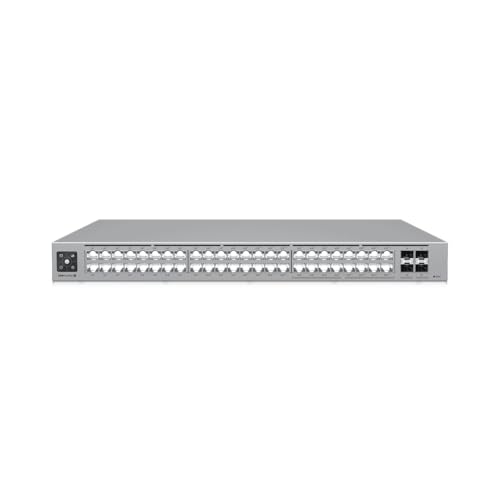
- 48 ports with 720W PoE availability
- Includes 2.5 GbE and four 10G SFP+ ports
- Managed through UniFi Network
Best For: Large UniFi deployments with many PoE devices
Best Fanless 10G Switch

- Five 10G/multi-gigabit RJ45 ports
- Fanless design for quiet operation
- Desktop or wall-mounting installation
Best For: Small, quiet 10G and multi-gigabit networks
Powerhouse PoE Core

- 24 Gigabit RJ45 ports
- 250W PoE+ capacity
- Two 1Gbps SFP ports
Best For: Rack-mounted networks with multiple PoE devices and SFP uplinks
Easy Managed PoE Value

- 24 PoE+ Gigabit ports
- 250W total PoE budget
- VLAN and auto-recovery features
Best For: Small-business networks needing simple management and dependable PoE
UniFi Ecosystem Pick

- 24 Gigabit ports
- PoE+ and SFP interfaces
- Metal, rack-friendly chassis
Best For: UniFi-oriented offices using access points, cameras, phones, and storage
Best for UniFi PoE Deployments – 48-Port UniFi Pro PoE Switch
For larger installations needing centralized control, this premium network switch combines 48 Gigabit PoE+ ports with four 10G SFP+ uplinks. Its managed Layer 2/3 feature set and UniFi integration make it a practical choice for expanding access points, cameras, and VoIP devices.
Best For: Large UniFi-based networks that need extensive PoE capacity and fast backbone uplinks.
Pros:
- 48 RJ-45 Gigabit ports support IEEE 802.3af/at PoE and PoE+.
- Four SFP+ 10G uplinks provide high-speed aggregation.
- Managed features include VLANs, spanning tree, 802.1X, RADIUS, DHCP, and port mirroring.
- Rack-mountable 1U design integrates with the UniFi Network application.
Cons:
- Its 48-port rack design may be more hardware than smaller networks require.
- PoE support is most useful when connected devices need powered Ethernet.
This is a strong premium network switch for organizations already using UniFi or planning a sizable managed PoE deployment. The combination of port count, 10G uplinks, and centralized management gives it room to support network growth.
Best for Enterprise PoE Access – Aruba 6000 48G PoE Switch
The Aruba 6000 is a premium network switch built around 48 Gigabit PoE/PoE+ ports and a 370W Class 4 power budget. Four 1G SFP ports add fiber connectivity, while the console and host ports support installation and administration tasks.
Best For: Enterprise access networks that need many PoE endpoints and a substantial fixed power budget.
Pros:
- Provides 48 10/100/1000BASE-T ports with Class 4 PoE/PoE+ support.
- 370W total power capacity supports a broad range of powered devices.
- Four 1G SFP ports provide fiber uplink options.
- Includes USB-C console and USB Type-A host ports.
Cons:
- The SFP uplinks are 1G rather than 10G.
- Fixed power supply and fixed fans limit hardware flexibility.
- Its enterprise-oriented design may be excessive for a small office.
Choose this model when PoE reach and port density matter more than multi-gigabit uplinks. It offers a straightforward fixed configuration for deployments centered on Gigabit access connections.
Best for 10G Aggregation – UniFi US-16-XG 10G Switch
This premium network switch is designed for high-speed aggregation rather than powering endpoints. It provides 12 1G/10G SFP+ ports and four 1G/10G RJ45 ports, with non-blocking throughput suited to connecting servers, uplinks, and other network switches.
Best For: Rack-based network aggregation requiring multiple 10G fiber and copper connections.
Pros:
- Offers 16 total ports with flexible SFP+ and RJ45 connectivity.
- Supports 1G and 10G connections across both port types.
- Rated for 160 Gbps non-blocking throughput and 320 Gbps switching capacity.
- Rack-mount brackets are included.
Cons:
- It does not provide PoE output.
- Its managed feature set is specified as Layer 2 rather than Layer 3.
- The 16-port layout may not suit large access-layer deployments.
The US-16-XG is a focused aggregation option for networks moving substantial traffic between switches and servers. Its mix of fiber and copper 10G ports makes it more suitable for a core or distribution role than for directly powering edge devices.
Best for Quiet Multi-Gig PoE – UniFi Pro Max 16-PoE
For compact deployments, this premium network switch pairs four 2.5GbE PoE++ ports with twelve Gigabit PoE+ ports and two 10G SFP+ uplinks. Its fanless cooling and desktop, wall, or rack mounting options make it flexible for offices and edge installations.
Best For: Quiet UniFi deployments with multi-gigabit access points, cameras, or other powered network devices.
Pros:
- Four 2.5GbE PoE++ ports support faster powered connections.
- Twelve additional Gigabit PoE+ ports expand endpoint capacity.
- Two 10G SFP+ ports provide high-speed uplinks.
- Fanless cooling and versatile mounting support quieter installations.
Cons:
- Its 180W PoE availability is lower than larger high-density switches.
- Only four ports provide 2.5GbE connectivity.
- It has 16 ports, so it may not fit larger access-layer deployments.
This model is a practical premium network switch for smaller sites that still benefit from multi-gigabit networking. The fanless design and flexible mounting are especially useful where noise and placement options matter.
Best 8-Port 10G Switch – TP-Link TL-SX1008
The TP-Link TL-SX1008 is a strong choice among premium network switches when you need several high-speed wired connections without configuring a managed network. Its eight RJ45 ports support 100Mb, 1G, 2.5G, 5G, and 10G links, making it suitable for mixed-speed devices such as a 10G NAS, server, gaming PC, or Wi-Fi access point.
Best For: Homes, offices, and workstations that need eight flexible 10G or multi-gigabit connections.
Pros:
- Eight 10G/multi-gigabit ports with up to 160 Gbps of switching capacity
- Auto-negotiates across five link speeds for broad device compatibility
- Plug-and-play setup with a sturdy metal desktop/rackmount design
- Smart fan and IEEE 802.3X flow control support quieter, reliable operation
Cons:
- Unmanaged design does not provide advanced network configuration
- Active cooling may be less silent than a fanless switch
Choose the TL-SX1008 if you want high port density and 10G performance with minimal setup. Its rackmount-ready metal enclosure also gives it more installation flexibility than a basic desktop switch.
Best High-Capacity PoE Switch – Ubiquiti USW-Pro-Max-48-PoE
The Ubiquiti USW-Pro-Max-48-PoE is a premium network switch for larger installations that need many connected devices and centralized power delivery. It combines 48 ports with 2.5 GbE connectivity, PoE+ and PoE++ output, four 10G SFP+ ports, and UniFi Network management.
Best For: Larger UniFi networks, offices, and installations with numerous access points, cameras, or other PoE devices.
Pros:
- 48-port design with 720W of total PoE availability
- Includes 16 2.5 GbE ports and four 10G SFP+ ports
- Supports both PoE+ and PoE++ output across the port array
- Etherlighting indicates port location, link or speed, and native VLAN/network
Cons:
- Large, heavy rack-oriented unit at 13.7 pounds
- Requires UniFi Network 8.0.24 or later for management
- Supplied details list a six-month manufacturer warranty
This switch makes the most sense when port count, PoE capacity, and UniFi integration matter more than a compact footprint. Its SFP+ uplinks and 2.5 GbE ports provide room for a demanding, expandable network.
Best Fanless 10G Switch – TP-Link TL-SX105
The TP-Link TL-SX105 is a practical premium network switch for smaller high-speed setups. Its five RJ45 ports support 100Mb through 10G connections, while the fanless enclosure keeps operation quiet for desktops, offices, media spaces, and other noise-sensitive locations.
Best For: Small networks connecting a 10G NAS, workstation, gaming PC, server, or multi-gigabit access point.
Pros:
- Five 10G/multi-gigabit ports with up to 100 Gbps of switching capacity
- Auto-negotiates between 100Mb, 1G, 2.5G, 5G, and 10G
- Fanless design provides quiet operation
- Compact metal desktop or wall-mounting design with plug-and-play setup
Cons:
- Five ports may be limiting for larger installations
- Unmanaged operation lacks advanced configuration features
The TL-SX105 is a good fit when you want 10G flexibility without fan noise or complicated installation. It offers a straightforward way to connect a handful of fast devices while leaving room for mixed-speed hardware.
Powerhouse PoE Core – EdgeSwitch 24 250W
Ubiquiti Networks EdgeSwitch 24 250W (ES-24-250W) Managed PoE+ Gigabit Switch with SFP,Black
Check Price On AmazonFor buyers comparing premium network switches, the Ubiquiti EdgeSwitch 24 250W combines 24 Gigabit Ethernet ports with PoE+ support and two 1Gbps SFP ports. Its 26Gbps non-blocking throughput and 250W maximum power consumption make it suitable for demanding wired networks with multiple powered devices.
Best For: Rack-mounted offices, surveillance deployments, and networks needing substantial PoE capacity with SFP uplinks.
Pros:
- 24 10/100/1000Mbps RJ45 ports support Gigabit connectivity.
- 250W maximum power capacity supports PoE+ deployments.
- Two 1Gbps SFP ports provide fiber or high-speed uplink options.
- 26Gbps non-blocking throughput supports busy network traffic.
Cons:
- Its 19.1-inch rack-oriented chassis may be larger than needed for compact setups.
- At 3.7kg, it is relatively substantial for a 24-port switch.
The EdgeSwitch 24 250W is a strong fit when PoE headroom, Gigabit port density, and SFP connectivity matter more than minimizing chassis size or weight.
Easy Managed PoE Value – TP-Link TL-SG1428PE
The TP-Link TL-SG1428PE is one of the more approachable premium network switches for buyers who want managed features without a complicated setup. It provides 24 PoE+ Gigabit ports, two additional non-PoE Gigabit ports, two SFP slots, VLAN features, and a 250W PoE budget.
Best For: Small businesses and installers wanting straightforward web management, traffic segmentation, and automated PoE device recovery.
Pros:
- 24 PoE+ ports provide up to 30W per port.
- 250W total PoE budget supports multiple powered endpoints.
- VLAN, QoS, IGMP, and link aggregation features support flexible network management.
- Auto recovery can detect and reboot dropped or unresponsive PoE devices after configuration.
Cons:
- The listed 1Gbps transfer rate does not provide multigigabit switching.
- Auto recovery requires configuration before it can operate.
- The 17.3-inch metal chassis still requires suitable rack or shelf space.
With a web-based management interface, generous PoE capacity, and VLAN support, the TL-SG1428PE offers a practical balance for users who want useful controls without a difficult installation process.
UniFi Ecosystem Pick – USW-24-POE Layer 2 Switch
The Ubiquiti UniFi USW-24-POE is a practical choice among premium network switches for installations built around PoE+ endpoints and Gigabit connectivity. Its 24-port design includes RJ45, PoE+, and SFP interfaces in a metal chassis suited to offices and equipment rooms.
Best For: UniFi-oriented offices and networks connecting access points, IP cameras, VoIP phones, servers, and storage devices.
Pros:
- 24-port Gigabit design supports a broad range of wired devices.
- PoE+ connectivity can serve compatible access points, cameras, and phones.
- SFP and RJ45 interfaces provide flexible connection options.
- Metal chassis and rack-friendly dimensions suit structured installations.
Cons:
- The supplied specifications identify it as a Layer 2 switch rather than a Layer 3 model.
- The notes do not specify total PoE budget or per-port power output.
- Its listed one-year manufacturer warranty is shorter than some competing coverage options.
The USW-24-POE makes the most sense when you need a compact 24-port PoE+ switch with SFP connectivity and compatibility across common office and network-device categories, while accepting the limits of the supplied power details.
How We Picked the Best Premium Network Switches
We evaluated these Premium Network Switches by looking at port count, Ethernet speed, PoE support, switching capacity, uplink options, management features, and practical deployment fit. The selection includes unmanaged multi-gig switches for straightforward speed upgrades, as well as managed Layer 2 and Layer 3-capable models for VLANs, traffic control, monitoring, and larger installations.
We also considered power budgets and expansion potential. A switch that supports today’s access points and cameras but lacks sufficient PoE headroom or faster uplinks may become a bottleneck as your network grows.
Quick Comparison
- Best for large PoE deployments: 48-port managed switches with generous power budgets and SFP+ uplinks.
- Best for 10GbE expansion: Compact TP-Link and Ubiquiti aggregation switches with multi-gig or 10GbE ports.
- Best for smaller installations: 5- or 8-port unmanaged switches that add high-speed connectivity without configuration overhead.
- Best for balanced office networks: 16- and 24-port managed PoE models with centralized monitoring and VLAN support.
Key Buying Factors for Premium Network Switches
Port Speed and Uplinks
Gigabit ports remain suitable for many clients, but 2.5GbE, 5GbE, and 10GbE ports can improve performance for Wi-Fi 6E or Wi-Fi 7 access points, servers, network storage, and editing workstations. Check whether advertised 10GbE connectivity is available on every port or only on dedicated uplinks.
PoE Standard and Power Budget
PoE+ supports many access points, phones, cameras, and IoT devices. Confirm the switch’s total wattage as well as its per-port limits. A high port count does not guarantee that every connected device can receive full power simultaneously.
Management and Installation
Unmanaged switches are simple plug-and-play choices. Smart and fully managed models add VLANs, link aggregation, quality-of-service controls, diagnostics, and monitoring. Consider whether you prefer a vendor ecosystem, local web management, or centralized cloud administration.
Noise, Size, and Reliability
Rack-mount switches with active cooling may be ideal for wiring closets but unsuitable for quiet offices or living spaces. Review dimensions, fan behavior, warranty coverage, and operating temperature before installation.
Who Should Buy Which Premium Network Switches?
Choose an unmanaged 5- or 8-port multi-gig model for a small office, media room, or workstation cluster where simplicity matters most. A 16-port managed PoE switch suits growing homes and small businesses that need VLANs, access-point power, and room for expansion. For surveillance systems, dense wireless deployments, or larger offices, select a 24- or 48-port managed switch with a substantial PoE budget and SFP+ uplinks.
Finally, prioritize ecosystem compatibility. If your network already uses a unified management platform, staying within that platform can simplify provisioning and troubleshooting. If you only need faster wired connections, a standards-based unmanaged switch may deliver the best value with less complexity.
