
Premium electronic wind instruments make it easier to practice quietly, trigger modern sounds, and perform with flexible MIDI control. They’re a smart choice for players who want sax-style expression without the maintenance of an acoustic horn.
In this roundup, we focus on models that balance tone options, fingering layouts, connectivity, portability, and overall playability so you can choose the right instrument for your level and goals.
Best 10 Premium Electronic Wind Instruments Picks for 2026
Professional Flagship

- 300+ acoustic, electronic, and world sounds
- SuperNATURAL and ZEN-Core sound engines
- Bluetooth, USB MIDI, and traditional MIDI
Best For: Experienced players needing a top-tier, expressive digital wind instrument
Feature-Rich Midrange
AP 100 Electronic Wind Instrument

- Programmable keys and voice announcements
- Breath-sensitive control for natural dynamics
- OTG connection plus dual timbres
Best For: Players who want an accessible, customizable wind instrument for practice and recording
Travel-Friendly Entry Pick
EX Electric Digital Wind Instrument

- 12 tones with three fingering modes
- Bluetooth MIDI and rechargeable power
- Built-in speaker plus headphones support
Best For: Beginners and students who want a simple, portable digital wind instrument
Performance-Grade Value
- 68 built-in sounds for broad use
- Built-in OTG recording support
- 5W speaker with rechargeable design
Best For: Performers wanting a compact wind synth with onboard output and recording
Studio-Ready Performer
- 72 timbres with quick tone switching
- LCD display shows key playing info
- 8-12 hour battery with speaker output
Best For: Players wanting a flexible EWI for practice and performance
Bluetooth Practice Pick

- Bluetooth audio and Bluetooth MIDI support
- LCD display for tones, volume, and keys
- Built-in OTG recording with 4 tone libraries
Best For: Players who want wireless connectivity and easy recording
Pro Controller Choice

- 200 built-in acoustic and synth sounds
- USB MIDI controller with OLED display
- 12+ hour battery and built-in speaker
Best For: Expressive players who also want MIDI control
Pro Feature Pick
Costzon Mini Digital Electric Saxophone

- 100 tones with flute and saxophone fingerings
- Wireless MIDI for Android, iOS, Mac, and Windows
- Up to 12 hours of rechargeable play time
Best For: Players who want a flexible, feature-packed portable EWI
Beginner-Friendly Choice

- 26 timbres with a 5-octave range
- 4 fingering modes and 3 vibrato modes
- USB-C charging with built-in speaker
Best For: Beginners who want an easy digital wind instrument with room to grow
Budget MIDI Option
KONIX DC02 Pro Digital Wind Instrument

- 10 tones with sax, flute, clarinet, and more
- MIDI support for major platforms and apps
- Built-in speaker and headphone connection
Best For: Beginners who want a compact EWI with MIDI and simple practice features
Professional Flagship – Roland AE-30 Aerophone Pro
If you want premium electronic wind instruments with the most complete feature set in this group, the Roland AE-30 Aerophone Pro is built for expressive playing and broad sound design. It combines traditional saxophone fingering, low-latency controls, and Roland’s advanced sound engines, making it a strong fit for players who want a polished stage or studio tool.
Best For: Experienced players who want a highly expressive, full-featured digital wind instrument with advanced connectivity.
Pros:
- More than 300 acoustic, electronic, and world sounds for wide musical coverage
- SuperNATURAL tone modeling and ZEN-Core synthesis for realistic and synth-style tones
- Low-latency sensors and traditional saxophone fingering for responsive playability
- Bluetooth audio/MIDI, USB MIDI, and traditional MIDI ports for flexible setup
Cons:
- At 9.3 pounds, it is less lightweight than simpler travel-friendly options
- Its deeper feature set may be more than a casual beginner needs
The AE-30 stands out as the most advanced option here, especially if you value depth, responsiveness, and connectivity over simplicity. For premium electronic wind instruments, it is the clear pick when you want one instrument that can cover acoustic realism, synth sounds, and performance control.
Feature-Rich Midrange – AP 100 Electronic Wind Instrument
The AP 100 is a practical choice in premium electronic wind instruments if you want useful features without going into a flagship-level price class. Its programmable keys, breath-sensitive voice control, and built-in voice announcements make it especially approachable for players who like guided operation and customizable controls.
Best For: Players who want an easy-to-use, customizable digital wind instrument with modern practice and recording features.
Pros:
- Programmable function keys that can be assigned to several playing functions
- Breath-sensitive voice control for more natural dynamics and expression
- Built-in voice announcements to help with tone and function changes
- OTG support and dual timbres for direct device connection and layered sounds
Cons:
- Sound library is limited to 80 built-in tones
- Less detailed sound-design depth than more advanced premium models
Overall, the AP 100 focuses on convenience, flexibility, and accessibility. If you want premium electronic wind instruments that are easy to learn and still offer useful performance tools, this model delivers a balanced feature set.
Travel-Friendly Entry Pick – EX Electric Digital Wind Instrument
The EX Electric Digital Wind Instrument is a compact option for buyers comparing premium electronic wind instruments but still wanting straightforward features. With 12 tones, three fingering modes, and a built-in speaker, it is designed to be easy to pick up, practice with, and connect to music apps over Bluetooth MIDI.
Best For: Beginners, students, and casual players who want a simple rechargeable wind instrument with app connectivity.
Pros:
- 12 onboard tones covering common voices like flute, clarinet, trumpet, and saxophone
- Three fingering modes to suit different playing preferences
- Bluetooth MIDI for app use and wireless music production
- Built-in speaker, headphones support, and rechargeable battery for flexible practice
Cons:
- Fewer tones than more advanced premium models
- Less oriented toward deep stage performance or sound design
This model makes sense if you want a manageable entry point with useful everyday features. Among premium electronic wind instruments, it is the most approachable choice for learning, practice, and simple mobile-connected playing.
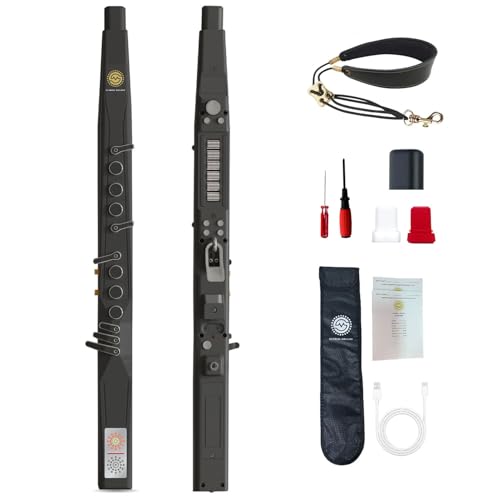
Performance-Grade Value – MK EWI 68 Sounds
The MK EWI is aimed at players who want premium electronic wind instruments with a performance-first design. It offers 68 sounds, built-in OTG recording, a rechargeable battery, and a high-power cavity speaker, giving it a practical mix of playability and useful output features.
Best For: Performing players who want a compact wind synth with built-in sound output and recording support.
Pros:
- 68 built-in sounds for a wider palette than basic entry-level models
- Built-in OTG recording for direct capture and workflow convenience
- 5W high-power cavity speaker for onboard playback
- Compact, rechargeable design with OTG connectivity
Cons:
- Sound details and control options are not as extensive as flagship models
- Product notes provide less information on fingering layouts and expression tools
If you want a compact instrument that still feels oriented toward performance, the MK EWI is worth a look. It balances portability with useful built-in features, making it a strong practical pick among premium electronic wind instruments.
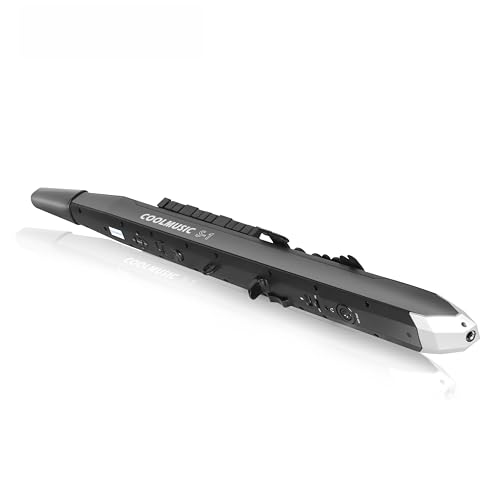
Studio-Ready Performer – Coolmusic S1 Wireless EWI
If you want premium electronic wind instruments with a feature set built for practice and live use, the Coolmusic S1 leans into convenience and control. It offers 72 timbre options, multiple fingering support, an LCD smart display, and onboard speaker output, so you can play, monitor settings, and switch sounds quickly.
Best For: Players who want a portable EWI with lots of timbre options, onboard monitoring, and practical performance features.
Pros:
- 72 timbre options with one-touch tone conversion and user timbre library support
- LCD smart display shows timbre, tone, volume, fingering, battery, and octave status
- Built-in high-power full-frequency speakers plus earphone monitoring for practice
- 8-12 hour built-in battery with Type-C charging support
Cons:
- Feature-rich layout may feel more complex than a simple beginner model
- Wireless and expansion features may be more than casual users need
The S1 is a strong pick if you want an all-in-one electronic wind instrument that covers performance, home practice, and easy sound switching. Its mix of display feedback, battery life, and output options makes it especially practical for players who value flexibility.
Bluetooth Practice Pick – AP 300 Pro Digital Saxophone
For buyers comparing premium electronic wind instruments, the AP 300 Pro focuses on modern connectivity and straightforward operation. Its LCD display, dual-mode Bluetooth audio and MIDI support, built-in OTG recording, and four tone libraries make it a practical option for practice, recording, and wireless playback.
Best For: Musicians who want wireless playback, MIDI connectivity, and simple setup in an electronic wind instrument.
Pros:
- Dual-mode Bluetooth supports both audio and MIDI connections
- LCD display clearly shows tones, volume, and key settings
- Built-in OTG recording helps capture cleaner sound without external noise interference
- 8 fingering options and four independent tone libraries add flexibility
Cons:
- Battery life is listed at up to 6 hours, which is shorter than some rivals
- Sound library depth is more limited than models with larger preset counts
The AP 300 Pro is best viewed as a convenience-first EWI for players who want quick wireless access and easy tone handling. It should suit users who prioritize connectivity and basic performance tools over deep preset exploration.
Pro Controller Choice – Akai EWI Solo
The Akai Professional EWI Solo stands out among premium electronic wind instruments for players who want a self-contained instrument and USB MIDI controller in one. With 200 built-in acoustic and synth sounds, a built-in speaker, OLED display, and expressive mouthpiece sensors, it is geared toward detailed control and flexible sound design.
Best For: Players who want a high-feature EWI for sound shaping, expressive control, and MIDI use.
Pros:
- 200 built-in premium acoustic and synth sounds
- USB MIDI support for software instrument control
- 12+ hour rechargeable battery and built-in speaker
- Responsive mouthpiece with air-pressure and bite sensors for expression
Cons:
- May be more advanced than players who only need basic practice features
- Feature depth can make it less immediately simple than entry-level options
This is the most controller-oriented option in the group, especially if you want to shape sound and perform with more expressive nuance. Its broad sound set and MIDI role make it a strong match for players who expect more than a basic wind instrument.
Pro Feature Pick – Costzon Mini Digital Electric Saxophone
If you want premium electronic wind instruments with a lot of control in a compact body, this Costzon model is built to feel flexible right away. It combines 100 tones, flute and saxophone fingerings, MIDI support, and a strong set of expression tools, making it a practical option for practice, experimenting with sounds, or playing through apps and DAWs.
Best For: Players who want a feature-rich portable EWI for practice, MIDI use, and sound exploration.
Pros:
- 100 tones, 2 fingerings, and a 4-octave range for broad sound coverage
- Wireless MIDI works with Android, iOS, Mac, and Windows devices
- Built-in 3W Hi-Fi speaker plus headphone jack for flexible practice
- 800mAh rechargeable battery with up to 12 hours of play time
Cons:
- Its many settings may take time to learn if you want a simple plug-and-play setup
- Best suited to players who will use the extra tones and controls, since that is a big part of its value
Overall, this is a strong choice if you want premium electronic wind instruments that emphasize versatility, portability, and MIDI connectivity. The included accessories and long battery life make it especially practical for travel, practice, and casual performance.
Beginner-Friendly Choice – M1 Electronic Wind Instrument
The M1 is a smart entry point if you are shopping for premium electronic wind instruments that are easier to approach without feeling limited. It offers 26 timbres, 5 octaves, 4 fingering modes, and 3 vibrato modes, so beginners can learn comfortably while still having room to explore different sounds and styles.
Best For: Beginners and casual players who want an easy-to-use digital saxophone with plenty of sound options.
Pros:
- 26 timbres across 5 octaves for wide sound variety
- 4 fingering modes help accommodate different playing preferences
- 3 vibrato modes add expressive control
- USB-C charging and a built-in speaker make practice convenient
Cons:
- It focuses on beginner-friendly usability more than advanced connectivity features
- Battery capacity is listed, but no long runtime claim is provided in the notes
For players who want a straightforward, versatile instrument to build confidence on, the M1 makes sense. It keeps the setup simple while still offering enough timbres and performance controls to stay useful as skills grow.
Budget MIDI Option – KONIX DC02 Pro Digital Wind Instrument
If you are comparing premium electronic wind instruments and want a compact model with useful core features, the KONIX DC02 Pro keeps things focused. It includes 10 tones, two playing styles, adjustable blowing sensitivity, built-in speaker output, headphone support, and MIDI connectivity for expanding sounds through apps and DAW software.
Best For: Budget-minded beginners who want MIDI support and a compact practice instrument.
Pros:
- 10 built-in tones covering saxophone, flute, clarinet, trumpet, and more
- MIDI connectivity for Android, iOS, macOS, and Windows devices
- Two fingerstyle options and adjustable blowing sensitivity
- Built-in speaker plus headphone jack for practice flexibility
Cons:
- Only 10 tones, so the onboard sound set is smaller than some rivals
- Battery life is listed at 4 hours, which is shorter than some alternatives
This is a practical pick if you value portability and MIDI expansion over a long feature list. It is especially appealing for newcomers who want an affordable, easy-to-carry EWI with enough tools to learn and experiment.
How We Picked These Premium Electronic Wind Instruments
We looked for instruments that offer a strong mix of expressive response, reliable build quality, useful sound libraries, and practical features like rechargeable power, headphone use, MIDI support, and multiple fingering modes. For Premium Electronic Wind Instruments, the best choices are the ones that feel musical first and digital second.
Quick Comparison
Before buying, compare sound count, fingering support, octave range, speaker quality, battery life, and whether the instrument is geared more toward stage performance, home practice, or beginner learning. Some models prioritize realism and control, while others emphasize portability and a broad built-in sound set.
Key Buying Factors for Premium Electronic Wind Instruments
Fingering and Response
Look for models that support familiar sax or recorder-style fingerings if you want an easier transition from acoustic winds. Responsive breath control and stable pitch tracking matter more than raw sound count.
Sound Library and Tone Flexibility
A larger number of tones can be useful, but quality and usability matter more than quantity. The best Premium Electronic Wind Instruments offer sounds you will actually use, plus transpose or vibrato controls for performance shaping.
Connectivity and Recording
MIDI output, Bluetooth, USB-C, and OTG recording can make an instrument much more versatile for home production and live setups. If you plan to use software instruments, confirm compatibility before buying.
Power, Portability, and Monitoring
Rechargeable batteries, built-in speakers, and headphone output each serve different needs. Street performers and practice users may want portability and speaker volume, while studio players may care more about silent monitoring and digital integration.
Who Should Buy Which Premium Electronic Wind Instruments?
Beginners should focus on ease of use, forgiving fingering modes, and simple controls. Intermediate players often benefit from broader tone options and better breath expression. Advanced users and performers should prioritize response, MIDI control, ergonomics, and reliability over extra novelty sounds.
If you want the most balanced shopping approach, choose the instrument that fits your playing environment first, then compare sound variety and connectivity. That is usually the fastest way to find the right Premium Electronic Wind Instruments for practice, recording, or live performance.
