
Choosing the right audio network gear can make a studio, install, or hybrid workflow far easier to manage. The best premium audio-over-IP interfaces combine reliable connectivity, clean conversion, and flexible routing.
In this roundup, we focus on 10 standout options for Dante, AES67, Thunderbolt, USB, MADI, and networked audio setups, so you can match the interface to your workflow with confidence.
Best 10 Premium Audio-Over-IP Interfaces Picks for 2026
Dante/MADI Routing Interface
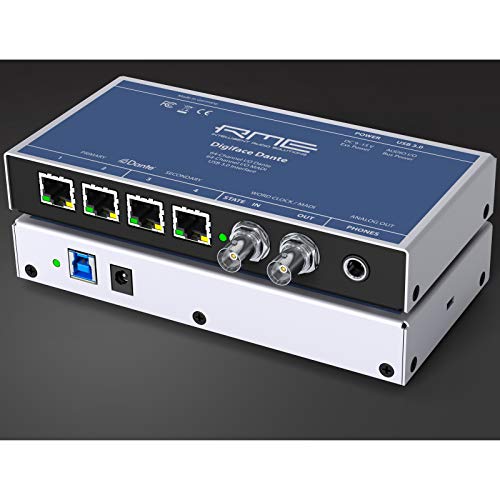
- 128-in/128-out Dante, MADI, and USB 3.0 routing
- 24-bit/192kHz support with word clock I/O
- Headphone output and bus power for flexible use
Best For: large Dante or MADI studio routing
Analog-to-IP Encoder

- Encodes analog RCA input to MP3 and PCM formats
- Supports VBR, CBR, G.711, uLaw, and aLaw
- RJ45 10/100 networking with link/activity LEDs
Best For: analog audio streaming over IP
USB-to-Dante Adapter

- 2-channel USB audio bridge for Dante networks
- AES67 compliant for interoperability
- 24-bit audio up to 96kHz with plug-and-play setup
Best For: compact USB-to-Dante bridging
DSP Recording Interface

- Unison preamps with classic console emulations
- 200+ UAD DSP and Native plug-ins included
- Monitor correction, Auto-Gain, and bass management tools
Best For: recording and mixing with DSP
Optical Dante Network Encoder
ToVi DXA-Opt-TX 2CH TOSLINK Encoder

- Converts 2-channel TOSLINK/SPDIF to Dante.
- Dante Ultimo 2×2 with low-latency design.
- AES67-ready with up to 192kHz/24-bit input.
Best For: Optical source conversion into Dante/AES67 networks
Premium Thunderbolt Studio Interface
Apollo x6 Gen 2 Thunderbolt 3 Interface

- Next-gen conversion with wide dynamic range.
- Access to 200+ UAD DSP and Native plug-ins.
- Auto-Gain and bass management simplify setup.
Best For: Premium studio recording and monitoring
Dante Stereo Network Bridge
RDL SF-BNC2 Bidirectional Stereo Interface

- Two inputs and two outputs for stereo Dante I/O.
- RCA and 3.5 mm jacks for simple connections.
- PoE-powered with no special setup software.
Best For: Unbalanced stereo devices needing Dante network access
Studio-Grade Multichannel MADI
RME MADIface USB Audio Interface

- 2 x MADI I/O in optical and coax formats
- Supports up to 64 channels at 192 kHz
- Includes TotalMix FX management software
Best For: Engineers needing a compact USB interface with MADI and high channel count
PoE Dante Breakout Box
Dante Audio 4 Channel Analog Audio Network Interface Box

- Four 3-pin XLR analog inputs
- Supports Dante and AES67 RTP transport
- Runs on PoE class 0 or Type-C power
Best For: Fixed installs needing a compact four-channel Dante endpoint
High-End Thunderbolt Conversion
Universal Audio Apollo x8p Gen 2 with UAD Analog Classics Thunderbolt 3 Audio Interface

- 8-channel Thunderbolt 3 interface with 192 kHz support
- Access to 200+ UAD DSP and Native plug-ins
- Includes Auto-Gain and bass management features
Best For: Producers wanting premium conversion and UAD processing in an 8-channel setup
Dante/MADI Routing Interface – Digiface Dante
If you need premium audio-over-IP interfaces for a high-channel-count workflow, the RME Digiface Dante is built for serious routing. It combines Dante, MADI, and USB 3.0 connectivity with 128 inputs and 128 outputs, plus 24-bit/192kHz support and word clock I/O for studio integration.
Best For: Engineers who need a compact interface for large Dante or MADI systems on Mac or PC.
Pros:
- 128-in/128-out routing for demanding networked audio setups
- Dante, MADI, and USB 3.0 connectivity in one interface
- 24-bit/192kHz support with word clock I/O
- Headphone output and bus power for flexible use
Cons:
- Uses a Windows-listed operating system in the supplied notes
- No built-in mic preamp details are provided
- May be more interface than smaller projects require
For users who care most about channel count and networked-audio flexibility, this model stands out as a focused routing tool rather than a general-purpose desktop interface.
Analog-to-IP Encoder – Instreamer IP Audio Encoder
For premium audio-over-IP interfaces focused on simple encoding, the Instreamer converts analog RCA line input to network audio. It supports MP3 up to 192/320kbps, VBR and CBR, plus G.711, uLaw, aLaw, and 16-bit PCM at sample rates from 8kHz to 48kHz.
Best For: Users who need to encode analog stereo or mono audio and stream it over IP networks.
Pros:
- Encodes analog audio to MP3 with 192/320kbps options
- Supports VBR, CBR, G.711, uLaw, aLaw, and 16-bit PCM
- RCA line inputs for straightforward analog source connection
- RJ45 10/100Mbps networking with link and activity LEDs
Cons:
- Limited to 2 channels per the supplied details
- Designed as an encoder, not a full-featured multi-channel interface
- Requires external power via the included adapter
This is a practical choice when the main goal is reliable analog-to-IP encoding rather than monitoring or complex studio routing.
USB-to-Dante Adapter – ToVi DXA-USB-ED
The ToVi Dante USB to Network Audio Adapter is a compact option among premium audio-over-IP interfaces, acting as a 2-channel bridge between USB audio devices and Dante networks. It supports 24-bit audio at 44.1kHz, 48kHz, and up to 96kHz, and is listed as fully AES67 compliant for interoperability.
Best For: Users who want a plug-and-play USB sound card bridge for Dante and AES67 systems.
Pros:
- 2-channel USB-to-Dante audio conversion
- AES67 compliant for network interoperability
- 24-bit audio with up to 96kHz sample rate support
- Includes USB cable and user manual in the box
Cons:
- Limited to 2 channels
- No detailed preamp or mixing features listed
- Best suited to bridging, not large routing tasks
If you need a compact network audio adapter for studio, broadcast, or live sound workflows, this model is built around straightforward USB-to-Dante conversion.
DSP Recording Interface – Apollo Twin X DUO Gen 2
Universal Audio Apollo Twin X DUO Gen 2 with UAD Analog Classics Thunderbolt 3 Audio Interface
Check Price On AmazonIf you want premium audio-over-IP interfaces with a more studio-forward feature set, the Universal Audio Apollo Twin X DUO Gen 2 is aimed at recording and mixing workflows. It offers Unison preamps with authentic emulations, 200+ UAD DSP and Native plug-ins, Apollo Monitor Correction powered by Sonarworks, Auto-Gain, and bass management for subwoofer integration.
Best For: Producers and musicians who want a Thunderbolt 3 interface with DSP tools and monitoring control.
Pros:
- Unison preamps with emulations of Neve, API, Avalon, Manley, Fender, and more
- Access to 200+ UAD DSP and Native plug-ins
- Monitor correction powered by Sonarworks for headphone or room use
- Auto-Gain and bass management add practical session tools
Cons:
- Focused on Thunderbolt 3 rather than network audio routing
- Feature set may be more than casual users need
- Expansion details beyond the listed DUO configuration are not provided
This is the strongest fit when you want analog-style recording character plus software processing and monitoring control in one desktop interface.
Optical Dante Network Encoder – ToVi DXA-Opt-TX 2CH TOSLINK Encoder
ToVi Dante Optical Encoder – 2CH TOSLINK Network Encoder, AES67, PoE or USB-C Powered (DXA-Opt-TX)
Check Price On AmazonIf you need one of the more flexible premium audio-over-IP interfaces for converting optical sources into a networked format, this ToVi encoder is built for straightforward TOSLINK/SPDIF-to-Dante workflows. It supports 2-channel audio over standard Ethernet, adds AES67 interoperability, and is aimed at low-latency, synchronized distribution in professional AV and commercial audio systems.
Best For: Integrating a 2-channel optical source into Dante or AES67-based audio networks.
Pros:
- Converts 2-channel TOSLINK/SPDIF audio to Dante audio-over-IP.
- Dante Ultimo 2×2 technology is designed for stable, low-latency transmission.
- Supports PCM input up to 192kHz/24-bit for high-resolution sources.
- AES67-ready for compatibility with supported third-party AoIP platforms.
Cons:
- Limited to 2-channel optical input.
- Output support is listed up to 96kHz/24-bit, which may be below the input ceiling.
- Geared toward network conversion rather than general-purpose analog interfacing.
This is a practical choice when the priority is getting optical audio onto a Dante network with minimal fuss. Its value comes from the combination of Dante, AES67 readiness, and high-resolution PCM support in a compact encoder.
Premium Thunderbolt Studio Interface – Apollo x6 Gen 2 Thunderbolt 3 Interface
Universal Audio Apollo x6 Gen 2 with UAD Analog Classics Thunderbolt 3 Audio Interface
Check Price On AmazonFor buyers comparing premium audio-over-IP interfaces and related high-end studio hardware, the Universal Audio Apollo x6 Gen 2 stands out for its next-generation audio conversion, low distortion, and broad plug-in ecosystem. It connects via Thunderbolt 3 and adds workflow tools like Auto-Gain plus bass management, making it a strong fit for recording and monitoring setups that need speed and precision.
Best For: High-end recording and monitoring with UAD DSP plug-ins and advanced conversion.
Pros:
- Wide dynamic range and very low distortion for audio conversion.
- Includes access to 200+ UAD DSP and Native plug-ins.
- Auto-Gain helps set levels quickly across multiple inputs.
- Bass management supports subwoofer integration in monitor setups.
Cons:
- Connectivity is Thunderbolt 3, not a networked audio-over-IP format.
- Most useful in studios already invested in the UAD ecosystem.
- Feature set is oriented toward recording workflows rather than simple routing.
This interface is best viewed as a premium studio centerpiece rather than a basic expansion box. If you want top-tier conversion plus UAD processing and monitoring tools, it offers a very capable all-in-one package.
Dante Stereo Network Bridge – RDL SF-BNC2 Bidirectional Stereo Interface
If you are shopping for premium audio-over-IP interfaces that bridge simple stereo gear into a Dante system, the RDL SF-BNC2 is a focused option. It provides two audio inputs and two audio outputs on RCA and 3.5 mm jacks, supports selectable Dante sample rates, and includes PoE operation for easy installation in rack or surface-mount setups.
Best For: Linking unbalanced stereo sources and outputs to a Dante network.
Pros:
- Two inputs and two outputs for bidirectional stereo Dante interfacing.
- Front-panel RCA jacks and stereo 3.5 mm mini-jacks are easy to access.
- Selectable Dante sample rates up to 96kHz.
- PoE-powered and does not require special software for setup.
Cons:
- Unbalanced analog connections may not suit every professional source.
- Designed for stereo audio rather than multichannel routing.
- Best for simpler integration tasks, not complex studio I/O needs.
Overall, this is a straightforward Dante bridge for consumer-style stereo connections that still needs professional network performance. Its low-noise, low-distortion design and flexible mounting options make it easy to deploy in installed audio systems.
Studio-Grade Multichannel MADI – RME MADIface USB Audio Interface
If you need premium audio-over-IP interfaces for a high-channel-count workflow, the RME MADIface is built for straightforward USB recording with serious routing depth. It offers 2 x MADI I/O in optical and coax formats, TotalMix FX management, and support for 64 channels at up to 192 kHz on Mac or Windows systems.
Best For: Engineers and producers who need a compact USB interface with MADI connectivity and 64-channel capability.
Pros:
- 2 x MADI I/O with both optical and coax connections
- Up to 64 channels for larger recording or playback setups
- 192 kHz maximum sample rate for high-resolution sessions
- TotalMix FX management software for routing and control
Cons:
- USB-based rather than native network audio transport
- Designed for MADI workflows, so it may be more interface than some users need
This is a strong fit when your system is centered on MADI and you want dependable USB compatibility with mainstream recording software. If channel count and routing matter more than simplicity, it stands out as a practical pro-level option.
PoE Dante Breakout Box – Dante Audio 4 Channel Analog Audio Network Interface Box
For premium audio-over-IP interfaces that need simple analog-to-network conversion, this 4-channel Dante box keeps the setup focused. It uses four 3-pin XLR inputs, supports Dante audio over IP and AES67 RTP transport, and can run on PoE class 0 for cleaner installation in professional systems.
Best For: Fixed installs and pro audio setups that need four-channel Dante and PoE power.
Pros:
- Four XLR inputs for analog audio capture
- Dante audio over IP plus AES67 RTP transport support
- PoE class 0 support for easier network-based power
- Aluminum housing built for professional use
Cons:
- Limited to 4 channels
- Designed around input conversion rather than a full-featured interface
This is a practical choice when you want a compact Dante endpoint with reliable network transport and minimal cabling. The Type-C power input adds flexibility, but the real appeal is its straightforward four-input design for installed audio systems.
High-End Thunderbolt Conversion – Universal Audio Apollo x8p Gen 2 with UAD Analog Classics Thunderbolt 3 Audio Interface
Universal Audio Apollo x8p Gen 2 with UAD Analog Classics Thunderbolt 3 Audio Interface
Check Price On AmazonIf you’re shopping premium audio-over-IP interfaces for a high-end studio signal chain, the Apollo x8p Gen 2 is aimed at users who value conversion quality and onboard processing. It delivers 8 channels, Thunderbolt 3 connectivity, a 192 kHz maximum sample rate, and access to 200+ UAD DSP and Native plug-ins for tracking and mixing.
Best For: Producers and engineers who want premium conversion, plug-ins, and an 8-channel Thunderbolt interface.
Pros:
- Next-generation audio conversion with wide dynamic range and low distortion
- Access to 200+ UAD DSP and Native plug-ins
- Auto-Gain for quick level setting across multiple inputs
- Bass management support for adding a subwoofer to monitor setups
Cons:
- Heavier desktop unit at 16.9 pounds
- Uses Thunderbolt 3 rather than network audio transport
- Requires compatible software and UAD plug-ins ecosystem for full value
This model makes sense when you want a premium studio interface with strong conversion and a deep plug-in library rather than a simple connectivity box. It is especially appealing for users building a polished monitoring and tracking setup around a powerful desktop interface.
How We Picked These Premium Audio-Over-IP Interfaces
We prioritized interoperability, channel count, connection options, and real-world flexibility. For Premium Audio-Over-IP Interfaces, that means strong support for common network audio standards, stable hardware design, and enough I/O to justify the investment. We also considered whether a unit is better suited to mobile production, studio tracking, broadcast, or fixed installation.
Quick Comparison
If you need a simple rule of thumb: choose Dante or AES67 gear for network-wide compatibility, Thunderbolt interfaces for high-end DAW integration, USB for portability, and MADI when you need robust, higher-channel-count system expansion. Some models in this list bridge formats, which can be especially useful when you are connecting legacy gear to modern networked workflows.
Key Buying Factors for Premium Audio-Over-IP Interfaces
Protocol Support
Check whether the interface supports Dante, AES67, or both. Dante is common in pro audio networking, while AES67 can improve cross-platform interoperability. If your system already uses one standard, matching it usually reduces setup friction.
I/O Count and Signal Type
Balance channel count against your actual use case. Two-channel units can be ideal for capture or playback, while four-channel and larger interfaces make more sense for production, install, or sub-mixing tasks. Also confirm whether you need analog XLR, line-level I/O, optical, USB, or Thunderbolt connectivity.
Power and Installation Flexibility
PoE, bus power, and USB-C power can simplify placement in racks, podiums, and distributed systems. For permanent installs, a compact enclosure and dependable network power support can matter as much as audio specs.
Latency, Drivers, and Workflow Fit
For recording and monitoring, low-latency performance and stable drivers are essential. Thunderbolt and well-supported USB interfaces often excel at direct DAW use, while networked options are usually best when routing and system-wide distribution matter more than a single computer connection.
Who Should Buy Which Premium Audio-Over-IP Interfaces?
Choose a network audio adapter if you need to bridge existing analog or optical sources into Dante/AES67 systems. Pick a high-end Thunderbolt interface if your priority is tracking through a DAW with premium conversion and onboard workflow tools. Select MADI or larger Dante hardware if you are building a scalable rig for broadcast, live sound, or complex installations.
For most buyers, the best Premium Audio-Over-IP Interfaces are the ones that fit the existing ecosystem first, then the channel count and connectivity second. That approach helps you avoid compatibility issues and keeps the system easier to expand later.
