
Choosing from today’s premium 3D scanners means balancing accuracy, scan speed, ease of use, and the type of objects you plan to capture.
Whether you scan parts for 3D printing, reverse engineering, or product design, the right model can save hours of cleanup and deliver better results from the start.
Best 10 Premium 3D Scanners Picks for 2026
Premium all-rounder
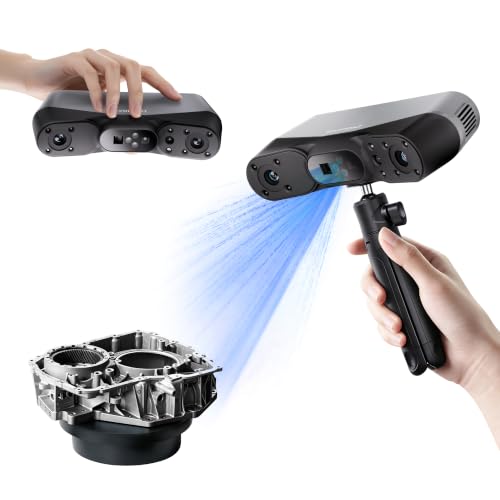
- 0.03 mm single-frame accuracy
- Five scan modes for varied objects
- Wi-Fi 6 and battery grip included
Best For: Mixed-use scanning, 3D printing, and outdoor capture
Metrology-grade pick

- Up to 0.02 mm accuracy
- 660,000 points/s scan speed
- Blue laser and IR structured light
Best For: Inspection, reverse engineering, and technical scanning
Precision mid-size choice

- Up to 0.03 mm accuracy
- 24-bit color acquisition
- Built for 15 mm to 1500 mm objects
Best For: Medium-size objects and handheld detail scanning
Industrial detail leader

- Up to 0.01 mm precision
- Scans dark and shiny surfaces
- Five modes plus Wi-Fi 6
Best For: Precision industrial scanning and inspection
Standalone Creator Pick
3DMakerpro Toucan Premium 3D Scanner

- Fully standalone scanning, editing, and exporting
- Up to 0.03mm accuracy with blue-light tech
- 32GB RAM, 256GB storage, and 120-minute battery
Best For: Users who want a portable all-in-one handheld scanner
Speed-and-Precision Choice
Creality Raptor Pro Wireless Scanner

- Up to 0.02mm accuracy in lab conditions
- 60 FPS scanning with 660,000 points per second
- Wireless scanning with Scan Bridge support
Best For: Users who want fast, high-detail scans with wireless convenience
Metrology Pick
Revopoint MetroY Pro Blue Laser Scanner

- Up to 0.01mm precision and 0.02mm accuracy
- Five modes for holes, surfaces, and turntable scans
- Wi-Fi 6, real-time streaming, and no spray needed
Best For: Professionals who need measurement-grade detail and flexible modes
Ultra-Wide Pro Scan
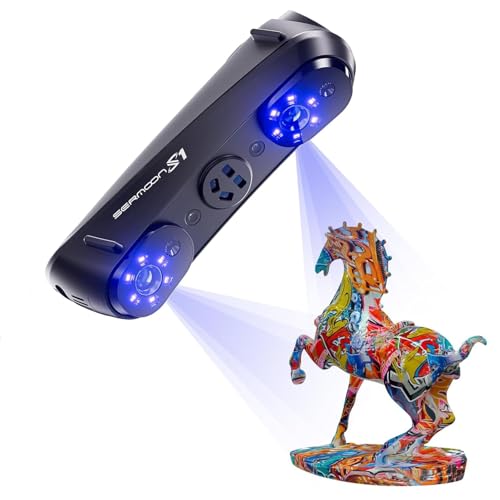
- 5 mm to 4000 mm scan range
- Triple blue-laser modes for flexible capture
- Up to 0.02 mm accuracy with 90 FPS scanning
Best For: Engineering and reverse engineering across small and large objects
Portable Outdoor Scan

- WiFi 6 wireless scanning and mobile streaming
- Scans reflective or dark surfaces without spray
- Lightweight 190 g design with outdoor support
Best For: Portable scanning, outdoor use, and detailed 3D printing
Industrial Precision Scan

- Up to 0.01 mm single-frame precision
- Four scan modes including auto turntable
- Handles shiny or dark surfaces without spray
Best For: Precision modeling, industrial measurement, and small-object automation
Premium all-rounder – Revopoint POP 4 3D Scanner
If you want premium 3D scanners that can handle everything from small parts to large objects, the Revopoint POP 4 is built for a wide range of real-world jobs. It combines fine accuracy, multiple scan modes, and strong outdoor performance, making it a flexible pick for 3D printing, reverse engineering, and field scanning.
Best For: Users who want one scanner for precision parts, larger objects, and mixed indoor/outdoor workflows.
Pros:
- Single-frame accuracy up to 0.03 mm with volumetric accuracy of 0.03 mm + 0.05 mm x L(m)
- Five scan modes, including blue laser for reflective and dark objects
- Works in bright environments, with up to 100,000 lux support in some modes
- Wireless scanning with Wi-Fi 6 and an included battery grip for portable use
Cons:
- Some AI segmentation features are Windows only
- Advanced capabilities may be more than casual users need
- Large feature set can mean a steeper learning curve
Overall, the POP 4 stands out as a versatile option if you need a premium 3D scanner that balances accuracy, speed, and scan-mode flexibility. It is especially appealing for users who move between studio work, outdoor jobs, and technical scanning tasks.
Metrology-grade pick – Creality Raptor Pro
Among premium 3D scanners, the Creality Raptor Pro is aimed at buyers who care most about precision and fast capture. Its blue laser and infrared structured light system is designed for detailed reverse engineering, automotive parts, bodies, and other feature-rich objects.
Best For: Users who need metrology-style accuracy for technical parts, inspection, and reverse engineering.
Pros:
- Metrology-grade accuracy up to 0.02 mm + 0.08 mm/m
- Fast scanning at up to 660,000 points/s
- Dual blue laser mode helps cover medium to large objects efficiently
- IR structured light mode supports marker-free scanning of feature-rich workpieces
Cons:
- Needs a strong Windows PC or recommended Mac setup to run well
- Desktop-focused workflow may not suit casual or lightweight users
- Best results likely require some familiarity with scanning software
The Raptor Pro is a strong match if your priority is technical accuracy rather than simplicity. It offers a serious mix of speed, precision, and scanning versatility for demanding projects.
Precision mid-size choice – 3DMakerpro Moose Premium
If you are comparing premium 3D scanners for medium-sized objects, the 3DMakerpro Moose Premium is built around high-detail handheld capture. It focuses on blue LED structured light, color capture, and stable performance for objects in the 15 mm to 1500 mm range.
Best For: Users scanning medium-sized objects who want detailed models with color and a handheld workflow.
Pros:
- Up to 0.03 mm accuracy and 0.07 mm resolution
- Supports 24-bit color acquisition for more realistic textures
- Scan-back and anti-shake features help improve stability
- Works with Windows and macOS, with lifetime free software updates
Cons:
- 10 fps performance is slower than some premium rivals
- Indoor environments are recommended for best results
- May take practice to master as a handheld scanner
The Moose Premium is a practical option if you want detail-first scanning in a handheld format. It is best viewed as a focused tool for medium objects rather than a speed-focused all-purpose scanner.
Industrial detail leader – Revopoint MetroY Ultra
The Revopoint MetroY Ultra belongs on any shortlist of premium 3D scanners for industrial work, thanks to its high precision and multiple laser and structured-light modes. It is designed for tight-tolerance measurement, shiny or dark surfaces, and fast capture on parts that need professional-grade treatment.
Best For: Industrial users who need highly accurate scans of small to medium parts, including dark or reflective surfaces.
Pros:
- Up to 0.01 mm single-frame precision and 0.015 + 0.04 mm x L(m) volumetric accuracy
- Five scanning modes, including 34 laser cross-lines and full-field blue structured light
- Can scan black, glossy, and metallic surfaces without spray
- Wireless Wi-Fi 6 support and a 5500 mAh battery grip for mobile use
Cons:
- Minimum computer requirements are fairly demanding
- Best suited to small and medium objects rather than very large scenes
- Higher-end feature set may be unnecessary for basic hobby work
The MetroY Ultra is the most measurement-focused option here, and it clearly targets users who need dependable detail in tougher scanning conditions. If your workflow centers on inspection, reverse engineering, or clean industrial output, it is an excellent fit.
Standalone Creator Pick – 3DMakerpro Toucan Premium 3D Scanner
If you want premium 3D scanners that are truly portable, the 3DMakerpro Toucan stands out because it scans, edits, models, and exports directly on the device. It combines a 48MP color camera, blue-light scanning, and onboard processing for users who want a self-contained workflow for 3D printing and object capture.
Best For: Creators who want a fully standalone handheld scanner for small to large objects.
Pros:
- Runs completely on-device with no computer or cables required.
- Up to 0.03mm accuracy with blue-light technology.
- Captures objects from small items to large furniture-scale pieces.
- Includes onboard storage, battery power, and physical controls for easier use.
Cons:
- Handheld scanning requires practice and good technique to get the best results.
- Working distance is limited to 200–1000 mm during operation.
- Geomagic Wrap Lite software is not included.
This is a strong choice if you value portability and an all-in-one design over a PC-tethered workflow. The Toucan is aimed at users who are willing to learn the scanning process in exchange for a highly self-sufficient setup.
Speed-and-Precision Choice – Creality Raptor Pro Wireless Scanner
Among premium 3D scanners, the Creality Raptor Pro focuses on fast capture without giving up high precision. With wireless scanning support, 22+7 blue laser lines, and up to 60 FPS scanning, it is built for users who need quick turnaround on detailed objects across a wide size range.
Best For: Users who want a fast, high-precision scanner with wireless convenience.
Pros:
- Delivers up to 0.02mm accuracy in laboratory conditions.
- Scans at up to 60 FPS and 660,000 points per second.
- Supports wireless scanning with the Scan Bridge accessory.
- Handles objects from 5mm to 2000mm and includes full-color scanning.
Cons:
- Wireless scanning depends on compatible accessories.
- Marker-based alignment may add setup steps for some projects.
- Best accuracy is specified under laboratory conditions.
The Raptor Pro is a practical pick when speed matters as much as detail. It should appeal to makers and professionals who want a broad scanning range, fast output, and the flexibility of a wireless workflow.
Metrology Pick – Revopoint MetroY Pro Blue Laser Scanner
If you need premium 3D scanners for reverse engineering or metrology, the Revopoint MetroY Pro is designed for very high detail and flexible scanning modes. Its blue laser system offers multiple capture modes, no-spray scanning on shiny and dark surfaces, and wireless Wi-Fi 6 connectivity for a more controlled professional workflow.
Best For: Professionals who need measurement-grade detail and versatile scanning modes.
Pros:
- Offers up to 0.01mm precision and 0.02mm accuracy.
- Five scanning modes cover deep holes, fast surface capture, and turntable use.
- No scanning spray needed in any laser mode, even on shiny and dark surfaces.
- Wi-Fi 6 support and real-time streaming make PC-connected scanning more flexible.
Cons:
- Revo Design and Revo Measure are sold separately.
- Software support is Windows only for the paid tools mentioned.
- Some advanced workflows may require markers or a turntable depending on the mode.
The MetroY Pro is the most specialized option here for technical users who care about accuracy, scan flexibility, and measurement workflows. It looks especially well suited to users who want professional software integration and strong performance on difficult surfaces.
Ultra-Wide Pro Scan – Creality Sermoon S1
If you want premium 3D scanners that can handle both tiny features and oversized parts, the Creality Sermoon S1 is built for that range. Its 5 mm to 4000 mm scan window, triple blue-laser modes, and 0.02 mm accuracy make it a strong fit for users who need one scanner for many kinds of jobs.
Best For: Engineering, reverse engineering, and scanning everything from small parts to large assemblies.
Pros:
- Ultra-wide scan range from 5 mm to 4000 mm for very small to very large objects
- Triple blue-laser system with 34-line, 7-line, and single-line modes for flexible capture
- Up to 0.02 mm accuracy and 0.08 mm/m volumetric precision
- 90 FPS scanning and marker-free workflow support for faster project turnaround
Cons:
- Recommended system specs are relatively demanding, especially on Windows
- Best performance depends on a capable PC or Mac setup
The Sermoon S1 stands out when you need a single scanner that can move between detail work and large-object capture without changing tools. It is especially appealing for professional workflows where scan speed, accuracy, and flexibility matter together.
Portable Outdoor Scan – Revopoint INSPIRE 2
The Revopoint INSPIRE 2 is a strong pick among premium 3D scanners if you want portability, wireless scanning, and outdoor flexibility. With WiFi 6, dual scanning modules, and support for reflective or dark surfaces without spray, it is designed to keep scans moving in more varied real-world conditions.
Best For: Portable scanning, outdoor use, and detailed 3D printing workflows.
Pros:
- Wireless WiFi 6 scanning with real-time PC-to-mobile streaming
- Infrared laser lines can capture reflective or dark surfaces without spray
- Up to 0.05 mm accuracy and 0.03 mm precision for detailed models
- Lightweight 190 g body with outdoor scanning support up to 20,000 lux
Cons:
- Revo Design is sold separately for the full scan-to-CAD workflow
- Some advanced features, like AI segmentation, are Windows only
INSPIRE 2 is well suited to users who value mobility and a flexible setup more than a stationary studio workflow. Its mix of wireless operation, outdoor support, and guided software makes it a practical choice for travel-friendly scanning and 3D printing prep.
Industrial Precision Scan – Revopoint MetroX Pro
For buyers comparing premium 3D scanners for high-detail work, the Revopoint MetroX Pro leans hard into industrial precision. It combines blue laser scanning, structured light, and automated turntable workflows to support accurate capture of shiny, dark, and feature-rich objects.
Best For: Precision modeling, industrial measurement, and automated small-object scanning.
Pros:
- Single-frame precision up to 0.01 mm and accuracy up to 0.02 mm
- Four scan modes, including cross-line lasers, parallel lines, structured light, and auto turntable
- Can scan shiny or dark surfaces without spray in laser modes
- PC-to-mobile streaming and multiple tracking modes for flexible workflows
Cons:
- Revo Design and Revo Measure are sold separately and Windows only
- It is focused on precision work rather than broad all-in-one large-object scanning
MetroX Pro is the most specialized option here for users who need measurement-grade detail and efficient capture of complex small parts. Its automation and precision tools make it a smart fit for industrial, manufacturing, and design tasks where accuracy comes first.
How We Picked These Premium 3D Scanners
We focused on Premium 3D Scanners that offer a strong mix of precision, scan stability, and practical workflow features. That includes usable accuracy claims, support for different object sizes, handheld convenience, and options such as laser scanning, wireless operation, or color capture where they add real value.
We also considered who each scanner is best suited for. Some models prioritize metrology-grade detail for engineering and inspection, while others are more flexible for creators who need portability and easier setup for 3D printing projects.
Quick Comparison: What Matters Most
Not every scanner is built for the same job. If you need the highest detail for small mechanical parts, prioritize accuracy and repeatability. If you scan larger objects or work on location, portability and working distance matter more. For textured or visual assets, color capture can be more important than raw precision.
Key Buying Factors for Premium 3D Scanners
Accuracy and Repeatability
Look beyond a single accuracy number. For Premium 3D Scanners, repeatable performance across multiple passes is just as important as the headline spec, especially for engineering and fit-critical parts.
Scan Technology
Blue laser systems often excel on detailed geometry and tricky surfaces, while structured-light and hybrid approaches can offer faster capture or better versatility. Choose the method that matches your typical subjects.
Object Size and Working Range
Check the smallest and largest objects the scanner can handle. A model that works well on miniature parts may struggle with furniture, body panels, or full-scale prototypes.
Speed, Tracking, and Workflow
Higher frame rates and better tracking can reduce lost scans and cleanup time. Wireless support, standalone operation, and intuitive software can also make a big difference in real-world use.
Surface Handling and Color
Reflective, dark, or feature-poor surfaces can be challenging. If your projects include consumer products, art, or organic shapes, color capture and surface versatility may be worth the extra cost.
Who Should Buy Which Premium 3D Scanners?
Engineers and inspection users should lean toward the most precise Premium 3D Scanners with laser-based capture and strong metrology credentials. Makers and 3D printing enthusiasts may prefer a balanced model that is easier to set up and flexible across different object sizes.
If you need mobility, choose a handheld scanner with solid tracking and wireless or standalone support. If visual fidelity matters as much as geometry, prioritize color scanning and smoother workflow tools. Matching the scanner to your use case matters more than chasing specs alone.
