
The best portable heart rate monitors make it easier to track workout intensity, review trends, or check your heart rhythm away from a clinic. This roundup includes chest straps, optical armbands, fingertip sensors, and portable ECG devices for different needs and budgets.
Because these products measure different things, the right choice depends on whether you prioritize exercise accuracy, all-day comfort, ECG recordings, app compatibility, or simple spot checks.
Best 10 Portable Heart Rate Monitors Picks for 2026
Reliable Everyday Tracking

- Soft, adjustable washable strap
- Up to 3.5-year battery life
- Removable heart rate module
Best For: Everyday training with compatible smartphones and fitness equipment
Detailed Rhythm Checks
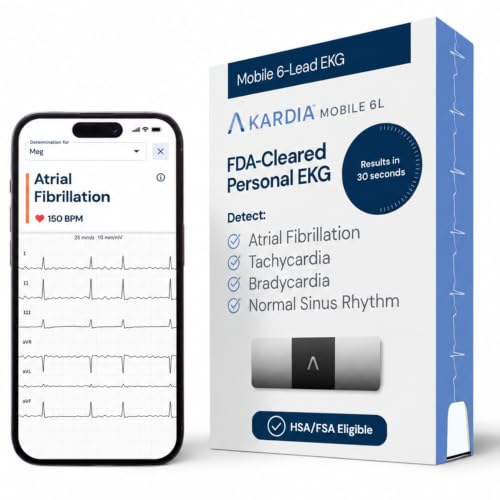
- Six-lead EKG in about 30 seconds
- No membership required for recordings
- Detects four listed heart rhythms
Best For: On-demand rhythm recordings with a compatible smartphone or tablet
Maximum Connectivity

- Bluetooth, ANT+, and 5 kHz support
- Waterproof with internal memory
- Up to 400 hours of battery life
Best For: Multi-device training and high-precision heart rate measurement
Modern Garmin Performance

- Captures heart rate and HRV data
- Machine-washable strap
- 3 ATM water rating and one-year battery
Best For: Garmin users seeking durable heart rate and HRV tracking
Most Versatile

- Wrist-free optical monitoring
- Dual Bluetooth and ANT+ connectivity
- Armband and goggle-clip wearing options
Best For: Swimmers and athletes wanting flexible, unobtrusive tracking
Best for Data-Driven Training

- Real-time heart rate and HRV data
- Running dynamics and workout recording
- Up to two months of rechargeable battery life
Best For: Garmin athletes seeking detailed training metrics
Best for Spot-Check EKGs
KardiaMobile 1-Lead EKG Monitor

- 30-second heart-rhythm readings
- Works with most smartphones
- No subscription, Wi-Fi, or cords required
Best For: Portable smartphone-based rhythm spot checks
Best Sports-Bra Heart Rate Monitor

- Clips onto medium- and high-support sports bras
- Transmits heart rate and heart rate variability data
- Up to one year of battery life
Best For: Women training with compatible Garmin devices
Best Finger Pulse Check
Vibeat Fingertip Pulse Oximeter

- Measures pulse rate and blood oxygen saturation
- OLED display starts measuring when worn
- Includes batteries, lanyard, and built-in record storage
Best For: Sports and aviation spot checks
Best ECG Recording Option

- Records and stores ECG signals in six channels
- Connects to smartphones and PCs via Bluetooth or USB
- No subscription or hidden software cost
Best For: Home ECG recording and case review
Reliable Everyday Tracking – Garmin HRM-Dual
The Garmin HRM-Dual is a practical choice among portable heart rate monitors for runners, cyclists, and gym users who want a comfortable chest strap with long battery life. Its adjustable soft strap and removable module make regular use and cleaning straightforward.
Best For: Everyday training with compatible smartphones and fitness equipment.
Pros:
- Soft, adjustable strap is designed for comfort.
- Removable module allows the strap to be washed.
- User-replaceable CR2032 battery lasts up to 3.5 years.
Cons:
- One-size design may not provide the ideal fit for everyone.
- Supplied notes do not specify ANT+ or other connection types.
The HRM-Dual stands out for low-maintenance ownership and extended battery life. It is a sensible option if comfort and infrequent battery replacement matter more than advanced monitoring features.
Detailed Rhythm Checks – KardiaMobile 6L EKG
The KardiaMobile 6L is a portable heart rate monitor designed for smartphone-based EKG recording rather than workout tracking. It records a six-lead EKG in about 30 seconds and can provide determinations for several heart rhythms without requiring a membership.
Best For: Users who want detailed, shareable rhythm recordings through a compatible smartphone or tablet.
Pros:
- Records a medical-grade, six-lead EKG.
- Detects AFib, bradycardia, tachycardia, and normal sinus rhythm.
- Offers unlimited recordings without a required subscription.
- Compact 24-gram design works with most popular smartphones and tablets.
Cons:
- Requires the Kardia app and a compatible smartphone or tablet.
- It does not check for heart attacks or replace routine medical care.
- Not tested or recommended for people with pacemakers or ICDs.
This is the strongest fit for on-demand rhythm checks and sharing data with a doctor, not continuous exercise monitoring. Buyers should review device compatibility and the stated medical-use limitations before purchasing.
Maximum Connectivity – Polar H10 Chest Strap
The Polar H10 is a versatile portable heart rate monitor for athletes who need accurate chest-strap readings across multiple devices. It supports Bluetooth, ANT+, and 5 kHz connections, while its waterproof build and internal memory add flexibility for training.
Best For: Serious training with multiple compatible phones, watches, machines, or fitness apps.
Pros:
- Designed for high-precision heart rate measurement.
- Supports Bluetooth, ANT+, and 5 kHz connectivity.
- Can use Bluetooth and ANT+ simultaneously, plus two Bluetooth connections.
- Waterproof with internal memory for multiple hours.
Cons:
- The listed M-XXL size may not suit every user.
- Requires the specified CR2025 battery; other sizes may damage the sensor.
- At 60 grams, it is heavier than some compact monitors.
The H10 is a strong all-around choice when broad compatibility and connection flexibility are priorities. Its long 400-hour battery estimate and onboard memory further support frequent, multi-device training.
Modern Garmin Performance – Garmin HRM 200
The Garmin HRM 200 is a portable heart rate monitor for transmitting real-time heart rate and heart rate variability data to compatible Garmin devices, fitness equipment, apps, and smartphones. Its machine-washable strap and 3 ATM water rating make it suitable for regular training.
Best For: Garmin users who want heart rate and HRV data with a durable, easy-clean chest strap.
Pros:
- Transmits real-time heart rate and heart rate variability data.
- Works with listed Garmin devices, fitness equipment, apps, and smartphones.
- Machine-washable strap simplifies cleaning.
- Offers a 3 ATM water rating and user-replaceable CR2032 battery.
Cons:
- Battery life is rated at up to one year, shorter than some alternatives.
- The supplied version is listed as XS-S, so fit should be checked carefully.
- Its strongest compatibility is with supported Garmin and app ecosystems.
The HRM 200 is a good fit for Garmin-centered training setups that benefit from HRV data and straightforward maintenance. Check the included strap size and device compatibility before buying.
Most Versatile – Polar Verity Sense
Polar Verity Sense - Optical Heart Rate Monitor Armband - ANT+, Dual Bluetooth, Black, S-L
Check Price On AmazonThe Polar Verity Sense is a compact, comfortable choice for shoppers comparing portable heart rate monitors. Its optical sensor can be worn on the upper or lower arm, attached to swimming goggles, or positioned under fitted clothing, while ANT+ and dual Bluetooth support makes it adaptable to connected devices and apps.
Best For: Swimmers, athletes, and anyone who prefers an unobtrusive alternative to a wrist-worn monitor.
Pros:
- Lightweight 19 g design keeps the wrist free.
- Supports two simultaneous Bluetooth connections and unlimited ANT+ connections.
- Can broadcast heart rate live or record a session for later transfer.
- Includes an armband, swimming goggle clip, pouch, and charging unit.
Cons:
- Requires a compatible phone, tablet, computer, watch, or app for viewing data.
- Its S-L sizing may not suit every user.
With multiple wearing options and broad connectivity, the Verity Sense is a flexible portable monitor for training and swimming. Choose it when comfort and placement versatility matter more than having a built-in display.
Best for Data-Driven Training – Garmin HRM 600
The Garmin HRM 600 is a performance-focused option among portable heart rate monitors, delivering real-time heart rate and HRV data to compatible Garmin devices, fitness equipment, and apps. It also records workouts when a watch is impractical and adds running, swimming, and daily activity metrics.
Best For: Runners, cyclists, and Garmin users who want detailed workout data and offline recording.
Pros:
- Provides real-time heart rate and HRV data to compatible devices.
- Supports running dynamics such as stride length and ground contact time balance with a compatible smartwatch.
- Records team-sport workouts and syncs data to Garmin Connect.
- Rechargeable battery lasts up to two months, and the strap is machine-washable.
Cons:
- Advanced running metrics require a compatible smartwatch.
- Compatibility is centered on compatible Garmin devices, apps, and equipment.
- The supplied version is sized M-XL, so fit should be checked carefully.
The HRM 600 stands out for athletes who value training metrics beyond basic pulse readings. Its recording features and long battery life are useful for activities where wearing a smartwatch is inconvenient.
Best for Spot-Check EKGs – KardiaMobile 1-Lead EKG Monitor
The KardiaMobile 1-Lead EKG Monitor takes a different approach to portable heart monitoring. Instead of continuously broadcasting exercise data, it uses finger or thumb contact with its sensors to provide a 30-second reading through a smartphone, with no subscription, Wi-Fi, cords, or PC required.
Best For: Smartphone users who want quick, portable heart-rhythm spot checks.
Pros:
- Compact 0.02 kg design is easy to carry.
- Provides results in about 30 seconds.
- Works with most smartphones without Bluetooth or Wi-Fi.
- Offers a medical-grade, FDA-cleared personal heart monitor.
Cons:
- Designed for spot-check EKG readings rather than continuous exercise monitoring.
- Requires a compatible smartphone to use.
- Its listed battery life is about 12 months.
KardiaMobile is best viewed as a compact personal EKG tool, not a fitness chest strap or armband. It is a practical pick for quick rhythm checks when portability and simple operation are priorities.
Best Sports-Bra Heart Rate Monitor – Garmin HRM-Fit
For athletes seeking portable heart rate monitors designed around training, the Garmin HRM-Fit clips directly onto compatible medium- and high-support sports bras. It provides real-time heart rate and heart rate variability data, plus extra running metrics when paired with a compatible Garmin device.
Best For: Women who want a discreet, sports-bra-mounted monitor for running, cycling, strength training, HIIT, and fitness classes.
Pros:
- Purpose-built clip-on design for medium- and high-support sports bras
- Tracks real-time heart rate and heart rate variability across compatible devices and apps
- Offers running dynamics, indoor pace and distance, and activity tracking with compatible Garmin equipment
- Battery life lasts up to one year
Cons:
- Not recommended for longline, front-zip, or light-support sports bras
- Some advanced metrics require a compatible Garmin device
- Heart rate data stored while out of smartwatch range requires starting and stopping the activity on a compatible Garmin watch
The HRM-Fit is a specialized choice rather than a general-purpose wearable. Its sports-bra attachment and long battery life make it especially practical for women who already use compatible Garmin equipment.
Best Finger Pulse Check – Vibeat Fingertip Pulse Oximeter
The Vibeat Fingertip Pulse Oximeter is a compact option among portable heart rate monitors when you want a quick spot check rather than continuous workout tracking. It displays pulse rate alongside blood oxygen saturation, perfusion index, and a pulse waveform on its OLED screen.
Best For: Sports and aviation users who want a battery-powered fingertip device for quick pulse and oxygen-saturation readings.
Pros:
- Starts measuring as soon as it is placed on the finger
- Displays pulse rate, blood oxygen saturation, perfusion index, and pulse waveform
- Provides threshold warnings with a buzzer and flashing readings
- Stores up to 12 groups of records and includes batteries and a lanyard
Cons:
- Intended for sports and aviation use, not diagnosis or treatment
- Designed for fingertip spot checks rather than wearable activity tracking
- Continuous mode may need to be adjusted from the default spot-check operation
This is a straightforward choice for fast, on-device measurements. Its warning function and small record capacity add convenience, but it should not be treated as a replacement for clinical monitoring.
Best ECG Recording Option – EMAY 6L Portable ECG Monitor
The EMAY 6L is a portable heart rate monitor for users who want ECG recording in addition to displayed heart rate. It records and stores signals in six channels, connects to smartphones or computers, and works with its software without a subscription or hidden cost.
Best For: Home health care users who want to review stored ECG cases through a compatible iOS, Android, Windows, or Mac device.
Pros:
- Records and stores six-channel ECG signals
- Displays heart rate and connects through Bluetooth or USB
- Compatible with smartphones and PCs for case upload, review, measurement, and settings
- Rechargeable lithium battery and no required subscription
Cons:
- Not intended to replace a hospital diagnostic ECG device
- Users with implanted pacemakers are not recommended to use it
- Requires a compatible smartphone or computer for the broader software functions
The EMAY 6L stands out for portable ECG capture rather than casual exercise tracking. Its six-channel recording and no-subscription software make it useful for home review, provided users understand its stated limitations.
How We Picked the Best Portable Heart Rate Monitors
We organized this roundup around measurement method, intended use, connectivity, comfort, portability, and overall practicality. Chest-strap sensors are generally a strong choice for real-time workout tracking, while optical armbands can be more comfortable for users who dislike a chest band. Portable ECG products are designed for spot rhythm recordings rather than continuous training data, and pulse oximeters provide quick readings of pulse rate and blood oxygen saturation.
We also considered whether each device supports Bluetooth, ANT+, smartphone apps, computer software, multiple users, replaceable or rechargeable power, water resistance, and subscription-free use where applicable. Medical concerns should always be discussed with a qualified clinician; consumer monitors are not a substitute for diagnosis.
Quick Comparison
| Type | Best for | Main advantage | Potential limitation |
|---|---|---|---|
| Chest strap | Training and interval workouts | Responsive heart-rate readings | Requires wearing a band around the chest |
| Optical armband | Comfortable exercise tracking | Less restrictive than a chest strap | Fit and motion can affect readings |
| Portable ECG | Recording heart rhythm symptoms | Detailed single- or multi-lead recordings | Usually intended for spot checks |
| Pulse oximeter | Quick pulse and SpO2 checks | Small, simple, and inexpensive | Not a replacement for ECG monitoring |
Key Buying Factors for Portable Heart Rate Monitors
Measurement Accuracy and Purpose
Choose a chest strap or optical armband if you need heart rate during runs, cycling, classes, or other workouts. Select an ECG monitor if you want to capture a rhythm recording to review or share. A fingertip pulse oximeter is better suited to brief pulse and oxygen-saturation readings.
Connectivity and Compatibility
Check whether the monitor works with your watch, fitness app, phone, or computer. Bluetooth is useful for phones and many modern fitness devices, while ANT+ can be important for bike computers and compatible sports watches. Confirm operating-system requirements before buying.
Comfort, Fit, and Power
A secure fit matters as much as the sensor itself. Look for adjustable straps, washable materials, or an armband design if you plan to wear the device often. Also check battery life, charging requirements, water resistance, and whether the device uses replaceable batteries.
Subscriptions and Data Sharing
If you want low ongoing costs, prioritize products that allow unlimited recordings or core features without a membership. For ECG devices, review how recordings are stored, exported, and shared with a healthcare professional.
Who Should Buy Which Portable Heart Rate Monitors?
Choose a chest strap for serious training, interval work, and users who want responsive readings compatible with sports equipment. Choose an optical armband for a more comfortable workout monitor that avoids a chest band. Choose a portable ECG if your priority is recording heart rhythm events rather than tracking exercise intensity. Choose a fingertip pulse oximeter for occasional, straightforward pulse and oxygen-saturation checks.
Before purchase, match the device to your main activity and confirm its compatibility with the apps or equipment you already use. If you experience concerning symptoms or receive an unusual reading, seek medical advice instead of relying solely on a consumer monitor.
