
When it comes to selecting the right NVIDIA RTX Ada workstation in 2025, you’re faced with a multitude of options tailored for diverse professional needs. From powerful models like the Quadro RTX 6000 to balanced choices such as the RTX 4070, each workstation offers unique features. Understanding these differences can greatly enhance your workflow. But what specific factors should you consider to guarantee you choose the best fit for your requirements?
nVidia RTX 4500 Ada Retail
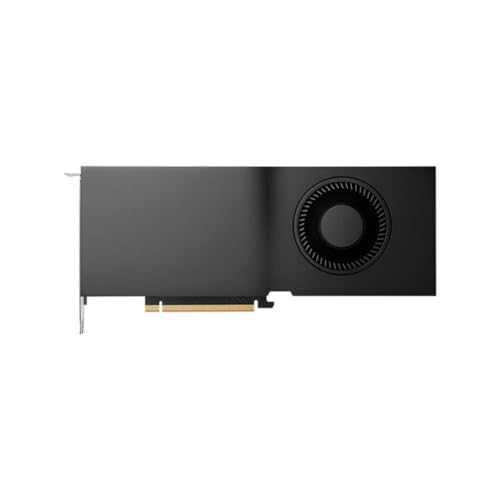
The nVidia RTX 4500 Ada Retail is an ideal choice for professionals in design, engineering, entertainment, and healthcare who demand exceptional performance in their workflows. With 24 GB of GDDR6 memory featuring ECC, it guarantees reliability during intensive tasks. Its compact dual-slot design and active blower fan keep your system cool, even under pressure. This GPU excels in accelerated computing and AI applications, allowing you to tackle complex challenges with ease. As generative AI reshapes industries, having the RTX 4500 means you’re equipped to innovate and create effectively, enhancing your productivity and opening new possibilities in your projects.
Best For: Professionals in design, engineering, entertainment, and healthcare who require high-performance computing capabilities for demanding applications.
Pros:
- 24 GB GDDR6 memory with ECC ensures reliability during intensive tasks.
- Compact dual-slot design and active blower fan maintain optimal cooling for sustained performance.
- Excels in accelerated computing and AI applications, enabling innovative solutions and enhanced productivity.
Cons:
- May be overkill for casual users or those with less demanding workloads.
- Requires sufficient power supply and space in the system, limiting compatibility with some setups.
- Higher price point compared to lower-end GPUs, which may not be justifiable for all users.
nVidia RTX 2000 ADA 16GB Graphics Card

For professionals seeking high-quality performance in creative applications, the nVidia RTX 2000 ADA 16GB Graphics Card stands out with its impressive 16 GB GDDR6 memory and real-time rendering capabilities. This dual-slot, half-height card is perfect for any workstation, delivering 4K resolution at 1250 MHz. Its AI-powered tools enhance visual quality while streamlining your workflow. Weighing just 2.82 ounces, it seamlessly integrates with your favorite creative software. Rated 5.0 out of 5 stars, it’s a top choice among users. Plus, you can enjoy a hassle-free return policy if it arrives damaged. Get ready to elevate your projects with unparalleled performance!
Best For: Professionals seeking high-quality performance in creative applications, particularly in graphic design, video editing, and 3D rendering.
Pros:
- High-performance 16 GB GDDR6 memory for demanding applications.
- Real-time rendering capabilities enhance workflow efficiency.
- AI-powered tools improve visual quality and integration with creative software.
Cons:
- Dual-slot design may not fit in smaller cases.
- Higher price point compared to some other graphics cards.
- Limited to 4K resolution, which may not meet the needs of ultra-high-definition users.
nVidia RTX 5000 Ada Quadro RTX 5000 32 GB GDDR6

Designed with professionals in mind, the nVidia RTX 5000 Ada Quadro RTX 5000 32 GB GDDR6 excels in demanding workflows such as rendering, AI, and complex graphics tasks. With its robust NVIDIA Ada Lovelace architecture, it boasts 12,800 CUDA cores, 100 third-generation RT Cores, and 400 fourth-generation Tensor Cores, ensuring top-tier performance. It handles a max resolution of 3840×2160 and operates at a memory speed of 2000 MHz. Features like NVIDIA GPUDirect and Mosaic Technology enhance your multi-display setups and video processing. Weighing just 1.32 pounds, it’s a powerful yet lightweight option for any workstation.
Best For: Professionals in rendering, AI, and complex graphics tasks looking for high-performance hardware.
Pros:
- Exceptional Performance: Equipped with 12,800 CUDA cores and advanced RT and Tensor cores for superior processing power.
- High Memory Capacity: 32 GB GDDR6 memory enables efficient handling of large datasets and complex applications.
- Multi-Display Support: Features like NVIDIA Mosaic Technology enhance productivity in multi-monitor setups.
Cons:
- Price Point: May be considered expensive for casual users or those with less demanding needs.
- Power Consumption: High-performance components may lead to increased energy usage and heat generation.
- Limited Availability: As a professional-grade product, it may not be readily available in all markets or retailers.
NVIDIA GeForce RTX 5080 Founders Edition

Engineered for high-end performance, the NVIDIA GeForce RTX 5080 Founders Edition stands out as an exceptional choice for gamers and professionals alike who demand top-tier graphics capabilities. Built on the innovative Blackwell architecture, this powerful graphics card boasts 24GB of RAM (16GB actual) and a GPU clock speed of 2295 MHz, ensuring you can tackle demanding applications with ease. Users rave about its efficiency, cool operation, and quiet performance. While it has a sleek design and arrives in perfect condition, be mindful of compatibility concerns with aftermarket cooling systems. Overall, it offers impressive performance that exceeds expectations.
Best For: Gamers and professionals seeking high-end graphics performance for demanding applications and games.
Pros:
- Excellent performance exceeding expectations compared to previous models.
- Runs cool and quietly, ensuring an efficient operation.
- Sleek design and arrives sealed in perfect condition.
Cons:
- Confusion regarding advertised RAM size (24GB but actual is 16GB).
- Compatibility concerns with aftermarket cooling systems due to split board architecture.
- Users advised to check seller legitimacy due to potential sketchy listings.
NVIDIA Quadro RTX 6000

The NVIDIA Quadro RTX 6000 stands out as an exceptional choice for professionals who require top-tier graphics performance in demanding environments. With 4,608 CUDA cores and 24 GB of GDDR6 memory, it delivers unparalleled speed and efficiency. Its real-time ray tracing capabilities enhance visual fidelity, making it ideal for rendering and AI workflows. You’ll appreciate the 624 GB/sec memory bandwidth and support for NVIDIA’s NVLink technology, allowing you to scale performance seamlessly. Plus, the four DisplayPort 1.4 connectors guarantee high-resolution displays and VR compatibility. For serious workstations, the Quadro RTX 6000 is truly a powerhouse.
Best For: Professionals in fields such as graphic design, 3D rendering, AI development, and visual computing who demand high-performance graphics solutions.
Pros:
- Unmatched Performance: With 4,608 CUDA cores and 24 GB of GDDR6 memory, it handles demanding tasks with ease.
- Real-Time Ray Tracing: Hardware-accelerated ray tracing enhances visual fidelity for realistic rendering.
- Versatile Connectivity: Four DisplayPort 1.4 connectors provide high-resolution display support and VR compatibility.
Cons:
- High Price Point: The Quadro RTX 6000 may be too expensive for casual users or hobbyists.
- Power Consumption: Requires significant power, which may necessitate a robust power supply.
- Large Form Factor: Its dimensions may not fit in all workstation setups, requiring careful planning for installation.
NVIDIA GeForce RTX 4070 Founder’s Edition Graphics Card

For creators and gamers who demand high performance without compromise, the NVIDIA GeForce RTX 4070 Founder’s Edition graphics card stands out as an exceptional choice. With a boost clock speed of 2.48 GHz and 5,888 CUDA cores, it delivers impressive graphics rendering and seamless multitasking. The 12GB GDDR6X memory guarantees you can handle resource-intensive applications effortlessly. Compatible with PCI Express 4.0 and earlier versions, it features HDMI and Display Port outputs for versatile connectivity. Plus, dedicated ray tracing and tensor cores enhance your gaming and creative projects, while technologies like NVIDIA DLSS and G-SYNC elevate your experience to new heights.
Best For: The NVIDIA GeForce RTX 4070 Founder’s Edition graphics card is best for gamers and content creators seeking high-performance graphics and advanced rendering capabilities.
Pros:
- Powerful Performance: With a boost clock speed of 2.48 GHz and 5,888 CUDA cores, it excels in graphics rendering and multitasking.
- Ample Memory: The 12GB GDDR6X memory allows for seamless handling of resource-intensive applications and games.
- Advanced Technologies: Features like dedicated ray tracing cores, NVIDIA DLSS, and G-SYNC enhance gaming and creative experiences significantly.
Cons:
- Price Point: As a high-end graphics card, it may be on the expensive side for budget-conscious consumers.
- Power Consumption: The performance demands may require a robust power supply, potentially adding to overall system costs.
- Availability: Due to high demand, it may be challenging to find at retail prices or in stock consistently.
ASUS Dual NVIDIA GeForce RTX 3060 Gaming Graphics Card
Packed with NVIDIA’s Ampere architecture, the ASUS Dual NVIDIA GeForce RTX 3060 Gaming Graphics Card is an excellent choice for gamers seeking high-performance visuals without breaking the bank. With 12GB of GDDR6 memory, it supports PCIe 4.0, HDMI 2.1, and DisplayPort 1.4a, ensuring superior connectivity. Its dual-slot design features an Axial-tech fan system with 0dB technology for silent operation during low workloads. You’ll enjoy enhanced ray tracing and AI capabilities thanks to the second and third-generation cores. With a boost clock of 1867 MHz in OC mode, this card delivers an impressive gaming experience that elevates your gameplay.
Best For: Gamers seeking high-performance visuals and advanced gaming technologies at an accessible price point.
Pros:
- 12GB GDDR6 memory provides ample capacity for high-resolution gaming and multitasking.
- Axial-tech fan design ensures efficient cooling and quiet operation during low workloads.
- Enhanced ray tracing and AI capabilities allow for immersive gaming experiences with realistic visuals.
Cons:
- Limited availability may lead to price inflation in certain markets.
- Dual-slot design could be restrictive in smaller cases or setups with limited space.
- Power consumption may be higher compared to previous generation graphics cards, requiring a solid power supply.
NVIDIA – GeForce RTX 4080 16GB GDDR6X Graphics Card
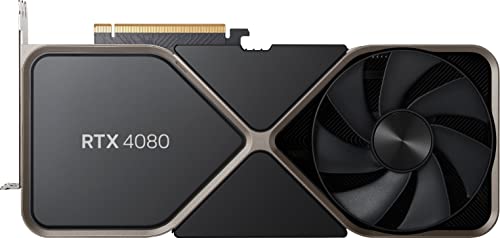
Designed for serious gamers and creative professionals, the NVIDIA GeForce RTX 4080 16GB GDDR6X Graphics Card delivers exceptional performance with its impressive 9,728 CUDA cores and a boost clock speed of 2.51 GHz. You’ll enjoy advanced gaming and rendering capabilities, thanks to dedicated ray tracing cores that elevate your visuals. It’s compatible with PCI Express 4.0 and 3.0, ensuring versatility in your setup. With dimensions of 11.97 x 4.84 x 2.38 inches and weighing 14.59 pounds, it fits snugly in most workstations. Plus, you’ll have access to warranty support and competitive pricing options, making it an attractive choice.
Best For: Serious gamers and creative professionals seeking high-performance graphics and rendering capabilities.
Pros:
- Exceptional performance with 9,728 CUDA cores and a boost clock speed of 2.51 GHz.
- Dedicated ray tracing cores for enhanced visual fidelity in gaming and creative applications.
- Compatibility with both PCI Express 4.0 and 3.0 for versatile installation options.
Cons:
- Heavier than some competitor graphics cards at 14.59 pounds, which may affect compatibility with smaller cases.
- Higher price point compared to entry-level graphics cards, potentially limiting accessibility for budget-conscious users.
- Large dimensions (11.97 x 4.84 x 2.38 inches) may require more space in your workstation setup.
Factors to Consider When Choosing Nvidia RTX Ada Workstations
When choosing an Nvidia RTX Ada workstation, you need to think about several key factors. Consider GPU memory capacity, performance for your specific applications, and the cooling solutions available. Don’t forget to check the form factor and compatibility with your software to guarantee everything runs smoothly.
GPU Memory Capacity
Choosing the right GPU memory capacity is essential for maximizing performance in your NVIDIA RTX Ada workstation. If you work with large datasets or complex computations in fields like AI, design, or rendering, you’ll need ample memory. Opting for higher memory sizes, like 24 GB or 32 GB, allows for better performance in professional applications that demand real-time rendering and multitasking. Additionally, consider ECC (Error-Correcting Code) memory for improved data integrity, especially for mission-critical tasks. Adequate GPU memory enhances your ability to work with higher resolutions and detailed textures, elevating visual quality. By selecting a GPU with the appropriate memory capacity, you’re also future-proofing your workstation against increasingly demanding software requirements in accelerated computing and AI.
Performance for Applications
To maximize performance in your NVIDIA RTX Ada workstation, you’ll want to evaluate several key factors tailored to your specific applications. Start by considering memory capacity; the RTX 4500 with 24 GB is perfect for memory-intensive tasks like 3D rendering, while the RTX 5000, boasting 32 GB, is optimized for professional workflows. If you’re focused on creative tools and real-time rendering, the RTX 2000 with 16 GB can accelerate your performance. Additionally, look for GPUs with dedicated Ray Tracing and Tensor Cores, like the NVIDIA GeForce RTX 4080, to enhance real-time graphics and AI performance. Finally, high memory speeds and CUDA cores, such as the RTX 5000’s 2000 MHz and 12,800 CUDA cores, provide efficient processing for complex calculations.
Cooling Solutions Available
Ideal performance in your NVIDIA RTX Ada workstation relies not just on powerful GPUs but also on effective cooling solutions. To maintain optimal operating temperatures, consider options like blower active fans that prevent thermal throttling during demanding tasks. Look for designs featuring axial-tech fans, which enhance airflow while minimizing noise, creating a pleasant working environment. For high-performance workloads, especially in accelerated computing and AI applications, robust thermal solutions are vital. Advanced features like 0dB operation guarantee silent fan performance during low workloads, enhancing your overall experience. Proper cooling not only prolongs your GPU’s lifespan but also boosts system stability and reliability, fundamental for professional workflows in design, engineering, and content creation. Choose wisely to maximize your workstation’s potential.
Form Factor Considerations
When considering an NVIDIA RTX Ada workstation, the form factor of your graphics card plays an essential role in compatibility and performance. You’ll find options ranging from dual slot, full height designs to half height configurations. Larger cards often feature advanced cooling systems, critical for maintaining high performance during demanding tasks. Keep in mind that bigger models may take up more space, potentially restricting access to other components and ports. Dual slot cards provide better thermal management due to improved airflow but could limit available expansion slots on the motherboard. Depending on whether you’re gaming or doing professional rendering, choosing the right form factor can greatly impact your workstation’s overall performance and efficiency.
Compatibility With Software
Ensuring your Nvidia RTX Ada workstation is compatible with the software you plan to use is essential for maximizing performance and efficiency. Many professional applications in design, engineering, and AI are optimized for Nvidia’s Ada architecture, which can greatly enhance your workflow. It’s vital to check that the GPU meets the specific hardware requirements of your software. The RTX GPU’s CUDA and Tensor cores can accelerate tasks in parallel processing and machine learning, providing a substantial performance boost. Don’t forget to keep your drivers and software updated, as these updates can improve compatibility and overall performance. Additionally, creative tools and rendering software often benefit from the ray tracing and AI features offered by Nvidia’s Ada architecture, making compatibility a key consideration.
Power Supply Requirements
Once you’ve confirmed software compatibility, it’s time to focus on power supply requirements for your Nvidia RTX Ada workstation. Make sure your power supply unit (PSU) can deliver adequate wattage, as high-performance models typically need between 650W and 850W. Check the PSU’s efficiency rating, aiming for at least 80 Plus Gold or Platinum to guarantee stable power delivery and reduce energy waste. Don’t forget to verify that your PSU has the necessary PCIe power connectors, usually 6-pin or 8-pin, to connect seamlessly with your graphics card. Finally, prioritize adequate airflow and cooling around the PSU since high-performance systems generate more heat, and proper ventilation is key to maintaining ideal operating temperatures.
Budget and Pricing Options
As you explore options for Nvidia RTX Ada workstations, you’ll quickly realize that your budget plays an essential role in determining the right fit for your needs. Prices can vary considerably based on GPU memory size, ranging from 16 GB to 32 GB and beyond. Higher-end models typically command a higher price, so assess the performance tier needed for your tasks. Keep an eye on pricing trends, as the market demand can cause fluctuations. Don’t forget the total cost of ownership, including potential upgrades or additional components, which can affect your budget. Finally, check warranty and return policies, as these may provide better long-term value and influence your overall pricing decision.
