
When it comes to maximizing your NAS setup, choosing drives with SSD cache support can greatly enhance performance. You’ll want reliable options that not only deliver speed but also offer ample storage capacity. From Toshiba to Seagate, there are impressive choices available. But what specific features should you look for to guarantee you get the best performance possible? Let’s explore the top contenders and what makes them stand out.
Toshiba N300 8TB NAS Internal Hard Drive
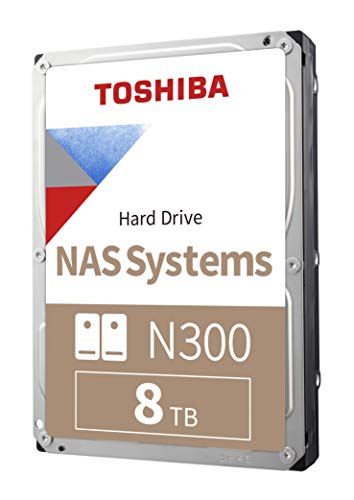
If you’re looking for a reliable storage solution for your small office or home office, the Toshiba N300 8TB NAS Internal Hard Drive is an excellent choice. This high-performance drive operates at 7200 RPM and supports workloads up to 180TB per year, ensuring you can handle heavy traffic with ease. With integrated RV sensors, it compensates for vibrations, enhancing reliability in multi-RAID setups. Plus, it’s optimized for 24/7 operation, making it perfect for cloud hosting and file sharing. Weighing just 1.61 pounds, it fits comfortably in your NAS system, while its 512 MB cache boosts data access speeds.
Best For: Small office and home office users seeking a reliable, high-performance NAS storage solution.
Pros:
- High-performance: Operates at 7200 RPM, providing fast data access and handling heavy workloads effectively.
- Reliable: Integrated RV sensors reduce the impact of vibrations, ensuring stability in multi-RAID environments.
- Optimized for continuous use: Designed for 24/7 operation, making it suitable for cloud hosting and file sharing.
Cons:
- Weight: At 1.61 pounds, it may be heavier compared to some other NAS drives.
- Limited warranty: Standard limited warranty may not cover all potential issues.
- Noisy operation: The 7200 RPM speed may result in higher noise levels compared to lower RPM drives.
SIX NVME M.2 SSD PCIe 4.0 – 1TB for Gaming PS5 Memory Storage Expansion

For gamers seeking to expand their PlayStation 5 memory, the SIX NVME M.2 SSD PCIe 4.0 offers a powerful 1TB capacity that dramatically enhances storage performance. With read speeds up to 7350MB/s, you’ll enjoy faster load times and smoother gameplay. This SSD is perfect for heavy computing tasks, boosting performance by up to 40% for gaming and content creation. Compatibility is a breeze, allowing easy installation in PS5, laptops, or desktops. Plus, it comes with a 5-year warranty and a 30-day return policy for peace of mind. Elevate your gaming experience with this high-speed storage solution!
Best For: Gamers looking to enhance their PlayStation 5 storage with high-speed performance and large capacity.
Pros:
- High read speeds of up to 7350MB/s ensure minimal load times and smooth gameplay.
- 1TB capacity provides ample space for games, content, and applications.
- Easy installation with included components, compatible with PS5, laptops, and desktops.
Cons:
- Limited to PCIe 4.0 compatibility, which may not be ideal for older systems.
- Potentially higher price compared to lower-speed SSDs.
- Installation requires some technical knowledge which may be daunting for inexperienced users.
Seagate IronWolf 8TB NAS Internal Hard Drive (ST8000VNZ04/N004)

The Seagate IronWolf 8TB NAS Internal Hard Drive (ST8000VNZ04/N004) is an exceptional choice for small to medium-sized businesses and home users seeking reliable, high-performance storage solutions. With a 7200 RPM speed and a 256MB cache, it delivers fast data transfer rates of up to 6.0 Gb/s. Designed specifically for NAS environments, it minimizes wear and tear while ensuring quiet operation. The integrated IronWolf Health Management system helps you monitor drive health, enhancing long-term reliability with a 1M hour MTBF. Plus, it comes with a five-year warranty and three years of Rescue Data Recovery Services for added peace of mind.
Best For: Small to medium-sized businesses and home users seeking reliable, high-performance storage solutions for NAS environments.
Pros:
- Designed for NAS environments, ensuring optimal performance with minimal wear and tear.
- Fast data transfer rates of up to 6.0 Gb/s and a 7200 RPM speed for quick access to data.
- Comes with a five-year warranty and three years of Rescue Data Recovery Services for added security.
Cons:
- The drive may be overkill for users with minimal storage needs or casual use.
- Higher price point compared to standard hard drives not specifically designed for NAS.
- Requires a compatible NAS enclosure, limiting its use in non-NAS setups.
Western Digital 4TB WD Red Plus NAS Internal Hard Drive

Designed specifically for small to medium business NAS systems, the Western Digital 4TB WD Red Plus NAS Internal Hard Drive stands out with its robust performance and reliability. Operating at 5400 RPM, it offers a SATA 6 Gb/s interface and a generous 256 MB cache, making data access quick and efficient. With support for up to 8 bays, you can expand your storage as needed. Its workload rate of up to 180 TB/year guarantees it handles demanding tasks smoothly. Plus, with a 3-year limited warranty, you can trust its durability in 24/7 environments, keeping your data safe and accessible.
Best For: Small to medium businesses looking for a reliable and efficient NAS storage solution.
Pros:
- High performance with a 5400 RPM speed and 256 MB cache for quick data access.
- Supports up to 8 bays, allowing for easy storage expansion.
- Designed for 24/7 operational environments, ensuring continuous availability and durability.
Cons:
- Limited to a lower RPM compared to faster drives, which may affect performance in high-demand scenarios.
- The warranty is only 3 years, which may be shorter compared to some competitors.
- Reliability may vary under heavy workloads or extreme conditions, necessitating careful monitoring.
Gigastone 2TB NAS SSD Drive (2-Pack)

If you’re a creative professional or a power user managing heavy workloads, the Gigastone 2TB NAS SSD Drive (2-Pack) is an excellent choice. Designed for 24/7 durability, these drives utilize TLC 3D NAND technology and SLC cache, delivering sequential transfer speeds of up to 550 MB/s. They’re perfect for tasks like virtualization, collaborative editing, and 4K/8K video production. With features like power loss protection, ECC, and a reliable TBW, you can trust their endurance and reliability. Compatible with popular NAS models, they fit well in business RAID configurations or home offices, backed by a 5-year warranty and lifetime tech support.
Best For: Creative professionals and power users managing heavy workloads who require high endurance and reliability in NAS systems.
Pros:
- High sequential transfer speeds of up to 550 MB/s for efficient data handling.
- Durable design with features like power loss protection and ECC, ensuring data integrity.
- Backed by a 5-year warranty and lifetime free technical support for peace of mind.
Cons:
- Not recommended for server models or SAN environments, limiting its versatility.
- May require specific NAS models (like Synology, QNAP, and Asustor) for optimal performance.
- The price point may be higher compared to standard HDD options, which could be a consideration for budget-conscious users.
Gigastone 1TB NAS SSD Drive (2-Pack)

For creative professionals who rely on high-speed data access and reliability, the Gigastone 1TB NAS SSD Drive (2-Pack) stands out with its impressive sequential transfer speed of up to 550 MB/s. This 2.5″ SATA internal SSD is designed for 24/7 operation, making it perfect for demanding workloads. With advanced TLC 3D NAND technology and SLC cache, you’ll experience enhanced performance and longevity. It’s compatible with popular NAS systems like Synology and QNAP, ideal for tasks such as 4K/8K video editing and collaborative projects. Plus, with a 5-year replacement warranty, you’ll have peace of mind with your investment.
Best For: Creative professionals needing high-speed data access and reliability for demanding workloads.
Pros:
- High sequential transfer speeds of up to 550 MB/s enhance performance for intensive tasks.
- Designed for 24/7 operation with high endurance, making it suitable for heavy workloads in NAS systems.
- 5-year replacement warranty and lifetime free technical support provide peace of mind for users.
Cons:
- Not recommended for server models or SAN environments, limiting its use cases.
- Compatibility may be restricted to specific NAS systems, like Synology and QNAP.
- Weighs 2.82 ounces, which might be heavier than some other SSD options.
UGREEN NASync DH4300 Plus 4-Bay Desktop NAS

The UGREEN NASync DH4300 Plus 4-Bay Desktop NAS is an ideal solution for users seeking massive storage without breaking the bank. With a capacity of up to 120TB, you can store millions of photos, songs, and movies. Powered by a quad-core Intel N5105 CPU and 8GB LPDDR4X RAM, it delivers impressive performance, transferring a 1GB file in just three seconds. The user-friendly app enables quick setup and remote access from various devices. At $629.99, it’s a cost-effective alternative to cloud storage, saving you over $6,500 in ten years. Just remember to use NAS-grade drives for peak performance!
Best For: Users seeking a high-capacity and cost-effective storage solution for large media libraries and easy file sharing across multiple devices.
Pros:
- User-friendly app for quick setup and remote access.
- Impressive performance with fast data transfer speeds and support for 4K HDMI output.
- Significant cost savings over cloud storage in the long run.
Cons:
- Some reported software limitations and initial configuration security issues.
- Optimal performance requires NAS-grade drives, which may be an additional cost.
- Not ideal for users needing advanced entertainment features or extensive software options without additional setup.
Western Digital 1TB WD Red SA500 NAS Internal SSD

Western Digital’s 1TB WD Red SA500 NAS Internal SSD stands out as an ideal choice for both home and business users seeking reliable performance in their NAS systems. With its SATA III interface and speeds of up to 560 MB/s, this SSD is optimized for caching, ensuring rapid access to frequently used files. Its superior endurance handles heavy read/write loads, making it perfect for 24/7 environments and tasks like OLTP databases, photo rendering, and 4K/8K video editing. Customers have rated it 4.8 out of 5 stars, reflecting its reliability and performance. Check the product page for warranty details.
Best For: Home and business users seeking reliable and high-performance storage solutions for NAS systems.
Pros:
- Optimized for rapid access to frequently used files, enhancing overall system performance.
- Superior endurance for heavy read/write loads, suitable for 24/7 usage.
- High customer satisfaction with a rating of 4.8 out of 5 stars from over 2,300 reviews.
Cons:
- Specific warranty details are not provided, requiring customers to check the product page.
- Higher restocking fees for damaged or tampered items may deter returns.
- Limited to SATA III interface, which may not match the speeds of newer interfaces like NVMe.
UGREEN NASync DXP4800 Plus 4-Bay Desktop NAS

If you’re looking for a powerful solution to manage and store vast amounts of data, the UGREEN NASync DXP4800 Plus 4-Bay Desktop NAS is an excellent choice. With its Intel Pentium Gold 8505 5-Core CPU and 8GB DDR5 RAM, you’ll enjoy lightning-fast performance. You can store up to 136TB, handling up to 47 million photos or 92,000 movies effortlessly. The 10GbE and 10Gbps USB ports guarantee super-fast transfers, while advanced encryption keeps your data secure. Plus, its user-friendly app makes setup and file-sharing a breeze across various devices. With a 2-year warranty, it’s a reliable investment for your data needs.
Best For: Individuals and businesses seeking a robust and scalable solution for managing large volumes of data securely and efficiently.
Pros:
- High storage capacity: Supports up to 136TB, accommodating extensive media collections.
- Fast data transfers: Features 10GbE and 10Gbps USB ports for rapid backup and access.
- User-friendly app: Simplifies setup and file-sharing across multiple platforms.
Cons:
- Diskless design: Requires purchasing hard drives separately, which may increase upfront costs.
- Limited built-in storage: Comes with only 128GB SSD, which may not suffice for all users.
- Potential complexity for beginners: Advanced features may be overwhelming for users unfamiliar with NAS systems.
TERRAMASTER F8 SSD NAS Storage (Diskless)

For small businesses and home users seeking high-speed data management, the TERRAMASTER F8 SSD NAS Storage (Diskless) offers a remarkable solution with its ability to support up to eight M.2 NVMe SSDs. Powered by an N95 quad-core CPU and equipped with 8GB DDR5 RAM, this ultra-compact NAS delivers transfer speeds up to 1024MB/s. Its advanced cooling system guarantees stable performance while maintaining a quiet operation, with noise levels below 19dB. You can easily set it up in just two minutes, making it perfect for applications like Plex servers and backups. Enjoy efficient data management with this powerful NAS.
Best For: Small businesses and home users looking for a high-speed, compact NAS solution for data management and storage.
Pros:
- High-speed performance with transfer speeds up to 1024MB/s, ideal for demanding applications.
- Ultra-compact design allows for easy placement in tight spaces, enhancing portability.
- Advanced cooling system ensures stable performance with low noise levels, making it suitable for various environments.
Cons:
- Diskless design requires additional investment in M.2 NVMe SSDs, which may increase overall cost.
- Minor interface and setup issues reported by some users, potentially affecting initial user experience.
- Limited to SSDs, which may not appeal to users looking for a traditional HDD NAS setup for lower cost per TB.
Factors to Consider When Choosing NAS Drives With SSD Cache Support
When you’re choosing NAS drives with SSD cache support, there are several key factors to keep in mind. You’ll want to contemplate performance improvements, compatibility with your existing systems, and storage capacity. Additionally, think about how RAID configurations and the cost versus performance balance will impact your decision.
Performance Improvements With SSD Cache
While many users seek out NAS drives for enhanced storage solutions, those equipped with SSD cache support offer notable performance improvements that can transform your experience. By utilizing SSDs as cache, you can achieve data access speeds that are up to 40% faster than traditional HDDs, which is especially beneficial during high-demand tasks like gaming and video editing. This means you’ll notice reduced latency and improved system responsiveness, even in multi-user environments. The rapid access to frequently used files leads to quicker file transfers and seamless streaming of high-quality content. Plus, SSD caching enhances the endurance of your NAS by minimizing wear on traditional hard drives, allowing your system to perform efficiently in 24/7 operation scenarios.
Compatibility With Existing Systems
Choosing the right NAS drive with SSD cache support involves several important factors to guarantee seamless integration with your existing systems. First, make certain the NAS drive supports the same interface, like SATA or PCIe, as your current setup. Next, check the maximum capacity your NAS can handle to avoid purchasing incompatible drives. It’s also essential to verify compatibility with your operating system, as some may have unique formatting or software requirements. Additionally, consider the RAID configurations your existing NAS supports, since not all drives work with every RAID level. Finally, confirm you’ve applied any necessary firmware updates to your NAS, as these can notably affect compatibility and performance with SSD cache drives.
Storage Capacity Considerations
After ensuring compatibility with your existing systems, it’s time to contemplate storage capacity when selecting NAS drives with SSD cache support. Consider the total storage capacity, which can range from 1TB to over 120TB, depending on the number of drive bays and individual drive sizes. You’ll want to balance the SSD cache, known for faster access times, with traditional hard drives, which offer larger capacities. Pay attention to workload ratings, like 180TB/year, to gauge how much data your NAS can handle over time. Additionally, the SSD cache size—ranging from 256MB to 512MB—can considerably impact data retrieval speed, especially in high-traffic applications. Make sure to evaluate these factors to meet your storage needs effectively.
RAID Configuration Options
When you’re setting up NAS drives with SSD cache support, understanding RAID configuration options is crucial for optimizing both performance and data protection. RAID levels like RAID 0, RAID 1, RAID 5, and RAID 10 all leverage SSD caching to boost read and write speeds. RAID 5 strikes a balance between performance and redundancy, needing at least three drives, making it ideal for systems that require both. On the other hand, RAID 10, which requires four drives, combines the benefits of RAID 0 and RAID 1 for excellent speed and data protection. Be sure to evaluate your workload types; different RAID configurations optimize performance for read-heavy, write-heavy, or mixed environments, ensuring you choose the best fit for your needs.
Cost vs. Performance Balance
While SSD cache support can greatly boost your NAS system’s performance, you’ll need to weigh the cost against the benefits carefully. SSDs come with a higher price per gigabyte compared to traditional hard drives, but their speed can considerably enhance system efficiency, especially in high-demand environments. By integrating SSD cache, you can alleviate bottlenecks and enjoy up to 40% faster data retrieval times. Balancing your investment in SSDs with traditional HDDs allows you to optimize cost and performance, ensuring that frequently accessed data benefits from SSD speed while maintaining larger storage capacity with HDDs. This approach provides a cost-effective solution for users needing both speed and ample storage. Consider your specific needs to make the best choice for your NAS setup.
Durability and Reliability Factors
Durability and reliability are essential factors to take into account for NAS drives with SSD cache support, especially since these drives often face high workloads and continuous use. Look for robust construction and components that can withstand wear and tear. When evaluating reliability, consider the Mean Time Between Failures (MTBF); higher values suggest longer lifespans and fewer critical failures. Effective thermal management is crucial, as excessive heat can throttle performance and damage SSDs. Also, prioritize data protection features like power loss protection, error correction code (ECC), and TRIM support to safeguard your data. Finally, check the workload rating in terabytes written (TBW); higher ratings indicate greater durability for intensive applications, ensuring your NAS operates smoothly over time.
