
When it comes to choosing the right NAS drives for quick data access, selecting models with 7200 RPM performance can make a significant difference. These drives not only offer impressive storage capacities but also guarantee reliable data transfer rates essential for both personal and professional use. With numerous options available, it’s important to take into account various factors that can impact your decision. Let’s explore the top contenders that could enhance your storage experience.
Seagate IronWolf 8TB NAS Internal Hard Drive (ST8000VNZ04/N004)

If you’re looking for a reliable and high-performing NAS drive, the Seagate IronWolf 8TB NAS Internal Hard Drive (ST8000VNZ04/N004) is an excellent choice, especially for multi-user environments with up to 8 bays. This 3.5-inch SATA drive operates at 7200 RPM and boasts a 256MB cache, ensuring swift data access. With a data transfer rate of 6.0 Gbps, it enhances file-sharing performance while reducing noise and vibration. The integrated IronWolf Health Management system keeps your drive in check, and with a 1 million hour MTBF, you can trust its long-term reliability. Plus, it comes with a five-year warranty for added peace of mind.
Best For: Users seeking a reliable and high-performing NAS drive for multi-user environments with up to 8 bays.
Pros:
- Optimized for RAID and designed to enhance file-sharing performance.
- Integrated health management system for monitoring drive status.
- Long-term reliability with a 1 million hour MTBF and a five-year warranty.
Cons:
- Higher initial cost compared to standard HDDs.
- Limited to 8-bay NAS systems for optimal performance.
- Some users may find the 7200 RPM speed insufficient for intensive workloads.
Seagate Exos 22TB SATA HDD (Renewed)

The Seagate Exos 22TB SATA HDD (Renewed) stands out as a powerhouse for enterprise-grade applications, making it an exceptional choice for businesses that require robust storage solutions. With its impressive 22TB capacity and 7200RPM speed, you’ll experience lightning-fast data access that’s perfect for cloud data centers and massive scale-out applications. PowerBalance technology optimizes efficiency, ensuring you get the most out of every terabyte while the helium-sealed design enhances durability and reduces weight. This drive combines high reliability with exceptional performance, making it an ideal option for those seeking dependable and efficient data storage.
Best For: Businesses requiring robust and reliable storage solutions for enterprise-grade applications, particularly in cloud data centers and large-scale data environments.
Pros:
- High capacity of 22TB allows for extensive data storage needs.
- 7200RPM speed ensures fast data access and retrieval.
- PowerBalance technology enhances energy efficiency, reducing operational costs.
Cons:
- The renewed condition may not offer the same assurances as new products.
- Weight may be a consideration for more compact setups compared to SSDs.
- Limited consumer-grade applications, as it is primarily designed for enterprise environments.
Western Digital 10TB WD Red Plus NAS Internal Hard Drive

For small to medium businesses seeking reliable storage solutions, the Western Digital 10TB WD Red Plus NAS Internal Hard Drive stands out with its impressive 7200 RPM speed. This drive, with a 3.5-inch form factor, offers a generous 10TB capacity, making it perfect for archiving and sharing data. Its SATA 6 Gb/s interface guarantees fast data transfer rates of up to 6 Gbps, while the 512 MB cache enhances performance. Designed for compatibility with up to 8-bay NAS systems, it boasts a robust workload rate of 180 TB/yr. Plus, you get peace of mind with a 3-year limited warranty.
Best For: Small to medium businesses looking for reliable and high-capacity storage solutions for NAS environments.
Pros:
- High capacity of 10TB, suitable for extensive data archiving and sharing.
- 7200 RPM rotational speed ensures fast read and write performance.
- Designed for NAS compatibility, supporting up to 8-bay systems for efficient use in business settings.
Cons:
- Limited to NAS systems, not suitable for traditional desktop use.
- Higher power consumption compared to lower RPM drives.
- 3-year warranty may be shorter compared to some competitors offering longer coverage.
Seagate IronWolf 10TB NAS Internal Hard Drive

Designed specifically for NAS systems, the Seagate IronWolf 10TB NAS Internal Hard Drive stands out with its impressive 7200 RPM performance, making it an ideal choice for users managing multi-user workloads. This 3.5″ SATA drive features CMR technology and is optimized for 24×7 usage, ensuring reliable performance. With AgileArray technology, it supports RAID configurations, while dual-plane balancing enhances error recovery. The 256MB cache accelerates sustained data transfer rates up to 210MB/s. Plus, you can trust its durability, boasting a 1 million hour MTBF and RV sensors. Enjoy peace of mind with a 3-Year Rescue Data Recovery Service included.
Best For: Users looking for a high-capacity, reliable hard drive optimized for multi-user NAS environments and 24/7 operation.
Pros:
- High performance with 7200 RPM and sustained data transfer rates up to 210MB/s.
- Designed for NAS usage with support for RAID configurations and enhanced error recovery.
- Includes a 3-Year Rescue Data Recovery Service with a 95% recovery success rate.
Cons:
- May be overkill for casual users with lower storage needs.
- 3.5″ form factor may not be compatible with all devices.
- Higher price point compared to standard desktop hard drives.
Seagate 8TB Enterprise Capacity Internal Hard Drive (ST8000NM0055)

When seeking a reliable hard drive for demanding workloads, the Seagate 8TB Enterprise Capacity Internal Hard Drive (ST8000NM0055) stands out as a top choice. With its 7200 RPM speed and SATA 6Gbps interface, you’ll experience lightning-fast data access. Designed for heavy application usage, it supports workloads of up to 550TB per year, making it ideal for business-centric NAS systems. Its 256 MB cache enhances performance, while a 2 million hour MTBF rating guarantees high reliability in 24×7 environments. Built on 40 years of enterprise knowledge, this drive promises durability and exceptional storage capacity for your needs.
Best For: Businesses and data centers requiring high-capacity and reliable storage solutions for demanding workloads.
Pros:
- High performance with 7200 RPM speed and 256 MB cache for fast data access.
- Designed for heavy workloads, supporting up to 550TB of data per year.
- Exceptional reliability with a 2 million hour MTBF rating, suitable for 24×7 operation.
Cons:
- Higher cost compared to standard desktop hard drives.
- Limited availability of storage capacity may vary.
- Requires proper cooling and management due to its enterprise-grade specifications.
Seagate Skyhawk AI 8TB Video Internal Hard Drive (ST8000VEZ01)

The Seagate Skyhawk AI 8TB Video Internal Hard Drive (ST8000VEZ01) stands out for those needing robust performance in surveillance and AI-driven applications. With a 7200 RPM rotational speed and a SATA 6Gb/s interface, it offers rapid data access and supports up to 64 HD video streams alongside 32 AI streams. The 256MB cache guarantees smooth operation, while its ImagePerfect AI technology assures zero dropped frames. Plus, its enterprise-class reliability features a 2M hours MTBF. With a five-year warranty and excellent customer ratings, this hard drive is an ideal choice for your demanding storage needs.
Best For: Those requiring high-capacity, reliable storage for surveillance and AI-driven applications.
Pros:
- Supports up to 64 HD video streams and 32 AI streams, making it ideal for intensive workloads.
- ImagePerfect AI technology ensures zero dropped frames during video recording.
- Enterprise-class reliability with a 2M hours MTBF and a five-year limited warranty.
Cons:
- Weighs 1.5 pounds, which may be heavier compared to some other HDD options.
- 7200 RPM rotational speed may not be as fast as some SSD alternatives.
- Limited to SATA interface, which may not leverage the full potential of newer storage technologies.
Seagate Exos 28TB Internal Hard Drive (Renewed)
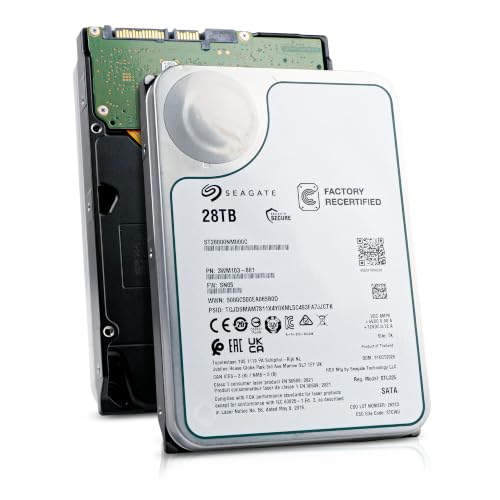
For those seeking robust storage solutions, the Seagate Exos 28TB Internal Hard Drive stands out as an exceptional choice for enterprise applications. With a 7200 RPM spindle speed and a SATA III 6Gb/s interface, it guarantees lightning-fast data access and transfer rates. Designed for 24/7 operation, this drive boasts a 512 MB cache, optimizing throughput for large data operations. Its durable construction and high MTBF of 2.5 million hours make it reliable for mission-critical tasks. Plus, the standard 3.5-inch form factor integrates seamlessly into most servers and NAS systems, providing versatile compatibility for your storage needs.
Best For: The Seagate Exos 28TB Internal Hard Drive is best for data centers, servers, NAS systems, and any enterprise seeking high-capacity and reliable storage solutions.
Pros:
- High capacity of 28 TB, ideal for large-scale data storage.
- 7200 RPM speed ensures quick data access and transfer rates.
- Designed for 24/7 operation with a high MTBF of 2.5 million hours for enhanced reliability.
Cons:
- Being a renewed product, it may have signs of previous use.
- Limited 90-day warranty may not provide sufficient coverage for long-term use.
- Heavier than some SSD alternatives, which may affect certain installations.
Seagate IronWolf 10TB NAS Internal Hard Drive (ST10000VN0008)

Seagate’s IronWolf 10TB NAS Internal Hard Drive (ST10000VN0008) stands out as an exceptional choice for those who require robust storage solutions for their NAS setups. With a spindle speed of 7200 RPM and a maximum sustained transfer rate of 210 MB/s, you’ll enjoy lightning-fast data access. Its impressive 10 TB capacity and 256 MB buffer make it perfect for multi-user environments, supporting up to 180 TB of data transfer per year. Designed for RAID configurations, this halogen-free drive is not only efficient but also eco-friendly. Upgrade your home server with the reliability and performance of the IronWolf series.
Best For: The Seagate IronWolf 10TB NAS Internal Hard Drive is best for users who need high-capacity, reliable storage solutions for RAID and NAS environments.
Pros:
- High storage capacity of 10 TB, perfect for extensive data storage needs.
- Fast data access with a spindle speed of 7200 RPM and a maximum sustained transfer rate of 210 MB/s.
- Designed for multi-user environments, handling up to 180 TB of data transfer per year.
Cons:
- As a 3.5-inch drive, it may not fit in all setups, especially those designed for 2.5-inch drives.
- Higher power consumption compared to lower RPM drives may lead to increased energy costs.
- Limited compatibility outside of RAID and NAS configurations, which may restrict use in standard PC setups.
MDD MAXDIGITALDATA 14TB Enterprise Hard Drive (Renewed)

MDD MAXDIGITALDATA’s 14TB Enterprise Hard Drive (Renewed) stands out for businesses and tech enthusiasts needing substantial storage capacity with reliable performance. This 3.5-inch, 7200 RPM SATA drive offers a hefty 14TB of space, perfect for hyperscale applications and enterprise-level tasks. With a 256 MB cache and a data transfer rate of 6 Gb/s, you’ll experience swift data access. Supporting workloads up to 550 TB per year, it’s designed for demanding environments like cloud data centers and RAID systems. Plus, with a 5-year warranty, you can trust in its reliability for all your storage needs.
Best For: Businesses and tech enthusiasts requiring high-capacity storage solutions for enterprise-level applications and data-intensive environments.
Pros:
- High Capacity: Offers an impressive 14TB of storage, ideal for large data sets.
- Fast Performance: Features a 7200 RPM rotational speed and a 6 Gb/s data transfer rate for quick data access.
- Reliable Warranty: Comes with a 5-year warranty, ensuring long-term reliability and peace of mind.
Cons:
- Bare Drive Only: Does not include screws, cables, or accessories, requiring additional purchases for installation.
- Weight: At 1.5 pounds, it may be heavier than some alternative storage options.
- Format Requirement: Needs to be formatted on the system for detection, which may be an inconvenience for some users.
Seagate 2TB 7200RPM SATA Hard Drive

The Seagate Enterprise Capacity 2TB 7200RPM SATA Hard Drive is an ideal choice for businesses needing reliable, high-performance storage solutions. With a 2.5-inch form factor and SATA III interface, it offers impressive data transfer rates of up to 16 Gb/s. This drive is endurance-optimized for 24/7 availability, making it perfect for storage-hungry applications like SAN and NAS. Its low idling power and PowerChoice feature enhance energy efficiency without sacrificing performance. The robust design features improved rotational vibration tolerance, ensuring reliability in demanding environments. Plus, you can enjoy peace of mind with warranty options available through Amazon.
Best For: Businesses requiring reliable and high-performance storage solutions for demanding applications like SAN and NAS.
Pros:
- Endurance-optimized for 24/7 availability, ensuring consistent performance in enterprise environments.
- Energy-efficient with low idling power and PowerChoice feature, reducing operational costs.
- Improved reliability with enhanced rotational vibration tolerance, making it suitable for robust applications.
Cons:
- Average customer ratings with only 3.4 out of 5 stars from 11 reviews, indicating mixed user satisfaction.
- Potential restocking fees for returns, which may deter customers from purchasing if they are unsure.
- Limited capacity of 2TB may not meet the needs of users with larger storage requirements.
Factors to Consider When Choosing NAS Drives With 7200RPM Performance
When picking NAS drives with 7200 RPM performance, you need to take into account several key factors. Think about storage capacity options, performance specifications, and how reliable and durable the drive is. Don’t forget to verify compatibility with your systems and check the warranty and support offered.
Storage Capacity Options
Choosing the right storage capacity for your NAS drives is essential, especially if you want to guarantee peak performance and future-proof your setup. NAS drives typically range from 2TB to 28TB, catering to various data storage needs. If you’re in a multi-user environment, consider drives with 10TB or more, as they can support workloads exceeding 180TB/year. For enterprise-grade applications, opt for drives with 14TB or greater, which excel in handling large-scale backups and data center operations. Always match your storage capacity with expected data growth and usage patterns, since many drives are optimized for specific tasks. Finally, make certain your NAS system accommodates the drive’s capacity and supports your desired RAID configurations for data redundancy and performance.
Performance Specifications
While selecting NAS drives with 7200 RPM performance, it’s essential to focus on several key specifications that directly impact efficiency and reliability. The rotational speed of 7200 RPM greatly enhances data access times, making it ideal for multi-user environments. Look for drives that offer sustained data transfer rates up to 210 MB/s, which are vital for effective file sharing. Additionally, consider drives with larger cache memory, like 256MB or 512MB, as they optimize throughput during heavy data operations. These drives are built to handle substantial workloads, often supporting up to 180 TB/year, ensuring they meet the demands of your applications. Prioritize these performance specifications to maximize your NAS experience.
Reliability and Durability
To guarantee your NAS drives with 7200 RPM performance remain reliable and durable, you should pay close attention to several critical factors. Look for drives with a Mean Time Between Failures (MTBF) rating of 1 million hours or higher, indicating long-term reliability. Choose models designed for continuous operation, as they often feature robust components that withstand 24/7 use. Technologies like rotational vibration sensors can help maintain performance in multi-drive environments by reducing wear. Additionally, opt for drives with at least 256MB of cache memory to enhance data access speeds and minimize strain on the drive. Finally, consider drives rated for higher workloads, supporting up to 550TB/year, ensuring they handle substantial data loads efficiently.
Compatibility With Systems
When selecting NAS drives with 7200 RPM performance, compatibility with your existing system is crucial to confirm seamless integration and preferred functionality. First, verify the drive’s form factor, usually 3.5 inches, fits your NAS enclosure to prevent installation issues. Next, check the SATA interface version; it should match or exceed what your NAS supports, ideally SATA III 6 Gb/s, for peak performance. Also, verify your NAS’s maximum supported storage capacity to accommodate the 7200 RPM drive you intend to install. Consider the RAID configurations your NAS supports, as some drives perform better with specific setups. Finally, evaluate the workload ratings of the NAS drive to confirm it meets your data transfer needs without exceeding your system’s limitations.
Warranty and Support
Choosing a NAS drive with 7200 RPM performance involves more than just speed; warranty and support are key factors that can greatly impact your experience. Many drives come with a limited warranty ranging from three to five years, ensuring you’re protected against manufacturing defects and premature failures. Some manufacturers even include data recovery services, giving you extra peace of mind in case of data loss. Check the return policy, as most allow returns of damaged drives within 30 days. Also, consider the availability of customer support; some brands offer dedicated assistance for troubleshooting and setup. Finally, be aware of warranty terms, particularly regarding accidental damage and conditions that could void your coverage.
Power Efficiency Features
Power efficiency is an essential factor in selecting NAS drives with 7200 RPM performance, as it can greatly impact both operational costs and longevity. Look for drives that utilize PowerBalance technology, which optimizes watts per terabyte, improving overall efficiency. Helium-sealed designs can considerably reduce power consumption while enhancing durability for continuous use. Consider energy-efficient models with low idle power consumption, crucial for 24/7 NAS operation, as they help cut down on costs. Additionally, advanced power management features allow drives to adjust power usage based on workload, further enhancing energy efficiency. These power-saving technologies not only lower energy bills but also extend the drive’s lifespan by minimizing heat generation and wear, ensuring long-term reliability in your NAS system.
Data Transfer Rates
While evaluating NAS drives with 7200 RPM performance, you’ll want to pay close attention to data transfer rates, as they play a critical role in your system’s overall efficiency. Typically, these drives can reach data transfer rates up to 6.0 gigabits per second, ensuring fast access to your data. Sustained rates often range from 255 MB/s to 260 MB/s, which is essential for handling large files and multiple users simultaneously. Technologies like CMR (Conventional Magnetic Recording) can further optimize these rates. Additionally, drives with larger cache memory, such as 256MB or 512MB, enhance throughput by storing frequently accessed data for quicker retrieval. Consistent performance is key, especially for multi-user workloads, with some drives supporting up to 180 TB/year.
Intended Use Cases
When considering NAS drives with 7200 RPM performance, it is crucial to match your choice with your specific needs. If you’re involved in video editing or sharing large files, these drives provide the high data transfer rates necessary for smooth operation. They excel in small to medium business setups, especially when using RAID configurations, ensuring data redundancy and performance even with multiple users. For continuous operation demands, like in cloud data centers, their reliability is key. With the ability to handle workloads up to 180 TB/year, they’re perfect for heavy data transfers and archiving. Their design for 24/7 use guarantees durability, making them ideal for both personal and mission-critical business applications.
