
A good Jellyfin server does not need a full-size desktop. A mini PC can keep your library available around the clock while using less space and, often, less power.
The right choice depends on whether your devices can direct-play your files or need the server to convert video on the fly. These 10 options span basic library hosting, efficient Intel-based transcoding, and more capable general-purpose systems.
Best 10 Mini PCs for Jellyfin Server Picks for 2026
Best for Expandable Storage

- Ryzen 3 5300U with 8GB RAM
- Spare M.2 NVMe slot
- Dual 2.5GbE ports
Best For: Expandable storage and fast wired networking
Balanced Intel Option

- Intel N100 processor
- 16GB RAM and 500GB SSD
- Listed 2.5GbE LAN
Best For: A compact host with 16GB RAM out of the box
Best for Remote Power Control
- Wake on LAN and auto power-on
- Listed AV1 decoding
- 8GB RAM and 256GB SSD
Best For: Unattended setups needing wake and restart options
Best for Network Flexibility

- Dual 2.5GbE Ethernet ports
- Second M.2 NVMe slot
- 16GB RAM, upgradeable to 64GB
Best For: A media server that doubles as a home-network project
Best for Dual-Network Home Labs
- Two 2.5GbE ports
- 16GB dual-channel DDR4
- Verify CPU: supplied notes conflict
Best For: A compact media server alongside home-lab services
Best for Internal Storage Options
- Extra M.2 slot and 2.5-inch drive bay
- 16GB RAM, upgradeable to 64GB
- Stated three-year limited warranty
Best For: Growing an internally stored media library
Best with Extra Features
GMKtec G11 Ryzen Embedded R2514

- Dual 2.5GbE ports
- 16GB dual-channel DDR4
- 256GB included SSD
Best For: Wired Jellyfin and home-lab setups
Best Heavy-Duty Pick
GMKtec G11 Ryzen Embedded R2514

- Two M.2 2280 SSD slots
- Dual 2.5GbE ports
- 16GB dual-channel DDR4
Best For: SSD expansion and flexible wired networking
Best with Included Storage

- 1TB SSD included
- Dual M.2 storage slots
- 2.5GbE and Wake on LAN
Best For: Storage-ready starter Jellyfin servers
Best for Expandable Storage – BOSGAME E5 Ryzen 3 5300U
Among mini pcs for jellyfin server builds, the BOSGAME E5 stands out if you want room to grow: it pairs a four-core, eight-thread Ryzen 3 5300U with dual 2.5GbE ports and a spare M.2 SSD slot. Its integrated Radeon graphics support 4K media decoding, but the supplied specifications do not establish Jellyfin hardware-transcoding performance.
Best For: A media library setup that prioritizes expandable SSD storage and fast wired networking.
Pros:
- Includes an extra M.2 2280 NVMe slot alongside the installed 256GB SSD.
- Dual 2.5GbE ports provide flexible, high-speed wired connections.
- Two RAM slots allow expansion beyond the included 8GB.
Cons:
- The included 256GB SSD leaves limited space for a substantial media library.
- Jellyfin transcoding capabilities are not specified in the product notes.
This is a flexible starting point if you plan to add storage yourself. Choose it for its expansion and networking rather than an unverified promise about simultaneous transcodes.
Basic Direct-Play Pick – Core 5005U Mini PC
If you are comparing mini pcs for jellyfin server use with an existing collection of compatible files, this Core 5005U model offers a 512GB SATA SSD, Gigabit Ethernet, and a cable for adding a 2.5-inch SATA drive. Its older Core 5005U platform makes it a more cautious choice when playback requires transcoding.
Best For: A small, wired media library where clients can play files directly and a 2.5-inch drive would be useful.
Pros:
- Includes a 512GB SSD and a 2.5-inch SATA drive expansion cable.
- Gigabit Ethernet supports a stable wired connection.
- Supports Ubuntu as an alternative to its preinstalled OS.
Cons:
- The preinstalled 10 Pro OS is listed as unable to upgrade.
- RAM expansion tops out at 16GB in a single slot.
- Hardware-transcoding support is not established by the supplied specifications.
The drive expansion is the practical draw here. Before buying, check your clients’ format compatibility so your intended setup does not depend on unspecified transcoding performance.
Balanced Intel Option – Beelink MINI S12 Pro N100
The Beelink MINI S12 Pro is a straightforward candidate among mini pcs for jellyfin server setups: its Intel N100, 16GB of RAM, 500GB SSD, and listed 2.5GbE port cover the core hardware needs of a compact host. The notes confirm 4K playback capability, but do not specify Jellyfin transcoding results.
Best For: A compact Jellyfin host that comes with 16GB of RAM and a fast wired network port.
Pros:
- Ships with 16GB DDR4 RAM and a 500GB M.2 SSD.
- Includes a listed 2.5GbE LAN port, Wi-Fi 6, and four USB 3.2 Gen 2 ports.
- Intel N100 has four cores and a stated boost frequency up to 3.4GHz.
Cons:
- The listed maximum RAM is 16GB, leaving no stated memory upgrade headroom.
- The product notes do not quantify Jellyfin hardware-transcoding capacity.
This configuration needs fewer immediate upgrades than the 8GB options in this roundup. Confirm the codecs and client devices you expect to use before counting on transcoding.
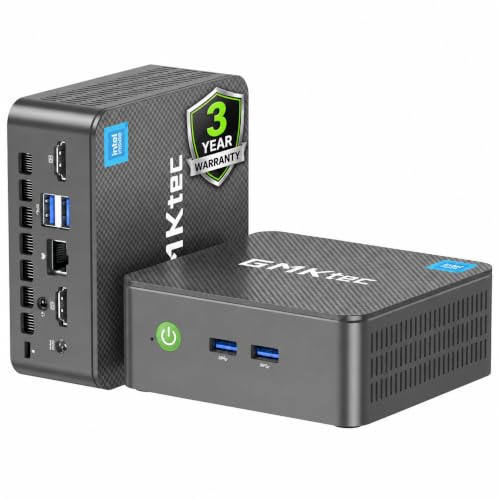
Best for Remote Power Control – GMKtec G3S N95
For shoppers considering mini pcs for jellyfin server duty in an unattended spot, the GMKtec G3S has an Intel N95, Gigabit Ethernet, and useful startup features: Wake on LAN, RTC Wake, and auto power-on. Its listed AV1 decoding is relevant to compatible playback, though the notes do not establish Jellyfin transcoding performance.
Best For: A small media host where remote wake and automatic restart settings matter more than included storage capacity.
Pros:
- Lists Wake on LAN, RTC Wake, and auto power-on support.
- Integrated graphics are listed with AV1 decoding support.
- Offers Gigabit Ethernet and two USB 3.2 Gen 2 ports.
Cons:
- The included 256GB SSD is small for a growing media library.
- Comes with 8GB RAM, and the supplied notes do not state a memory upgrade limit.
- Only Gigabit Ethernet is listed, rather than 2.5GbE.
Its server-friendly power options distinguish it from a basic desktop mini PC. Budget for additional media storage, and do not treat AV1 decoding alone as proof of multi-stream transcoding ability.
Best for Network Flexibility – BOSGAME E5 Ryzen 3 5300U
Among mini pcs for jellyfin server use, the BOSGAME E5 stands out if your media library also needs a capable home-network host. Its Ryzen 3 5300U, 16GB of RAM, and 512GB NVMe SSD provide a practical starting configuration, while dual 2.5GbE ports give you more networking options than a single-port mini PC.
Best For: A Jellyfin setup that shares hardware with home-server or networking projects.
Pros:
- Dual 2.5GbE ports suit flexible network configurations.
- RAM is upgradeable to 64GB, with a second M.2 2280 NVMe slot for added storage.
- Compact design with an optimized cooling fan and copper heat pipes.
Cons:
- 512GB of included storage may be limiting for a large media library.
- The supplied specifications do not establish Jellyfin transcoding capacity or codec support.
Choose the E5 for its expansion and connectivity rather than an assumed number of simultaneous transcodes. Plan additional storage around the size of your library.
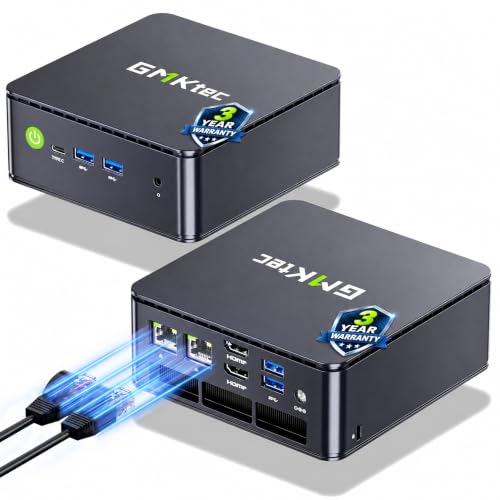
Best for Dual-Network Home Labs – GMKtec G11 Plus
The GMKtec G11 Plus is worth considering among mini pcs for jellyfin server setups that also host containers or other home-lab services. The supplied listing describes 16GB of dual-channel DDR4, a 512GB SSD, and two 2.5GbE ports—useful starting points for a compact, network-connected machine.
Best For: Home-lab users who want a media server alongside networking or container projects.
Pros:
- Dual 2.5GbE ports offer options for separate network connections.
- 16GB of dual-channel DDR4 is included.
- The listing identifies a 512GB SSD and support for triple 4K displays.
Cons:
- The supplied notes conflict on the processor, naming both a Ryzen 5 3500U and an AMD Ryzen Embedded R2514; verify the shipped configuration.
- No Jellyfin-specific transcoding performance is documented.
This model’s network connectivity is its clearest advantage. Because the processor details are inconsistent, confirm the exact CPU and video capabilities before buying it for a particular transcoding workload.
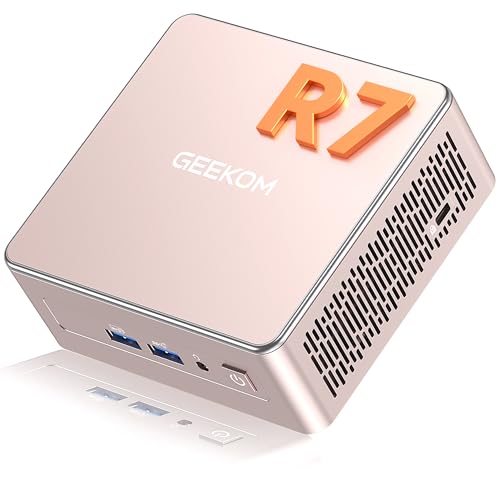
Best for Internal Storage Options – GEEKOM A5 2027 Edition
For shoppers comparing mini pcs for jellyfin server duty, the GEEKOM A5 2027 Edition offers several ways to expand beyond its included 500GB NVMe SSD. Its Ryzen 7 7730U and 16GB of RAM come in a compact system with an extra M.2 2242 slot and a 2.5-inch drive bay.
Best For: Buyers who want room to add internal media storage and value longer stated warranty coverage.
Pros:
- Extra M.2 2242 slot and 2.5-inch drive bay provide storage expansion options.
- Dual-slot DDR4 memory is upgradeable to 64GB.
- Includes a stated three-year limited warranty.
Cons:
- The included 500GB SSD leaves limited room for a substantial media collection.
- The supplied notes do not specify Ethernet capabilities or Jellyfin transcoding performance.
The A5 is a practical pick if you plan to add a drive as your library grows. Check its network specifications and the media formats you need to handle before committing to it as a server.
Best with Extra Features – GMKtec G11 Ryzen Embedded R2514
Among mini pcs for jellyfin server use, this GMKtec G11 stands out for its Ryzen Embedded R2514, 16GB of dual-channel RAM, and two 2.5GbE ports. The supplied configuration includes a 256GB PCIe M.2 SSD, so plan additional storage if you have a large media library.
Best For: A Jellyfin setup that also needs fast wired networking or home-lab duties.
Pros:
- Ryzen Embedded R2514 is described as designed for continuous operation.
- Dual 2.5GbE ports provide flexible wired-network connections.
- 16GB of dual-channel DDR4 and H.265/HEVC encoding support suit multimedia workloads.
Cons:
- The included 256GB SSD leaves limited space for a substantial media library.
- H.265/HEVC support alone does not establish Jellyfin hardware-transcoding compatibility or capacity.
Choose this G11 primarily for its networking and server-oriented platform. Verify your intended Jellyfin transcoding setup before relying on it for multiple converted streams.
Best Heavy-Duty Pick – GMKtec G11 Ryzen Embedded R2514
If you are comparing mini pcs for jellyfin server duty, this GMKtec G11 pairs a Ryzen Embedded R2514 with 16GB of dual-channel DDR4 and two M.2 2280 PCIe 3.0 SSD slots. Dual 2.5GbE ports make it appealing when your media server shares space with other network projects.
Best For: Buyers who want internal SSD expansion and dual wired connections in a compact server.
Pros:
- Two M.2 2280 PCIe 3.0 slots offer room for SSD storage expansion.
- Dual 2.5GbE ports support flexible networking.
- The processor is described as intended for continuous operation, and the listed system is compatible with Ubuntu and Linux.
Cons:
- The supplied notes do not establish how much storage is included with this listing.
- Advertised H.265/HEVC support does not specify Jellyfin hardware-transcoding performance.
This is the G11 listing to consider if internal SSD slots are a priority. Check the exact storage configuration and your preferred Jellyfin acceleration setup before purchase.
Best with Included Storage – GMKtec G10 Ryzen 5 3500U
For shoppers seeking mini pcs for jellyfin server use with useful storage out of the box, the GMKtec G10 includes a 1TB SSD and 16GB of DDR4. Its Ryzen 5 3500U, 2.5GbE Ethernet, and second M.2 slot make it a practical candidate for a compact media-server build.
Best For: A starter Jellyfin server that needs more included SSD space and a path to internal expansion.
Pros:
- Includes a 1TB SSD and 16GB of RAM.
- Dual M.2 2280 PCIe 3.0 slots allow storage expansion.
- 2.5GbE Ethernet, Wake on LAN, and auto power-on are useful server features.
Cons:
- Upgraded storage is not included.
- The supplied notes do not confirm Jellyfin hardware-transcoding support or stream capacity.
The G10 is the straightforward storage-first pick here. Its server-friendly connectivity is clear, but assess transcoding requirements separately rather than assuming playback specifications translate into Jellyfin performance.
How We Picked the Best Mini PCs for Jellyfin Server
We compared the listed processors, memory, and included storage against common Jellyfin tasks: organizing a library, serving direct-play streams, and transcoding video when a client cannot play the original file. We also weighed practical server considerations such as likely power draw, external-storage needs, and the difference between a processor’s capabilities and features a particular mini PC actually exposes. Specifications alone cannot confirm sustained transcoding performance, noise, or network reliability; check current listings and owner reports before buying.
Quick Comparison: Which Hardware Fits Your Setup?
- Intel N100 or N95: The Beelink MINI S12 Pro and GMKtec G3S are sensible starting points for an efficient always-on server. Intel Quick Sync can help with supported hardware transcodes when it is correctly enabled.
- AMD Ryzen 3 5300U: The two BOSGAME E5 listings offer four cores and eight threads for library management and other services. Compare their actual ports, storage options, and included software rather than assuming the variants are identical.
- AMD Ryzen 5 3500U: The GMKtec G11 Plus and G10 provide 16GB RAM in their listed configurations; the G10’s 1TB SSD offers more room for metadata and a starter library.
- Ryzen 7 7730U: The GEEKOM A5 is the stronger general-purpose CPU choice here, though extra CPU speed is not a substitute for verified hardware-transcoding support.
- Older or embedded chips: The Core 5005U system and Ryzen Embedded R2514 GMKtec G11 listings are best evaluated by price, power use, and confirmed codec support. Treat comparative performance claims in product names as marketing, not test results.
Key Buying Factors for Mini PCs for Jellyfin Server Use
Direct Play Versus Transcoding
If your TV, streaming box, or phone plays your files directly, even modest hardware can serve multiple streams; your network and storage may become the limits first. Transcoding demands more. Check the exact CPU or GPU generation against the codecs in your library, including HEVC, 10-bit video, and AV1 where relevant. Hardware acceleration also depends on the operating system, drivers, and Jellyfin configuration. Burning in subtitles or converting HDR to SDR can add substantial load.
Storage, Networking, and Everyday Setup
An included 256GB–1TB SSD is useful for the OS, Jellyfin database, and some media, but large libraries usually need a separate USB drive, NAS, or expandable internal storage. Confirm the ports and drive support on the exact listing. Prefer wired Ethernet for a stationary server, and check its advertised speed if you expect many simultaneous streams. Plan for backups: a media drive and the Jellyfin database can both fail. Finally, verify the supplied operating system and license details, especially on vaguely labeled listings, before relying on an unattended setup.
Who Should Buy Which Mini PCs for Jellyfin Server?
For a compact, power-conscious setup that may need supported hardware transcoding, start by comparing the N100-based Beelink with the N95-based GMKtec. For mostly direct-play households that also want to run other lightweight applications, compare the Ryzen-based BOSGAME and GMKtec configurations on price and connectivity. Choose the GEEKOM A5 if broader CPU-heavy work matters beyond Jellyfin. Consider the older Core 5005U or embedded R2514 models only when their price and verified features make sense for your particular library. Whichever you choose, match the machine to your real client devices and media formats—not just the number of advertised 4K displays.
