
As you explore the evolving world of edge AI computing, the need for powerful yet portable mini PCs becomes increasingly clear. In 2026, you’ll find options that not only excel in performance but also prioritize energy efficiency and connectivity. Each of the seven mini PCs on our list offers unique features tailored to meet diverse industrial needs. Let’s uncover which devices stand out and why they might be the right fit for your applications.
AINEST WITHBOX OpenClaw AI Mini PC
The AINEST WITHBOX OpenClaw AI Mini PC is the perfect choice for developers and power users looking for a compact yet powerful local AI deployment workstation. Its 4-core/8-thread AMD Ryzen processor delivers robust AI inference and multitasking, making your projects smoother. You’ll appreciate its dual 2.5G Ethernet ports, ensuring high-bandwidth connections for clustered workloads. Plus, with support for triple 4K displays, you can enhance your multi-window development and AI visualization. Pre-configured for OpenClaw, this mini PC eliminates setup hassles, letting you focus on your work with efficient, lag-free performance. It’s the ideal blend of power and portability for your AI needs.
Best For: Developers and power users seeking a compact and powerful local AI deployment workstation.
Pros:
- Robust performance with a 4-core/8-thread AMD Ryzen processor for efficient multitasking and AI inference.
- High-speed connectivity through dual 2.5G Ethernet ports, ideal for clustered AI workloads.
- Enhanced productivity with support for triple 4K display outputs, facilitating multi-window development and visualization.
Cons:
- Limited upgrade options due to its compact design, which may restrict future hardware enhancements.
- Price point may be higher compared to traditional PCs without specialized AI capabilities.
- Potential heat generation from high-performance components, which may require good ventilation.
ACEMAGIC M5 Mini PC i7-14650HX

Looking for a powerful yet compact solution for edge AI computing? The ACEMAGIC M5 Mini PC i7-14650HX packs a punch with its Intel Core i7-14650HX processor, boasting 16 cores and 24 threads, delivering impressive performance in multi-threaded tasks. With 32GB of expandable RAM and a 1TB NVMe SSD, it guarantees speedy data access. Its compact design features advanced cooling technology, keeping everything running smoothly. Connectivity options are abundant, supporting triple 4K displays. Pre-installed with Windows 11 Pro, it’s perfect for gaming, multimedia tasks, or productivity. This mini PC delivers robust performance without compromising on space.
Best For: Users seeking a high-performance, compact mini PC suitable for edge AI computing, casual gaming, and multimedia tasks.
Pros:
- Impressive performance with 16 cores and 24 threads, ideal for multi-threaded workloads.
- Compact design with advanced cooling technology to maintain optimal performance without overheating.
- Versatile connectivity options supporting triple 4K display outputs, perfect for multitasking and productivity.
Cons:
- Limited built-in storage of 1TB, which may require upgrades for users with extensive data needs.
- Potential noise from the cooling system under heavy loads, which may be noticeable in quiet environments.
- Higher price point compared to basic mini PCs, making it less accessible for budget-conscious users.
MINISFORUM MS-R1 ARM Mini Workstation
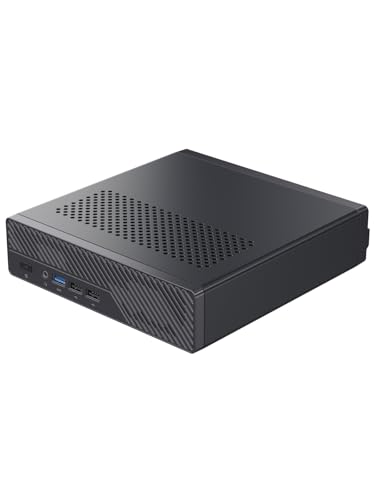
For educators and researchers seeking powerful yet compact computing solutions, the MINISFORUM MS-R1 ARM Mini Workstation stands out with its impressive 45 TOPS AI compute capability, including 28.8 TOPS dedicated to its NPU. Featuring a robust CIX CP8180 processor and 64GB of fast ECC LPDDR5 memory, this workstation excels in high-parallel virtualization. Dual 10GbE LAN ports, Wi-Fi 6E, and Bluetooth 5.3 guarantee seamless connectivity. You can expand storage via PCIe slots and enjoy triple video output with HDMI and USB-C support. It’s perfect for everything from classroom teaching to intensive multimedia projects, making it a versatile choice.
Best For: Educators and researchers looking for a powerful, compact workstation for high-performance computing and virtualization tasks.
Pros:
- High AI Compute Capability: Offers 45 TOPS AI compute power, making it suitable for AI and machine learning tasks.
- Robust Connectivity Options: Equipped with dual 10GbE LAN ports, Wi-Fi 6E, and Bluetooth 5.3 for fast and reliable connectivity.
- Expandable Storage: Supports PCIe x16 and M.2 interfaces for flexible hardware and storage expansion.
Cons:
- No SSD Included: Lacks pre-installed SSD, requiring additional investment for storage.
- Limited Graphics Options: May not support high-end gaming due to reliance on integrated graphics unless expanded with additional hardware.
- High Power Requirement: The performance capabilities may require adequate power supply and cooling solutions for optimal operation.
MINISFORUM MS-R1 ARM Mini Workstation CP8180 Mini PC

With its robust ARM CIX CP8180 processor and impressive 64GB of LPDDR5 memory, the MINISFORUM MS-R1 Mini Workstation is an excellent choice for professionals in business and education seeking powerful edge AI computing solutions. You’ll enjoy near-x86 performance with 28W TDP and 45 TOPS total compute, making it perfect for multimedia tasks and video conferencing. Its triple display support and multiple connectivity options, including 10GbE networking and Wi-Fi 6E, enhance productivity. Plus, with storage capabilities of up to 8TB, you can manage resource-heavy applications effortlessly. This compact powerhouse caters to all your office and home needs seamlessly.
Best For: Professionals in business and education seeking powerful edge AI computing solutions with robust multitasking capabilities.
Pros:
- High-performance ARM CIX CP8180 processor with near-x86 performance.
- Extensive connectivity options, including dual 10GbE ports and Wi-Fi 6E for rapid data transfer.
- Supports triple display setup and large storage capacity of up to 8TB for resource-intensive applications.
Cons:
- Limited gaming performance due to integrated graphics.
- Operating system is Debian, which may not be familiar to all users.
- Fan cooling system might generate noise under heavy load.
Seeed Studio reComputer Industrial J4012 Edge AI Device

The Seeed Studio reComputer Industrial J4012 Edge AI Device stands out as an ideal choice for industrial applications, thanks to its compact, fanless design that operates efficiently in challenging environments. Powered by the Jetson Orin NX processor, it features 16 GB of RAM and 128 GB of storage, running on Linux. With a temperature range of -20 to 60°C, it’s built for durability. You’ll appreciate the versatile mounting options and extensive connectivity, including multiple USB ports and support for 5G. While the device weighs 2.21 kg, it remains a reliable option for edge AI computing.
Best For: The Seeed Studio reComputer Industrial J4012 is best for industrial applications requiring robust edge AI computing in varied environmental conditions.
Pros:
- Durable construction with a wide temperature range of -20 to 60°C, suitable for harsh environments.
- Compact, fanless design that minimizes noise and maintenance needs.
- Extensive connectivity options, including multiple USB ports and support for 5G, enabling versatile applications.
Cons:
- Additional power adapter must be purchased separately, adding to the overall cost.
- Moderate customer review rating of 3.8 out of 5 stars may indicate potential quality concerns.
- Weight of 2.21 kg could be considered heavy for some portable applications.
Yahboom Jetson Orin NX Super Kit for AI Mini PC

Engineered for developers and businesses seeking powerful AI solutions, the Yahboom Jetson Orin NX Super Kit stands out with its impressive AI performance of up to 157 TOPS. With a 1024-core NVIDIA Ampere GPU and an 8-core Arm Cortex CPU, it delivers exceptional processing capabilities. The 16GB LPDDR5 memory and support for external NVMe storage guarantee you can handle large AI models effortlessly. This kit excels in various applications, from speech-to-text to real-time video analysis. Plus, the software environment based on Ubuntu 22.04 simplifies development, making it a top choice for anyone diving into edge AI computing.
Best For: Developers and businesses looking for advanced AI processing capabilities in edge computing applications.
Pros:
- Exceptional AI performance of up to 157 TOPS, ideal for complex AI models.
- Versatile applications in various fields such as manufacturing, healthcare, and agriculture.
- Complete software environment based on Ubuntu 22.04, simplifying development and integration.
Cons:
- Relatively high price point may not be suitable for casual users or hobbyists.
- Requires technical expertise to fully leverage its capabilities.
- Weight of 1.61 kg may not be ideal for portable applications.
Industrial PC Ryzen R2314 Processor (No RAM, No SSD)

For developers looking to build custom edge AI solutions, the Industrial PC Ryzen R2314 Processor stands out as an ideal choice. With its 4 cores and a max turbo frequency of 3.5 GHz, this processor delivers efficient performance. You’ll appreciate its versatile compatibility with OPNsense, Linux, and Windows. The quad 2.5GbE LAN provides lightning-fast networking capabilities, perfect for soft routing and security. Plus, the integrated UHD graphics support 4K at 60Hz, enhancing your visual output. With expansion options for 5G, Wi-Fi, and Bluetooth modules, you’re set for a robust, customizable edge AI experience.
Best For: Developers and businesses looking to create customized edge AI solutions with high-performance computing and advanced networking features.
Pros:
- High Performance: With a 4-core processor and a max turbo frequency of 3.5 GHz, it ensures efficient processing for demanding applications.
- Versatile Compatibility: Supports multiple operating systems including OPNsense, Linux, and Windows, making it suitable for various use cases.
- Fast Networking: Equipped with quad 2.5GbE LAN for enhanced networking capabilities, ideal for soft routing and network security.
Cons:
- No RAM or SSD Included: Requires additional purchases to fully operate, which may increase overall costs.
- Limited Integrated Graphics: While it supports 4K resolution, the integrated UHD graphics may not meet the needs of graphics-intensive applications.
- Compact Expansion Options: Limited to specific modules for connectivity, which may restrict customization compared to more extensive systems.
Factors to Consider When Choosing Mini PCs for Edge AI Computing
When you’re choosing a mini PC for edge AI computing, several key factors will impact your decision. You’ll want to evaluate performance specifications, connectivity options, and design features to guarantee it meets your needs. Don’t forget to take into account expandability and operating system compatibility to future-proof your investment.
Performance Specifications Overview
Choosing the right mini PC for edge AI computing hinges on understanding its performance specifications, as these factors directly impact your system’s efficiency and capabilities. Look for multi-core processors that support high-thread counts, which enhance multitasking and AI inference. Advanced cooling systems, like vapor chamber technology and heat pipes, are essential for maintaining peak performance during intense computational tasks. Memory capacity and speed, especially high-bandwidth options like DDR4 or LPDDR5, are critical for processing large datasets and complex AI models effectively. Additionally, storage solutions using NVMe PCIe technology guarantee fast data transmission rates, meeting the high-speed demands of AI applications. Finally, support for multiple 4K display outputs enhances usability in both development and operational environments.
Connectivity Options Available
Connectivity options play an essential role in selecting a mini PC for edge AI computing. You’ll want to take into account the number and type of network ports, specifically dual 2.5G Ethernet, for high-speed data transfer. This is vital for managing large AI workloads efficiently. Additionally, look for support for advanced wireless standards like Wi-Fi 6E and Bluetooth 5.3 to enhance connectivity in environments with multiple IoT devices. Multiple display outputs, such as triple 4K support, are important for effective visualization of AI outputs. Expansion options, including PCIe slots and USB-C ports, allow for additional networking modules or peripherals. Finally, think about devices with hybrid connectivity options like 5G and LTE for versatile deployment in edge computing scenarios.
Cooling and Design Features
While evaluating mini PCs for edge AI computing, cooling and design features are fundamental for maintaining performance under demanding workloads. Effective cooling systems, like advanced vapor chamber technology and silent fans, guarantee reliability during intensive AI computations. Compact designs often incorporate heat pipes and aluminum fins, enhancing airflow for efficient heat dissipation—essential for system stability. You’ll want to evaluate the materials and layout; fanless designs work great where noise reduction is crucial. Additionally, check the operating temperature range, ideally between -20 to 60°C, to verify functionality in diverse environments. Finally, dustproof designs can enhance longevity by preventing dust accumulation on critical components, making your mini PC more reliable in challenging settings.
Expandability and Upgrade Potential
A robust cooling system and an efficient design are just the beginning when evaluating mini PCs for edge AI computing. You’ll want models with expandable RAM and storage options, like those supporting dual-channel memory and M.2 NVMe slots, to enhance performance. Look for PCIe slots that allow hardware upgrades, enabling you to add GPUs or advanced networking components as your computational needs grow. Multiple connectivity options, such as USB-C or 10GbE LAN ports, facilitate the integration of additional peripherals and improve network capabilities. Opt for devices that support various operating systems for future upgrades and flexibility in deploying new software. Finally, make certain the mini PC’s design accommodates future expansions without compromising performance or thermal management.
Operating System Compatibility
Choosing the right operating system for your mini PC is vital for optimizing performance in edge AI computing. You’ll want to prioritize a Linux-based OS, as many AI development frameworks and tools are optimized for these environments. However, compatibility with Windows can also be advantageous, especially for applications requiring specific software unavailable on Linux. Some mini PCs even offer dual-boot capabilities, giving you the flexibility to run multiple operating systems for various needs. Pre-installed operating systems can further streamline your setup, reducing configuration time and allowing for quicker deployment of AI solutions. Finally, consider the availability of software support and updates, as this is essential for maintaining security and performance in your edge AI applications.
Power Consumption Considerations
When it comes to edge AI computing, power consumption is essential, as devices with lower TDP (Thermal Design Power) ratings can markedly cut energy costs and reduce heat output. Look for mini PCs that feature advanced cooling solutions, like vapor chamber technology, which help maintain ideal performance while minimizing power usage. Efficient power management is vital, especially for portable devices; it enhances battery life, making them suitable for remote applications. Opt for processors with high performance per watt, such as those using ARM architecture, to boost energy efficiency in AI workloads. Additionally, many edge AI devices include features like sleep modes and dynamic frequency scaling, which further reduce power consumption during idle or low-load periods, ensuring you get the most out of your mini PC.
