
A good desk dock lets your MacBook connect to monitors, power, and peripherals with fewer cables to manage. But a dock that fits your ports may not support the number of displays you want.
These 10 picks cover compact hubs, laptop stands, and full-size docks. Start with your Mac model and monitor setup, then compare charging and everyday ports.
Best 10 Mac Compatible Docking Stations for Desks Picks for 2026
Best High-Connectivity Mac Dock
TobenONE 17-in-2 Vertical Dock
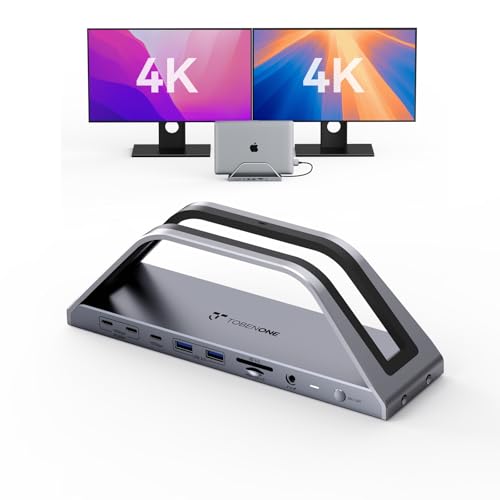
- Dual 4K/60Hz HDMI on supported Macs
- Seven USB ports and 2.5Gbps Ethernet
- Included adapter; up to 100W MacBook charging
Best For: MacBook desks with many wired accessories
Best for VGA Presentations
TobenONE MacBook Docking Stand

- Dual 4K/60Hz HDMI on supported Macs
- VGA mirrors the second HDMI output
- Included 100W charger; up to 87W to MacBook
Best For: MacBook setups that also use a VGA projector
Best Cross-Platform Dual-Monitor Dock

- Two 4K/60Hz monitors via DisplayLink
- HDMI or DisplayPort display connections
- Driver required; no laptop charging
Best For: Shared Mac and Windows workstations
Best Adjustable Stand-Dock

- Adjustable aluminum laptop stand
- One 4K/60Hz HDMI output
- Three 10Gbps USB ports; up to 85W pass-through
Best For: Ergonomic single-monitor MacBook desks
Best for Mountable Desks
Kensington SD4760P Triple-Monitor Dock

- Three HDMI displays with DisplayLink
- Six 5Gbps USB-A ports and 100W charging
- Optional out-of-sight mounting
Best For: Peripheral-heavy Mac desks needing three monitors
Best for Shared Workstations
Plugable Triple Display USB-C Dock

- Three HDMI outputs across supported laptops
- Six USB 3.0 ports and wired Ethernet
- 100W charging; Mac driver required
Best For: Shared Mac and Windows workstations
Best for Single-Monitor Macs

- One extended Mac display up to 4K/60Hz
- HDMI, DisplayPort, Ethernet, and USB ports
- Up to 87W available for laptop charging
Best For: MacBook users prioritizing ports over multiple extended displays
Best for Legacy Peripherals
Plugable UD-3900 Dual-HDMI Dock

- Dual HDMI up to 1920×1200 at 60Hz
- Six USB ports plus Gigabit Ethernet
- Mac driver required; no laptop charging
Best For: Productivity desks with older USB accessories and dual HD monitors
Most Display Connections

- Two HDMI and two DisplayPort connectors
- USB, card readers, and Gigabit Ethernet
- Mac external displays listed as mirror mode
Best For: Port-heavy desks where Mac display mirroring meets the need
Best Stand-and-Dock Combo

- Laptop stand with two 4K/60Hz HDMI outputs
- 10Gbps USB, Ethernet, and card readers
- No dual displays for base M1/M2/M3 MacBooks
Best For: Compatible MacBooks needing a raised stand and dual monitors
Best High-Connectivity Mac Dock – TobenONE 17-in-2 Vertical Dock
Among mac compatible docking stations for desks, this TobenONE model suits a MacBook workstation with many peripherals. Its vertical slot helps reclaim desk space while two HDMI outputs, seven USB-A/USB-C ports, and a 2.5Gbps Ethernet port handle the connections.
Best For: MacBook users who want a vertical dock with extensive connectivity and dual-monitor capability on supported models.
Pros:
- Two HDMI outputs support up to 4K at 60Hz each on compatible MacBooks.
- Included 150W adapter supports up to 100W MacBook charging; two front PD ports provide up to 30W each.
- Includes 2.5Gbps Ethernet and SD/TF 4.0 card slots.
Cons:
- Base M1, M2, and M3 MacBooks support only one extended external monitor.
- The roughly 0.8-inch vertical slot may not fit a MacBook in a protective case.
Choose this dock for its broad port selection, but check your MacBook chip’s display limits and the slot fit before buying.
Best for VGA Presentations – TobenONE MacBook Docking Stand
This TobenONE stand is one of the more presentation-friendly mac compatible docking stations for desks: it holds a MacBook vertically and provides two HDMI outputs plus VGA for an older projector or display. It also includes a 100W charger.
Best For: MacBook users who want a space-saving vertical dock with HDMI and VGA display connections.
Pros:
- Two HDMI ports support dual 4K at 60Hz on compatible MacBooks.
- VGA accommodates legacy display setups; HDMI2 and VGA mirror the same content.
- Included 100W charger supplies up to 87W to a MacBook; the dock also offers USB, card-reader, audio, and Gigabit Ethernet connections.
Cons:
- Base M1, M2, and M3 MacBooks support only one extended external monitor.
- HDMI2 and VGA cannot show two independent images.
The vertical design can free up work surface without giving up older display connectivity. Verify your MacBook model and intended monitor arrangement before choosing it.
Best Cross-Platform Dual-Monitor Dock – WAVLINK DisplayLink Dock
If your desk hosts both Mac and Windows laptops, this WAVLINK is a flexible option among mac compatible docking stations for desks. DisplayLink enables up to two external 4K/60Hz monitors through a single USB connection, with HDMI and DisplayPort choices.
Best For: Everyday dual-monitor work across compatible Mac, Windows, and ChromeOS laptops.
Pros:
- Supports two external 4K/60Hz monitors using HDMI, DisplayPort, or a mix of the two.
- Connects to compatible USB-A, USB-C, USB4, and Thunderbolt laptops.
- Includes six USB-A 3.0 ports, Gigabit Ethernet, and a 3.5mm audio jack.
Cons:
- DisplayLink driver installation is required for video output.
- Does not charge the laptop.
- Not intended for gaming, high-frame-rate video editing, or DRM-protected streaming.
This is a practical pick when monitor flexibility matters more than one-cable charging. Plan for driver setup and a separate laptop charger.
Best Adjustable Stand-Dock – BENFEI 6-in-1 Laptop Stand
The BENFEI combines an adjustable laptop riser with a compact hub, making it a useful alternative to conventional mac compatible docking stations for desks. It provides one 4K/60Hz HDMI output, Gigabit Ethernet, and three 10Gbps USB data ports.
Best For: MacBook users who prioritize adjustable screen height and a single external monitor.
Pros:
- Adjusts from 68mm to 178mm in height, with an aluminum build and anti-slip silicone.
- Provides one 4K/60Hz HDMI output and Gigabit Ethernet.
- One USB-C and two USB-A 3.2 ports support up to 10Gbps; USB-C pass-through charging supports up to 85W to the laptop.
Cons:
- Only one HDMI output is listed, so it is not a dual-external-monitor dock.
- The notes specify USB-C pass-through charging, not an included power adapter.
Pick this if positioning your laptop comfortably matters as much as adding essential connections. For two external monitors or a larger port selection, look elsewhere.
Best for Mountable Desks – Kensington SD4760P Triple-Monitor Dock
For mac compatible docking stations for desks where surface space matters, the Kensington SD4760P offers three HDMI outputs and an optional under-desk mounting setup. It supports macOS 11 or later, including M1 through M4 MacBooks, but its DisplayLink monitor setup requires a driver.
Best For: Mac users who want three external displays, plenty of USB-A ports, and the option to clear the dock off their desktop.
Pros:
- Supports one 4K display at 30Hz plus two 1080p displays at 60Hz.
- Provides six 5Gbps USB-A ports, Gigabit Ethernet, and a combo audio jack.
- Offers up to 100W laptop charging and optional zero-footprint mounting.
Cons:
- DisplayLink requires a driver for the multi-monitor setup.
- The mounting bracket is sold separately; the 4K output is limited to 30Hz.
This is a practical pick for a peripheral-heavy Mac desk, especially if you plan to mount the dock out of sight. Check the display resolution limits before committing to a three-monitor layout.
Best for Shared Workstations – Plugable Triple Display USB-C Dock
Among mac compatible docking stations for desks shared by different laptop users, this Plugable dock stands out for its macOS, Windows, and ChromeOS support. It connects up to three HDMI monitors and supplies up to 100W of USB-C charging; Mac users need to install the DisplayLink driver.
Best For: Shared or hybrid workstations that need wired networking and multiple displays across mixed laptop fleets.
Pros:
- Supports one 4K HDMI display at 30Hz and two 1080p displays at 60Hz.
- Includes six USB 3.0 ports, Gigabit Ethernet, audio, and 100W Power Delivery.
- Works with macOS 11+ and newer Apple Silicon MacBooks, including models with native single-display limitations.
Cons:
- macOS requires driver installation for DisplayLink displays.
- HDCP is not supported, and the dock is not compatible with Linux.
The combination of triple-display support and cross-platform connectivity suits a managed desk setup. Its driver requirement and lack of HDCP support are worth checking against your workflow.
Best for Single-Monitor Macs – LIONWEI 13-in-1 USB-C Hub
If you’re comparing mac compatible docking stations for desks, this LIONWEI 13-in-1 hub is worth considering when ports matter more than multiple extended Mac displays. It offers two HDMI ports, DisplayPort, USB-A and USB-C connections, Ethernet, and audio, but macOS can extend only one external monitor.
Best For: MacBook desks needing a broad selection of connections and one extended external display.
Pros:
- Supports one extended Mac display at up to 4K at 60Hz.
- Includes HDMI, DisplayPort, Gigabit Ethernet, a 3.5mm audio jack, and multiple USB ports.
- Supports 10Gbps transfers on specified ports and up to 87W laptop charging after the dock’s power use.
Cons:
- macOS cannot extend across multiple external monitors with this hub.
- Its advertised 100W Power Delivery leaves up to 87W for the laptop.
Choose this hub for connection variety rather than a multi-monitor Mac workstation. Its single-extended-display limit is the key distinction from the DisplayLink docks above.
Best for Legacy Peripherals – Plugable UD-3900 Dual-HDMI Dock
Among mac compatible docking stations for desks, the Plugable UD-3900 is a practical choice when you need two HDMI monitors and plenty of connections for older USB accessories. Its hybrid cable connects through USB-C or USB 3.0, but macOS 14 or later requires a manual DisplayLink driver installation.
Best For: Mac desk setups focused on office work, dual HD displays, and USB peripherals rather than charging or 4K video.
Pros:
- Runs two HDMI displays at up to 1920×1200 at 60Hz.
- Offers six USB ports, Gigabit Ethernet, and separate headphone and microphone jacks.
- Includes a hybrid USB-C/USB 3.0 host cable.
Cons:
- Requires a manual DisplayLink driver installation on macOS 14 or later.
- Does not charge the laptop or support 4K displays.
- Not suited to gaming or HDCP-protected streaming content.
Choose this dock for a peripheral-heavy productivity desk; look elsewhere if single-cable laptop charging or higher-resolution monitors are priorities.
Most Display Connections – MOKiN 14-in-1 USB-C Dock
If you’re comparing mac compatible docking stations for desks with several display cables and accessories, this MOKiN hub offers a broad port selection. It combines two HDMI and two DisplayPort connections with five USB ports, card readers, Ethernet, and a USB-C power input.
Best For: Mac users who want a variety of monitor connections and everyday ports in one USB-C hub, subject to their Mac’s display capabilities.
Pros:
- Provides two HDMI and two DisplayPort connections for flexible cabling.
- Includes three 5Gbps USB ports, two USB 2.0 ports, SD/microSD slots, and Gigabit Ethernet.
- Supports USB-C Power Delivery charging with a suitable adapter.
- Has a button to turn off connected screens.
Cons:
- The listed power adapter is not included.
- The notes say Mac laptops support mirror mode for connected external monitors; do not assume independent multi-monitor extension on macOS.
The port mix is the draw here, but verify the display behavior you need before buying it for a multi-screen Mac workstation.
Best Stand-and-Dock Combo – PULWTOP MacBook Stand Dock
For mac compatible docking stations for desks that also lift the laptop, the PULWTOP combines a MacBook stand with a 10-port dock. It offers two HDMI outputs rated for 4K at 60Hz, fast USB data ports, Ethernet, card readers, audio, and USB-C power pass-through.
Best For: Owners of a listed MacBook model who want a raised laptop and dual-display connections without a separate stand.
Pros:
- Stand design raises a laptop while consolidating desk connections.
- Supports two HDMI displays at up to 4K at 60Hz on compatible MacBooks.
- Includes three 10Gbps USB data ports, Gigabit Ethernet, SD/TF slots, and audio.
- Supports up to 100W USB-C Power Delivery pass-through.
Cons:
- Dual displays are not supported for base-chip M1, M2, or M3 MacBooks.
- Power adapter is not included.
- Not designed for MacBook Neo, Windows, or Chrome devices.
This is a space-saving option if your exact MacBook is on the compatibility list. Check the chip before purchase, especially if dual external monitors are essential.
How We Picked the Best Mac Compatible Docking Stations for Desks
We selected 10 options spanning compact USB-C hubs, stands with built-in connections, and larger desktop docks. The shortlist includes single-, dual-, and triple-monitor claims, plus different approaches to power delivery and peripheral ports. We prioritized the questions that determine whether a dock will work at your desk: Mac display support, the connection required, charging capacity, and the ports you will actually use.
Product names and advertised specifications are a starting point, not a compatibility guarantee. Before buying, check the manufacturer’s current specifications against your exact Mac model, chip, and macOS version.
Quick Comparison: Choose by Desk Setup
- One external display and a tidy workspace: A compact hub or stand-style dock may be enough if its HDMI output, power input, and USB ports cover your needs.
- Two or more external displays: First determine whether the dock uses native video output or DisplayLink. A dock with multiple HDMI sockets does not necessarily add display support to your Mac.
- Many always-connected accessories: A full-size dock can be a better fit for several USB devices, wired Ethernet, audio, and monitor cables.
- Minimal charging clutter: Look for sufficient USB-C Power Delivery, and confirm whether the advertised charger is included or must be supplied separately.
Key Buying Factors for Mac Compatible Docking Stations for Desks
Display Support Comes First
Check how many external monitors your specific Mac supports natively and how the dock sends video. Some dual- or triple-display configurations depend on DisplayLink software, which requires a driver and macOS permissions. That may be a useful workaround for productivity, but consider your workplace’s software rules and any requirements for protected video playback. Also verify resolution and refresh rate for each display when all monitors are connected.
Charging, Host Connection, and Ports
Match dock power delivery to your MacBook’s charging needs, especially if you work under sustained load. Advertised wattage may describe the dock’s power adapter rather than the power delivered to the laptop. Check whether the host cable is included and whether one cable carries video, data, and charging. Count the ports you need simultaneously: USB-A for existing accessories, USB-C for newer devices, Ethernet for wired networking, and audio if your setup calls for it. For external drives, check USB data speeds instead of assuming every USB-C port performs alike.
Physical Fit
A stand can free desk space but must suit your laptop’s size and ventilation needs. A separate dock is easier to place out of sight, provided its cable reaches your MacBook. Check cable direction, power-brick placement, and room for HDMI plugs before committing.
Who Should Buy Which Mac Compatible Docking Stations for Desks?
Choose a simple hub if you use one monitor and a few accessories. Choose a stand-style dock if laptop positioning matters as much as connectivity. Choose a larger dock if you keep multiple monitors and peripherals plugged in every day. If your Mac cannot run your desired display count natively, consider a clearly identified DisplayLink model only after confirming its driver requirements suit your workflow. For any of these Mac Compatible Docking Stations for Desks, the safest final check is a compatibility listing for your exact Mac and complete monitor setup.
