
If you’re looking to boost your system’s storage performance, M.2 PCIe adapters for Gen5 SSDs might be just what you need. These adapters not only offer incredible transfer speeds but also enhance your overall efficiency. With options like the SABRENT M.2 Adapter and ASUS Hyper M.2 Card, you’ll find a solution that fits your specific requirements. Curious about which adapters stand out and how they can transform your setup? Let’s explore the top contenders.
SABRENT M.2 NVMe SSD to PCIe x16 Adapter with Aluminum Heatsink

If you’re looking to maximize your Gen5 SSD’s performance, the SABRENT M.2 NVMe SSD to PCIe x16 Adapter with Aluminum Heatsink is a standout choice. This adapter offers compatibility with all generations of NVMe M.2 SSDs, supporting transfer speeds up to 16GBps. Its tool-free design makes installation a breeze, although some users found the instructions could use improvement. The built-in aluminum heatsink effectively prevents throttling, ensuring stable operation without active cooling. Weighing just 3.1 ounces, it fits snugly in x4/x8 PCIe slots, making it a reliable option for enhancing your system’s storage capabilities. Enjoy the performance boost!
Best For: Users looking to enhance their storage capabilities with a high-performance NVMe SSD adapter that offers easy installation and effective cooling.
Pros:
- High Transfer Speeds: Supports up to 16GBps transfer speeds for optimal performance.
- Tool-Free Installation: Designed for easy setup without the need for tools, making it user-friendly.
- Effective Cooling: Built-in aluminum heatsink prevents throttling, ensuring stable operation.
Cons:
- Installation Challenges: Some users reported difficulties with installation instructions and thermal pad placement.
- Screw Tightness Issues: A few users experienced problems with screws being too tight or not securing properly.
- Limited Guidance: Recommendations for clearer installation guides and better fasteners were noted by users.
ASUS Hyper M.2 x16 Gen5 Card for NVMe Devices

The ASUS Hyper M.2 x16 Gen5 Card stands out as the ideal choice for enthusiasts and professionals looking to maximize their NVMe storage capabilities. Supporting up to four M.2 devices, this PCIe 5.0 expansion card delivers an impressive 512 Gbps total bandwidth. Its robust cooling solution, featuring a large heatsink and active blower fan, keeps your SSDs cool under heavy loads. Installation is straightforward, though verify your motherboard supports PCIe bifurcation for peak performance. While it’s praised for speed and expansion, be mindful of potential noise from the fan and compatibility issues with RAID setups.
Best For: Enthusiasts and professionals seeking to expand their NVMe storage capabilities with high bandwidth and effective cooling solutions.
Pros:
- Excellent speed and performance with up to 512 Gbps total bandwidth.
- Robust cooling system with a large heatsink and active fan to prevent throttling.
- Easy installation process for compatible motherboards.
Cons:
- The fan can be loud during operation.
- Limited documentation may hinder setup for some users.
- Potential compatibility issues with RAID configurations and certain motherboards.
SABRENT M.2 NVMe SSD to PCIe Adapter Card

For those looking to upgrade their desktop storage performance, the Sabrent M.2 NVMe SSD to PCIe Adapter Card stands out as an ideal choice. It’s compatible with PCIe x16/x8/x4 slots and supports various M.2 NVMe SSD sizes, including 2230, 2242, 2260, and 2280. You’ll experience ultra-fast transfer speeds, making it perfect for expanding storage capabilities. The card features an aluminum heatsink and thermal pad for effective heat dissipation. Plus, installation is a breeze with a tool-free setup using included screws and a screwdriver. Just verify your BIOS supports NVMe via PCIe for peak performance.
Best For: Users looking to enhance their desktop storage performance with fast and efficient M.2 NVMe SSD integration.
Pros:
- Ultra-fast transfer speeds for improved storage performance.
- Supports multiple M.2 SSD sizes (2230, 2242, 2260, 2280) for flexibility in upgrades.
- Easy installation with a tool-free setup and included accessories.
Cons:
- Not compatible with SATA drives or PCIe x1 slots, limiting options.
- Requires modern BIOS that supports NVMe via PCIe for functionality.
- Potential thermal management concerns if not properly cooled, despite the included heatsink.
PCIe 5.0 M.2 NVMe Adapter Expansion Card

Designed specifically for high-performance computing enthusiasts and professionals, the PCIe 5.0 M.2 NVMe Adapter Expansion Card seamlessly supports the latest Gen5 SSDs while remaining backward compatible with earlier PCIe versions. This compact card fits in 1U servers and works with various NVMe M.2 drive sizes. With no drivers needed for Windows, Linux, or Mac OS, installation is straightforward. It includes a heatsink and necessary tools for setup. Weighing just 1.76 ounces, it won’t add bulk to your system. Enjoy fast data transfer speeds and reliable performance with this essential upgrade for your storage needs.
Best For: High-performance computing enthusiasts and professionals looking for a reliable NVMe storage upgrade.
Pros:
- Backward compatible with multiple PCIe versions (4.0/3.0/2.0), ensuring versatility with older systems.
- Easy installation with no drivers required for major operating systems, simplifying the setup process.
- Compact design with a lightweight aluminum heatsink, making it suitable for space-constrained environments like 1U servers.
Cons:
- Customer rating of 3.9 out of 5 stars suggests mixed feedback from users.
- Requires a partition manager to format the drive and assign letters for OS detection, which could be a hassle for some users.
- Limited return policy may pose a risk if the product is not functioning as expected after 30 days.
M.2 NVME to PCIe Adapter with Aluminum Heatsink Solution
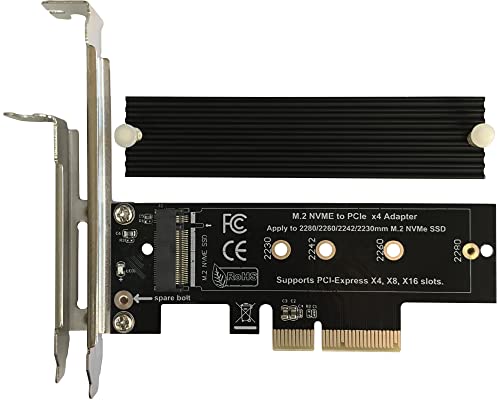
If you’re looking to maximize the performance of your M.2 NVMe SSDs, this M.2 to PCIe adapter with an aluminum heatsink is an ideal choice. It supports PCIe 3.0/4.0 x4, providing up to 64Gbps bandwidth, and is compatible with various M.2 sizes. The aluminum heatsink guarantees peak heat dissipation, keeping your SSD cool during intense workloads. With no driver needed for most systems, installation is a breeze. The package includes everything you need—brackets, screws, and thermal pads. It’s an excellent option for enhancing storage performance in your Windows or Linux system. Upgrade your setup today!
Best For: Those looking to enhance their computer’s storage performance with M.2 NVMe SSDs while ensuring effective heat dissipation.
Pros:
- Supports high bandwidth of up to 64Gbps with PCIe 4.0 compatibility.
- Easy installation with no drivers needed for most systems.
- Includes comprehensive package contents for versatile setup options.
Cons:
- Additional driver required for older systems like Windows 7 and Windows Server 2008 R2.
- May not fit in smaller cases due to the size of the heatsink.
- Performance gains may vary depending on the SSD and system configuration.
M.2 NVMe Gen5 to PCIe 5.0 Adapter Card
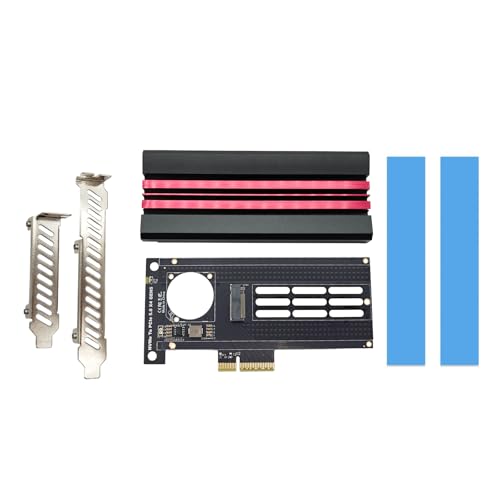
The M.2 NVMe Gen5 to PCIe 5.0 Adapter Card is perfect for gamers and content creators looking to boost their system’s performance with lightning-fast data transfer speeds of up to 16GB/s. This PCIe 5.0 M.2 SSD expansion card supports M.2 2280 and is backward compatible with Gen4 and Gen3 SSDs. Its robust aluminum heatsink and dual thermal pads guarantee stable performance during intense tasks. Installation is a breeze with plug-and-play compatibility across Windows and Linux systems. Just remember, to achieve full PCIe 5.0 speeds, you’ll need a compatible CPU and motherboard. Upgrade your storage today!
Best For: Gamers and content creators seeking enhanced data transfer speeds and improved system performance.
Pros:
- Maximum speed of 16GB/s, allowing for rapid data access and transfer.
- Backward compatibility with Gen4 and Gen3 SSDs, ensuring versatility and flexibility in upgrades.
- Easy installation with plug-and-play support for various operating systems, making it user-friendly.
Cons:
- Full PCIe 5.0 speeds require a compatible CPU and motherboard, which may necessitate additional upgrades.
- Limited to PCIe M.2 SSDs, meaning SATA SSDs are not supported, potentially restricting options.
- New M.2 NVMe SSDs require initialization and formatting before they can be used, which may be a hassle for some users.
JEYI PCIe 5.0 M.2 NVMe Adapter Card

Gamers and content creators looking for lightning-fast storage expansion will find the JEYI PCIe 5.0 M.2 NVMe Adapter Card an exceptional choice. It supports PCIe Gen5 SSDs, delivering speeds up to 128Gbps (16GB/s), making it perfect for demanding tasks like 8K video editing. With a built-in aluminum heatsink and tool-free installation, you won’t have to worry about throttling or complicated setups. Compatible with various M.2 sizes and operating systems, this adapter fits seamlessly into your desktop or workstation. Rated 4.1 stars, it’s a reliable option for enhancing your storage performance without sacrificing GPU lanes.
Best For: Gamers, content creators, and IT professionals looking for high-speed storage expansion with minimal setup hassle.
Pros:
- Supports PCIe Gen5 SSDs with speeds up to 128Gbps (16GB/s) for optimal performance.
- Built-in aluminum heatsink ensures stable heat dissipation and prevents throttling during intensive tasks.
- Tool-free installation allows for quick and easy setup, accommodating various M.2 sizes.
Cons:
- Limited to systems with compatible PCIe slots, which may not be available in older motherboards.
- Does not include SSDs; users must purchase them separately.
- Performance may vary based on the specific NVMe drive used.
Dual M.2 PCIE Adapter for SATA or NVMe SSD

For tech enthusiasts looking to expand their storage options, the Dual M.2 PCIe Adapter for SATA or NVMe SSD is an excellent choice. This adapter allows you to connect one SATA and one NVMe SSD simultaneously, maximizing your storage capabilities. It supports various M.2 sizes and comes with both regular and low-profile brackets for installation ease. With advanced heat sinks featuring 24 ventilation holes, it guarantees superior cooling during heavy use. Compatible with multiple operating systems, this adapter’s performance and flexibility make it a standout in the market, earning a solid 4.2-star rating from users. Enhance your setup today!
Best For: Tech enthusiasts and gamers looking to expand their storage options with both SATA and NVMe SSDs.
Pros:
- Supports simultaneous connection of one SATA and one NVMe SSD, maximizing storage capabilities.
- Includes both regular and low-profile brackets for versatile installation options.
- Advanced heat sink design with 24 ventilation holes ensures effective cooling during heavy workloads.
Cons:
- Requires a SATA cable for the SATA SSD connection, which is not included.
- May not be compatible with all motherboard configurations, particularly older models.
- Limited to M.2 SSD sizes; users with non-M.2 SSDs will need alternative solutions.
SSK M.2 NVME SATA SSD Enclosure Adapter

Designed for tech enthusiasts seeking versatility, the SSK M.2 NVME SATA SSD Enclosure Adapter seamlessly supports both NVMe PCI-E and SATA M-Key/B+M connectors. It accommodates SSD sizes 2242, 2260, and 2280, ensuring broad compatibility. With a USB 3.2 Gen 2 interface, you’ll enjoy lightning-fast transfer speeds, completing a HD movie transfer in just 2 seconds. Its aluminum alloy build enhances durability and heat dissipation, while the slim design promotes portability. Users appreciate its plug-and-play functionality across multiple operating systems. However, be cautious of potential overheating with specific chipsets, so consider your options for peak performance.
Best For: Tech enthusiasts looking for a versatile and high-speed SSD enclosure for NVMe and SATA drives.
Pros:
- High-speed performance: USB 3.2 Gen 2 interface allows for transfers at 10 Gbps, making data transfer incredibly fast.
- Durable design: Constructed from aluminum alloy, providing excellent heat dissipation and long-lasting durability.
- Wide compatibility: Supports various operating systems and multiple SSD sizes (2242, 2260, 2280) with plug-and-play functionality.
Cons:
- Overheating issues: Some users report overheating, particularly with certain chipsets like JMicron, which may affect stability.
- Limited compatibility: Not compatible with M.2 PCIe AHCI SSDs, WiFi devices, mSATA SSDs, or non-M.2 SSDs.
- Thermal management concerns: Recommendations suggest avoiding slide-in covers to enhance thermal management, which may limit design choices.
GLOTRENDS M.2 NVMe to PCIe Adapter with Heatsink
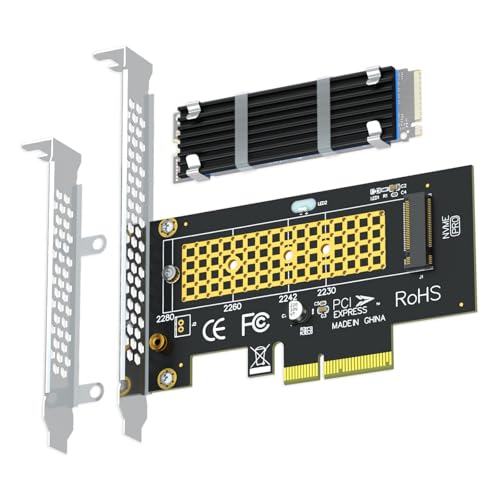
The GLOTRENDS M.2 NVMe to PCIe Adapter with Heatsink is an excellent choice for enthusiasts looking to maximize their SSD performance. This adapter converts PCIe X4/X8/X16 slots into M.2 Key M slots, supporting sizes up to 2280. It cools your M.2 SSDs by 5-20°C, ensuring peak performance. Compatible with PCIe 4.0/3.0 NVMe SSDs, it allows for high-capacity options up to 4TB. With a compact design and included mounting brackets, it fits various PC frames easily. Plus, you get lifetime tech support, making it a reliable addition to your setup. Enjoy enhanced speed and efficiency with this adapter!
Best For: Enthusiasts and gamers looking to upgrade their systems with high-capacity, high-speed M.2 NVMe SSDs for optimal performance.
Pros:
- Efficient Cooling: The included heatsinks reduce M.2 SSD temperatures by 5-20°C, enhancing durability and performance.
- Broad Compatibility: Supports a wide range of PCIe 4.0/3.0 NVMe SSD sizes (2230 to 2280) and capacities (up to 4TB).
- Lifetime Tech Support: Provides reliable assistance for troubleshooting and installation issues.
Cons:
- Limited Slot Compatibility: Does not support PCIe X1 or PCI slots, restricting installation options.
- SSD Initialization Required: New SSDs must be initialized and formatted before use, which may be cumbersome for some users.
- Intel CPU Limitation: Intel CPUs below 11th generation do not support full PCIe 4.0 speeds, limiting performance for some users.
Factors to Consider When Choosing M2 Pcie Adapters for Gen5 Ssds
When choosing an M.2 PCIe adapter for your Gen5 SSD, you’ll want to take into account several key factors. Compatibility with your SSD type and PCIe version support are essential for peak performance. Additionally, think about the cooling solutions offered, installation ease, and the size and form factor to guarantee a seamless fit in your system.
Compatibility With SSD Types
Choosing the right M.2 PCIe adapter for Gen5 SSDs hinges on compatibility with various SSD types. You’ll want to ascertain that the adapter supports NVMe M.2 M key SSDs and older B+M key PCIe SSDs. Additionally, check that it accommodates different M.2 sizes like 2230, 2242, 2260, and 2280 to fit your SSD’s length. It’s also essential to find an adapter designed for PCIe 5.0 that’s backward compatible with PCIe 4.0 and 3.0. Don’t overlook operating system compatibility, as some adapters may need specific drivers, especially for older systems like Windows 7. Finally, verify if your motherboard supports PCIe bifurcation if you plan to use multiple NVMe devices on one adapter, as this affects performance.
PCIe Version Support
To maximize the performance of Gen5 SSDs, it is vital to guarantee your M.2 PCIe adapter supports PCIe 5.0, which offers speeds up to 16GB/s. This support is significant for accessing the full potential of your Gen5 SSD. Additionally, check for backward compatibility with earlier PCIe versions, like 4.0 and 3.0, so your adapter can work with older systems. The number of PCIe lanes on the adapter also matters; opt for ones with x4 lanes or higher to accommodate the high bandwidth requirements. Confirm the adapter meets PCIe Gen5 standards for performance and stability, and consider its design and connector type to fit your motherboard’s available PCIe slots seamlessly. These factors will help you make an informed choice.
Cooling Solutions Offered
Cooling solutions play an essential role in guaranteeing the performance and longevity of M.2 PCIe adapters for Gen5 SSDs. Effective cooling is vital, as overheating can cause throttling and diminish SSD speeds during intense workloads. Many adapters come equipped with built-in aluminum heatsinks and thermal pads, which can lower SSD temperatures by 5 to 20°C. Additionally, some designs include active cooling mechanisms like blower-style fans to prevent overheating during sustained data transfers. When selecting an adapter, consider how the thermal management components are configured, as this can greatly affect your SSD’s reliability. Also, verify compatibility with various M.2 sizes and high bandwidth support, like PCIe 4.0 and 5.0, to enhance the cooling system’s effectiveness.
Installation Ease
When it comes to installing M.2 PCIe adapters for Gen5 SSDs, ease of installation can make a significant difference in your overall experience. Look for tool-free designs that let you mount SSDs without specialized tools or technical know-how. However, some adapters may challenge you with unclear instructions or tricky thermal pad and screw placements. To minimize frustration, choose adapters that come with clear step-by-step guides and all necessary mounting hardware. Also, consider the adapter’s compatibility with your PCIe slots (x4, x8, or x16) to guarantee smooth integration. Finally, prioritize models that offer easy access to your SSDs for future upgrades or replacements, enhancing your overall convenience during installation.
Size and Form Factor
Selecting the right size and form factor for M.2 PCIe adapters is just as important as ease of installation. M.2 PCIe adapters come in various sizes, including 2230, 2242, 2260, and 2280 mm, so you’ll need to verify compatibility with your SSD’s dimensions. The adapter must securely hold the SSD in the designated M.2 slot, preventing any movement. Additionally, check that the adapter fits within your PC case, as larger heatsinks or cooling features can affect clearance. Most adapters require a PCIe x4, x8, or x16 slot, so be aware of what’s available on your motherboard. Finally, consider the design, as it may impact airflow and cooling efficiency for high-performance Gen5 SSDs that generate more heat.
Performance Specifications
Performance specifications are vital when choosing M.2 PCIe adapters for Gen5 SSDs, as they directly impact your system’s data throughput and efficiency. Prioritize adapters that support PCIe 5.0, offering maximum transfer speeds of up to 16GB/s. This greatly boosts data performance for your Gen5 SSDs. Guarantee compatibility with a full range of M.2 sizes (2230, 2242, 2260, 2280) for versatility. Robust thermal management solutions, like aluminum heatsinks and thermal pads, are important to maintain ideal temperatures and prevent throttling under heavy workloads. Additionally, look for backward compatibility with PCIe 4.0 and 3.0 to assure functionality in older systems, while also evaluating the maximum bandwidth, which can reach up to 512 Gbps for multi-drive setups.
Power Requirements
Power requirements are a critical factor in choosing M.2 PCIe adapters for Gen5 SSDs. First, make certain the adapter has a dedicated power supply connector, like a 6-pin PCIe power connector, to meet the higher demands of Gen5 devices. Look for adapters that specify their power delivery capabilities, as these SSDs may need up to 14 watts for peak performance during heavy transfers. Also, check compatibility with your motherboard’s power distribution, especially if it requires PCIe bifurcation for multiple SSDs. A two-phase power solution is beneficial for efficient power distribution and preventing overheating. Finally, verify the adapter can handle the thermal management of Gen5 SSDs to avoid throttling and maintain ideal performance.
Warranty and Support Options
When you’re choosing an M.2 PCIe adapter for Gen5 SSDs, warranty and support options can greatly impact your overall satisfaction. Always check the manufacturer’s warranty terms, as they can vary widely, often offering full refunds for defective items within a specified period. Look for adapters that come with lifetime technical support, which can be invaluable for troubleshooting installation or compatibility issues. Before purchasing, review the detailed warranty information on the manufacturer’s website to understand coverage and conditions. Also, verify the return policy to guarantee you have options for defective or misrepresented products. Finally, check user reviews to gauge the responsiveness and helpfulness of customer support, as this can considerably enhance your overall experience.
