
When you’re diving into the world of TensorFlow and machine learning, the right laptop can make all the difference. You’ll want a device that combines power with performance, capable of handling complex computations without a hitch. But with so many options out there, how do you choose the best fit for your needs? Let’s explore the top contenders that can elevate your TensorFlow experience.
Pack of 4 Tensorflow Logo Car Stickers
If you’re a TensorFlow enthusiast looking to showcase your passion, the Pack of 4 TensorFlow Logo Car Stickers is perfect for you. Each sticker measures 3 inches, making them ideal for small to medium spaces on various surfaces, like cars, laptops, and water bottles. You’ll love the simple peel-and-apply process, allowing for quick and hassle-free application. With no extra steps required, you can easily personalize your belongings or add a stylish touch. Whether you’re decorating your locker or your skateboard, these stickers offer a versatile way to express your dedication to machine learning and TensorFlow.
Best For: TensorFlow enthusiasts who want to showcase their passion through stylish and versatile stickers.
Pros:
- Easy peel-and-apply process for quick application.
- Compatible with a variety of surfaces for versatile use.
- Practical 3-inch size, perfect for small to medium spaces.
Cons:
- Limited design options, only featuring the TensorFlow logo.
- May not adhere well to rough or uneven surfaces.
- Potential fading or wear over time with outdoor exposure.
HP 17 Inch Laptop 2026 Edition
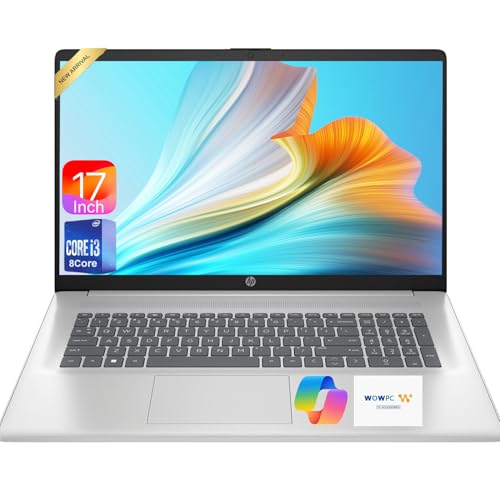
The HP 17 Inch Laptop 2026 Edition is an excellent choice for students and professionals seeking a reliable machine for multitasking and productivity tasks. With its Intel 13th Gen i3 processor and 8GB of RAM, you can smoothly handle web browsing, video calls, and online classes. The 128GB SSD guarantees quick access to your files, while the 17.3-inch HD+ display enhances your viewing experience. Enjoy up to 7 hours of battery life and benefit from HP Fast Charge. Plus, with Wi-Fi 6 and Bluetooth 5.3, staying connected is effortless. Overall, it’s a solid pick for your machine learning needs.
Best For: The HP 17 Inch Laptop 2026 Edition is best for students and professionals looking for a reliable and efficient laptop for multitasking and productivity tasks.
Pros:
- Strong multitasking capabilities with an 8-core processor and 8GB of RAM.
- Large 17.3-inch HD+ display for an enhanced viewing experience.
- Fast charging feature allows for quick battery recharges.
Cons:
- Limited storage capacity with only 128GB SSD.
- Integrated graphics may not support high-end gaming or graphic-intensive tasks.
- Heavier compared to more portable laptops at 4.6 lbs.
Pack of 4 Tensorflow Logo Car Stickers
Show off your love for TensorFlow with the Pack of 4 TensorFlow Logo Car Stickers, perfect for tech enthusiasts and data scientists alike. Each sticker measures 3 inches, making them ideal for a variety of surfaces like cars, laptops, and water bottles. Made from durable, water-resistant vinyl, these stickers can handle moisture and sunlight, ensuring they stay vibrant indoors or outdoors. You’ll appreciate the peel-and-stick backing, allowing for quick and easy application on clean, flat areas. Customize everything from your skateboard to your locker without taking up too much space. Showcase your passion for machine learning today!
Best For: Tech enthusiasts, data scientists, and anyone looking to personalize their belongings with a stylish TensorFlow logo.
Pros:
- Durable Material: Made from water-resistant vinyl, ensuring longevity and vibrant colors.
- Easy Application: Peel-and-stick backing allows for quick and hassle-free placement on various surfaces.
- Versatile Use: Suitable for a wide range of items, including cars, laptops, and skateboards, without taking up much space.
Cons:
- Size Limitations: At only 3 inches, some may find the stickers too small for larger surfaces.
- Limited Design Options: The pack only includes TensorFlow logos, lacking variety for those who prefer different designs.
- Potential for Residue: Removal might leave adhesive residue on surfaces, depending on the material.
HP 15.6″ Business Laptop with AMD Ryzen 3 CPU

Designed for students and professionals alike, the HP 15.6″ Business Laptop with AMD Ryzen 3 CPU offers a powerful and efficient computing experience at an accessible price. With its AMD Ryzen 3 5300U processor, you’ll enjoy smooth multitasking thanks to 8GB of RAM. The 256GB PCIe SSD guarantees quick access to your files, while the vibrant 15.6″ HD display makes everything easy to see. You can expect up to 9 hours of battery life, perfect for long study sessions or remote work. Plus, with various ports and Windows 11 preloaded, it’s ready for any task you throw at it.
Best For: Students and professionals seeking a reliable and budget-friendly laptop for multitasking, education, and remote work.
Pros:
- Powerful Performance: Equipped with an AMD Ryzen 3 5300U processor and 8GB of RAM for smooth multitasking.
- Fast Storage: 256GB PCIe SSD provides quick access to files and applications.
- Long Battery Life: Up to 9 hours of battery life, ideal for extended use without frequent charging.
Cons:
- Display Quality: The HD resolution (1366 x 768) may not meet the expectations of users seeking higher clarity and detail.
- Weight: At 3.8 lbs, it may be slightly heavier compared to some ultra-portable options.
- Limited Graphics: Integrated AMD Radeon Graphics may not be suitable for demanding gaming or graphic-intensive tasks.
ASUS 15.6” FHD Laptop (L510MA-TH04)

If you’re looking for an affordable and portable option for basic machine learning tasks with TensorFlow, the ASUS 15.6” FHD Laptop (L510MA-TH04) could be a solid choice. Weighing just 3.46 pounds, this laptop features a 15.6” FHD display with a 1920 x 1080 resolution, making it great for viewing data clearly. Powered by an Intel Celeron N4020 processor and 4GB of RAM, it handles lightweight tasks smoothly. With 128GB SSD storage and up to 6.5 hours of battery life, you’ll have enough power for your projects. Plus, it has essential connectivity options for peripherals.
Best For: Individuals seeking an affordable and portable laptop for basic tasks and light machine learning projects.
Pros:
- Lightweight design at 3.46 pounds for easy portability.
- FHD display with 1920 x 1080 resolution for clear visuals.
- Sufficient battery life of up to 6.5 hours for on-the-go use.
Cons:
- Limited performance with an Intel Celeron N4020 processor and 4GB of RAM for heavy tasks.
- Only 128GB SSD storage may not suffice for larger projects or data.
- Operating system in S Mode may limit software compatibility and functionality.
Tensorflow Logo 50 Pack Retro Stickers

For tech enthusiasts and TensorFlow aficionados, the TensorFlow Logo 50 Pack Retro Stickers offers a fun and creative way to personalize your devices. Each pack includes 50 individual 1-inch circular stickers, perfect for scrapbooking, journals, planners, and more. Their strong peel-and-stick backing guarantees they adhere smoothly to various surfaces, including laptops, phones, and water bottles. These planner-friendly stickers fit neatly into daily boxes of standard planners, making them versatile for any setup. Plus, they’re non-toxic, non-residue, and non-fading, so you can enjoy your customization worry-free. Made in the USA, these stickers are the ideal accessory for any TensorFlow fan!
Best For: Tech enthusiasts and TensorFlow aficionados looking to personalize their devices with fun and creative stickers.
Pros:
- Versatile usage: Suitable for scrapbooking, journals, planners, laptops, phones, and water bottles.
- High-quality adhesive: Strong peel-and-stick backing ensures smooth adherence to various surfaces.
- Safe materials: Non-toxic, non-residue, and non-fading, providing worry-free customization.
Cons:
- Limited size: Each sticker is only 1 inch in diameter, which may be too small for some preferences.
- Specific design: The TensorFlow logo may not appeal to those unfamiliar with the brand or its technology.
- Single design theme: The pack only includes TensorFlow logos, lacking variety in design options.
ASUS L510 Ultra Thin Laptop (L510MA-DS02)

The ASUS L510 Ultra Thin Laptop (L510MA-DS02) stands out with its lightweight design, weighing just 3.46 lbs, making it an excellent choice for students and professionals who need a portable solution for TensorFlow tasks. With a 15.6” FHD display, Intel Celeron N4020 processor, and 4GB of RAM, it efficiently handles basic machine learning applications. The 64GB eMMC storage provides decent space for your projects, while the long-lasting battery guarantees productivity on the go. Plus, with multiple USB ports and HDMI output, you can easily connect your devices. This laptop balances performance and portability perfectly for your TensorFlow needs.
Best For: The ASUS L510 Ultra Thin Laptop is best for students and professionals seeking a lightweight, portable device for basic productivity tasks and light machine learning applications.
Pros:
- Lightweight design at just 3.46 lbs, perfect for on-the-go use.
- Long-lasting battery life ensures productivity without frequent charging.
- Multiple connectivity options with USB ports and HDMI output for versatile usage.
Cons:
- Limited 4GB RAM may restrict performance for more intensive applications.
- 64GB eMMC storage may not be sufficient for large projects or extensive software.
- Integrated graphics may not support advanced graphical tasks or gaming.
HP 15 inch Laptop (15-dy5599nr)

Designed for budding data scientists and students, the HP 15 inch Laptop (15-dy5599nr) offers a powerful 12th Generation Intel Core i3 processor that can handle TensorFlow tasks with ease. Its 15.6-inch FHD IPS display guarantees you see your data clearly, while 8 GB of RAM and a 128 GB SSD provide fast performance and ample storage. Weighing just a few pounds, this laptop’s thin design makes it perfect for on-the-go use. With Wi-Fi 6 connectivity and HP QuickDrop for easy file transfers, you’ll stay connected effortlessly. Plus, its long battery life means you can work anywhere without worry.
Best For: This laptop is best for students and budding data scientists seeking a portable and efficient device for data analysis and everyday tasks.
Pros:
- Powerful performance with a 12th Generation Intel Core i3 processor suitable for handling demanding applications like TensorFlow.
- Lightweight and portable design makes it easy to carry for on-the-go use.
- Long battery life of up to 10 hours allows for extended use without the need for frequent charging.
Cons:
- Limited storage of 128 GB SSD may require external options for users with large data needs.
- Integrated graphics may not support high-end gaming or graphics-intensive applications.
- Windows 11 Home in S Mode restricts software installation to Microsoft Store apps, limiting flexibility.
HP 15.6″ Business Laptop with AMD Ryzen 3 CPU
If you’re seeking a reliable laptop for TensorFlow tasks, the HP 15.6″ Business Laptop with an AMD Ryzen 3 CPU stands out with its robust performance specifications. Featuring a 4-core Ryzen 3 5300U processor, 8GB of RAM, and a 256GB PCIe SSD, it guarantees smooth multitasking and quick data access. The integrated Radeon Graphics enhances your visual experience, perfect for media playback. With a 15.6″ HD display and up to 9 hours of battery life, you can work efficiently without interruptions. Plus, it comes preloaded with Windows 11 and Microsoft Office 365, making it ideal for various professional tasks.
Best For: Professionals and students looking for a reliable laptop for productivity tasks and remote learning.
Pros:
- Powerful performance with AMD Ryzen 3 CPU and 8GB RAM for smooth multitasking.
- Long battery life of up to 9 hours, allowing for uninterrupted work.
- Preloaded with Windows 11 and Microsoft Office 365, providing essential tools for business and education.
Cons:
- Integrated graphics may not meet the demands of intensive gaming or high-end design tasks.
- Limited storage of 256GB may require external solutions for large file management.
- Only 250 nits brightness may not be sufficient for bright outdoor environments.
Ghost Manta 15.6 FHD Student Laptop

Ideal for students and professionals alike, the Ghost Manta 15.6 FHD Student Laptop offers an impressive combination of performance and portability. With a stunning 15.6-inch FHD display and an Intel Pentium Quad-Core processor, it handles everyday tasks effortlessly. You’ll appreciate the 16GB DDR4 RAM, which is upgradable, ensuring smooth multitasking. Connectivity is exceptional with Wi-Fi 6 and Bluetooth 5.2, making it easy to stay connected. Its sleek design, backlit keyboard, and built-in fingerprint sensor enhance usability. Plus, with a 2-year warranty and a 90-day hassle-free return policy, you can buy with confidence. This laptop’s perfect for your machine learning needs!
Best For: The Ghost Manta 15.6 FHD Student Laptop is best for students and professionals looking for a reliable and versatile laptop for everyday tasks and multitasking.
Pros:
- High-performance Intel Pentium Quad-Core processor with 16GB RAM, ensuring smooth performance for various applications.
- Excellent connectivity options including Wi-Fi 6 and Bluetooth 5.2 for fast internet and stable device connections.
- User-friendly features such as a backlit keyboard and built-in fingerprint sensor for enhanced usability and security.
Cons:
- Limited storage capacity of 256GB, which may require external storage for users with large files.
- Weight of 6 pounds, making it slightly heavier compared to some other laptops in the same category.
- Integrated Intel UHD Graphics, which may not meet the demands of high-end gaming or graphic-intensive applications.
Factors to Consider When Choosing Laptops for TensorFlow
When you’re choosing a laptop for TensorFlow, several key factors come into play. You’ll want to take into account the processor’s performance, RAM capacity, and storage speed to guarantee smooth operation. Additionally, don’t overlook graphics capabilities and battery life, as they can greatly influence your workflow.
Processor Performance Requirements
Choosing the right processor is crucial for optimizing your TensorFlow experience, as a powerful multi-core processor can drastically enhance performance during model training and inference tasks. Look for processors with higher clock speeds and at least six cores to handle parallel computations effectively. While integrated graphics may work for basic tasks, a dedicated GPU is recommended for intensive deep learning applications to leverage CUDA acceleration. Check benchmark scores and performance ratings, focusing on both single-thread and multi-thread performance, to verify the processor can handle TensorFlow workloads. Finally, make certain the processor supports the latest instruction sets and architectures, as these elements can greatly improve computational efficiency and maintain compatibility with TensorFlow updates.
RAM Capacity Considerations
Having at least 8GB of RAM is essential for working with TensorFlow, but opting for 16GB or more will greatly enhance your experience, especially with larger datasets and complex models. Higher RAM capacity allows you to multitask effectively, minimizing the risk of memory bottlenecks during intensive computations or when running multiple applications. When dealing with large neural networks, extra RAM enables quicker loading of models and data, leading to faster processing times. Insufficient RAM can result in performance issues, such as slower training times and system crashes, particularly with high-resolution images or extensive datasets. Additionally, choosing laptops with expandable RAM options guarantees you can adapt to the growing demands of machine learning tasks and model sizes.
Storage Speed Importance
Storage speed plays an essential role in your TensorFlow performance, especially during model training and inference. The quicker your data can be retrieved and processed, the smoother your machine learning tasks will run. Solid State Drives (SSDs) are a game-changer here, offering considerably faster read and write speeds than traditional Hard Disk Drives (HDDs). For ideal performance, consider using NVMe SSDs, which can exceed data transfer rates of 3000 MB/s. Slow storage can cause increased latency in loading data batches, negatively impacting your training time. Remember, it’s vital to strike a balance between storage speed and capacity, as TensorFlow projects often require quick access to large datasets for effective training cycles. Choose wisely to enhance your workflow.
Graphics Capability Necessities
When it comes to running TensorFlow efficiently, powerful graphics capabilities are essential, especially if you’re leveraging GPU acceleration for deep learning. While integrated graphics might handle basic tasks, dedicated GPUs—like those from the NVIDIA RTX series—offer superior performance for complex neural networks. Aim for at least 4GB of VRAM; more VRAM allows you to process larger models and datasets effectively. You’ll also want a laptop that supports CUDA, enabling TensorFlow to capitalize on NVIDIA GPUs for faster computations. Additionally, don’t overlook thermal management; powerful GPUs generate heat, and inadequate cooling can lead to overheating, which negatively impacts performance. Prioritize these graphics capabilities to guarantee your TensorFlow experience is smooth and efficient.
Battery Life Expectations
Battery life plays an essential role in your laptop’s performance for TensorFlow, especially during extended model training sessions. Aim for a laptop with at least 7 hours of battery life to avoid constant recharging. Consider options with fast-charge capabilities, which can replenish 50% of the battery in about 45 minutes—great for users on the go. High-performance laptops usually offer mixed-use battery life between 6 to 10 hours, depending on your workload and power-saving settings. Look for laptops with optimized battery management features to enhance longevity during intensive tasks. Keep in mind that laptops with integrated graphics typically provide longer battery life than those with dedicated GPUs, which consume more power during heavy computations.
Portability and Weight
Portability and weight are essential factors to take into account for TensorFlow users who need a laptop that can keep up with their on-the-go lifestyle. Aim for a laptop weighing between 3 to 5 pounds, which strikes a balance between portability and performance. A slim profile of less than 1 inch in thickness further enhances ease of transport, making it ideal for travel. Look for models with a battery life of at least 7 hours, so you can work longer without searching for an outlet. Lightweight materials like aluminum or high-quality plastic can help reduce the overall weight while ensuring durability. A compact design makes it easy to fit your laptop into backpacks or carrying cases, adding to your convenience.
