
When it comes to selecting the right insulation resistance tester, you want tools that deliver accuracy and reliability. With so many options available, narrowing down the best choices can be a challenge. From Klein Tools to Fluke, each model offers unique features tailored for professional electricians. Let’s explore the top contenders and what makes them stand out in the field. You might just find the perfect tester for your needs.
Klein Tools ET600 Multimeter and Insulation Tester

If you’re an electrician looking for a reliable tool, the Klein Tools ET600 Multimeter and Insulation Tester stands out with its ability to measure insulation resistance up to 4000MΩ at various DC voltages. This tester features test and lock buttons for straightforward operation, ensuring thorough insulation testing. With voltage detection and a warning alarm, safety’s prioritized during your work. You can also measure up to 1000V AC/DC, resistance, and continuity efficiently. Its automatic ranging True RMS technology guarantees accurate results. Plus, the user-friendly design includes a backlit display, low battery indicator, and easy maintenance, making it a must-have in your toolkit.
Best For: Electricians and technicians seeking a reliable and accurate multimeter for insulation testing and electrical measurements.
Pros:
- Measures insulation resistance up to 4000MΩ at multiple DC voltages for thorough testing.
- Automatic ranging True RMS technology ensures precise and reliable measurements.
- User-friendly design with a backlit display and low battery indicator for easy operation and maintenance.
Cons:
- May be more expensive than basic multimeters without insulation testing capabilities.
- The size may be bulkier compared to simpler, more compact multimeters.
- Limited to specific DC voltage levels for insulation testing, which may not cover all applications.
KAIWEETS HT5203 Megohmmeter Insulation Resistance Tester
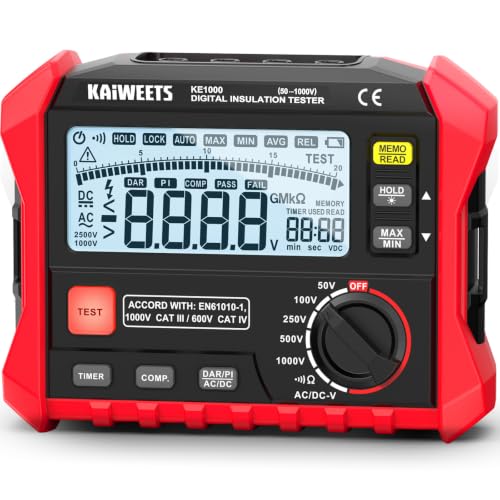
The KAIWEETS HT5203 Megohmmeter Insulation Resistance Tester stands out as an ideal choice for electricians seeking reliability and precision in their work. It measures resistance up to 100 GΩ and offers five selectable test voltages: 50V to 1000V. With impressive accuracy, it guarantees precise readings and includes one-touch DAR and PI calculations for efficiency. The built-in timer automates testing for consistent results. Plus, you can store and recall readings easily with instant PASS/FAIL displays, making reporting a breeze. Safety is prioritized with a rugged design, adhering to IEC standards, and you’ll benefit from 36-month after-sales support.
Best For: Electricians and technicians who require a reliable and precise insulation resistance tester for various electrical applications.
Pros:
- Offers a wide measurement range up to 100 GΩ with five selectable test voltages, accommodating various testing needs.
- Features one-touch DAR and PI calculations, as well as a built-in timer, enhancing efficiency and ease of use.
- Provides instant PASS/FAIL displays and the ability to store readings, streamlining reporting and data management.
Cons:
- The device may be more expensive compared to basic insulation testers, which could be a consideration for budget-conscious users.
- The complexity of features may require a learning curve for those unfamiliar with advanced insulation testing equipment.
- Limited to specific voltage settings, which may not suit all specialized testing scenarios.
Fluke 1507 Digital Megohmmeter Insulation Resistance Tester

Engineered specifically for electricians, the Fluke 1507 Digital Megohmmeter Insulation Resistance Tester excels in advanced industrial and electrical insulation testing. It offers multiple insulation test voltages—50 V, 100 V, 250 V, 500 V, and 1000 V—ensuring versatility for various applications. Each unit is calibrated before shipment, accompanied by a NIST-Traceable Calibration Certificate, guaranteeing it meets manufacturer specifications. The remote test probe makes reaching tight spots easy, and the live circuit detection feature enhances your safety by preventing tests if voltage exceeds 30 V. With a large, backlit display, you’ll find reading measurements straightforward, even in low-light environments.
Best For: Electricians and professionals in industrial settings who require reliable insulation testing with multiple voltage options.
Pros:
- Multiple test voltages (50 V, 100 V, 250 V, 500 V, and 1000 V) cater to a variety of applications.
- Remote test probe allows for easy access to hard-to-reach areas, enhancing testing efficiency.
- Live circuit detection feature improves user safety by preventing tests when voltage exceeds 30 V.
Cons:
- May be considered expensive compared to basic insulation testers.
- Requires regular calibration to maintain accuracy over time.
- The backlit display, while helpful, may consume battery life more quickly.
AIOMEST Digital Insulation Resistance Tester

For electricians seeking reliable and versatile testing equipment, the AIOMEST Digital Insulation Resistance Tester stands out with its ability to measure insulation resistance from 0.1MΩ to an impressive 20GΩ. You’ll appreciate its five output voltages—50V, 100V, 250V, 500V, and 1000V—along with its data management features that let you store up to 100 measurements. This tester also functions as an AC/DC voltmeter, measuring voltages up to 600V. With advanced testing capabilities like Polarization Index and a durable, portable design, it’s perfect for outdoor use. Plus, it includes essential accessories and a 365-day quality warranty.
Best For: Electricians and maintenance professionals seeking a reliable, multi-functional insulation resistance tester for various electrical equipment.
Pros:
- Versatile measurement range from 0.1MΩ to 20GΩ with multiple output voltages.
- Advanced testing capabilities including Polarization Index and Dielectric Absorption Ratio.
- Durable, portable design with essential accessories included, ideal for outdoor use.
Cons:
- Accuracy may vary under certain conditions, with a margin of ±(5%+10 digits).
- Limited storage capacity of 100 measurement sets may not suffice for extensive testing sessions.
- Requires batteries for operation, which may necessitate additional costs for replacements.
Supco M500 Insulation Tester/Electronic Megohmmeter

Electricians seeking a reliable and portable solution will find the Supco M500 Insulation Tester/Electronic Megohmmeter an excellent choice. This handheld device measures insulation values up to 1000 megohms at 500 VAC, making it perfect for testing motor winding insulation and diagnosing heat-damaged areas. Its impact-resistant design guarantees durability on the job site, while the compact carrying case conveniently stores the test leads. Operating on 2 C batteries, it’s a cost-effective alternative to more expensive options. With fast and accurate measurements, you can quickly verify insulation condition, enhancing your efficiency and reliability in various applications.
Best For: Electricians and technicians who require a portable and reliable insulation testing solution for various applications.
Pros:
- Fast and accurate measurements help enhance efficiency in diagnosing insulation conditions.
- Impact-resistant design ensures durability on job sites, providing long-lasting use.
- Cost-effective alternative to traditional megohmmeters, making it accessible for budget-conscious professionals.
Cons:
- Requires 2 C batteries which are not included, adding to the initial cost.
- Limited measurement range of up to 1000 megohms may not suit all industrial applications.
- Handheld design may not be ideal for repetitive testing in larger setups.
UEi IRT807 Insulation Resistance Tester

The UEi IRT807 Insulation Resistance Tester is an essential tool for professionals who need reliable insulation resistance measurements up to 2GΩ. This tester offers voltage testing up to 1000V AC/DC and features multiple voltage settings at 50V, 100V, 250V, 500V, and 1000V. With a high accuracy rate and CATIV and CATIII safety ratings, you can trust it on any job site. The easy-to-read LCD display, work light, and durable design enhance usability. Plus, you’ll appreciate the included accessories like silicone test leads and a soft carrying case, making it perfect for your insulation testing needs.
Best For: Professionals in electrical and insulation testing who require accurate and reliable measurements.
Pros:
- High insulation resistance measurement capability up to 2GΩ, suitable for various applications.
- Multiple voltage testing options (50V to 1000V) provide versatility for different testing scenarios.
- Durable design features a rubber boot and kickstand, enhancing usability in tough job site conditions.
Cons:
- Higher price point compared to basic insulation testers may not be suitable for casual users.
- Limited to a maximum voltage of 1000V, which may not meet the needs of all high-voltage applications.
- Auto power off feature may inadvertently turn off during long testing sessions if not monitored.
M500 Insulation Tester/Electronic Megohmmeter (0 to 1000 Megohms, 500V)

Engineers and technicians seeking reliable insulation testing will find the M500 Insulation Tester to be an invaluable tool. This electronic megohmmeter measures insulation resistance from 20 to 1000 megohms at 500V, ensuring accurate assessments. Its clear LED indicators help you quickly identify faults, while the zone scale provides an easy evaluation of insulation condition. Built with a durable, impact-resistant case, it’s also waterproof and corrosion-resistant. The lightweight design, along with a removable back panel for test lead storage, makes it convenient for on-the-go use. Perfect for various applications like motors and compressors, the M500 won’t let you down.
Best For: Engineers and technicians conducting insulation testing in various applications such as motors, compressors, and control circuits.
Pros:
- Clear LED indicators facilitate quick fault detection for efficient troubleshooting.
- Durable design with impact-resistant, waterproof, and corrosion-resistant features ensures longevity in tough environments.
- Lightweight and portable with a removable back panel for easy test lead storage enhances convenience during fieldwork.
Cons:
- Requires 2xC batteries which are not included, adding to the overall cost of ownership.
- Limited to 500V testing, which may not be sufficient for some high-voltage applications.
- Zone scale might be confusing for beginners unfamiliar with insulation resistance assessment.
Digital Insulation Resistance Tester (YF-VC60B+)

For professionals in the electrical field, the Digital Insulation Resistance Tester YF-VC60B+ stands out with its impressive voltage measurement range of up to 1000V and resistance capabilities reaching 2000MΩ. This tester features both DC and AC voltage ranges, ensuring you’re equipped for various applications. The high-definition LCD display with backlight makes reading easy, even in low light. Its lightweight design includes a protective cover and an adjustable shoulder strap for convenient, two-handed operation. With included accessories like test leads and clips, you’ll have everything you need for accurate insulation testing in electrical systems.
Best For: Professionals in the electrical field who require accurate and reliable insulation resistance testing.
Pros:
- High voltage measurement range of up to 1000V and resistance capabilities of 2000MΩ.
- High-definition LCD display with backlight for easy reading in low-light conditions.
- Lightweight design with protective cover and adjustable shoulder strap for enhanced portability.
Cons:
- May be considered expensive for hobbyists or occasional users.
- Requires regular battery replacements, which could be inconvenient.
- Limited to insulation testing and may not cover other electrical diagnostics.
Megohmmeter Insulation Resistance Tester

When you need reliable insulation resistance measurements, the WapoRich Megohmmeter stands out as an excellent choice for electricians. It offers a measurement range from 200MΩ to 2GΩ, making it versatile for various applications. With testing voltages of DC250V, DC500V, DC1000V, and AC750V, you can tackle both insulation resistance and voltage measurements accurately. The user-friendly 3.5-inch backlit LCD guarantees easy reading, while the lightweight design with a shoulder strap enhances portability. Plus, safety features like high voltage alarms and a self-recovering fuse protect your equipment. It’s perfect for everything from household appliances to power transformers.
Best For: Electricians and maintenance professionals seeking reliable and versatile insulation resistance measurements for various applications.
Pros:
- High measurement range from 200MΩ to 2GΩ, suitable for diverse testing needs.
- User-friendly design with a backlit LCD and hands-free operation for ease of use.
- Enhanced safety features including high voltage alarms and self-recovering fuse for equipment protection.
Cons:
- Limited to a maximum measurement accuracy of ± 4%, which may not meet the needs of all precision applications.
- Requires battery or adapter power supply, which could be a limitation in some field conditions.
- Weighs 1.1 pounds, which may be slightly heavier compared to other portable testers on the market.
2In1 Handhold Insulation Resistance Meter & Digital Multimeter
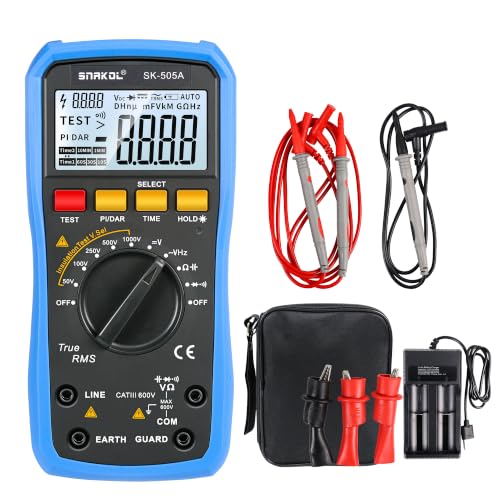
The SNAKOL SK-505A stands out as an ideal choice for electricians seeking versatility in their toolkit. This 2-in-1 insulation resistance meter and digital multimeter measures insulation resistance up to 20GΩ and supports a rated voltage of 1000V. With features like auto-ranging, backlit display, and the ability to measure resistance, voltage, capacitance, diodes, and frequency, it simplifies your tasks. Powered by two rechargeable lithium batteries, it comes with a charger for convenience. Plus, the SK-505A meets safety standard CAT III 600V and includes a one-year warranty, ensuring reliability and peace of mind during your electrical projects.
Best For: Electricians and technicians looking for a versatile and reliable tool for insulation resistance testing and general electrical measurements.
Pros:
- Multi-functional: Combines insulation resistance testing and digital multimeter features, allowing for a wide range of measurements.
- User-friendly: Auto-ranging capabilities and a backlit display make it easy to read and operate in various lighting conditions.
- Convenient power source: Powered by rechargeable lithium batteries with a charger included, extending usage life and reducing the need for frequent battery replacements.
Cons:
- Limited to 1000V: The maximum rated voltage may not be sufficient for all high-voltage applications.
- Learning curve: Some users may need time to familiarize themselves with the various functions and features.
- Portability concerns: While it comes with a carrying bag, the device may still be considered bulky for some users who prefer more compact tools.
Factors to Consider When Choosing Insulation Resistance Testers for Electricians
When you’re choosing insulation resistance testers, consider factors that can impact your work efficiency. Look at the measurement range options, voltage selection flexibility, and how accurate the device is, along with its calibration standards. Don’t forget to check for safety features and a user-friendly interface to make your testing process smoother.
Measurement Range Options
Choosing the right measurement range for insulation resistance testers is vital for electricians. These testers typically measure resistance values from 0.1MΩ to 100GΩ, with higher ranges ideal for extensive insulation systems. A broader measurement range allows you to assess various equipment, including motors, cables, and appliances, guaranteeing adequate insulation integrity across different applications.
Accuracy is essential, so look for models with tolerances like ±(3% + 5 digits) for reliable results. Many advanced testers also feature real-time calculations for dielectric absorption ratios (DAR) and polarization indexes (PI), which help you evaluate insulator quality over time. Selecting a tester with the right measurement range guarantees you’ll tackle any insulation testing challenge effectively.
Voltage Selection Flexibility
Selecting insulation resistance testers with voltage selection flexibility is critical for electricians, as it directly impacts the accuracy and safety of your tests. Look for testers that offer multiple selectable test voltages, typically ranging from 50V to 1000V. This versatility allows you to assess insulation resistance across various equipment types and conditions effectively. By having lower voltage options, you can safely test delicate components without risking damage, while higher voltage settings are suitable for robust systems. Remember, specific materials may require certain voltages for accurate readings. Plus, flexibility in voltage selection guarantees compliance with industry safety standards, allowing you to perform tests safely and effectively across different applications. Choose wisely to enhance your testing capabilities!
Accuracy and Calibration Standards
Having a flexible voltage selection is just one aspect of guaranteeing accurate and reliable testing. You’ll want to choose an insulation resistance tester that specifies measurement accuracy, ideally around ±(3% + 5 digits) for various resistance limits. Look for NIST-traceable calibration standards, as they guarantee your tester meets manufacturer specifications for consistency. Testers featuring automatic ranging and true root mean square (TRMS) technology enhance accuracy in measuring insulation resistance and voltage levels. Additionally, select a model that offers multiple test voltages, such as 50V, 100V, 250V, 500V, and 1000V, to suit different insulation materials. Finally, guarantee you get a clear calibration certification upon purchase to maintain measurement accuracy over time.
Safety Features Included
When evaluating insulation resistance testers, it is crucial to take into account the safety features that protect you during operation. Look for testers with live circuit detection, which prevents testing when voltage exceeds safe levels, ensuring your safety. Choose devices that meet CAT III or CAT IV ratings, as these standards signify protection against high voltage and electrical hazards in various settings. A built-in warning system, like an alarm or high voltage indicator, can alert you to dangerous conditions, promoting proactive safety measures. Additionally, rugged designs with double insulation and impact-resistant housing safeguard both you and the tester in harsh environments. Automatic power-off features also conserve battery life and prevent overheating, keeping your tester functional and safe for extended use.
User-Friendly Interface
A user-friendly interface makes it easier for electricians to operate insulation resistance testers efficiently. Look for large, backlit displays that enhance visibility, especially in low-light conditions, so you can read measurements quickly. Intuitive buttons and features like auto-ranging capabilities simplify operation, allowing you to select functions without needing extensive technical knowledge. Some models even include data hold functions, letting you freeze readings for easier analysis and documentation—crucial in busy work environments. A clear and organized layout of controls reduces the time spent maneuvering the device, allowing you to focus on testing. Additionally, testers with built-in safety features, such as voltage detection warnings and automatic power-off, enhance usability and provide extra layers of protection during operation.
Durability and Portability
While a user-friendly interface is essential for efficient operation, durability and portability are equally important when selecting insulation resistance testers. You’ll want a rugged, impact-resistant design that can handle harsh working environments, ensuring your tester lasts through demanding tasks. A lightweight construction makes portability easier, especially when traveling to various job sites, so look for testers that come with carrying cases. Additionally, dust-proof and moisture-resistant features are significant for outdoor use, protecting your device from challenging conditions. Built-in storage for test leads can help keep everything organized during fieldwork. Finally, consider the battery life and ease of replacement, as extended usage without frequent recharging or replacements is critical for maintaining your efficiency on the job.
