
If you want fast, stable recording with serious plug-in power, Thunderbolt is still one of the best connection standards for modern studios.
This roundup focuses on high-performance Thunderbolt audio interfaces built for low-latency tracking, reliable monitoring, and clean integration with Mac, Windows, and hybrid workflows.
Best 10 High-Performance Thunderbolt Audio Interfaces Picks for 2026
Studio-Grade Apollo Workflow

- Unison preamps support realtime analog-style tracking
- Includes 200+ UAD DSP and Native plug-ins
- Monitor Correction and Auto-Gain help streamline sessions
Best For: Compact premium tracking and mixing with Apollo processing
High-I/O Network Hub

- 32 x 34 I/O with Thunderbolt 4 / USB4 connectivity
- ESS Sabre32 conversion and low-latency drivers
- AVB networking and patchbay routing for complex setups
Best For: Large studios needing serious I/O and networked routing
Compact Apollo Power
- QUAD DSP supports more UAD plug-in processing
- Unison preamps enable realtime tone shaping
- Monitor Correction and Auto-Gain support workflow
Best For: Compact Apollo users who need extra onboard DSP
Flagship Studio Router
- 28 x 32 Thunderbolt 4 / USB4 with up to 256 channels
- Advanced mic channels with remote control and inserts
- AVB networking plus dual headphone outputs and speaker switching
Best For: Advanced studios needing flexible routing and strong mic inputs
Flagship conversion and plug-in power
Universal Audio Apollo x6 Gen 2 Thunderbolt 3 Audio Interface

- Next-gen Apollo conversion with wide dynamic range
- 200+ UAD DSP and Native plug-ins included
- Auto-Gain and bass management streamline sessions
Best For: Engineers who want premium Apollo sound and UAD workflow
High-channel-count studio hub
MOTU 10pre 26x28 Thunderbolt 4/USB4 Audio Interface
- 10 mic inputs with 26 inputs / 28 outputs total
- Ultra-low latency as low as 1.8 ms at 96 kHz
- AVB networking and dual Thunderbolt/USB4 connectivity
Best For: Large studios that need lots of inputs and flexible expansion
Premium eight-input Apollo workflow
Universal Audio Apollo x8 Gen 2 Thunderbolt 3 Audio Interface

- Next-gen Apollo conversion with low distortion
- 200+ UAD DSP and Native plug-ins included
- Eight channels plus Auto-Gain for faster sessions
Best For: Studios that want Apollo quality with more onboard inputs
Thunderbolt DSP Expansion
UAD 2 Satellite OCTO Core Thunderbolt 3 DSP Interface

- 8 Shark processors for heavy mix processing
- Thunderbolt 3 with backward compatibility
- Includes Analog Classics Plus plug-in bundle
Best For: UAD users who need extra DSP for large mixes
Studio Bundle Pick
Apollo Twin X Quad Gen 2 Studio + Sphere LX

- Apollo X Gen 2 conversion with wide dynamic range
- Dual Unison preamps and QUAD Core DSP
- Includes Sphere LX modeling microphone
Best For: Studios wanting an interface and mic modeling bundle
Premium Desktop Interface
Apollo x4 Gen 2 with UAD Analog Classics

- Next-gen conversion with very low distortion
- Unison preamps and 200+ UAD plug-ins
- Monitor Correction and Auto-Gain included
Best For: Solo artists and small studios seeking premium Thunderbolt recording
Studio-Grade Apollo Workflow – Apollo Twin X DUO Gen 2
Universal Audio Apollo Twin X DUO Gen 2 with UAD Analog Classics Thunderbolt 3 Audio Interface
Check Price On AmazonFor buyers comparing high-performance Thunderbolt audio interfaces, the Apollo Twin X DUO Gen 2 focuses on front-end sound and mix-ready processing in a compact desktop format. It pairs Thunderbolt 3 connectivity with Unison preamps, realtime UAD plug-ins, and monitor correction tools, making it a strong fit when you want tracking and monitoring help in one box.
Best For: Vocalists, producers, and home studios that want premium Apollo conversion and UAD processing in a compact Thunderbolt 3 interface.
Pros:
- Unison preamps support realtime recording through emulations of Neve, API, Avalon, Manley, Fender, and more
- Includes access to 200+ UAD DSP and Native plug-ins, including Capitol Chambers, Sound City Studios, and EL8 Distressor
- Apollo Monitor Correction powered by Sonarworks helps you mix more confidently in any room or on headphones
- Auto-Gain speeds up level setting across multiple inputs
Cons:
- Thunderbolt 3 connectivity may not suit buyers looking specifically for the newest Thunderbolt 4 platform
- Smaller desktop format offers less I/O than larger rack-style interfaces
Overall, this is a polished choice if you want the Apollo sound, realtime plug-in workflow, and strong monitoring tools in a streamlined interface. It is especially appealing when tone and workflow matter as much as raw I/O count.
High-I/O Network Hub – MOTU 16A Thunderbolt 4/USB4
Among high-performance Thunderbolt audio interfaces, the MOTU 16A stands out for sheer connectivity and routing flexibility. It combines Thunderbolt 4/USB4 support, ESS Sabre32 conversion, low-latency drivers, and AVB networking, making it a strong option when you need a serious hub for a larger studio system.
Best For: Engineers and studios that need lots of I/O, low latency, and flexible networked routing in a Thunderbolt 4 interface.
Pros:
- 32 x 34 Thunderbolt 4 / USB4 interface with up to 256 audio channels depending on host connection
- ESS Sabre32 DAC technology delivers 125 dB dynamic range with support up to 192 kHz
- Round-trip latency can be as low as 1.8 ms at 96 kHz with compatible DAW hosts
- AVB networking, patchbay routing, and 64-channel mixing with effects add major system flexibility
Cons:
- Feature set is broad and may be more interface than a simple project studio needs
- Rack-style connectivity and routing depth can take some setup time to learn
If your priority is expandability, routing, and performance, the 16A is built for demanding studio workflows. It is especially compelling for users who want one interface to anchor a larger monitoring or networked audio setup.
Compact Apollo Power – Apollo Twin X QUAD Gen 2
Universal Audio Apollo Twin X QUAD Gen 2 with UAD Analog Classics Thunderbolt 3 Audio Interface
Check Price On AmazonIf you want high-performance Thunderbolt audio interfaces with the Apollo workflow but need a compact desktop unit, the Apollo Twin X QUAD Gen 2 is an easy shortlist candidate. It adds Thunderbolt 3 connectivity, four DSP cores, Unison preamps, and Apollo Monitor Correction, so it is designed for serious tracking and mixing in a smaller footprint.
Best For: Users who want a compact Apollo interface with more onboard DSP power for UAD plug-in sessions.
Pros:
- Widest dynamic range and lowest distortion of any Apollo, according to the supplied notes
- Unison preamps let you record through authentic emulations of Neve, API, Avalon, Manley, Fender, and more
- Includes access to 200+ UAD DSP and Native plug-ins
- Apollo Monitor Correction and Auto-Gain support practical tracking and mixing workflows
Cons:
- Still limited by the compact Twin format versus larger multi-I/O interfaces
- Thunderbolt 3 connection is not the newest Thunderbolt generation
This model makes the most sense if you value Apollo sound and want extra QUAD DSP for plug-in-heavy sessions. It balances compact size with the processing depth many home and project studios look for.
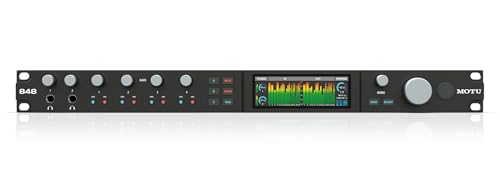
Flagship Studio Router – MOTU 848 Thunderbolt 4/USB4
For buyers prioritizing high-performance Thunderbolt audio interfaces with modern connectivity and deep studio control, the MOTU 848 is built to do a lot at once. It combines Thunderbolt 4/USB4 operation, low-latency drivers, high-end ESS conversion, advanced mic inputs, and AVB networking in a unit aimed at demanding production environments.
Best For: Advanced studios that need a flexible Thunderbolt 4 interface with strong mic pres, monitoring tools, and networked audio.
Pros:
- 28 x 32 Thunderbolt 4 / USB4 interface with up to 256 audio channels depending on host connection
- Advanced mic channels offer +74 dB preamp gain, pad, phantom power, phase invert, and remote control
- ESS Sabre32 conversion and 1.8 ms RTL performance at 96 kHz support demanding sessions
- AVB networking, dual headphone outs, and A/B/C speaker selection add studio flexibility
Cons:
- Feature-rich design may be more than basic recording setups require
- Getting the most from routing, networking, and DSP features can take some familiarization
The 848 is best viewed as a control center for a serious studio rather than just a simple recording interface. If you want strong conversion, routing depth, and modern Thunderbolt connectivity in one unit, it is one of the most capable options here.
Flagship conversion and plug-in power – Universal Audio Apollo x6 Gen 2 Thunderbolt 3 Audio Interface
Universal Audio Apollo x6 Gen 2 with UAD Analog Classics Thunderbolt 3 Audio Interface
Check Price On AmazonIf you want high-performance Thunderbolt audio interfaces with serious studio polish, the Apollo x6 Gen 2 is built around next-generation conversion, low distortion, and the kind of workflow tools that speed up tracking. It also gives you access to the UAD DSP and Native plug-in ecosystem, plus Auto-Gain and bass management for more efficient session setup and monitoring.
Best For: Producers and engineers who want premium Apollo conversion, UAD plug-ins, and a compact Thunderbolt workflow for serious recording and mixing.
Pros:
- Next-generation audio conversion with the widest dynamic range and lowest distortion in the Apollo line
- Includes access to 200+ UAD DSP and Native plug-ins, such as Capitol Chambers, Sound City Studios, and EL8 Distressor
- Auto-Gain helps set levels across multiple inputs quickly
- Bass management supports adding a subwoofer to your monitor setup
Cons:
- Only 6 channels, so it is not the biggest Apollo option for large input counts
- Best value depends on whether you will actually use the included UAD plug-in ecosystem
The Apollo x6 Gen 2 makes the most sense if you value audio quality and plug-in integration over sheer channel count. For a focused studio build, it offers a strong mix of conversion quality, monitoring tools, and DSP-backed production workflow.
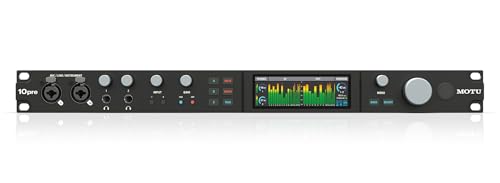
High-channel-count studio hub – MOTU 10pre 26×28 Thunderbolt 4/USB4 Audio Interface
MOTU 10pre 26x28 Thunderbolt 4/USB4 audio interface for Mac, Windows and iOS with 10 mic inputs
Check Price On AmazonFor high-performance Thunderbolt audio interfaces that need to handle lots of I/O, the MOTU 10pre stands out with 10 mic inputs, 26 x 28 routing, and ultra-low latency drivers. It is aimed at serious tracking and mixing setups, with a built-in display, flexible connectivity, and enough expansion to serve as the center of a large studio.
Best For: Large recording setups, hybrid studios, and users who need many mic inputs plus flexible expansion.
Pros:
- 10 mic/line/instrument inputs and 26 inputs / 28 outputs overall
- Ultra-low latency performance as low as 1.8 ms at 96 kHz with supported DAW hosts
- ESS Sabre32 converters with 125 dB dynamic range
- Includes AVB networking, dual headphone outputs, and front-panel control room features
Cons:
- Feature set is complex, so it may be more interface than some simple project studios need
- Best suited to buyers who will use the expansion, networking, and routing depth
The 10pre is a strong choice when input count, routing flexibility, and latency performance all matter. It is especially compelling if you want one interface that can scale with a bigger studio and connect cleanly across Thunderbolt, USB4, and AVB workflows.
Premium eight-input Apollo workflow – Universal Audio Apollo x8 Gen 2 Thunderbolt 3 Audio Interface
Universal Audio Apollo x8 Gen 2 with UAD Analog Classics Thunderbolt 3 Audio Interface
Check Price On AmazonIf you are comparing high-performance Thunderbolt audio interfaces for a serious production room, the Apollo x8 Gen 2 delivers the same premium Apollo conversion and UAD plug-in access in a format with more onboard inputs than the x6. It is built for producers who want strong recording headroom, quick setup with Auto-Gain, and monitoring support like bass management for a subwoofer-based system.
Best For: Studios and producers who want Apollo sound quality, 8 channels, and UAD workflow features in a Thunderbolt interface.
Pros:
- Next-generation audio conversion with the widest dynamic range and lowest distortion in the Apollo range
- Includes access to 200+ UAD DSP and Native plug-ins
- Auto-Gain speeds up multi-input level setup
- Eight channels make it a stronger fit for larger tracking sessions than the x6
Cons:
- Priced and positioned as a premium studio interface, so it is not the most basic option
- Uses XLR audio input details in the supplied specs, so buyers should confirm their exact I/O needs
The Apollo x8 Gen 2 is the more spacious Apollo pick if you want the same conversion and plug-in ecosystem but need additional channel capacity. It is a good fit for a center-of-studio interface where workflow, sound quality, and UAD integration all matter.
Thunderbolt DSP Expansion – UAD 2 Satellite OCTO Core Thunderbolt 3 DSP Interface
Universal Audio UAD 2 Satellite OCTO Core Thunderbolt 3 DSP Interface MAC or PC
Check Price On AmazonIf you’re building a high-performance Thunderbolt audio interfaces setup around UAD plug-ins, the UAD 2 Satellite OCTO is a practical DSP expansion option for modern Mac and Windows 10 systems. It does not act as a recording interface, but it can meaningfully increase available processing for large professional mixes while staying compatible with a wide range of host DAWs and Thunderbolt devices.
Best For: Producers and mixers who already use UAD hardware and need extra Thunderbolt-based DSP for larger sessions.
Pros:
- 8 Shark processors deliver a substantial DSP boost for demanding mixes.
- Runs UAD plug-ins over Thunderbolt 3 and supports backwards compatibility with Thunderbolt 1 and 2 devices.
- Works with Pro Tools, Logic Pro X, Cubase, Live, and more.
- Includes the Analog Classics Plus bundle with legacy-style compressor, EQ, and preamp plug-ins.
Cons:
- It is an expansion unit, not a standalone audio interface for recording inputs.
- Best value comes to users already invested in the UAD ecosystem.
This is a strong choice if your priority is more onboard plug-in processing rather than I/O. For mix-heavy workflows, the dual Thunderbolt 3 ports and support for other UAD-2 devices make it easy to fit into an expanding studio rig.
Studio Bundle Pick – Apollo Twin X Quad Gen 2 Studio + Sphere LX
The Apollo Twin X Quad Gen 2 Studio bundle is aimed at buyers who want a high-performance Thunderbolt audio interface with premium conversion, onboard DSP, and a modeling mic in one package. It pairs elite-class Apollo X Gen 2 conversion with dual Unison preamps and QUAD Core DSP, making it a strong fit for recording, monitoring, and realtime plug-in use.
Best For: Home and project studios that want an advanced Thunderbolt interface bundle with mic modeling and realtime UAD processing.
Pros:
- Elite-class Apollo X Gen 2 conversion with wide dynamic range.
- Dual Unison preamps let you track through emulations of Neve, API, Manley, Fender, and more.
- QUAD Core DSP supports realtime recording through UAD plug-ins.
- Includes Sphere LX, a large-diaphragm condenser modeling microphone with a low-noise design.
Cons:
- Bundle may be more than you need if you only want a basic interface.
- Best suited to users who will take advantage of the included mic and UAD ecosystem.
For buyers who want an all-in-one creative package, this bundle combines interface quality, monitoring tools, and mic modeling in a compact Thunderbolt setup. The included Studio+ Edition plug-ins and expandability add to its appeal for serious recording workflows.
Premium Desktop Interface – Apollo x4 Gen 2 with UAD Analog Classics
Universal Audio Apollo x4 Gen 2 with UAD Analog Classics Thunderbolt 3 Audio Interface
Check Price On AmazonThe Apollo x4 Gen 2 is a compact high-performance Thunderbolt audio interface for users who want premium conversion, Unison preamps, and access to UAD processing in a desktop format. Its focus is on clean capture, realtime tone shaping, and flexible monitoring tools rather than high channel counts for large tracking sessions.
Best For: Solo artists and small studios that want a refined Thunderbolt interface with premium conversion and UAD processing.
Pros:
- Next-generation audio conversion with the widest dynamic range and lowest distortion of any Apollo.
- Unison preamps support realtime recording through emulations of classic analog gear.
- Access to 200+ UAD DSP and Native plug-ins.
- Includes Apollo Monitor Correction powered by Sonarworks and Auto-Gain for faster setup.
Cons:
- Designed as a desktop interface, so it is not aimed at larger multichannel tracking rigs.
- Requires comfort with the UAD workflow to get the most out of its feature set.
This model stands out for buyers who want top-tier conversion and a streamlined recording experience on Thunderbolt 3. If you value mix confidence, realtime tracking, and smart monitoring tools, it is a very capable compact interface.
How We Picked These High-Performance Thunderbolt Audio Interfaces
We focused on interfaces that offer a strong balance of audio quality, driver stability, routing flexibility, and real-world studio usefulness. That means looking at preamp count, converter performance, DSP or onboard mixing tools, expansion options, and compatibility across current Thunderbolt and USB4 systems.
We also prioritized models that suit different studio sizes, from compact desktop units to larger multi-input systems and DSP-focused options for mixing and tracking.
Quick Comparison: What Stands Out
Compact Apollo models are best for solo producers, vocalists, and small studios that want premium monitoring and UAD processing in a desktop footprint. Larger MOTU units are a better fit for engineers who need more simultaneous inputs, flexible routing, and scalable I/O for bands, outboard gear, or post-production.
If your goal is plug-in heavy recording with minimal latency, Apollo interfaces and the UAD Satellite are especially relevant. If you need broader channel counts and modern connectivity, the MOTU Thunderbolt 4/USB4 lineup deserves close attention.
Key Buying Factors for High-Performance Thunderbolt Audio Interfaces
I/O Count and Future Expansion
Start with the number of microphones, line sources, and monitor feeds you actually use today, then add headroom. Higher channel counts matter quickly once you record drums, live bands, hardware synths, or multiple guests.
Latency, DSP, and Monitoring Workflow
One of the biggest advantages of High-Performance Thunderbolt Audio Interfaces is the ability to monitor with very low latency. Built-in DSP, direct monitoring, and mixer software can make tracking far more comfortable, especially when using demanding plug-ins.
Compatibility and Connection Type
Confirm that your computer supports the interface connection you need. Some models rely on Thunderbolt 3, while others support Thunderbolt 4/USB4 and wider platform compatibility. Mac and Windows support can vary by model and workflow.
Sound Shaping and Included Software
Bundled plug-ins, channel-strip tools, and modeling software can add real value, particularly if you want a ready-to-record setup without building a full plug-in library from scratch.
Who Should Buy Which High-Performance Thunderbolt Audio Interfaces?
Solo artists and home studios should favor compact desktop units with strong monitoring and enough inputs for vocals, guitars, and overdubs. Producers who rely on UAD effects or want the smoothest possible tracking experience should look closely at Apollo models and DSP options.
If you need more inputs, more routing flexibility, or a better fit for larger sessions, a multi-I/O MOTU interface is likely the smarter choice. For users who already own an interface but want more plug-in processing power, the UAD Satellite can be a practical system upgrade.
