
Building a serious keyboard rig takes more than choosing a powerful synthesizer. The right workstation setup also needs stable support, comfortable playing height, practical cable management, and enough room for the way you create.
We’ve selected 10 high-performance keyboard workstations and supporting desk solutions for producers, performers, composers, and home studios. Use the guide below to match keyboard action, sound design, portability, and workspace ergonomics to your needs.
Best 10 High-Performance Keyboard Workstations Picks for 2026
Flagship Expressive Control
Yamaha Montage M8X 88-Key Synthesizer

- 400-note polyphony across three engines
- GEX action with polyphonic aftertouch
- DAW integration through the Expanded Softsynth Plugin
Best For: Professional performance, synthesis, and studio work
Ergonomic Desk Upgrade
FLEXISPOT 36-Inch Standing Desk Converter

- Mechanical spring lift system for sit-stand use
- 36-inch surface fits dual monitors
- Supports 33 pounds on top and 4.4 pounds on tray
Best For: Home offices upgrading an existing desk
Complete Stage Workstation
Korg Nautilus 88-Key Workstation

- Weighted hammer action with aftertouch
- Nine sound engines and advanced effects
- Set List Mode supports organized live performance
Best For: Performers and producers needing a versatile 88-key workstation
Best Studio Desk

- Four-position tray supports up to 55 pounds
- Desktop and tray height adjustments improve ergonomics
- Steel and MDF construction with three-way rail stability
Best For: Permanent home studios with full-size 88-key keyboards
Best Live Performance Synth

- ZEN-Core engine includes over 3,800 ready-to-play sounds
- Weighted 88-key design with hands-on performance controls
- Bundle includes pedal, cable, cover, DVD, and polishing cloth
Best For: Live performers and mobile music creators
Flagship Sound Design
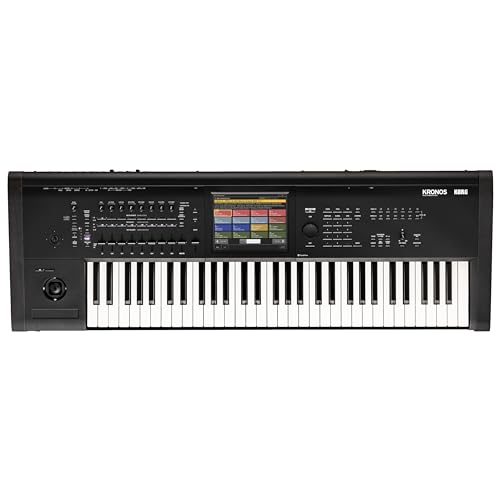
- Nine sound engines for extensive sound creation
- TouchView display and ribbon controller
- 61-key semi-weighted action with joystick
Best For: Advanced sound design and expressive live performance
Studio-Friendly Value

- Class-compliant USB audio/MIDI
- 128-note polyphony for sequences and live play
- Lightweight 14.9-pound 61-key design
Best For: Portable computer-based production and performance
Weighted-Key Workstation

- 88-key weighted hammer-action keybed
- Mic and line inputs included
- Step MIDI sequencers and audio recorder
Best For: Pianists wanting workstation production features
Flexible Mobile Setup – VIVO Mobile Height Adjustable Table
For shoppers building high-performance keyboard workstations in a compact office or flexible workspace, the VIVO CART-V06A combines a rolling desktop with a sliding keyboard tray. Its adjustable height and lockable casters make it useful when you need to alternate between seated and standing work.
Best For: Mobile home offices, presentations, and users who need a freestanding sit-stand workstation.
Pros:
- Height adjusts from 30.3 to 47 inches with tension springs and a one-touch lock.
- Spacious 35.4-by-22.2-inch desktop supports up to 33 pounds.
- Sliding 27-by-9.4-inch tray accommodates a keyboard and mouse side by side.
- Four lockable casters provide mobility and stability when parked.
Cons:
- The 33-pound weight capacity may limit heavier equipment setups.
- Assembly is recommended for two people.
This cart is a practical choice when portability matters more than built-in storage. It offers a useful balance of height flexibility, keyboard comfort, and easy repositioning.
Flagship Expressive Control – Yamaha Montage M8X 88-Key Synthesizer
The Yamaha Montage M8X is a performance-focused centerpiece for high-performance keyboard workstations. Its 88-key GEX action, polyphonic aftertouch, three sound engines, and extensive performance controls are designed for expressive playing, sound design, and studio integration.
Best For: Professional performers, sound designers, and studio musicians seeking a flagship 88-key synthesizer.
Pros:
- 400-note total polyphony supports complex performances.
- AN-X engine recreates analog-style synthesis with sophisticated modulation.
- Polyphonic aftertouch enables pressure control on individual held notes.
- Expanded Softsynth Plugin can replicate the MONTAGE M in a DAW.
Cons:
- At 61.9 pounds, it is a substantial instrument for frequent transport.
- Its 50.94-inch width requires considerable workstation space.
With Seamless Sound Switching and dedicated Keyboard, Part, and Scene controls, the M8X is built for demanding live and studio workflows. Its size and weight make it better suited to a permanent or carefully planned setup.
Ergonomic Desk Upgrade – FLEXISPOT 36-Inch Standing Desk Converter
The FLEXISPOT 36-inch converter is a straightforward way to add sit-stand flexibility to high-performance keyboard workstations without replacing the existing desk. Its mechanical spring lift system, keyboard tray, and dual-monitor surface support an ergonomic computer setup.
Best For: Home-office users and professionals upgrading a fixed desk for standing work and dual monitors.
Pros:
- Mechanical spring system provides smooth height adjustment without gas-spring concerns.
- 36-inch surface accommodates dual monitors and accessories.
- Reinforced steel frame supports up to 33 pounds on top.
- Keyboard tray holds up to 4.4 pounds and promotes a more natural arm angle.
Cons:
- It is a desktop riser rather than a complete standalone desk.
- The keyboard tray has a lower weight limit than the main surface.
Because it arrives almost fully assembled, this converter is convenient for quick workspace upgrades. It is especially useful when you want dual-monitor capacity and sit-stand functionality while keeping your current desk.
Complete Stage Workstation – Korg Nautilus 88-Key Workstation
Korg Nautilus 88 Key Workstation with Aftertouch | Aftertouch for expressive control
Check Price On AmazonThe Korg Nautilus 88 is a full-size music workstation for high-performance keyboard workstations centered on realistic piano response and broad sound creation. Its weighted hammer action with aftertouch, nine sound engines, effects, sequencer, and Set List Mode make it suited to both live performance and production.
Best For: Keyboardists who want an expressive 88-key instrument for performing, sequencing, and sound exploration.
Pros:
- Four-stage weighted hammer action with aftertouch delivers a piano-oriented playing experience.
- Nine sound engines and advanced effects cover a wide range of sounds.
- Set List Mode organizes programs, combinations, and sequences for live use.
- Dynamics Knob adjusts keyboard sensitivity for different playing situations.
Cons:
- The 56.57-inch length and 50.9-pound weight require a substantial setup.
- Its feature-rich design may be more than casual players need.
The Nautilus 88 is a strong fit when one instrument needs to handle piano-style playing, synthesis, effects, and sequencing. Its large footprint is justified for players building a dedicated performance or production station.
Best Studio Desk – 88-Key Adjustable Workstation
For producers building high-performance keyboard workstations around a full 88-key instrument, this music studio desk combines a height-adjustable tray with a matching desktop adjustment bracket. Its steel and CARB Phase 2-compliant MDF construction is designed for stability, organization, and long-term studio use.
Best For: Home studios and music producers using a full-size 88-key keyboard.
Pros:
- Keyboard tray offers four height settings and supports up to 55 pounds.
- Height-adjustment bracket helps align the desktop and tray ergonomically.
- Three-way rail system, steel construction, and rounded corners support stability and safety.
- Tray attaches to pre-installed bolts for simpler single-person assembly.
Cons:
- The desk weighs 74.8 pounds and occupies more than 61 inches of width.
- The cable tray is sold separately.
- Manufacturer warranty is limited to six months.
This is the most purpose-built option here for a permanent 88-key setup. Choose it when adjustable ergonomics, tray stability, and studio cable management matter more than portability.
Best Live Performance Synth – Roland JUNO-D8 88-Key Bundle
The Roland JUNO-D8 is a practical centerpiece for high-performance keyboard workstations that also need to travel. It pairs an 88-key format and weighted keys with the ZEN-Core sound engine, hands-on controls, USB-C connectivity, and useful performance accessories.
Best For: Live performers and creators who need a portable 88-key synthesizer with stage-ready sounds.
Pros:
- Provides more than 3,800 sounds through the ZEN-Core engine.
- Includes pianos, organs, and synth sounds aimed at live performance.
- Knobs, sliders, and pitch bend/mod controls allow fast sound shaping.
- Bundle includes a sustain pedal, cable, cover, instructional DVD, and polishing cloth.
Cons:
- At nearly 55 inches wide, it still requires substantial setup space.
- Its feature set is focused on synthesizer performance rather than serving as a standalone studio desk.
Choose the JUNO-D8 when sound generation and live control are the priority. USB-C mobility and the included accessories make it more flexible for gigs, livestreaming, and mobile production than a fixed workstation desk.
Best Compact Upgrade – Adjustable Under-Desk Keyboard Tray
For shoppers upgrading an existing desk rather than replacing it, the AX WABER tray adds flexible keyboard positioning to high-performance keyboard workstations. Its slide-out design, height adjustment, horizontal rotation, and vertical tilt support a more adaptable typing or control surface.
Best For: Home-office, gaming, and compact workstation setups with a compatible desk.
Pros:
- Adjusts up to 6.5 inches vertically, rotates 180 degrees, and tilts 30 degrees.
- Slides out up to 9.8 inches and includes a soft protective pad.
- Includes mounting hardware and assembly instructions.
- Built-in storage drawer adds convenient under-desk organization.
Cons:
- Requires a desk at least 0.61 inches thick and sufficient legroom.
- Not compatible with desktops that have beveled edges.
- Buyers must verify desk dimensions and compatibility before installation.
This tray is a space-saving ergonomic accessory, not a complete 88-key music workstation. It makes the most sense when your current desk is sturdy and compatible, but its fixed surface or typing position needs more flexibility.
Flagship Sound Design – Korg Kronos 3 61-Key
The Korg Kronos 3 is a strong choice for high-performance keyboard workstations when broad synthesis depth and hands-on control matter. Its 61-key Natural Touch semi-weighted action, nine sound engines, color TouchView display, ribbon controller, and four-way joystick support detailed sound design and live performance.
Best For: Players who want extensive onboard sound creation and expressive performance controls in a 61-key format.
Pros:
- Nine sound engines provide substantial sonic flexibility.
- Color TouchView display supports direct workstation control.
- Natural Touch semi-weighted action, ribbon controller, and four-way joystick add expressive options.
Cons:
- At 39.4 pounds, it is relatively heavy for a 61-key workstation.
- The semi-weighted action may not suit players seeking fully weighted piano-style keys.
The Kronos 3 61 balances a manageable key count with deep synthesis features and performance-oriented controls. It is particularly compelling for users who prioritize onboard sound variety over portability.
Studio-Friendly Value – Yamaha MX61
The Yamaha MX61 is a practical pick among high-performance keyboard workstations for home studios and computer-based production. Class-compliant USB audio/MIDI, 128-note polyphony, the Motif sound engine, and support for recording stereo audio plus 16 MIDI channels through one USB cable make it easy to connect and produce.
Best For: Producers and performers who want a lightweight 61-key synthesizer with straightforward USB studio integration.
Pros:
- Class-compliant USB audio/MIDI enables plug-and-play connectivity without drivers.
- 128-note polyphony helps support live playing and full 16-track sequences.
- At 14.9 pounds, it is notably portable for a 61-key instrument.
- Motif sound engine supports layering, zoning, switching, cycling, and randomizing elements.
Cons:
- The listed warranty is limited to one year and has authorized-retailer restrictions.
- Software remote-control functions vary by supported computer software.
The MX61 emphasizes efficient computer connectivity and portability rather than a large standalone workstation interface. It is a sensible fit for musicians building a streamlined recording or performance setup around USB.
Weighted-Key Workstation – Korg Kross 2 88
The Korg Kross 2-88 is designed for players who want high-performance keyboard workstations with a full-length piano-style range. Its 88-key Natural Weighted Hammer Action keybed is paired with the EDS-i sound engine, mic and line inputs, step MIDI sequencers, and an audio recorder for an expansive workstation setup.
Best For: Pianists and arrangers who prioritize weighted 88-key playability alongside sequencing and recording features.
Pros:
- 88-key Natural Weighted Hammer Action keybed offers piano-style playing feel.
- Includes mic and line inputs for flexible audio connections.
- Step MIDI sequencers and an audio recorder support self-contained production.
Cons:
- Its 64-inch listed length makes it less convenient to transport and place than shorter keyboards.
- At 38.5 pounds, it is not a lightweight option.
- The listed warranty is limited to one year.
The Kross 2-88 is the most piano-oriented option in this group, combining weighted keys with workstation tools. Choose it when authentic key feel and a full 88-key range matter more than compact dimensions.
How We Picked These High-Performance Keyboard Workstations
We evaluated the selection across two connected categories: complete keyboard workstations and furniture or accessories that make a demanding setup easier to use. For instruments, we considered key count, action, aftertouch, sound-design capability, sequencing features, portability, and suitability for live or studio work. For desks and supports, we looked at stability, height adjustment, keyboard clearance, rolling mobility, tray design, and compatibility with full-size instruments.
Because a 61-key synthesizer serves a different buyer than an 88-key weighted workstation, the list is designed for comparison rather than a single winner. Always verify dimensions, weight capacity, included accessories, and current specifications before ordering.
Quick Comparison
| Best For | Look For | Typical Choice in This Roundup |
|---|---|---|
| Flagship sound design | Deep synthesis, premium action, polyphonic aftertouch | Yamaha Montage M8X |
| Professional workstation production | Arranger, sequencing, sampling, and broad onboard sounds | Korg Nautilus or Kronos 3 |
| Portable performance | Lower weight, 61 keys, flexible sounds | Korg Kross 2 or Yamaha MX61 |
| Full-range piano playing | 88 keys and suitable action | Korg Nautilus 88 or Kross 2-88 |
| Ergonomic desk support | Stable surface, height adjustment, proper keyboard clearance | Music studio desk or VIVO cart |
| Compact workstation upgrade | Adjustable tray and minimal footprint | FLEXISPOT converter or AX WABER tray |
Key Buying Factors for High-Performance Keyboard Workstations
Key Count and Action
Choose 88 keys when realistic piano technique, two-handed arrangements, or weighted response matters most. A 61-key instrument is easier to transport and often better for synth-focused performance. Check whether the action is weighted, semi-weighted, or synth-style, and confirm whether aftertouch is supported if expressive control is important.
Sound Engine and Workflow
Workstations vary widely in how they create and arrange music. Look for the synthesis methods, onboard effects, multitimbral parts, sequencing tools, sampling functions, and storage options that fit your workflow. A powerful sound engine is less useful if the interface slows down programming or live changes.
Ergonomics and Stability
For desks, measure the instrument’s width, depth, and weight before buying. The support should leave enough clearance for cables, pedals, monitors, and ventilation. Height adjustment can help align the keyboard with your elbows, while a sliding or swiveling tray may improve access in smaller rooms. Avoid exceeding the stated weight capacity.
Connectivity and Expansion
Review MIDI, USB, audio, pedal, and external storage connections alongside compatibility with your computer and studio hardware. If the workstation will be the center of a larger setup, leave room for an audio interface, monitor controller, or additional controller.
Who Should Buy Which High-Performance Keyboard Workstations?
Choose a flagship 88-key model if you need premium expression, detailed sound design, and a centerpiece instrument for studio or stage. Choose a full workstation keyboard if you want sequencing, layered sounds, and substantial production capability without relying on a computer for every task.
Choose a 61-key workstation if portability, synth performance, and efficient use of space matter more than piano-range playing. Choose an adjustable desk, cart, or converter if your current problem is posture, placement, or limited workspace rather than sound generation. A suitable support system can make any keyboard more comfortable and easier to integrate.
