
The best high-performance borescope inspection cameras make it easier to see inside engines, walls, pipes, ducts, and other hard-to-reach spaces without unnecessary disassembly. This roundup compares 10 capable models with features such as articulating probes, dual or triple cameras, bright LED lighting, waterproof construction, and built-in displays.
Whether you need a dependable tool for automotive troubleshooting, HVAC service, plumbing inspection, or general maintenance, the right camera depends on probe control, image quality, screen design, reach, and durability. Use the guide below to narrow the choices by application and budget.
Best 10 High-Performance Borescope Inspection Cameras Picks for 2026
Best Articulating Pick
Teslong 2-Way Inspection Borescope

- 210° two-way articulation
- 4.5-inch IPS display
- 32GB storage and IP67 probe
Best For: Mechanics, HVAC technicians, and home inspectors
Best Long-Reach Option
DEPSTECH DS620 Triple-Lens Endoscope

- 16.5-foot semi-rigid cable
- Triple-lens angle switching
- 5-inch IPS screen with IP67 probe
Best For: Plumbing, HVAC, and industrial inspections
Best Connected Worksite Pick
Klein Tools ET19 Wi-Fi Pro Borescope

- Dual-lens 5.5 mm camera
- 9.8-foot armored snake
- Wi-Fi sharing plus LCD viewing
Best For: Contractors needing shareable inspection records
Best Slim Articulating Pick

- 0.24-inch ultra-slim probe
- 220° two-way articulation
- 1080p, zoom, and 32GB storage
Best For: Automotive, plumbing, and HVAC work in narrow spaces
Long-Reach Dual-Lens Pick
Teslong NTS300 16.5FT Dual-Lens Borescope

- Dual forward and side cameras
- 16.5-foot semi-rigid cable
- IP67 probe with 4.5-hour battery
Best For: Deep wall, HVAC, plumbing, and engine inspections
Best Articulation Control
DXZtoz 220° Two-Way Articulating Borescope

- 220° two-way steering lens
- 1080p capture with 2MP imaging
- Eight LEDs and 1–15cm focus range
Best For: Precise engine, HVAC, plumbing, and equipment inspections
Compact Dual-View Choice
Teslong Articulating Dual-Lens Borescope

- Front and side cameras
- Two-way articulation with joystick control
- 4.5-inch IPS screen and adjustable LEDs
Best For: Short-range automotive and household inspections
Best Dual-Lens Coverage
DEPSTECH DS300 16.5FT Borescope
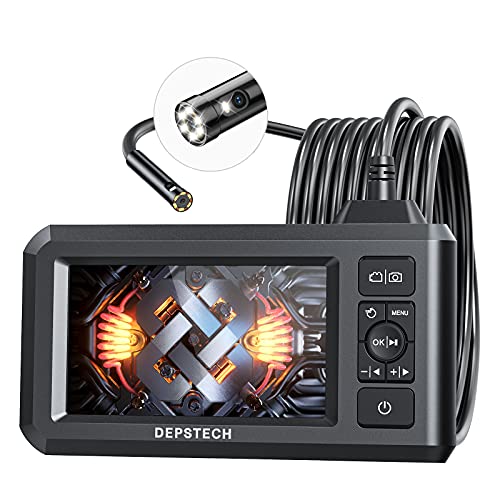
- Dual-lens and split-screen viewing
- 1080P video with 4.3-inch IPS display
- 16.5-foot IP67 semi-rigid cable
Best For: Long-reach inspections requiring front and side views
Best Large-Screen Simplicity
TGJOR 5-Inch Dual-Lens Borescope

- Large 5-inch HD screen with 170° view
- 16.4-foot IP67 waterproof probe
- Plug-and-play design with 3–4-hour runtime
Best For: Live inspections where recording is not required
Best Articulation

- 210° articulation with 420° motion range
- Dual-lens 1080P recording system
- 32GB card and protective case included
Best For: Tight, complex inspections requiring precise probe control
Best Articulating Pick – Teslong 2-Way Inspection Borescope
For high-performance borescope inspection cameras that prioritize controlled movement, the Teslong articulating model is a practical choice for automotive, HVAC, and household work. Its two-way articulation, semi-rigid 5-foot cable, and standalone display help you inspect difficult spaces without relying on a phone app.
Best For: Mechanics, HVAC technicians, and home inspectors who need one-handed control in tight spaces.
Pros:
- Two-way 210° articulation helps navigate complex inspection areas.
- 4.5-inch IPS display provides sharp, real-time viewing without an app.
- 1080p video, adjustable LED lighting, IP67 waterproofing, and included 32GB storage.
Cons:
- The 5-foot probe is shorter than some long-reach inspection cameras.
- Still-image resolution is listed at 2MP.
The Teslong stands out when probe positioning matters more than maximum reach. Its joystick, semi-rigid cable, and built-in screen make it well suited to repeat inspections where fast, direct control is valuable.
Best Long-Reach Option – DEPSTECH DS620 Triple-Lens Endoscope
The DEPSTECH DS620 is one of the more versatile high-performance borescope inspection cameras for jobs that require extended reach and multiple viewing angles. Its triple-lens design lets you switch perspectives electronically, while the 16.5-foot semi-rigid cable reaches deep into pipes, walls, machinery, and vehicle systems.
Best For: Plumbing, industrial maintenance, HVAC, and inspections where long cable reach is essential.
Pros:
- Triple-lens design enables front and alternate-angle viewing without repositioning the probe.
- 16.5-foot semi-rigid cable provides substantial reach.
- 5-inch IPS screen, 1080p video, 10 LEDs, IP67 probe, and included magnet and hook.
Cons:
- MicroSD card is required for media storage and is not included.
- Listed continuous operating time is approximately 2–3 hours.
Choose the DS620 when coverage and reach are more important than maximum battery runtime. The three-camera arrangement can reduce cable adjustments, while the large screen and waterproof probe support work in dark or damp locations.
Best Connected Worksite Pick – Klein Tools ET19 Wi-Fi Pro Borescope
The Klein Tools ET19 combines a compact 5.5 mm camera with Wi-Fi sharing, making it a practical option among high-performance borescope inspection cameras for professionals who need to document and send findings. Its dual-lens design, armored 9.8-foot snake, and built-in LCD support both on-site viewing and smartphone-based sharing.
Best For: Contractors and maintenance professionals who need to capture, transfer, and share inspection images or video.
Pros:
- Dual-lens camera offers multiple viewing angles.
- 5.5 mm, 9.8-foot armored snake navigates bends and confined pathways.
- Wi-Fi app support enables sharing, while the 4.3-inch LCD allows direct viewing.
Cons:
- Its 0.92MP still-image resolution is lower than several alternatives in this roundup.
- Sharing features depend on the ET19 app and a compatible smartphone.
The ET19 is a strong documentation-focused tool rather than a purely standalone scope. It offers useful flexibility for plumbing, HVAC, automotive, and industrial maintenance, especially when inspection records must be shared quickly.
Best Slim Articulating Pick – FOXWELL 220° Borescope Camera
For high-performance borescope inspection cameras designed to reach narrow openings, the FOXWELL combines a slim 0.24-inch probe with 220° two-way articulation. Its 1080p imaging, zoom controls, semi-rigid gooseneck, and offline recording make it useful for automotive, plumbing, and HVAC inspections.
Best For: Users inspecting spark-plug holes, valve areas, ductwork, and other especially tight spaces.
Pros:
- Ultra-slim 0.24-inch probe fits spaces where larger scopes may not.
- 220° two-way articulation supports precise positioning.
- 1080p imaging, 2x/4x zoom, IP67 protection, 32GB storage, and 5–7 hours of battery life.
Cons:
- The 5.3-foot gooseneck offers less reach than the DEPSTECH model.
- Automatic heat protection may power the unit off in spaces reaching 158°F.
The FOXWELL is the most targeted choice for narrow access combined with active probe control. Its built-in storage and app-free operation also suit field work where connectivity is unavailable or inconvenient.
Long-Reach Dual-Lens Pick – Teslong NTS300 16.5FT Dual-Lens Borescope
For high-performance borescope inspection cameras that can cover substantial distances, the Teslong NTS300 combines dual camera views, a 16.5-foot semi-rigid cable, and a self-contained 5-inch IPS display. It is suited to inspections where you need to switch between forward and side views without relying on a phone or app.
Best For: Homeowners, mechanics, and HVAC technicians inspecting walls, ducts, drains, plumbing, and engine compartments.
Pros:
- Dual forward- and side-facing cameras with independent LED lighting.
- Long 16.5-foot cable reaches deep into ducts, wall cavities, and engine bays.
- IP67 waterproof probe, adjustable illumination, and included hook, magnet, mirror, and hard case.
- Built-in 5000mAh battery provides approximately 4.5 hours of use.
Cons:
- 720p video capture and 1MP still resolution are less detailed than some higher-resolution options.
- The 8mm probe may be too large for very narrow access points.
- Charging takes approximately five hours.
The NTS300 is a practical choice when reach and viewing flexibility matter more than maximum image resolution. Its long cable, dual lenses, waterproof probe, and standalone screen make it especially useful for broad home, HVAC, plumbing, and automotive inspection work.
Best Articulation Control – DXZtoz 220° Two-Way Articulating Borescope
This DXZtoz model stands out among high-performance borescope inspection cameras for its 220-degree two-way articulation. A control wheel helps steer the 8.5mm probe around turns and obstacles, while the 1080p-capable system and 4.3-inch IPS monitor support close-up inspection in confined spaces.
Best For: Mechanics and technicians who need directional control for engines, valves, pistons, spark plugs, HVAC lines, and electrical or plumbing work.
Pros:
- 220-degree two-way articulation helps guide the lens around obstructions.
- 2MP camera, 1080p video capture, 8X zoom, and an adjustable 1–15cm focal range.
- Eight high-intensity LEDs with four brightness settings improve visibility in dark areas.
- Includes a 32GB memory card, accessories, protective case, and approximately five-hour battery life.
Cons:
- The 5.5-foot probe is shorter than long-reach inspection models.
- The 4.3-inch display is smaller than the screens on some competing units.
- Articulation and controls may require a brief learning period.
Choose this borescope when steering precision is the priority. Its articulating tip can reduce repositioning in tight mechanical spaces, while the waterproof, oil-resistant probe and included recording accessories add useful flexibility for professional inspection tasks.
Compact Dual-View Choice – Teslong Articulating Dual-Lens Borescope
For high-performance borescope inspection cameras in a more compact format, this Teslong pairs two-way articulation with front- and side-view lenses. Its 4.5-inch IPS screen, adjustable probe lighting, and one-handed controls are designed to make short, detailed inspections easier without an app.
Best For: Automotive and household inspections in tight spaces where dual views, compact handling, and quick lens switching are useful.
Pros:
- Dual front and side cameras provide alternate views without repositioning the probe.
- Two-way articulating joystick supports one-handed operation.
- 4.5-inch IPS display and adjustable high-brightness LEDs aid viewing in dark areas.
- 5-foot semi-rigid gooseneck, IP67 waterproofing, microSD support, and carrying case add practicality.
Cons:
- 720p video and 1MP still resolution are modest for detailed documentation.
- The 5-foot cable offers less reach than the 16.5-foot Teslong model.
- The supplied details do not specify battery runtime.
This is a convenient option for users who value maneuverability and fast view changes over maximum cable length. The articulating probe, dual lenses, compact screen, and app-free operation make it well suited to routine automotive and household checks.
Best Dual-Lens Coverage – DEPSTECH DS300 16.5FT Borescope
The DEPSTECH DS300 is a practical choice among high-performance borescope inspection cameras when you need to inspect long, narrow spaces from more than one angle. Its dual-lens design, split-screen viewing, 1080P video, and semi-rigid 16.5-foot cable suit plumbing, HVAC, automotive, chimney, and machinery work.
Best For: Detailed inspections that benefit from switching between front and side views over a long reach.
Pros:
- Dual cameras, split-screen viewing, and a 70° wide-angle mode improve coverage.
- 4.3-inch IPS display, 1080P video, 2MP still images, and adjustable LED lighting provide a clear live view.
- 16.5-foot semi-rigid cable, 180° camera orientation, and IP67 waterproofing support varied inspection tasks.
- Built-in battery runs for about four hours and includes hook and magnet accessories.
Cons:
- A TF/microSD card is not included.
- The relatively long cable may be more than needed for short inspections.
With its long probe and flexible viewing modes, the DS300 is a strong all-around option for users who want to document findings and examine both forward and side-facing surfaces without adding a mirror.
Best Large-Screen Simplicity – TGJOR 5-Inch Dual-Lens Borescope
The TGJOR endoscope is designed for straightforward, on-site viewing rather than image capture. Its 5-inch screen, dual-lens switching, 16.4-foot semi-rigid probe, and IP67 waterproof construction make it a useful high-performance borescope inspection camera for plumbing, automotive, HVAC, drain, and sewer work.
Best For: Users who prioritize a large screen and immediate plug-and-play inspection over saving photos or videos.
Pros:
- Large 5-inch HD screen offers a 170° viewing angle.
- Dual front and side lenses switch instantly for more flexible inspection angles.
- 16.4-foot semi-rigid cable, eight adjustable LEDs, and IP67 waterproofing suit wet or confined areas.
- USB-C charging and a 2,000mAh battery provide approximately three to four hours of use.
Cons:
- It cannot take pictures or record videos.
- Its fixed-focus range is limited to approximately 1.2–4 inches.
The main trade-off is clear: this model emphasizes a bright, large live display and simple operation, but it is not the right fit if you need inspection records for reports, maintenance logs, or before-and-after comparisons.
Best Articulation – Acoath 210° Two-Way Borescope
The Acoath two-way articulating borescope stands out among high-performance borescope inspection cameras for navigating difficult angles. Its 210° articulation, dual-lens system, slim 0.33-inch probe, and built-in recording support are well suited to automotive, HVAC, wall, pipe, and mechanical inspections.
Best For: Complex close-quarters inspections where precise probe positioning matters more than cable length.
Pros:
- Two-way 210° articulation provides a 420° range of motion for difficult viewing angles.
- Dual 70° front and 60° side lenses switch with one button.
- 1080P photo and video capture, autofocus, eight LEDs, and four brightness levels support detailed viewing.
- Includes a 32GB TF card, protective case, hook, magnet, mirror, and a 24-month warranty.
Cons:
- The 5-foot cable offers less reach than the longer 16.4- and 16.5-foot models.
- The 4.3-inch display is smaller than the 5-inch screen on the TGJOR model.
For bends, cavities, and inspection points that are hard to frame with a conventional probe, the articulating head is the key advantage. The included storage card and case also make this a well-equipped option for repeat professional use.
How We Picked These High-Performance Borescope Inspection Cameras
We focused on practical inspection performance rather than headline specifications alone. The selected cameras were evaluated by their probe design, articulation range, camera coverage, lighting, display quality, cable length, water resistance, and ease of use. We also considered whether each model is better suited to automotive work, HVAC and wall inspections, plumbing, industrial maintenance, or general household troubleshooting.
Models with dual or triple lenses can provide a wider view and make it easier to inspect both the area directly ahead and surfaces around the probe. Articulating designs are especially useful when the camera must turn around corners or navigate complex machinery.
Quick Comparison
- Best for controlled navigation: Choose a two-way or multi-way articulating probe when positioning accuracy matters.
- Best for broad coverage: Dual- and triple-lens cameras reduce the need to reposition the probe repeatedly.
- Best for standalone use: Models with built-in IPS screens are convenient when you do not want to use a phone.
- Best for remote viewing: Wi-Fi-enabled designs can stream footage to a compatible mobile device.
- Best for wet environments: Look for an IP-rated probe and confirm the rating applies to the camera tip and cable.
Key Buying Factors for High-Performance Borescope Inspection Cameras
Probe Articulation and Flexibility
A flexible cable is not the same as a steerable probe. Two-way articulation gives you more control around bends, while multi-way systems can simplify difficult engine, wall, and duct inspections. Consider how much space is available to manipulate the handle and cable.
Camera Views, Resolution, and Lighting
1080p-class imaging can reveal useful detail, but lighting and focus are equally important in dark cavities. Dual-lens systems add side or rear visibility, while adjustable LEDs help prevent washed-out images on reflective surfaces.
Screen, Recording, and Connectivity
A built-in 4.3- or 5-inch IPS screen offers quick, self-contained operation. Wi-Fi models may be more convenient for sharing images, but they depend on a phone or tablet and can introduce setup steps. Check storage options, photo and video recording, and whether a memory card is included.
Reach and Durability
Match the probe length to the job without choosing excessive cable that is difficult to control. For plumbing, outdoor, or engine-bay work, prioritize water resistance, a protected probe, robust connectors, and a cable that can tolerate repeated bending.
Who Should Buy Which High-Performance Borescope Inspection Cameras?
Automotive technicians and serious DIY mechanics should prioritize articulation, a durable probe, strong lighting, and a side-view or dual-lens camera for cylinders, hoses, and confined engine areas.
HVAC technicians and home inspectors will generally benefit from a long flexible cable, a clear standalone display, and dual- or triple-lens coverage for walls, vents, insulation cavities, and ductwork.
Plumbers and maintenance professionals should focus on reach, waterproofing, bright adjustable LEDs, and reliable recording. An IP-rated probe is particularly important for drains and other damp locations.
Occasional household users can save money with a straightforward camera featuring an integrated screen and simple controls. Choose a compact model unless you regularly inspect deep pipes, walls, or machinery.
