
Better indoor air starts with better information. The best high-performance air quality monitoring systems track the pollutants and comfort factors that matter most, helping you decide when to ventilate, filter, or investigate a problem.
Our 2026 roundup includes professional-grade monitors, connected sensor platforms, portable detectors, and feature-rich displays for homes, offices, classrooms, and other indoor environments.
Best 10 High-Performance Air Quality Monitoring Systems Picks for 2026
Best for Portable Data Analysis

- Measures CO2, PM2.5, PM10, temperature, and humidity
- Exports readings as CSV through USB
- Portable design with TFT display and audio alarm
Best For: Schools, homes, and small businesses needing portable readings and downloadable records
Best Professional Indoor-Outdoor Bundle

- Pairs indoor and weatherproof outdoor monitoring
- Tracks particulate matter, AQI, climate, and pressure
- Offers Wi-Fi access through the AirVisual platform
Best For: Users who need connected indoor and outdoor pollution tracking
Best for Radon and Whole-Home Awareness

- Detects radon alongside PM2.5, CO2, and VOCs
- Battery-powered for flexible cable-free placement
- App offers alerts, trends, and cloud history
Best For: Households wanting radon detection plus comprehensive indoor monitoring
Best Overall
AirGradient ONE Open-Source IAQ Monitor
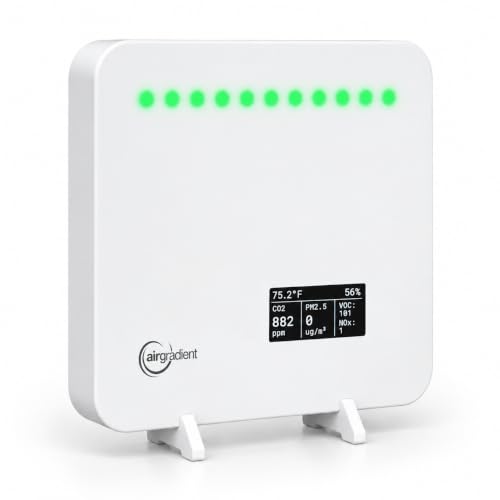
- Tracks PM2.5, CO2, TVOCs, NOx, temperature, and humidity
- Subscription-free dashboard with Home Assistant support
- Individually tested and calibrated for PM2.5
Best For: Smart-home users and detailed indoor monitoring
Best for Trend Tracking
18-in-1 Monitor with 15-Day History

- Displays PM, CO2, HCHO, TVOC, AQI, and more
- Records 24-hour and 15-day air quality trends
- Features a 7-inch TFT screen and True NDIR CO2 sensor
Best For: Pattern tracking in homes, offices, and classrooms
Best Portable Option
16-in-1 Compact Air Quality Tester

- Measures particles, CO2, TVOC, HCHO, temperature, and humidity
- Updates readings every 1.5 seconds on an HD color screen
- Supports handheld use with USB-C charging
Best For: Portable spot-checking at home, work, or in vehicles
Best Large-Screen Value
YNAK 16-in-1 Real-Time Air Quality Monitor

- Nine real-time detection parameters
- 7-inch display with adjustable brightness
- Includes AC adapter and USB-C cable
Best For: Portable monitoring across rooms, cars, and campsites
Best Compact Travel Option
AQItech Professional Indoor Air Quality Monitor

- Measures particles, gases, temperature, and humidity
- Updates readings every three seconds
- Portable design with simple controls
Best For: Short monitoring sessions at home, in cars, or outdoors
Best for Portable Data Analysis – Temtop M2000C 2ND
The Temtop M2000C 2ND is a practical choice among high-performance air quality monitoring systems for users who need portable readings and downloadable data. It tracks CO2, PM2.5, PM10, temperature, and humidity, then supports CSV export through USB for longer-term analysis.
Best For: Schools, homes, and small businesses that want a portable monitor with an audio alarm and data-export capability.
Pros:
- Measures CO2, PM2.5, PM10, temperature, and humidity.
- Exports readings in CSV format through USB.
- Color TFT display, audio alarm, rechargeable battery, and portable design.
- Includes a 12-month warranty and round-the-clock customer support.
Cons:
- Does not list radon, VOC, or outdoor monitoring capabilities.
- Data analysis requires transferring readings to another device.
Choose this Temtop model if straightforward measurements and offline data review matter more than app-based remote monitoring. Its combination of portability, alarms, and exportable records suits routine indoor checks and educational applications.
Best Professional Indoor-Outdoor Bundle – IQAir AirVisual Bundle
The IQAir AirVisual bundle is designed for buyers seeking high-performance air quality monitoring systems that connect indoor conditions with the surrounding outdoor environment. Its indoor unit tracks common contaminants, temperature, and humidity, while the weatherproof outdoor sensor measures multiple pollution and weather parameters.
Best For: Homeowners and organizations that want professional-grade indoor and outdoor tracking through a connected platform.
Pros:
- Combines indoor monitoring with a weatherproof outdoor sensor.
- Outdoor unit can measure PM1, PM2.5, PM10, AQI, temperature, humidity, and pressure.
- Wi-Fi connectivity supports smartphone, tablet, and desktop access.
- Outdoor sensor includes two professional-grade laser sensors and a 12 m cable.
Cons:
- CO2 measurement outdoors requires an optional sensor module.
- Outdoor installation requires access to a standard electrical outlet.
This is the strongest fit when air quality decisions depend on both indoor pollution sources and outdoor conditions such as traffic, smoke, or wildfire pollution. The app and AirVisual platform add convenient wireless viewing and broader data context.
Best for Radon and Whole-Home Awareness – Airthings View Plus
The Airthings View Plus stands out among high-performance air quality monitoring systems by combining radon detection with measurements for PM2.5, CO2, VOCs, humidity, temperature, and air pressure. Its battery-powered design and Wi-Fi connectivity make it suitable for continuous indoor monitoring without a permanent power cable.
Best For: Households prioritizing radon awareness alongside broader indoor air quality tracking.
Pros:
- Monitors radon, PM2.5, CO2, VOCs, humidity, temperature, and pressure.
- Battery-powered operation supports flexible, cable-free placement.
- App provides live data, notifications, trends, and cloud history.
- Optional registration extends the warranty to five years.
Cons:
- The monitor requires the Airthings app and internet access for full operation.
- An account is required to use the device.
- Battery operation requires periodic replacement of six AA batteries.
For buyers concerned about radon as well as everyday pollutants, this Airthings model offers unusually broad coverage in a compact enclosure. It is less suitable for completely offline use, but its app-based alerts and historical trends support ongoing household monitoring.
Best for Smart Building Trends – CF-60PP SMART Monitor
The CF-60PP SMART is built for users comparing high-performance air quality monitoring systems for homes, classrooms, and offices. It displays real-time readings and historical graphs for PM1.0, PM2.5, PM10, CO2, TVOC, HCHO, AQI, temperature, humidity, and a pollen metric, with optional app connectivity and USB data export.
Best For: Facility managers and households that need on-device trend viewing, threshold alarms, and documented indoor air quality records.
Pros:
- Displays multiple pollutant and climate readings on one screen.
- Shows 4-minute, 6-minute, 2-hour, and 12-hour historical graphs without a phone.
- Supports local alarms, app push notifications, and customizable thresholds.
- Stores up to one year of history and supports USB export.
Cons:
- Remote alerts and cloud trends require app and Wi-Fi connectivity.
- Requires a 9V battery, which may need periodic replacement.
This model is a good match for buyers who want visible trends rather than isolated readings. Its combination of local privacy, optional cloud access, threshold alarms, pollen tracking, and exportable history is especially useful for documenting conditions in shared indoor spaces.
Best Overall – AirGradient ONE Open-Source IAQ Monitor
The AirGradient ONE is a strong choice for high-performance air quality monitoring systems when you want broad pollutant coverage, tested sensor modules, and flexible smart-home integration. It tracks PM2.5, CO2, TVOCs, NOx, temperature, and humidity, while its subscription-free dashboard, open-source design, and Home Assistant support add useful long-term flexibility.
Best For: Homes, offices, classrooms, and smart-home users who want detailed readings, local-control options, and a compact display.
Pros:
- Measures six key indoor air quality factors, including PM2.5, CO2, TVOCs, and NOx.
- Uses established SenseAir, Plantower, Sensirion, and NDIR sensor modules.
- Includes a subscription-free dashboard, free API access, open-source firmware, and Home Assistant compatibility.
- Offers a small OLED display, LED status bar, tabletop placement, and wall mounting.
Cons:
- The 1.3-inch OLED display is relatively small compared with full-color touchscreen monitors.
- Its advanced open-source and integration features may be more than casual users need.
With independent recognition for indoor PM2.5 accuracy and an individually tested, calibrated design, the AirGradient ONE stands out for buyers prioritizing measurement breadth and ecosystem flexibility over a large built-in screen.
Best for Trend Tracking – 18-in-1 Monitor with 15-Day History
This 18-in-1 monitor fits high-performance air quality monitoring systems for buyers who want a large, easy-to-read display and historical context. It combines PM1.0, PM2.5, PM10, CO2, HCHO, TVOC, temperature, humidity, AQI, and time readings with 24-hour and 15-day trend history.
Best For: Families, offices, classrooms, and anyone who wants to review pollution patterns and see ventilation changes over time.
Pros:
- Provides a broad set of readings, including particulate matter, CO2, HCHO, TVOC, and AQI.
- Stores both 24-hour and 15-day air quality trends.
- Uses a True NDIR CO2 sensor and external temperature and humidity sensors.
- Large 7-inch TFT display includes color-coded alerts, audible alarms, and day/night themes.
Cons:
- Battery operation lasts up to eight hours, so extended portable use requires recharging.
- The large display may take up more space than compact tabletop monitors.
Its combination of a full-size screen, warning alerts, and extended history makes this model particularly practical for identifying recurring indoor air problems rather than checking readings only in the moment.
Best Portable Option – 16-in-1 Compact Air Quality Tester
This compact 16-in-1 tester is a practical entry point into high-performance air quality monitoring systems when portability matters. It measures PM1.0, PM2.5, PM10, CO2, TVOC, HCHO, temperature, and humidity, updates readings every 1.5 seconds, and supports handheld use around the home, office, or car.
Best For: Users who need a portable monitor for rooms, vehicles, bedrooms, offices, and other indoor locations.
Pros:
- Tracks particulate matter, CO2, TVOC, HCHO, temperature, and humidity in one device.
- Provides continuous updates every 1.5 seconds on an HD color screen.
- Offers simple single-tap operation, adjustable audio prompts, and a quiet sampling mode.
- Uses universal USB-C charging and includes an adapter and cable.
Cons:
- Its 4- to 5-hour runtime is shorter than the battery life listed for the larger 18-in-1 monitor.
- The supplied notes do not mention app connectivity, remote access, or historical data storage.
Choose this model if quick readings and easy relocation are more important than extended trend analysis or smart-home integrations. Its lightweight design and straightforward controls make it convenient for spot-checking multiple spaces.
Best All-Around Coverage – Sainlogic 16-in-1 Indoor Air Quality Monitor
For shoppers comparing high-performance air quality monitoring systems, the Sainlogic stands out as a broad-coverage indoor monitor with a large display, portable design, and customizable alerts. It tracks CO2, particulate matter, HCHO, TVOC, temperature, humidity, and AQI without requiring Wi-Fi or an app.
Best For: Families, nurseries, allergy-sensitive households, and users who want flexible room-to-room monitoring.
Pros:
- Measures nine key indoor air and environmental indicators.
- Large 7.2-inch display with three brightness levels and tri-color status alerts.
- Rechargeable 2500mAh battery provides up to eight hours of wireless use.
- Offers seven user-defined alert thresholds, visual warnings, and a mute option.
Cons:
- Battery runtime is limited to up to eight hours per charge.
- It does not provide app or Wi-Fi connectivity.
The Sainlogic is a practical choice when visible, detailed readings matter more than smart-home integration. Its large screen and customizable alert behavior make it especially convenient for shared living spaces.
Best Large-Screen Value – YNAK 16-in-1 Real-Time Air Quality Monitor
The YNAK is a strong option for buyers seeking high-performance air quality monitoring systems with an easy-to-read interface and portable operation. Its external sensor array monitors nine parameters in real time, while the 7-inch display and alert buzzers make changes easy to notice.
Best For: Bedrooms, offices, vehicles, campsites, and households wanting straightforward readings with included charging accessories.
Pros:
- Monitors CO2, PM1.0, PM2.5, PM10, HCHO, TVOC, temperature, humidity, and AQI.
- 7-inch LED display offers three brightness settings.
- Provides seven AQI alert functions with a mute button.
- Includes a USB-C cable, AC adapter, and 12-month warranty.
Cons:
- Up to eight hours of runtime may require regular recharging for continuous use.
- The sensors should be kept away from perfumes and strong odors, and should not be touched.
With its included adapter, clear display, and broad parameter coverage, the YNAK delivers a convenient monitoring setup out of the box. It is particularly appealing for users who move a monitor between indoor spaces and vehicles.
Best Compact Travel Option – AQItech Professional Indoor Air Quality Monitor
For shoppers prioritizing portability among high-performance air quality monitoring systems, the AQItech combines multi-parameter detection with simple one-button controls. It measures particulate matter, gases, temperature, and humidity while supporting visual alerts in a compact gunmetal-black design.
Best For: Users who need a portable monitor for homes, cars, nurseries, offices, or campsites.
Pros:
- Tracks PM1.0, PM2.5, PM10, CO2, TVOC, HCHO, temperature, and humidity.
- Collects and analyzes readings every three seconds.
- One-button operation supports power, temperature-unit changes, and alarm silencing.
- Portable design includes versatile mounting options and a 12-month warranty.
Cons:
- Wireless runtime is limited to approximately four to five hours per charge.
- It offers fewer operating hours than the two eight-hour models in this roundup.
The AQItech is best suited to short monitoring sessions and frequent relocation. Its simple controls and compact format make it convenient for checking conditions in several settings, though its shorter battery life favors users who can recharge regularly.
How We Picked the Best High-Performance Air Quality Monitoring Systems
We evaluated these monitors by looking at the breadth of parameters measured, sensor usefulness, display clarity, alert options, data access, portability, and suitability for different indoor settings. We also considered whether a device supports longer-term trend analysis rather than showing only a momentary reading.
Because no single monitor is ideal for every buyer, the list includes systems focused on radon, connected indoor-outdoor tracking, building management, Home Assistant integration, and affordable multi-parameter monitoring.
Quick Comparison
- Best for connected whole-environment tracking: IQAir AirVisual, with indoor and outdoor monitoring options.
- Best for radon awareness: Airthings View Plus, which combines radon monitoring with common indoor air metrics.
- Best for smart-home integration: AirGradient ONE, particularly for Home Assistant users.
- Best for professional or business use: CF-60PP SMART, designed for indoor commercial environments.
- Best for portable, broad measurement: the various 16-in-1 and 18-in-1 monitors, which prioritize parameter coverage and large displays.
Key Buying Factors for High-Performance Air Quality Monitoring Systems
Choose the Right Pollutants
CO2 is a useful ventilation indicator, while PM2.5 and PM10 reveal fine and coarse particulate exposure. VOC, TVOC, formaldehyde, and NOx readings can help identify chemical sources, but sensor capabilities and accuracy vary. If radon is a concern, choose a monitor specifically designed to measure it rather than assuming a general-purpose detector can.
Consider Data and Alerts
Audio alarms, color screens, app notifications, history graphs, exports, and API access all serve different needs. A visible display works well in a shared room; cloud dashboards and data exports are more useful for facility managers or users tracking changes over weeks.
Check Placement and Maintenance
Place the monitor away from windows, vents, kitchens, and direct sunlight unless you are intentionally measuring those sources. Battery operation improves portability, while mains power is usually better for continuous monitoring. Review calibration guidance and replacement requirements before buying.
Who Should Buy Which High-Performance Air Quality Monitoring Systems?
Homeowners wanting a broad overview should choose a multi-parameter monitor with clear readings and history. Families concerned about radon should prioritize a dedicated radon-capable system. Smart-home enthusiasts should look for Home Assistant or other platform compatibility. Businesses, schools, and property managers will generally benefit from professional alerts, reliable trend data, and exportable reports. For occasional checks or multiple rooms, a portable 16-in-1 or 18-in-1 unit may provide the most flexibility.
