
As you prepare for the evolving landscape of data security in 2026, choosing the right hardware encrypted storage device becomes essential. With threats to your sensitive information on the rise, understanding the features and capabilities of top devices can make a significant difference. From robust encryption standards to varying storage capacities, there’s a lot to evaluate before making a decision. Let’s explore the top contenders that could help you safeguard your valuable data effectively.
Kingston Ironkey Locker+ 50 Encrypted USB Flash Drive (32GB)

The Kingston Ironkey Locker+ 50 Encrypted USB Flash Drive (32GB) is perfect for professionals who prioritize security without sacrificing performance. With USB 3.2 Gen 1 speeds, you’ll enjoy read speeds up to 145MB/s and write speeds up to 115MB/s. Its durable metal casing protects your data while XTS-AES encryption safeguards it from unauthorized access. You can use multi-password options and a virtual keyboard, preventing keyloggers from capturing your credentials. Additionally, automatic personal cloud backup guarantees your files remain safe. This drive combines robust security and impressive performance, making it an ideal choice for anyone serious about data protection.
Best For: Professionals who prioritize data security and performance in their portable storage solutions.
Pros:
- High-speed performance with read speeds up to 145MB/s and write speeds up to 115MB/s, enhancing productivity.
- Robust security features including XTS-AES encryption and multi-password options to protect sensitive data.
- Durable metal casing that offers protection against physical damage and wear.
Cons:
- Limited storage capacity of 32GB may not be sufficient for users with larger data needs.
- Price point may be higher compared to non-encrypted USB drives, which could deter budget-conscious buyers.
- Dependency on specific password management features could complicate usability for less tech-savvy users.
Kingston Ironkey Keypad 200 32GB Encrypted USB

For those who prioritize security in their data storage, the Kingston IronKey Keypad 200 32GB Encrypted USB stands out with its military-grade security features. This USB drive offers 32GB of storage, with read speeds of 145 MB/s and write speeds of 115 MB/s, ensuring fast access to your data. Its FIPS 140-3 Level 3 certification and XTS-AES 256-bit hardware encryption provide robust protection against unauthorized access. With a user-friendly alphanumeric keypad, it’s compatible with multiple operating systems. Weighing just 25 grams, it’s portable and easy to carry. Plus, it comes with a 3-year warranty for peace of mind.
Best For: Individuals and businesses seeking a highly secure data storage solution with advanced encryption and portability.
Pros:
- Military-grade security features including FIPS 140-3 Level 3 certification and XTS-AES 256-bit encryption.
- User-friendly alphanumeric keypad that allows for easy access and PIN management.
- Lightweight and portable design makes it convenient for on-the-go data storage.
Cons:
- Limited storage capacity of 32GB may not be sufficient for users with larger data needs.
- Higher price point compared to standard USB drives without encryption.
- Potential learning curve for users unfamiliar with alphanumeric keypads for PIN entry.
Apricorn 2TB Aegis Padlock Portable External Hard Drive

Looking for a reliable and secure storage solution? The Apricorn 2TB Aegis Padlock Portable External Hard Drive is a fantastic choice. With AES XTS 256-bit hardware encryption and a simple PIN access system, it keeps your data safe. It supports up to five user PINs and includes a brute force self-destruct feature for extra security. Weighing just 0.5 pounds and featuring a rugged design, it’s easy to take on the go. Plus, it offers impressive read speeds of 625 MB/s and is compatible with USB 3.0. With a three-year warranty, you can trust its durability and performance.
Best For: Individuals and businesses seeking a secure and portable external hard drive for sensitive data storage.
Pros:
- Robust security features including AES XTS 256-bit encryption and a brute force self-destruct mechanism.
- Compact and lightweight design makes it easy to carry and use on the go.
- Fast data transfer speeds with read speeds of 625 MB/s, significantly faster than USB 2.0.
Cons:
- Limited storage capacity of 2 TB may not meet the needs of users requiring more extensive data storage.
- No software management may limit advanced users who prefer more control over their data.
- Physical keypad may be prone to wear over time, potentially affecting usability.
Kingston IronKey Vault Privacy 80 1.92TB External SSD
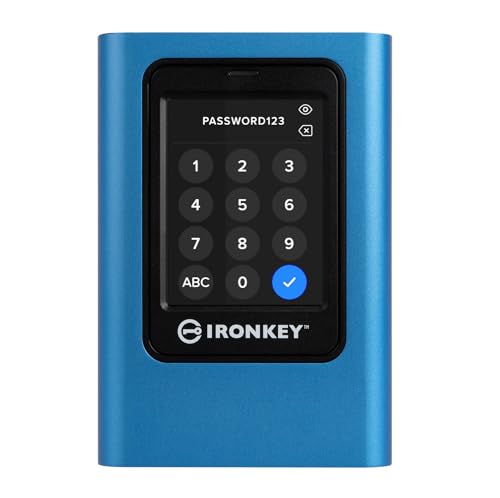
When security is your top priority, the Kingston IronKey Vault Privacy 80 1.92TB External SSD stands out with its FIPS 197 certification and robust XTS-AES 256-bit encryption. You’ll appreciate the multi-password options, including admin and user modes, allowing you to tailor access. The intuitive touch-screen interface makes navigation a breeze, and you can choose between PIN and passphrase modes for added convenience. Plus, with dual read-only (write protect) modes and built-in malware protection, your data stays safe. With 1.92TB of storage, this SSD combines high capacity with exceptional security, making it an excellent choice for safeguarding your sensitive information.
Best For: Security-conscious individuals and businesses looking to protect sensitive data with robust encryption and user-friendly access controls.
Pros:
- FIPS 197 Certified for enhanced security compliance.
- Intuitive Touch-screen interface makes it easy to navigate and manage settings.
- Dual Read-Only Modes provide added protection against unauthorized data modification.
Cons:
- Higher price point compared to standard external SSDs.
- Limited to 1.92TB storage, which may not be sufficient for some users with extensive data needs.
- Requires a learning curve for those unfamiliar with advanced security features.
Kingston Ironkey Vault Privacy 50 USB-C Encrypted Flash Drive (512GB)

The Kingston IronKey Vault Privacy 50 USB-C Encrypted Flash Drive (512GB) is an excellent choice for professionals and individuals who prioritize data security without sacrificing convenience. With FIPS 197 certification and XTS-AES 256-bit hardware encryption, your files are well-protected against threats like BadUSB and brute force attacks. You’ll appreciate its dual read-only settings and multi-password options, ensuring flexibility in access control. Capable of 400 MB/s write speeds and 310 MB/s read speeds, this water-resistant drive is compatible with various devices featuring USB Type-A or USB Type-C ports. Plus, it comes with a limited 5-year warranty for peace of mind.
Best For: Professionals and individuals who prioritize data security and require a reliable, high-performance encrypted flash drive.
Pros:
- FIPS 197 certified with advanced XTS-AES 256-bit hardware encryption for enhanced data protection.
- High performance with 400 MB/s write speeds and 310 MB/s read speeds for efficient file transfers.
- Water-resistant design ensures durability in various environments.
Cons:
- Limited to 512GB storage capacity, which may not be sufficient for users with extensive data needs.
- Higher price point compared to non-encrypted flash drives, potentially making it less accessible for casual users.
- The limited 5-year warranty may not cover all user concerns over the long term.
Kingston IronKey Vault Privacy 80 480GB External SSD

For professionals who prioritize data security, the Kingston IronKey Vault Privacy 80 480GB External SSD stands out with its robust encryption features, including FIPS 197 certification and XTS-AES 256-bit encryption. This external SSD offers a 2.5-inch form factor and a generous 480 GB capacity. It boasts a touch-screen with multi-password options and configurable password rules, ensuring your data remains protected. With dual read-only modes and brute force attack protection, you can feel secure knowing that your files are safe. Plus, its USB 3.2 connectivity provides fast data transfer speeds of up to 250 MB/s, making it a reliable choice for your storage needs.
Best For: Professionals who prioritize data security and require reliable external storage with advanced encryption features.
Pros:
- FIPS 197 Certified and offers strong XTS-AES 256-bit encryption for enhanced data security.
- Equipped with a touch-screen interface that supports multi-password options for user convenience.
- Fast data transfer speeds of up to 250 MB/s via USB 3.2, ensuring efficient file access and storage.
Cons:
- Limited 480 GB capacity may not be sufficient for users with extensive storage needs.
- The higher price point compared to non-encrypted external SSDs may deter budget-conscious buyers.
- Reliance on password security may pose challenges if passwords are forgotten or lost.
Corsair Flash Padlock 3, 256 GB Secure USB Flash Drive

With its robust 256-bit AES hardware encryption, the Corsair Flash Padlock 3, 256 GB Secure USB Flash Drive is an ideal choice for anyone serious about data security. Its built-in PIN pad allows for easy access without needing software, ensuring your data is protected against theft. The ruggedized rubber housing is both water-resistant and shockproof, making it durable for daily use. Plus, it offers ultra-fast read/write speeds via USB 3.0, while remaining compatible with USB 2.0. Backed by a 5-year warranty, this reliable device ranks highly among users, earning a solid 4.5 out of 5 stars.
Best For: Individuals or professionals seeking a secure and durable USB flash drive for sensitive data storage.
Pros:
- 256-bit AES hardware encryption provides robust data security.
- Ruggedized rubber housing makes it water-resistant and shockproof for enhanced durability.
- Ultra-fast read/write speeds over USB 3.0 ensure quick data transfer.
Cons:
- The built-in PIN pad may be cumbersome for users who prefer software-based access.
- Limited storage capacity compared to some other USB flash drives on the market.
- Slightly heavier than typical USB flash drives due to its rugged design.
Corsair Flash Padlock® 3 128GB Secure USB 3.0 Flash Drive with Key

Need a secure way to protect your sensitive data? The Corsair Flash Padlock® 3 128GB Secure USB 3.0 Flash Drive with Key is an excellent choice. It features 256-bit hardware AES encryption, ensuring your files are safe from prying eyes. You can customize a 4-10 digit PIN to lock and release your drive, and if you enter the wrong PIN five times, the device locks for two minutes, adding an extra layer of security. Its durable rubber, shock-proof housing makes it reliable for everyday use. Plus, it’s plug-and-play compatible with USB 1.1, 2.0, or 3.0 ports.
Best For: Individuals and businesses seeking a reliable and secure method to protect sensitive data on the go.
Pros:
- 256-bit hardware AES encryption provides robust security for your files.
- User customizable PIN allows for personalized access control.
- Durable rubber housing ensures the drive is shock-proof and reliable for daily use.
Cons:
- Limited to a 4-10 digit PIN, which may not be as secure as longer passcodes.
- Locking feature after failed attempts could be inconvenient if the user forgets the PIN.
- May be more expensive compared to standard USB drives without security features.
iStorage diskAshur2 2TB Portable Hard Drive
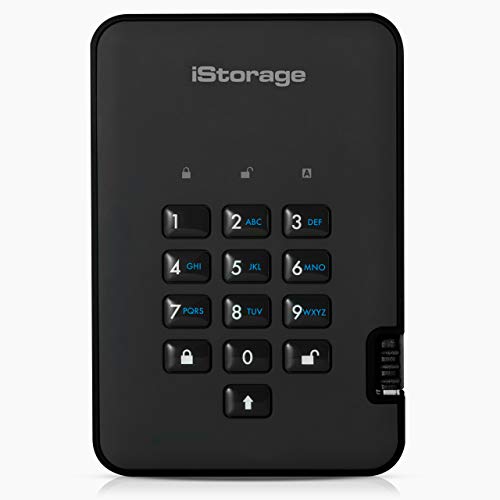
The iStorage diskAshur2 2TB Portable Hard Drive is an ideal choice for professionals and individuals who prioritize data security while on the go. With its AES-XTS 256-bit hardware encryption and 7-15 digit PIN protection, your data remains secure against unauthorized access. This rugged drive is dust and water resistant (IP56 certified), making it perfect for travel. Plus, its lightning-fast USB 3.2 transfer speeds guarantee you won’t sacrifice performance. Compatible with various devices and operating systems, it’s easy to use—just enter your PIN and access your data seamlessly, even if the drive is lost or stolen.
Best For: Professionals and individuals who prioritize data security while on the go.
Pros:
- AES-XTS 256-bit hardware encryption ensures data protection.
- Dust and water resistant (IP56 certified) for rugged use during travel.
- Lightning-fast USB 3.2 transfer speeds enhance performance.
Cons:
- Requires a PIN for access, which may be inconvenient for some users.
- Limited to 2TB of storage, which may not be sufficient for extensive data needs.
- Higher price point compared to non-secure portable hard drives.
Seagate One Touch 2TB Portable External Hard Drive

For those seeking a secure and portable storage solution, the Seagate One Touch 2TB Portable External Hard Drive stands out with its password-activated hardware encryption. Weighing just 148 grams and featuring a sleek space gray brushed metal enclosure, it’s designed for easy transport. With a 2TB capacity, this drive offers USB 3.0 plug-and-play connectivity, achieving read speeds of 120 MB/s. You can back up data with a single click or schedule it for daily, weekly, or monthly intervals. Plus, it comes with a two-year warranty and a subscription to Mylio Create and Adobe Creative Cloud Photography plan.
Best For: Individuals and professionals looking for a secure, portable storage solution with high capacity and easy backup options.
Pros:
- Password-activated hardware encryption ensures data security.
- Lightweight and portable design makes it easy to carry on the go.
- Plug-and-play connectivity with USB 3.0 for fast data transfer.
Cons:
- Reformatting may be required for use with Time Machine on Mac.
- Limited read speed compared to some newer SSD options.
- No built-in power supply; relies solely on USB for power.
Factors to Consider When Choosing Hardware Encrypted Storage Devices
When you’re choosing a hardware encrypted storage device, several key factors can make a big difference. You’ll want to take into account encryption standards, access methods, and storage capacity, along with data transfer speeds and durability. Each of these aspects can affect how secure and convenient your storage solution will be.
Encryption Standards and Types
Choosing the right encryption standards and types for hardware encrypted storage devices is essential to safeguarding your sensitive data. Look for devices that utilize AES (Advanced Encryption Standard), particularly AES-256, as it encrypts data in real-time and offers robust security. The XTS mode of AES is also a great option, providing resistance to various attacks for enhanced protection.
Consider devices with FIPS 140-3 certification, confirming they meet strict government security requirements. Multi-password options add layers of security, allowing separate access for users and administrators. Finally, check for brute force protection features that lock the device after a specified number of incorrect attempts, preventing unauthorized access. Prioritize these factors to guarantee your data remains secure.
Access and Authentication Methods
While robust encryption standards protect your data, the methods you use to access and authenticate those devices are equally important. You’ll find a range of options like alphanumeric PINs, complex passphrases, and multi-password systems for both users and admins. Some devices use AES-XTS 256-bit encryption, allowing you to enter a PIN without needing extra software. Advanced models may offer virtual keyboards to thwart keylogging and tamper-evident designs for added security. It’s also essential to choose devices compatible with various operating systems, ensuring seamless use with Windows, macOS, Linux, and others via standard USB interfaces. Finally, look for features that guard against brute force attacks, such as self-destruct mechanisms after several incorrect attempts.
Storage Capacity Options
Selecting the right storage capacity for hardware encrypted devices is essential, especially given the varying needs of users. If you’re just transferring basic files, a smaller device with 32GB might work. However, if you need to store larger amounts of sensitive data, options like 1TB or 2TB are ideal for backups, multimedia files, and extensive documents. For personal documents or smaller projects, a capacity of 64GB to 128GB may suffice. It’s also vital to think about your future storage needs—choosing a larger capacity device can offer more flexibility as your data grows. Different devices provide various capacities, so make sure to select one that aligns with both your current and projected data usage.
Data Transfer Speeds
When it comes to hardware encrypted storage devices, understanding data transfer speeds is key to optimizing your experience. These speeds directly affect how quickly you can read from or write to your device, impacting overall efficiency. For instance, higher read speeds of up to 625 MB/s enable rapid access to large files, while write speeds around 400 MB/s make saving data quicker—essential for frequent updates. Don’t overlook the USB interface standards, either; USB 3.2 can deliver considerably faster rates compared to USB 2.0. To guarantee you choose the right device, consider both read and write speeds based on your specific applications and workflows. This guarantees your hardware meets your performance needs effectively.
Durability and Portability
Choosing a hardware encrypted storage device that’s both durable and portable is vital for protecting your data in various environments. Look for drives with rugged casings made of rubber or epoxy coatings to shield against drops and impacts. Water-resistant and dust-resistant features greatly enhance durability, ensuring your data remains intact. When it comes to portability, opt for lighter and more compact drives that are easy to carry and store. Devices with built-in cables or compact designs simplify access and transport, eliminating the need for extra accessories. Many durable encrypted drives can withstand extreme conditions, making them perfect for travel and outdoor use. This reliability is significant for anyone needing dependable data storage on the go.
Compatibility With Devices
Guaranteeing compatibility with devices is essential for getting the most out of your hardware encrypted storage device. First, check that it works with the operating systems you use—be it Windows, macOS, Linux, or mobile platforms like Android and Chrome OS. Many devices are designed to be OS-independent, allowing seamless integration without needing extra drivers. Look for support for various connectivity options, such as USB 2.0, USB 3.0, or USB-C, to confirm compatibility with your existing hardware. Additionally, some devices feature a plug-and-play design that simplifies connection and enhances usability across different systems. Finally, verify compatibility with any backup software or cloud services you plan to use for peak performance.
Warranty and Support Services
After confirming compatibility with your devices, the next step involves evaluating the warranty and support services offered with hardware encrypted storage devices. Many of these devices come with a manufacturer’s warranty ranging from 3 to 5 years, giving you peace of mind about your investment. Check the return policy too; a full refund within 30 days for defective items is essential for customer satisfaction. Some manufacturers provide customer support to assist with warranty requests, helping you resolve any issues quickly. Warranty terms can vary, so it’s important to understand what’s covered, like accidental damage or product malfunctions. Being informed about warranty and support services can greatly enhance the overall value and reliability of your hardware encrypted storage device.
Additional Security Features
What additional security features should you look for in hardware encrypted storage devices? First, opt for devices that utilize AES encryption, preferably in XTS mode, to enhance data protection. You should also prioritize hardware-level security features like brute force protection, which locks the device after several incorrect password attempts, preventing unauthorized access. Multi-password options—such as admin and user modes—allow for different access levels, adding another layer of security. Look for tamper-evident designs and epoxy coatings that provide physical protection against unauthorized tampering. Finally, verify that the device complies with security standards like FIPS certifications, which validate the effectiveness of its encryption and security features against recognized benchmarks. These considerations will help keep your data safe.
