
When it comes to building a powerful GPU server, choosing the right case is essential for maintaining ideal airflow and cooling efficiency. You need a case that not only accommodates your hardware but also promotes effective heat dissipation. With options like the CORSAIR 7000D Airflow and the CORSAIR Frame 5000D RS, you have plenty of solid choices available. But what factors should you consider to guarantee you make the best decision for your setup?
CORSAIR 4000D RS ARGB Mid-Tower ATX PC Case

If you’re on the hunt for a versatile and customizable case for your GPU server, the CORSAIR 4000D RS ARGB Mid-Tower ATX PC Case is an excellent choice. Weighing 22.74 pounds and featuring dimensions of 19.17″D x 9.41″W x 19.13″H, this black mid-tower case boasts a FRAME Modular Case System, letting you upgrade components easily. With pre-installed 3x RS ARGB PWM fans and a 3D Y-Pattern Airflow Panel, it guarantees peak cooling. You can also manage cables effortlessly, keeping your setup tidy. Plus, it supports various motherboard sizes, making it a solid option for your GPU server needs.
Best For: Those seeking a customizable and efficient mid-tower case for building a versatile GPU server setup.
Pros:
- Extensive customization options with the FRAME Modular Case System for easy upgrades and modifications.
- Excellent cooling performance through pre-installed RS ARGB PWM fans and a 3D Y-Pattern Airflow Panel.
- Flexible cable management features that help maintain a clean and organized interior.
Cons:
- Weighty design at 22.74 pounds, which may not be ideal for users looking for a lightweight option.
- Limited internal bays with only 3 available for SSDs/HDDs, which might restrict storage expansion.
- Cooling compatibility may require additional investment in radiators or fans for optimal performance.
CORSAIR AIR 5400 RS-R ARGB Triple-Chamber Mid-Tower PC Case

The CORSAIR AIR 5400 RS-R ARGB Triple-Chamber Mid-Tower PC Case is an ideal choice for gamers and professionals seeking superior cooling performance for high-end GPU setups. Its triple-chamber design separates the CPU, GPU, and PSU, enhancing airflow and heat management. The isolated CPU cooling chamber supports a 360mm radiator, while the central chamber promotes vertical airflow for cooling components effectively. The bottom airflow ducts accelerate air through a narrow channel, boosting efficiency without increasing noise levels. With pre-installed ARGB fans, this case not only keeps your hardware cool but also adds an eye-catching aesthetic to your setup.
Best For: Gamers and professionals seeking optimal cooling and airflow for high-performance hardware setups.
Pros:
- Superior Cooling: Triple-chamber design isolates components for enhanced airflow and temperature management.
- Aesthetic Appeal: Pre-installed ARGB fans add visual flair while maintaining functional cooling capabilities.
- Noise Reduction: Innovative airflow ducts increase efficiency without raising fan speeds, minimizing noise levels.
Cons:
- Space Requirements: The mid-tower design may not accommodate extremely large or custom-built components.
- Price Point: Higher-end features may come at a premium price compared to basic cases.
- Complexity in Setup: The advanced chamber design might complicate cable management for some users.
CORSAIR 3500X RS ARGB Mid-Tower PC Case
For gamers and content creators seeking a robust and visually striking setup, the CORSAIR 3500X RS ARGB Mid-Tower PC Case delivers with its panoramic glass design and effective cooling capabilities. This case features a spacious interior and GPU anti-sag support, accommodating Mini-ITX to EATX motherboards. With three pre-installed RS120-R ARGB fans, you’ll enjoy high-performance cooling and stunning lighting. Plus, it supports up to ten additional 120mm fans for maximum airflow. The wraparound glass aesthetic offers a clear view of your components, while removable panels simplify assembly and maintenance, making it an excellent choice for your next build.
Best For: Gamers and content creators looking for a visually stunning and functional mid-tower PC case that supports a wide range of motherboard sizes.
Pros:
- Spacious interior with GPU anti-sag support for optimal component stability.
- Includes three pre-installed ARGB fans for effective cooling and customizable lighting.
- Panoramic glass design and removable panels provide easy access for building and maintenance.
Cons:
- Limited to 120mm fan sizes for additional cooling options.
- May not accommodate larger EATX motherboards comfortably due to space constraints.
- The aesthetic focus may not appeal to users preferring a more understated design.
CORSAIR 7000D Airflow Full-Tower ATX PC Case
Designed with ambitious builders in mind, the CORSAIR 7000D Airflow Full-Tower ATX PC Case excels in cooling performance and spaciousness. It supports up to three 360mm radiators or two 420mm radiators, ensuring your components stay cool under pressure. With room for up to 12x 120mm or 7x 140mm fans, you’ll enjoy optimized airflow. The RapidRoute cable management system simplifies routing, while the 30mm of space behind the motherboard keeps things tidy. Plus, with ten storage drives and a customizable PSU shroud, your build will look as sleek as it performs. It’s a solid investment for any serious builder.
Best For: Enthusiastic gamers and builders looking for a high-performance case with excellent cooling capabilities and ample space for components.
Pros:
- Exceptional cooling options: Supports multiple large radiators and numerous fans for optimal airflow.
- Efficient cable management: The RapidRoute system and generous space behind the motherboard keep cables organized and out of sight.
- Ample storage and expansion: Accommodates up to ten storage drives and multiple expansion slots for enhanced customization.
Cons:
- Size and weight: The full-tower design may be cumbersome for smaller setups or limited spaces.
- Potential overkill for casual users: Features and capacity may exceed the needs of those with basic builds.
- Higher price point: It might be considered expensive compared to smaller, less feature-rich cases.
CORSAIR Frame 5000D RS Modular High Airflow Mid-Tower PC Case
Offering a modular design that caters to customization enthusiasts, the CORSAIR Frame 5000D RS Modular High Airflow Mid-Tower PC Case stands out for those who prioritize both aesthetics and functionality in their GPU server builds. You’ll appreciate the extensive customization options, from upgrading the motherboard tray to changing USB ports. Its cooling capabilities are impressive, supporting up to 14 fans and a top-mounted 420mm radiator. With efficient cable management and sleek lines, it keeps your build clean and visually appealing. Plus, features like the GPU Anti-Sag support guarantee your hardware stays secure while maintaining peak airflow.
Best For: Enthusiasts looking for a customizable, high-performance mid-tower case that prioritizes airflow and aesthetics for their PC builds.
Pros:
- Extensive modular design allows for personalized upgrades and customization to meet evolving needs.
- Exceptional cooling capabilities with support for multiple radiator sizes and up to 14 fans for optimal airflow.
- Sleek appearance and efficient cable management ensure a clean and organized build.
Cons:
- The modular features may require a higher initial investment compared to standard cases.
- Some users may find the advanced customization options overwhelming or unnecessary.
- Limited color options may not appeal to those looking for more vibrant aesthetics.
CORSAIR Frame 4500X RS ARGB Mid-Tower PC Case
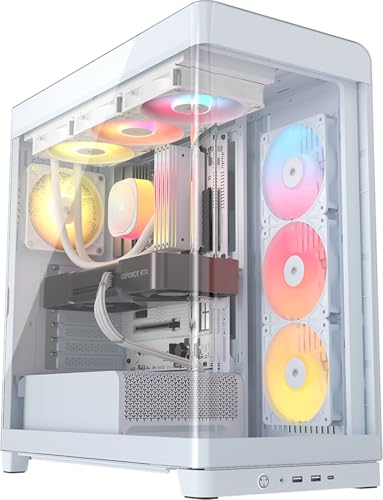
The CORSAIR Frame 4500X RS ARGB Mid-Tower PC Case is an excellent choice for gamers and PC builders who value both aesthetic appeal and efficient cooling. Its stunning single-piece curved glass panel showcases your components beautifully while the cascading industrial design promotes ideal airflow. Equipped with three pre-installed RS120R ARGB fans and support for up to ten fans, cooling is a top priority. You’ll enjoy ample GPU clearance, modular design for easy upgrades, and compatibility with various motherboard sizes. With a customer rating of 4.8 out of 5, this case is a reliable option for your next build.
Best For: Gamers and PC builders seeking a stylish case with excellent cooling capabilities and customizable options.
Pros:
- Stunning design: The single-piece curved glass panel provides an unobstructed view of your components.
- Superior cooling: Comes with three pre-installed ARGB fans and supports additional fans for optimal airflow.
- Modular and spacious: Compatible with various motherboard sizes and has ample GPU clearance for upgrades.
Cons:
- Limited storage options: Only accommodates two 2.5″ SSDs and one 3.5″ HDD.
- No front cooling options: The front panel does not support additional cooling fans, potentially limiting airflow from the front.
- Bottom-mount power supply: This design might complicate cable management for some users.
CORSAIR 3200D RS Mid-Tower PC Case with 3X RS120 PWM Fans
For DIY PC builders aiming for high-performance cooling, the CORSAIR 3200D RS Mid-Tower PC Case stands out with its impressive support for up to nine 120mm fans. It includes three RS120 ARGB fans, enhancing both airflow and aesthetics. With top-mounted 360mm radiator support, you can achieve efficient cooling for demanding setups. The case features a built-in GPU Anti-sag Stabilization Arm, ensuring your heavy GPUs remain secure. Plus, its black chassis design and customizable lighting effects make it visually appealing. With ample cable management options, you’ll enjoy a clean, organized build, perfect for gamers and content creators alike.
Best For: DIY PC builders and gamers seeking efficient cooling solutions and customizable aesthetics in their setups.
Pros:
- Supports up to 9x 120mm fans for enhanced airflow and cooling performance.
- Includes GPU Anti-sag Stabilization Arm to securely hold heavy graphics cards.
- Ample cable management options for a clean and organized build.
Cons:
- Limited to mid-tower size, which may restrict compatibility with larger components.
- ARBG fans require additional software for full lighting customization, potentially complicating setup.
- Top-mounted radiator may limit compatibility with certain CPU coolers due to height restrictions.
CORSAIR 4000D RS Frame Mid-Tower PC Case

Designed with gamers and content creators in mind, the CORSAIR 4000D RS Frame Mid-Tower PC Case stands out due to its modular customization features. You can easily upgrade components like the motherboard tray and front I/O panel, adapting it to your specific needs. The pre-installed 3x CORSAIR RS PWM Fans guarantee efficient cooling, while the innovative 3D Y-Pattern Airflow Panel promotes peak airflow. With flexible fan placement options and excellent cable management solutions, you’ll keep your system organized and cool. Overall, the 4000D RS is a fantastic choice for anyone looking to enhance their gaming or content creation setup.
Best For: Gamers and content creators seeking a customizable and efficient cooling solution for their PC builds.
Pros:
- Modular design allows for easy upgrades and personalized configurations.
- Optimized airflow with a 3D Y-Pattern Airflow Panel and perforated steel front for enhanced cooling.
- Flexible fan placement options and excellent cable management keep the system organized.
Cons:
- Limited space for larger components may restrict certain high-end hardware options.
- Some users may find assembly instructions less intuitive.
- Pre-installed fans may not meet the performance needs of extreme gamers without additional upgrades.
Cooler Master QUBE 540 ATX Mid-Tower PC Case
With its versatile orientation options, the Cooler Master QUBE 540 ATX Mid-Tower PC Case is perfect for builders who want flexibility in their setups. You can position it horizontally or vertically, tailoring your layout to your space. It supports GPUs up to 415 mm, accommodating powerhouse cards like the RTX 5090 and RX 9070 XT. Plus, it fits various motherboard sizes, from ITX to E-ATX. The full front mesh panel enhances airflow, and the included SickleFlow 120mm fan boosts cooling efficiency. With convenient I/O options, including USB 3.2 ports, connectivity is a breeze for your gaming or workstation needs.
Best For: Gamers and PC builders seeking a versatile and flexible mid-tower case that accommodates high-performance components.
Pros:
- Flexible orientation allows for both horizontal and vertical setups to fit any space.
- Ample GPU clearance supports powerful graphics cards, ensuring compatibility with the latest models.
- Exceptional cooling potential with a full mesh front panel and a pre-installed 120mm fan for enhanced airflow.
Cons:
- Limited front fan support may restrict additional cooling options for extremely high-performance builds.
- Size constraints for some users wanting to maximize internal components in an E-ATX configuration.
- Price point may be higher compared to basic cases without advanced features.
ASUS ProArt PA602 E-ATX PC Case

The ASUS ProArt PA602 E-ATX PC Case stands out as an ideal choice for creative professionals and gamers who demand high performance and versatility. With dimensions of 23.35D x 9.65W x 22.05H inches and a weight of 35.5 pounds, this full tower case supports extended ATX motherboards. It features dual 200mm front fans and a 140mm rear exhaust fan, ensuring excellent airflow. You’ll appreciate the tool-less PCIe mounting and integrated GPU holder for easy setup. Plus, its sleek design is complemented by a 20Gbps USB-C port, making it a stylish and functional addition to your workspace.
Best For: Creative professionals and gamers seeking a high-performance, versatile PC case with excellent airflow and user-friendly features.
Pros:
- Tool-less PCIe mounting allows for quick and easy installation of components.
- Integrated GPU holder provides additional support for heavy graphics cards.
- Excellent cooling capabilities with dual 200mm front fans and a 140mm rear exhaust fan.
Cons:
- Large size may not fit in smaller workspaces or setups.
- Weight of 35.5 pounds can make transportation more challenging.
- Limited USB 2.0 ports may not meet the needs of users with multiple peripherals.
Factors to Consider When Choosing GPU Server Cases for Airflow Optimization
When you’re selecting a GPU server case, you need to think about several key factors to optimize airflow. Consider the case size and dimensions, the efficiency of the cooling system, and the airflow design features. Don’t forget to evaluate fan configurations and cable management solutions, as these can greatly impact your server’s performance.
Case Size and Dimensions
Choosing the right case size and dimensions is essential for optimizing airflow in your GPU server setup. Larger cases generally provide more room for fans and ventilation paths, which enhances cooling efficiency. For instance, a mid-tower case, around 19.17″D x 9.41″W x 19.13″H, strikes a balance between size and usability while accommodating various cooling options. If you’re aiming for advanced cooling systems, consider a full-tower case, as it can support multiple radiators and larger fans. Don’t forget GPU clearance; many cases fit graphics cards up to 460mm, impacting airflow patterns based on internal layouts. Finally, modular cases offer customizable dimensions, allowing you to optimize fan placements and cooling configurations as needed to manage airflow effectively.
Cooling System Efficiency
Optimizing airflow doesn’t stop at selecting the right case size; it also hinges on the efficiency of your cooling system. An effective cooling setup supports multiple intake and exhaust fans, which can greatly boost airflow and keep internal temperatures low, especially during high-performance tasks. Look for cases featuring perforated panels and air ducts to promote better air circulation and minimize hotspots. If you’re using high-end GPUs or CPUs, opt for cases that accommodate larger radiators like 360mm or 420mm for superior cooling. Additionally, consider fan configurations with variable speed control, such as PWM fans, to balance cooling performance and noise. Modular fan placement lets you customize airflow paths, enhancing thermal management tailored to your specific hardware.
Airflow Design Features
To guarantee your GPU server case delivers maximum cooling, consider key airflow design features that directly impact performance. Look for cases with perforated front panels, which allow for high airflow and minimal obstruction, enhancing cooling efficiency. Multiple fan mounting options, supporting larger fans like 200mm or 140mm, provide flexibility to meet different cooling needs. A 3D Y-Pattern airflow panel design is essential, directing cool air toward components while efficiently expelling hot air. Advanced airflow technology, such as ducts, accelerates air movement through narrow channels, increasing cooling velocity without raising fan speeds, thereby reducing noise. Finally, cases supporting dual radiator configurations, like dual 360mm radiators, greatly improve thermal management for high-performance GPU setups.
Fan Configuration Options
Airflow design features set the foundation for efficient cooling, but the right fan configuration truly maximizes that potential. When selecting a GPU server case, consider the ideal fan setup. Look for cases that support various fan sizes, like 120mm or 140mm, and position them for enhanced air intake and exhaust. Advanced mounting systems allow you to customize fan placements, ensuring efficient airflow tailored to your needs. Additionally, some cases accommodate multiple radiators, such as dual 360mm or 420mm options, boosting cooling capabilities further. Don’t overlook specialized airflow designs, including perforated steel panels and airflow ducts, which help minimize obstruction and considerably improve cooling efficiency. Your hardware will thank you for prioritizing these configurations.
Cable Management Solutions
When you’re building a GPU server, effective cable management plays a crucial role in maintaining ideal airflow. Tangled cables can obstruct airflow paths, so look for cases with built-in cable tie-down locations and removable side panels. These features allow for cleaner cable routing and make upgrades easier. Additionally, cases that include dedicated cable management channels or shrouds help conceal cables, enhancing both aesthetics and airflow. A well-organized cable system reduces heat buildup, promoting better circulation around essential components. Finally, consider modular designs that let you customize cable routing based on your hardware configuration, ensuring optimal airflow and cooling efficiency. Investing in good cable management solutions pays off in the long run for your GPU server’s performance.
GPU Clearance Specifications
Choosing the right GPU clearance specifications is vital for guaranteeing that your server case not only accommodates your high-performance graphics cards but also maintains ideal airflow. You’ll want to verify the clearance is sufficient for full-sized GPUs, which can often exceed lengths of 400 mm. If the clearance is inadequate, it can restrict airflow around the graphics card, leading to higher temperatures and reduced performance. Look for cases designed for maximum airflow that feature additional spacing or GPU anti-sag support. It’s also important to take into account how cooling fans and radiators are laid out in relation to GPU clearance, as any obstructions can impede airflow and heat dissipation, ultimately affecting your system’s efficiency.
Material and Build Quality
The materials and build quality of your GPU server case play a significant role in enhancing airflow. Choosing steel or aluminum cases guarantees durability while allowing effective ventilation designs. A high-quality build enhances structural integrity, keeping the case shape intact under the weight of heavy GPUs. Look for cases with perforated or mesh panels; they reduce resistance and encourage peak cooling in high-performance setups. Additionally, a thoughtful internal layout aids in better cable management, minimizing clutter that could obstruct airflow paths. Remember, the thickness of case walls influences acoustic performance too; thinner materials may amplify noise from cooling fans, while thicker, well-constructed cases can dampen sound without compromising airflow. These factors are essential for maintaining efficient cooling.
