
If you’re serious about filmmaking, you know the importance of smooth, stable shots. Gimbal stabilizers can help you achieve that cinematic quality, whether you’re shooting on a professional camera or a smartphone. With so many options available, it can be tough to decide which one fits your needs. Let’s explore some of the top choices that can elevate your filmmaking game and help you capture stunning visuals.
DJI RS 3 Mini 3-Axis Gimbal Stabilizer for Cameras
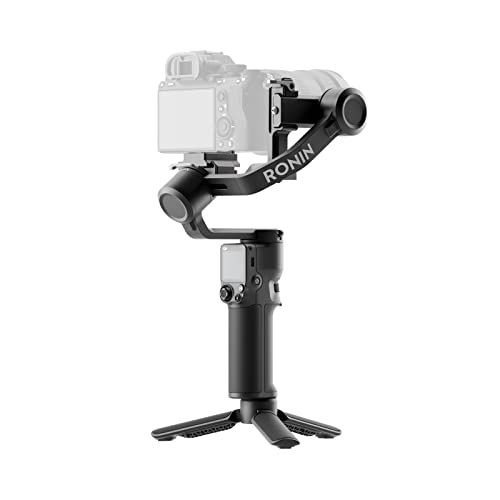
If you’re a travel photographer looking for a lightweight and portable solution, the DJI RS 3 Mini 3-Axis Gimbal Stabilizer is your best bet. Weighing just 795g in portrait mode, it easily fits into your gear without weighing you down. With a payload capacity of up to 2 kg, it supports various camera setups, enhancing your shooting experience. The 3rd-Gen RS Stabilization Algorithm guarantees professional-quality stabilization, even during low-angle shots. Plus, native vertical shooting allows quick adjustments for social media content. It’s an essential tool that combines versatility with ease of use, making your travel photography seamless and enjoyable.
Best For: Travel photographers seeking a lightweight and portable gimbal stabilizer for smooth video capture.
Pros:
- Lightweight and portable design makes it easy to carry during travel.
- Excellent stabilization with the 3rd-Gen RS Stabilization Algorithm ensures professional-quality shots.
- Versatile compatibility with various camera setups, accommodating different lenses and shooting styles.
Cons:
- Some users have reported motor issues after limited use, affecting performance.
- Concerns about software compatibility and Bluetooth features may hinder user experience.
- Limited payload capacity compared to other models, which may not support heavier camera setups.
DJI RS 4 Pro 3-Axis Gimbal Stabilizer for Cameras

The DJI RS 4 Pro 3-Axis Gimbal Stabilizer is an ideal choice for filmmakers and content creators who demand high-performance stabilization for their DSLR and cinema cameras. With a payload capacity of 4.5kg, it supports various setups, ensuring smooth footage even in dynamic environments. Its 2nd-Gen vertical shooting feature lets you switch orientations effortlessly, perfect for social media. Plus, the enhanced motor torque and LiDAR focusing offer precise control over your shots. Though it has a learning curve and might feel bulky, its exceptional stabilization and focus control make it a worthy investment for serious filmmakers.
Best For: Filmmakers and content creators seeking a high-performance gimbal stabilizer for DSLR and cinema cameras.
Pros:
- High payload capacity supports various camera setups.
- Smooth stabilization for high-movement scenarios.
- Enhanced focus control with Focus Pro Motor.
Cons:
- Bulkiness may hinder use in tight spaces.
- Learning curve for advanced features.
- Higher price point may be a consideration for budget-conscious users.
DJI Osmo Mobile 7P Gimbal Stabilizer for iPhone and Android

Designed for content creators and mobile filmmakers, the DJI Osmo Mobile 7P Gimbal Stabilizer offers advanced features like native tracking and 3-axis stabilization, ensuring your videos are smooth and professional. With a built-in extension rod and tripod, you can capture versatile shots effortlessly. The quick launch and one-tap edit features via the DJI Mimo app streamline your workflow, while dual-lens tracking enhances focus. Plus, enjoy a robust battery life of 10 hours, with the ability to charge your phone while filming. Rated 4.5 stars by users, it’s perfect for vlogging and travel, elevating your storytelling to new heights.
Best For: Content creators and mobile filmmakers seeking a professional-grade gimbal stabilizer for smooth video capture.
Pros:
- 3-axis stabilization ensures shake-free video for high-quality results.
- Built-in lighting and intelligent tracking enhance shooting capabilities in various environments.
- Quick launch and one-tap editing features streamline the filming and post-production process.
Cons:
- Users have reported battery drain issues with the DJI Mimo app.
- Some experienced occasional app freezing, affecting usability.
- Price may be considered premium compared to basic gimbals, limiting access for budget-conscious users.
DJI RS 4 Pro Combo Gimbal Stabilizer for Cameras
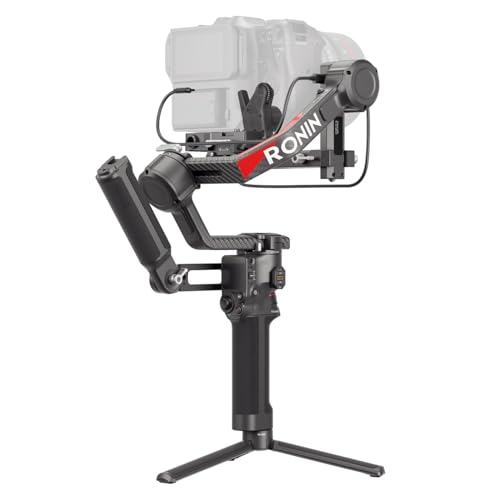
For filmmakers seeking unparalleled stability and versatility, the DJI RS 4 Pro Combo Gimbal Stabilizer stands out as an exceptional choice. This 3-axis gimbal supports up to 4.5kg, making it perfect for various DSLR and cinema cameras. You’ll appreciate the native vertical shooting feature and the remote dual focus control for precise adjustments. With a remarkable 29-hour battery life, this gimbal keeps you rolling longer. While there’s a learning curve, mastering it will elevate your cinematography, especially in dynamic shooting scenarios. Just be prepared for its bulkiness and higher price point, which may challenge budget-conscious users.
Best For: Filmmakers and content creators seeking a high-quality gimbal stabilizer for dynamic shooting and versatile camera support.
Pros:
- Excellent 3-axis stabilization for steady footage.
- Native vertical shooting allows for quick transitions between landscape and portrait modes.
- Impressive 29-hour battery life supports extended shooting sessions.
Cons:
- Bulkiness may hinder use in tight spaces.
- Learning curve for advanced features can be challenging for beginners.
- Higher price point may be a consideration for budget-conscious users.
DJI Osmo Mobile SE 3-Axis Phone Gimbal

Capturing smooth, professional-quality videos has never been easier, thanks to the DJI Osmo Mobile SE 3-Axis Phone Gimbal. Weighing just 12.4 ounces, this gimbal is lightweight and portable, perfect for on-the-go filmmaking. Its 3-axis stabilization guarantees steady footage, while ActiveTrack 6.0 keeps your subjects in focus effortlessly. Switch between landscape and portrait modes with ease, and utilize the built-in tripod for solo shoots. With a battery life of around 8 hours, you can film for extended periods. Just remember to check your phone’s compatibility and download the DJI Mimo app for full functionality. Elevate your content creation today!
Best For: Content creators, vloggers, and anyone looking to capture smooth videos on their smartphones.
Pros:
- 3-axis stabilization provides smooth footage, enhancing video quality significantly.
- ActiveTrack 6.0 technology allows for effortless tracking of subjects like kids or pets.
- Compact and foldable design makes it easy to transport, perfect for travel.
Cons:
- Requires the DJI Mimo app for full functionality, which may be a hassle for some users.
- Compatibility issues may arise with thicker phone cases, affecting stability.
- Learning curve for mastering tracking and features, which could be challenging for beginners.
FeiyuTech SCORP-C2 Gimbal Stabilizer for DSLR and Mirrorless Cameras

The FeiyuTech SCORP-C2 Gimbal Stabilizer stands out for content creators who require a robust payload capacity of 3.5 kg, making it ideal for both DSLR and mirrorless cameras. With built-in AI tracking and native vertical shooting, you can effortlessly capture dynamic shots. Its ergonomic grip guarantees comfort during long shoots, while the OLED display allows for quick adjustments. The intuitive controls make it user-friendly, even for beginners. Plus, the real-time balance check saves you setup time. Although some users noted build quality concerns, its performance and versatility make it a solid choice for aspiring filmmakers.
Best For: Content creators seeking a reliable gimbal with high payload capacity and user-friendly features for dynamic shooting.
Pros:
- Built-in AI tracking allows for effortless gesture recognition and tracking without an app.
- Ergonomic grip design provides comfort for longer shooting sessions.
- OLED display enables quick parameter adjustments and visualizes status effectively.
Cons:
- Some users reported cheaper build quality compared to earlier models.
- Absence of an integrated bipod may limit stabilization options.
- Joystick design issues could affect precise control for some users.
DJI Osmo Mobile 7 Gimbal Stabilizer for iPhone and Android

If you’re a mobile filmmaker seeking professional-quality footage, the DJI Osmo Mobile 7 Gimbal Stabilizer stands out with its exceptional 3-axis stabilization. Weighing just 300 grams, it’s lightweight and portable, making it perfect for on-the-go shooting. With up to 10 hours of battery life and a built-in tripod, you can film effortlessly. The ActiveTrack 7.0 guarantees your subjects stay in focus, while features like Timelapse and Gesture Controls enhance your creative options. Though it performs best with the DJI Mimo app, its robust design and impressive capabilities make it a top choice for both iPhone and Android users.
Best For: Mobile filmmakers and content creators looking for professional-quality stabilization and versatile filming features.
Pros:
- Excellent 3-axis stabilization for professional-quality footage.
- Lightweight and portable design for easy on-the-go shooting.
- Long battery life with the capability to charge smartphones.
Cons:
- Premium pricing compared to basic gimbals.
- Tracking range limited to 5 meters.
- Full functionality requires the DJI Mimo app, with better performance on iPhones than Android devices.
DJI RS 4 Mini Gimbal Stabilizer for Cameras

For creators seeking a lightweight and efficient solution, the DJI RS 4 Mini Gimbal Stabilizer stands out with its impressive 2kg payload capacity. It’s perfect for mirrorless cameras, vlog cams, and smartphones. You’ll love the quick setup with auto axis locks and the fast vertical switch, allowing you to shift from horizontal to vertical in just 10 seconds. The intelligent tracking module keeps your subjects framed, while the responsive follow mode reacts instantly to your movements. With the included starter kit, you’ll have everything you need to capture smooth, dynamic footage in even the most fast-paced environments.
Best For: Creators looking for a mobile-friendly gimbal that offers quick setup and smooth footage in dynamic environments.
Pros:
- Lightweight design with a 2kg payload capacity, making it versatile for various camera types.
- Quick setup with auto axis locks and a fast vertical switch for seamless shooting transitions.
- Intelligent tracking and responsive follow mode enhance the filming experience by keeping subjects in frame.
Cons:
- Compatibility issues may limit some users, as the DJI Ronin app is no longer available on Google Play.
- The payload capacity may not be sufficient for heavier camera setups or additional accessories.
- May require some learning curve for optimal use of intelligent features and settings.
3-Shoe Camera Stabilizer Expansion Cage Mount for Vlogging
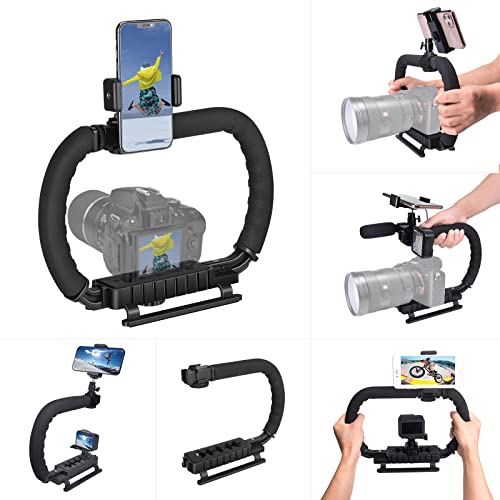
Vloggers seeking a reliable and versatile stabilizing solution will find the 3-Shoe DSLR/Mirrorless/Action Camera Camcorder Phone Stabilizer Expansion Cage Mount an excellent choice. Weighing just 15.8 ounces, this lightweight rig is compatible with a variety of cameras and smartphones. Its ergonomic design reduces strain during long shoots, while the detachable handle converts to a low-position stabilizer. With three shoe mounts, you can easily attach microphones or lights for professional-quality vlogs. Although it doesn’t function like a gimbal, it provides stability for handheld shooting. For the price, it’s a solid investment in your vlogging toolkit.
Best For: Vloggers, photography enthusiasts, and professional filmmakers looking for an affordable and versatile stabilizer for handheld shooting.
Pros:
- Lightweight and ergonomic design reduces strain during extended use.
- Compatible with a wide range of cameras and smartphones, enhancing versatility.
- Three shoe mounts allow for easy attachment of external devices like microphones and lights.
Cons:
- Does not function like a gimbal; requires a camera with good stabilization for optimal performance.
- Some users reported flex and warping under heavy loads, raising durability concerns.
- Lack of clear assembly instructions may lead to confusion during setup.
DJI RS 3 Pro Combo Gimbal Stabilizer for DSLR and Cinema Cameras

The DJI RS 3 Pro Combo Gimbal Stabilizer stands out as the ideal choice for filmmakers seeking professional-grade stabilization for their DSLR and cinema cameras. Weighing just 1.5 kg, it supports a max payload of 4.5 kg, making it compatible with models like Canon’s C70 and Sony’s FX6. Its automated axis locks and carbon fiber arms enhance setup efficiency, while SuperSmooth Mode delivers stability during fast movements. With O3 Pro Video Transmission, you’ll enjoy low-latency video up to 6 km. Users appreciate its compact design and ease of use, making it a top-rated tool for elevating your filmmaking experience.
Best For: Filmmakers and videographers seeking a lightweight and efficient stabilization solution for professional DSLR and cinema cameras.
Pros:
- Automated axis locks for quick setup and storage.
- SuperSmooth Mode provides enhanced stabilization for dynamic shooting scenarios.
- O3 Pro Video Transmission supports low-latency video transmission up to 6 km.
Cons:
- Some users report minor connectivity issues with certain accessories.
- Balancing heavier camera setups can be challenging.
- Additional accessories may be required for full functionality.
Factors to Consider When Choosing Gimbal Stabilizers for Cinema Cameras
When choosing a gimbal stabilizer for your cinema camera, you need to reflect on several key factors. Think about the payload capacity to guarantee it can handle your camera setup and the type of stabilization technology that suits your shooting style. Don’t forget to check for compatibility with your camera, as well as weight, portability, and battery life, which all play an essential role in your overall shooting experience.
Payload Capacity Considerations
Choosing the right gimbal stabilizer hinges on understanding its payload capacity, which directly impacts your filming experience. The payload capacity determines how much weight your camera and accessories can support. Most gimbals handle between 2 kg (4.4 lbs) for lighter setups to over 4.5 kg (10 lbs) for professional cinema gear. It’s crucial to take into account not only your camera body weight but also any additional accessories like lenses, microphones, and lights when calculating total payload. Exceeding the gimbal’s specified capacity can lead to reduced stabilization, added strain on motors, and potential damage. If you prefer dynamic filming with larger cameras, opt for a sturdier gimbal with a higher payload capacity to guarantee peak performance and stability during your shoots.
Stabilization Technology Types
While selecting a gimbal stabilizer, understanding the different types of stabilization technology is essential for achieving the best results in your filmmaking. Most gimbals utilize 3-axis stabilization to counteract pitch, yaw, and roll movements, ensuring smooth footage. If you’re filming fast-moving scenes, look for advanced features like SuperSmooth mode, which boosts motor torque for enhanced stability. Some models also offer proprietary algorithms, such as the 3rd-Gen RS stabilization algorithm, perfect for low-angle shots. Integrated AI tracking technology simplifies your workflow by enabling automatic subject tracking without an app. Real-time balance checks and intuitive controls let you quickly achieve ideal stabilization, minimizing setup time and enhancing your overall efficiency during shoots.
Compatibility With Cameras
Selecting the right gimbal stabilizer for your cinema camera involves several key factors, guaranteeing you get ideal performance and compatibility. First, confirm the gimbal supports your specific camera model, as many are designed for brands like Canon, Sony, and Panasonic. Next, check the payload capacity; some gimbals can handle up to 4.5 kg (10 lbs), which is essential for heavier setups. Look for models that allow native vertical shooting, making it easier to switch orientations for social media. Additionally, consider the motor torque, as higher torque guarantees better stabilization with larger cameras. Finally, verify compatibility with accessories like remote focus motors or video transmitters, enhancing your filming capabilities and creative options.
Weight and Portability
When it comes to gimbal stabilizers, weight and portability play essential roles in your filming experience. You’ll find options ranging from lightweight models around 795g (1.75 lbs) to heavier units exceeding 4 kg (8.8 lbs). This variance can greatly affect how easily you can transport your gear. Compact designs, typically around 6.3 x 7.09 x 11.81 inches, enhance maneuverability and fit snugly in your camera bag. If you’re traveling or shooting on location, lightweight and folding designs are ideal. Keep in mind the payload capacity: lighter gimbals support up to 2 kg (4.4 lbs), while heavier models can handle more than 4.5 kg (10 lbs). Balance weight with stability to choose the best gimbal for your camera setup.
Battery Life and Runtime
After considering weight and portability, it’s important to focus on battery life and runtime, as these factors can make or break your shooting experience. High-performance gimbals like the DJI RS 4 Pro can deliver up to 29 hours of runtime with an additional battery grip, perfect for extended shoots. In contrast, models like the DJI Osmo Mobile SE offer 8 to 10 hours, which might suffice for casual projects but can limit longer endeavors. Battery type also matters; some gimbals require specific batteries, while others allow for convenient rechargeable options. Keep in mind that heavier setups drain batteries faster, and look for gimbals that can power connected cameras, reducing the need for multiple power sources during filming.
