
Clean cable routing can make a gaming build look better, run cooler, and stay easier to upgrade. The right case saves time during assembly and reduces clutter around fans, radiators, and storage.
These picks focus on practical layouts, generous clearance, and features that help keep a gaming PC case for cable management neat from day one.
Best 10 Gaming PC Case for Cable Management Picks for 2026
Modular Airflow Choice

- Cable-cover panel supports cleaner routing.
- 3 pre-installed RS ARGB fans included.
- Modular FRAME system adds upgrade flexibility.
Best For: Builders who want tidy cable management plus flexible airflow tuning.
Compact Cable Routing Pick

- Up to 34 mm cable-routing space.
- Compact 44-liter footprint with ATX support.
- Pre-installed rear 120 mm PWM fan included.
Best For: Gamers who want a compact case with straightforward cable routing.
Roomiest Route-Management Build

- RapidRoute system simplifies cable routing.
- 30 mm behind-tray space helps hide wiring.
- Full-tower design supports large cooling setups.
Best For: Large ATX builds where easy cable management is the top priority.
Clean Showcase Build

- BTF hidden connectors hide modular cables.
- Dual glass panels create a polished showcase look.
- Supports 360 mm AIOs and large GPUs.
Best For: Builders who want hidden cables and a clean display-focused ATX case.
Back-Mounted Cable-Management Pick

- 26mm rear cable space helps keep wiring tidy.
- Back-mounted design and snap-on panel simplify access.
- Fits big components like RTX 4090 GPUs and 360mm top cooling.
Best For: M-ATX or ITX builders wanting a clean, rear-routed setup
Airflow and Routing Value Pick

- Wide channels, hooks, and straps support clean cable routing.
- Perforated PSU shroud and mesh panels help airflow.
- Includes two 120mm fans and radiator support up to 360mm front.
Best For: ATX builders who want simple cable management and strong airflow
Premium Dual-Chamber Showcase

- Dual-chamber design provides extensive rear cable space.
- Included PCIe 4.0 riser cable supports vertical GPU mounting.
- Tool-less panels and Velcro straps help keep builds organized.
Best For: Showcase builders wanting premium concealment and a vertical GPU look
Spacious airflow pick
Spacious airflow case with 6 PWM ARGB fans

- 6 pre-installed PWM ARGB fans
- Large ATX interior for cable management
- Side-opening tempered glass door for easier access
Best For: Builders who want roomy cable routing and easy access
Clean-build premium pick
Dual-chamber case with clean cable routing

- Dual-chamber layout keeps the interior uncrowded
- Wide channels and straps simplify cable routing
- Three pre-installed RGB fans included
Best For: Users who want a tidy, premium-looking build
Budget value pick
Budget airflow case with four RGB fans
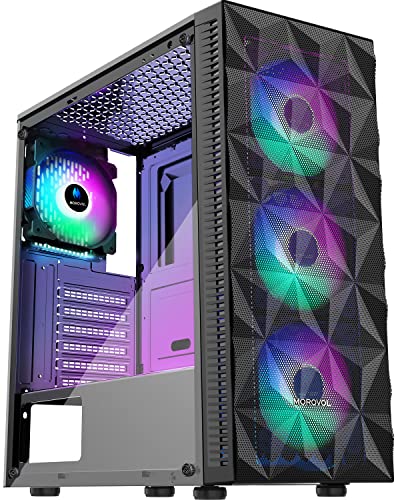
- 4 pre-installed RGB 120mm fans
- Removable tempered glass side panel
- Diamond mesh front panel for airflow
Best For: Budget builders who want easy assembly and airflow
Modular Airflow Choice – CORSAIR 4000D RS ARGB
If you want a gaming pc case for cable management that still leaves room to tune airflow, the CORSAIR 4000D RS ARGB is built around flexibility. Its FRAME modular system, hidden cable cover option, and roomy layout make it easier to keep builds tidy while still supporting high-airflow cooling and modern stealth motherboards.
Best For: Builders who want a customizable mid-tower with clean cable routing and strong airflow options.
Pros:
- Internal side panel can act as a cable cover for a cleaner look.
- 3x pre-installed RS ARGB fans provide ready-made airflow out of the box.
- InfiniRail mounting system adds flexible fan placement in the front and roof.
- Supports ASUS BTF, MSI Zero, and Gigabyte Stealth-style builds.
Cons:
- Best cable-management features depend on how you configure the modular interior.
- More advanced customization may be more than casual builders need.
The 4000D RS ARGB stands out if you want tidy wiring without giving up cooling flexibility. It blends a cable-cover approach with modular fan mounting, making it a strong all-around pick for clean, performance-focused builds.
Compact Cable Routing Pick – ASUS Prime AP303 Mesh Black
The ASUS Prime AP303 is a compact option for anyone shopping for a gaming pc case for cable management without going oversized. It offers up to 34 mm of cable routing space, a mesh design for airflow, and support for full-size ATX parts in a relatively small 44-liter footprint.
Best For: Builders who want a smaller case with practical cable routing and broad component support.
Pros:
- Up to 34 mm of cable routing space helps organize wiring behind the tray.
- Mesh panel design supports cooling-friendly airflow.
- Fits graphics cards up to 360 mm and radiators up to 360 mm.
- Includes a pre-installed rear 120 mm PWM fan.
Cons:
- Compact 44-liter size gives you less overall working room than a full tower.
- Cable-management space is solid, but not as generous as larger chassis.
For a smaller gaming build, the AP303 balances routing space, cooling support, and modern connectivity. It is a sensible pick if you want a tidy interior in a case that does not take over your desk.
Roomiest Route-Management Build – CORSAIR 7000D AIRFLOW
The CORSAIR 7000D AIRFLOW is a full-tower gaming pc case for cable management when you want maximum working space and a very simple routing path. Its RapidRoute system, hinged access door, and 30 mm of space behind the motherboard make it especially appealing for large builds with lots of cables.
Best For: Enthusiasts building a large ATX system who want the easiest possible cable routing.
Pros:
- RapidRoute cable management system uses a single hidden channel for major cables.
- 30 mm of space behind the motherboard gives wiring extra room.
- Full-tower interior supports up to 3 simultaneous 360 mm radiators.
- Includes 3x 140 mm AirGuide fans and a PWM fan repeater.
Cons:
- Very large chassis takes up substantial desk or floor space.
- Heavier than typical mid-tower options.
If you are building a high-end system and want cable management to feel easy instead of cramped, this case delivers. It is overkill for small setups, but ideal when space, airflow, and clean routing all matter.
Clean Showcase Build – ASUS A31 Black
The ASUS A31 is aimed at builders who want a gaming pc case for cable management and a polished showcase look. Its BTF hidden connector design, frameless dual-glass panels, and seamless cable management focus on keeping the interior visually clean while supporting mainstream high-end parts.
Best For: Builders who want a tidy, display-ready ATX case with hidden cables and modern aesthetics.
Pros:
- BTF hidden connector design helps conceal modular cables behind the motherboard.
- Dual tempered glass and frameless construction create a clean panoramic view.
- Supports 360 mm AIO cooling and large RTX 5090/4090-class builds.
- 8-degree angled base is designed to improve airflow and viewing angle.
Cons:
- Showcase styling may matter more here than raw utility for some users.
- Best cable-hiding results depend on using compatible hidden-connector hardware.
The A31 is a strong choice if your goal is a neat-looking build with cables kept out of sight. It pairs modern hidden-connector support with strong component compatibility, making it a practical showcase case.
Back-Mounted Cable-Management Pick – Redragon GC218M Gaming Case
If you want a gaming pc case for cable management that keeps the build looking clean without making assembly difficult, the Redragon GC218M is built around that idea. Its rear-mounted layout gives you 26mm of cable space, plus a snap-on panel for quick, tool-free access, so it suits builders who want an organized interior and easy maintenance.
Best For: M-ATX or ITX builders who want a tidy rear-mounted layout with strong airflow and panoramic styling.
Pros:
- 26mm of rear cable-management space helps reduce clutter.
- Back-mounted design and snap-on panel make access easier during builds and upgrades.
- Supports up to RTX 4090 GPUs, 170mm CPU coolers, and 360mm top liquid coolers.
- Includes 2 pre-installed 120mm fans and up to 9-fan capacity for airflow-focused setups.
Cons:
- It is limited to ITX and M-ATX motherboards, so full ATX builds are not supported.
- The rear-mount format may be less familiar if you prefer a traditional layout.
The GC218M stands out if your priority is keeping cables out of sight while still fitting high-end parts. It balances clean routing, strong cooling options, and a panoramic glass look in one compact mid-tower design.
Airflow and Routing Value Pick – NZXT H5 Flow Mid-Tower
The NZXT H5 Flow is a practical gaming pc case for cable management if you want a straightforward mid-tower that also focuses on cooling. Its wide channels, hooks, and straps make cable routing easier, while the perforated PSU shroud and mesh panels support airflow for everyday gaming builds.
Best For: Builders who want a compact ATX case with easy cable routing and strong airflow support.
Pros:
- Wide channels, hooks, and straps help route and conceal cables cleanly.
- Perforated PSU shroud improves GPU cooling by allowing better air intake.
- Supports 360mm front and 240mm top radiators for liquid-cooling setups.
- Includes two 120mm Quiet Airflow fans out of the box.
Cons:
- It only includes two fans, so some builds may need more cooling hardware.
- Its compact mid-tower size may feel tighter than larger dual-chamber cases.
For builders who care more about a clean, efficient layout than flashy extras, the H5 Flow is easy to recommend. It gives you organized routing, solid airflow features, and broad compatibility in a manageable ATX footprint.
Premium Dual-Chamber Showcase – HYTE Y70 Panoramic Case
The HYTE Y70 is a premium gaming pc case for cable management if you want a showcase build with a lot of room to hide wiring. Its dual-chamber interior, extensive rear-chamber cable space, and tool-less panels are designed for a cleaner build process, while the panoramic glass keeps the main chamber visually open.
Best For: Showcase builders who want premium cable concealment, vertical GPU mounting, and a luxury finish.
Pros:
- Dual-chamber layout gives extensive rear cable-management space.
- Included PCIe 4.0 riser cable supports a clean vertical GPU presentation.
- Tool-less panels and reusable Velcro straps make assembly and routing easier.
- Strong cooling support with room for multiple radiators and up to 10 fans.
Cons:
- Its large size and premium design may be more case than some builders need.
- The open showcase style may prioritize appearance over a simple compact footprint.
The Y70 is best viewed as a premium showcase chassis that still takes cable management seriously. If you want an organized build with dramatic glass presentation and room for advanced cooling, it offers a very polished platform.
Spacious airflow pick – Spacious airflow case with 6 PWM ARGB fans
If you’re looking for a gaming pc case for cable management that also leans hard into airflow and RGB, the MUSETEX NN8 is built to make assembly feel easier. Its large ATX mid-tower layout, side-opening glass door, and pre-installed fan setup give you room to route cables cleanly while keeping the build accessible for upgrades and dust cleaning.
Best For: Builders who want roomy cable routing, strong airflow, and a showpiece-style glass side panel.
Pros:
- 6 pre-installed PWM ARGB fans for cooling and customizable lighting.
- Large-space ATX layout with plenty of room for cable management.
- Side-opening tempered glass door makes access and cleaning easier.
- Supports multiple storage options, including up to 5 SSDs + 1 HDD or 4 SSDs + 2 HDDs.
Cons:
- Requires a motherboard with a 3-pin RGB interface for lighting control.
- Large feature set may be more than needed for very simple builds.
The NN8 is a practical pick if you want a case that combines cable-routing space with easy access and strong cooling hardware out of the box. It is especially appealing for builders who value both convenience and a clean-looking interior.
Clean-build premium pick – Dual-chamber case with clean cable routing
The NZXT H6 Flow RGB is a strong option if you want a gaming pc case for cable management with a clean, modern look. Its dual-chamber layout separates components for a less crowded interior, and the wide channels and straps are designed to simplify routing during the build.
Best For: Builders who want a tidy, premium-looking setup with straightforward cable routing.
Pros:
- Dual-chamber design helps create a clean, uncrowded interior.
- Wide cable channels and straps make cable management simpler.
- Three pre-installed 120mm RGB fans support cooling and visual impact.
- Wraparound panoramic glass highlights internal components.
Cons:
- Only three internal bays are listed, so storage layout is more limited than some larger cases.
- Best suited to builders who value organization and presentation over maximum drive capacity.
If cable neatness is a top priority, this case is one of the most straightforward picks here. It focuses on making the interior look clean while still giving you airflow-focused hardware and strong visual presentation.
Budget value pick – Budget airflow case with four RGB fans
The MOROVOL 621-N4 is a budget-friendly gaming pc case for cable management if you want a straightforward ATX mid-tower with room for standard parts. It does not advertise a dedicated cable-routing system, but its mid-tower sizing, removable tempered glass side panel, and practical internal support make it easy to work in during a simple build.
Best For: Budget builders who want decent airflow, easy component installation, and a simple ATX layout.
Pros:
- Pre-installed with 4 RGB 120mm fans for airflow and lighting.
- Removable tempered glass side panel makes installation easier.
- Supports ATX, Micro-ATX, and Mini-ITX motherboards.
- Diamond mesh front panel is designed for strong airflow performance.
Cons:
- No dedicated cable management features are highlighted in the notes.
- GPU, PSU, and CPU cooler size limits are more modest than larger cases.
This case makes sense if you want an affordable path to an attractive, airflow-focused build and can handle cable organization with basic routing skills. It is best viewed as a value option rather than a specialist cable-management chassis.
How We Picked the Best Gaming PC Case for Cable Management
For this roundup, we prioritized internal layout, motherboard-tray clearance, tie-down points, PSU shroud design, routing channels, and space behind the tray. We also considered airflow, radiator and GPU compatibility, and whether the case includes helpful features like pre-routed fan hubs or modular covers.
Because a Gaming PC Case for Cable Management is only useful if it also supports a modern build, we favored models that make it easier to work with thick GPU power leads, front-panel connectors, and multiple fan or RGB cables.
Quick Comparison
Compact mid-towers are best if you want a smaller footprint and relatively simple builds. Full-tower cases offer the most room for hidden routing and future expansion. Dual-chamber designs and back-connect motherboard support can be especially helpful when you want the cleanest possible interior.
If your priority is a balanced build, look for cases that combine good airflow with at least a few millimeters of behind-the-tray space, removable drive cages, and easy access to cable pass-throughs. If you plan custom cooling or multiple RGB devices, choose a chassis with more routing flexibility and a larger interior.
Key Buying Factors for a Gaming PC Case for Cable Management
Routing Space and Access
Check how much room exists behind the motherboard tray and whether the case has wide cutouts near the 24-pin, CPU power, and GPU cable paths. Rubber grommets, Velcro straps, and a PSU shroud can make final cleanup much easier.
Motherboard Compatibility and Connector Style
Back-connect and BTF-style support can dramatically simplify the visible side of the build. If you want the cleanest result, confirm that your board and case both support hidden connectors.
Airflow Vs. Aesthetics
Glass-heavy cases can still manage cables well, but they leave less room for mistakes in the visible chamber. Mesh-front or airflow-focused models are often the safest choice if you want lower temperatures and a less cramped routing path.
Component Clearance
Measure GPU length, CPU cooler height, radiator size, and PSU length before buying. Tight fits often create messy cable bends, especially with thicker braided power cables and front-panel bundles.
Who Should Buy Which Gaming PC Case for Cable Management?
If you want the easiest all-around build experience, choose a roomy airflow case with good pass-throughs and pre-installed fans. If you care most about a showpiece interior, a dual-chamber or panoramic-glass model can hide cables more effectively while keeping the main compartment visually clean.
Budget-focused builders should look for straightforward mid-towers with decent tray space and included fans. Enthusiasts planning future upgrades, multiple drives, or large radiators will usually be happier with a larger chassis that gives them more freedom to route and re-route cables over time.
