
A good dock turns your MacBook into a desktop workstation with one convenient connection. The catch: two HDMI ports do not always mean two independent external displays on macOS.
These nine options range from compact USB-C hubs to full-size Thunderbolt docks. Use this guide to narrow the field by your MacBook model, monitor requirements, charging needs, and everyday peripherals.
Best 9 Dual Monitor Docking Stations for Macbook Picks for 2026
Best Vertical Stand
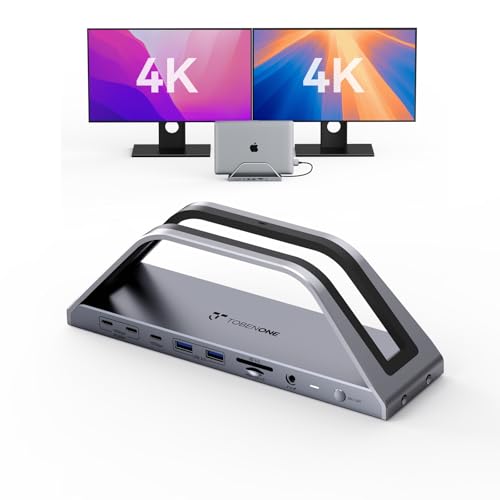
- Dual 4K/60Hz HDMI on supported Macs
- Included 150W adapter; up to 100W laptop charging
- 2.5Gbps Ethernet and SD/TF readers
Best For: An upright MacBook desk setup with extensive connectivity
Best Status Display

- Supports two external 4K displays
- Built-in 160W power supply
- 2.26-inch port-status screen
Best For: A powered upright dock for MacBook and Windows desks
Best Port Variety

- Two HDMI ports plus VGA
- Dual HDMI up to 4K/30Hz on supported Macs
- Up to 85W charging; adapter sold separately
Best For: MacBook desks with varied monitors and USB peripherals
Best Stand-and-Dock Combo

- Dual 4K@60Hz HDMI on compatible MacBooks
- Built-in laptop stand and Gigabit Ethernet
- No dual-display support for base M1–M3 MacBooks
Best For: Compatible MacBook setups needing dual displays and a raised laptop
Best Compact MacBook Adapter

- Two external monitors at up to 4K@30Hz each
- Ethernet, card readers, USB, and 100W PD
- Needs two suitable ports on one side
Best For: Portable MacBook setups that can use dual 4K@30Hz
Best for Mixed Mac and Windows Setups

- 13 ports, including HDMI, DisplayPort, and Ethernet
- Mac extends only one external monitor
- Up to 87W remains for laptop charging
Best For: Mixed-OS desks needing many ports, not dual extended Mac displays
Compact Travel Hub

- Dual HDMI mirrors on macOS
- Up to 85W pass-through charging
- Ethernet and SD/microSD readers
Best For: Portable MacBook setups where mirrored monitors are sufficient
Charging-Centric Desktop Dock

- 14 ports for a desk setup
- Up to 160W total charging output
- Dual HDMI mirrors on macOS
Best For: Multi-device charging and mirrored MacBook displays
Native Dual-Display Pick
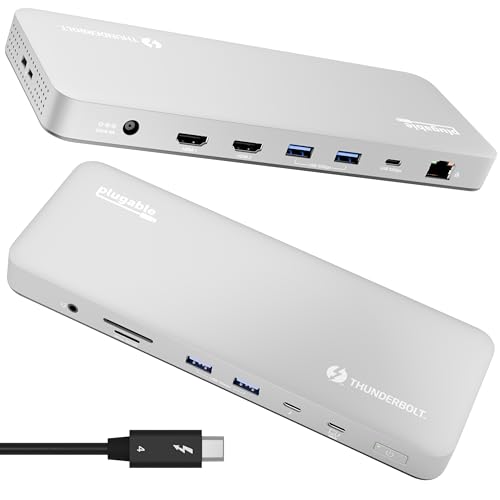
- Dual 4K 60Hz on supported Macs
- Driverless setup with 100W charging
- Base M1/M2 limited to one display
Best For: Compatible MacBooks needing two external displays
Best Vertical Stand – TobenONE 17-in-2 MacBook Dock
Among dual monitor docking stations for MacBook, this TobenONE model stands out for holding your laptop upright while connecting two HDMI displays at up to 4K/60Hz each on supported Macs. Its included 150W adapter also powers the dock, with up to 100W charging for the MacBook.
Best For: MacBook users who want a vertical stand, fast wired networking, and an included power supply.
Pros:
- Two HDMI outputs support dual 4K/60Hz displays on compatible MacBooks.
- Seven USB-A/C ports, 2.5Gbps Ethernet, and SD/TF card readers cover a busy desk.
- Included adapter provides up to 100W laptop charging; two front PD ports offer up to 30W charging.
Cons:
- Base M1/M2 MacBooks support only one extended external monitor.
- The roughly 0.8-inch stand slot may not fit a MacBook in a protective case.
Check your MacBook chip and case fit before buying. If both work with the dock, it combines a vertical stand and a well-equipped dual-display hub in one spot.
Best Status Display – MOKiN 13-in-1 Powered Dock
If you are comparing dual monitor docking stations for MacBook, the MOKiN offers a different desk layout: an upright aluminum dock with a 2.26-inch screen showing port connection status. It supports two external 4K displays and has a built-in 160W power supply.
Best For: MacBook and Windows users who want a powered, upright dock with visible connection status.
Pros:
- Supports dual external displays through its video outputs.
- Built-in 160W supply supports charging multiple devices, with up to 100W per USB-C port.
- Three USB 3.2 Gen 2 data ports offer up to 10Gbps transfers; the display and screen-lock button add desktop controls.
Cons:
- Its upright body needs a dedicated place on the desk.
- MacBook dual-display behavior depends on the laptop’s external-monitor support; verify your model before ordering.
This is the practical pick if an included power supply and at-a-glance port status matter more to you than a laptop stand. Check the video-output configuration and your MacBook’s display capabilities for your intended setup.
Best Port Variety – TobenONE 15-in-2 MacBook Dock
For shoppers weighing dual monitor docking stations for MacBook, this TobenONE is a port-heavy, plug-and-play option with two HDMI connections, VGA, USB ports, and Gigabit Ethernet. A single HDMI display can run at up to 4K/60Hz; two HDMI displays run at up to 4K/30Hz on supported MacBooks.
Best For: Compatible MacBook users who need a mix of display, USB, and wired-network connections without installing drivers.
Pros:
- Two HDMI ports plus VGA provide options for different monitor connections.
- Four USB 3.0 ports, two USB 2.0 ports, USB-C, audio, and Gigabit Ethernet handle common peripherals.
- Supports up to 85W MacBook charging when paired with your own suitable USB-C power adapter.
Cons:
- Dual HDMI output tops out at 4K/30Hz rather than 4K/60Hz.
- The power adapter is not included.
- Base M1, M2, and M3 MacBooks support only one extended external monitor with this dock.
Choose this dock for its connection mix, not for high-refresh dual 4K output. Confirm your MacBook chip supports two external displays and budget for an adapter if you want pass-through charging.
Best Stand-and-Dock Combo – PULWTOP MacBook Dual 4K Dock
Among dual monitor docking stations for MacBook, this PULWTOP model stands out by doubling as a laptop stand. Its two HDMI ports support up to 4K at 60Hz on each display with compatible MacBooks, while the stand raises your laptop and leaves room for airflow.
Best For: Owners of a compatible MacBook who want two external displays and a raised laptop in one setup.
Pros:
- Two HDMI outputs support dual 4K@60Hz displays on compatible MacBooks.
- Includes three 10Gbps USB ports, SD/TF readers, audio, and Gigabit Ethernet.
- Stand design combines laptop positioning and connectivity.
Cons:
- Base M1, M2, and M3 MacBooks are not supported for dual displays.
- 100W PD pass-through requires a separate power adapter.
Check your MacBook chip before buying: the listed dual-display support includes Intel models, M1–M5 Pro/Max models, and base M4/M5 models, but not base M1–M3 models. It is also not intended for Windows or Chrome devices.
Best Compact MacBook Adapter – MOKiN 9-in-2 Dual HDMI Dock
For shoppers comparing dual monitor docking stations for MacBook, the MOKiN is a compact adapter with two HDMI ports, USB connections, card readers, Ethernet, and charging pass-through. It supports two different external monitors at up to 4K@30Hz each; a single HDMI connection can reach 4K@60Hz.
Best For: MacBook owners who want a small, portable dual-HDMI adapter and can work within its dual-display resolution limit.
Pros:
- Two HDMI outputs support two different external monitors.
- Includes Gigabit Ethernet, SD/microSD readers, USB ports, and 100W power delivery.
- Slim aluminum housing weighs 103 g.
Cons:
- Using both HDMI ports limits output to 4K@30Hz per display.
- Requires a MacBook with two suitable USB-C/Thunderbolt ports on the same side.
This is a space-saving choice when portability matters more than dual 4K@60Hz. Confirm your MacBook’s port arrangement before ordering, since the adapter will not fit the stated one-port-on-a-side configuration.
Best for Mixed Mac and Windows Setups – LIONWEI 13-in-1 USB-C Dock
The LIONWEI offers a broad port selection for buyers browsing dual monitor docking stations for MacBook, but its display limitation matters: on macOS, it can extend only one external monitor, up to 4K@60Hz. Its multiple-display extension features are intended for Windows systems.
Best For: Users who share a dock between a MacBook and a Windows laptop and need extensive USB connectivity more than two extended Mac displays.
Pros:
- 13 ports include two HDMI connections, DisplayPort, Gigabit Ethernet, and audio.
- Offers 10Gbps-capable USB connections and 100W PD input.
- Supports Windows multi-display extension as described in the product notes.
Cons:
- macOS can extend only one external monitor through this dock.
- The dock uses 13W of its 100W PD input, leaving up to 87W for laptop charging.
Choose this primarily for its ports or a mixed-OS desk—not if your main goal is two independently extended monitors on a MacBook.
Compact Travel Hub – Anker 8-in-1 USB-C Hub
Among dual monitor docking stations for MacBook, this compact Anker hub is best understood as a port expander, not a way to create two independent Mac displays. Its two HDMI outputs show identical images on macOS.
Best For: MacBook users who want portable connectivity and can work with mirrored external monitors.
Pros:
- Two HDMI ports support 4K at 30Hz each; a single display supports 4K at 60Hz.
- Adds Ethernet, two USB-A ports, and SD and microSD card readers.
- Supports up to 85W USB-C pass-through charging.
Cons:
- External monitors show identical content on macOS, not separate extended desktops.
- Charging requires a separate 100W PD wall charger and USB-C cable.
Choose it for a light, versatile setup; if you need two distinct MacBook displays, the macOS mirroring limitation is decisive.
If charging several devices is your priority while comparing dual monitor docking stations for MacBook, the Anker Prime combines 14 ports with up to 160W total output. Be aware that its two external displays show identical content on macOS.
Best For: A stationary MacBook desk that needs multiple connections and device charging, but not two independent external desktops.
Pros:
- Offers 14-in-1 connectivity, including dual HDMI, audio, and Ethernet.
- Charges up to four devices simultaneously, with 160W total output.
- Provides data ports rated up to 10Gbps and includes an upstream USB-C cable.
Cons:
- Both external monitors show identical images on macOS.
- Dual-HDMI output is listed at up to 2K at 60Hz with a DP 1.4 laptop, or 1080p at 60Hz with DP 1.2.
This is a strong fit for consolidating cables and charging at a desk, but the macOS mirroring restriction makes it a poor choice for a two-screen extended workspace.
For shoppers seeking dual monitor docking stations for MacBook that can drive two external displays without drivers, this Plugable Thunderbolt 4 dock is the most Mac-display-focused option here. It supports dual 4K at 60Hz HDMI displays on the specified compatible Macs, subject to the MacBook chip and mode restrictions.
Best For: Users with an M4/M5 MacBook, a Pro/Max M-series Mac, or a base M3 Mac used in clamshell mode who want dual external displays.
Pros:
- Supports two 4K at 60Hz HDMI displays on compatible Macs without driver downloads.
- Provides 100W host charging and 13 ports, including Thunderbolt 4, Ethernet, and SD/microSD.
- Includes USB-A, USB-C, and 3.5mm audio connections.
Cons:
- Base M1 and M2 MacBooks support only one external display.
- Base M3 MacBooks require clamshell mode for dual displays.
Check your MacBook’s chip before buying. On a supported model, this is the clearest route of the three to a driverless dual-display workspace.
How We Picked the Best Dual Monitor Docking Stations for Macbook
We focused on the questions that determine whether a dock will work well in a real desk setup: how it drives two displays, which MacBook models it supports, how much power it delivers, and whether its ports suit common accessories. The selected products include compact hubs, MacBook-specific docking stations, and a Thunderbolt 4 dock. A product name or advertised port count alone cannot establish compatibility, so verify the current specifications for your exact Mac before buying.
Quick Comparison: Which Type Fits Your Desk?
Full-size desktop docks are the best starting point if you want a tidy, mostly permanent setup with charging and several USB accessories. The TobenONE 150W and MOKiN 160W models emphasize integrated power, while the Anker Prime offers a broad 14-in-1 port selection. Compact hubs and adapters, including the Anker 8-in-1 and the 13-in-1 USB-C hub, are worth considering when portability or a smaller footprint matters more. Thunderbolt users should look closely at the Plugable Thunderbolt 4 dock, but still confirm its dual-display requirements against their MacBook model.
Key Buying Factors for Dual Monitor Docking Stations for Macbook
Start with Your MacBook’s Display Limit
Check the exact chip and model year in About This Mac, then confirm Apple’s supported external-display configurations. Support varies across MacBook Air and Pro generations, and some models require the laptop lid to be closed for a particular two-display setup. If a dock promises more displays than your Mac natively supports, find out whether it uses DisplayLink software. DisplayLink can be useful, but it adds a driver and may not suit every protected-video or graphics-sensitive workflow.
Check How the Video Outputs Work
Two HDMI sockets are not proof of two separate extended desktops. Some USB-C docks rely on DisplayPort MST, which macOS generally does not use to extend across multiple displays from a single video stream. Check the manufacturer’s macOS-specific display diagram, required host connections, maximum resolution, and refresh rate. A dual-cable MacBook dock may need both of its USB-C plugs connected.
Match Charging and Ports to Your Routine
Look for the wattage actually delivered to the MacBook, not just the power rating in a dock’s name. Higher-power MacBook Pro models may charge slowly under heavy use from a lower-wattage connection. Then count the ports you will use simultaneously: USB-A or USB-C for peripherals, Ethernet for wired networking, and card slots or audio if needed. Check whether the power adapter is included and whether a compact hub needs a separate USB-C charger.
Who Should Buy Which Dual Monitor Docking Stations for Macbook?
Choose a powered desktop dock if your MacBook stays at one workstation and you want fewer cables to reconnect. Choose a compact hub if you frequently move between desks and can live with fewer ports or separate charging. Consider the Plugable Thunderbolt 4 option if Thunderbolt connectivity is a priority. If you have a base-model MacBook or an older Mac, resolve the dual-display question first; the right dock is the one whose documented setup supports your exact machine, not simply the one with the most video outputs.
