
Need more screens than your laptop supports on its own? A DisplayLink dock can add monitors through USB, making it a practical option for Mac and Windows workstations.
The right choice depends on more than monitor count. Check resolution, video connectors, laptop charging, and software requirements before you buy.
Best 10 Displaylink Docking Stations Picks for 2026
Best Triple-Display Charging Dock

- Three extended displays
- Up to 100W laptop charging
- Six 10Gbps USB ports
Best For: Three-screen productivity desks that need laptop charging
Best Dual-4K USB-A Dock

- Two displays up to 4K at 60Hz
- HDMI or DisplayPort options
- Connects to USB-A or USB-C laptops
Best For: Dual-4K workstations using mixed laptop ports
Best Classic Dual-HDMI Dock

- Two HDMI displays up to 1920x1200
- Hybrid USB-A/USB-C host cable
- Six USB ports and wired Ethernet
Best For: Dual-HDMI office setups that do not need 4K
Best Mixed-Fleet Office Dock

- Two HDMI displays up to 1920x1200
- USB-A and USB-C host cables included
- Supports Windows, macOS, and ChromeOS
Best For: Standardized dual-monitor desks across mixed laptop fleets
Triple-Monitor Pick

- Up to three external displays
- 100W laptop charging
- Six 10Gbps USB ports
Best For: Three-monitor USB-C workstations
USB-A Compatibility Pick

- USB-C or USB 3.0 host connection
- Two 4K 60Hz displays
- Six USB 3.0 ports
Best For: Mixed USB-A and USB-C office laptops
Secure Desk Pick
Belkin 14-in-1 Dual Display Dock

- Two 4K 60Hz displays
- Up to 100W laptop charging
- VESA mount and lock compatible
Best For: Mountable dual-monitor USB-C desks
Flexible Display Connections
WAVLINK 15-in-1 Triple-Monitor Dock

- Three HDMI and two DisplayPort connectors
- Up to 100W laptop Power Delivery
- DisplayLink driver required
Best For: Multi-monitor office desks needing varied display ports
Compact Travel Pick

- Compact, 3.6-ounce design
- Three 5Gbps USB ports and Gigabit Ethernet
- Does not charge a laptop
Best For: Portable HDMI and peripheral expansion
Business Desk Choice
Plugable 13-in-1 Triple-Monitor Dock
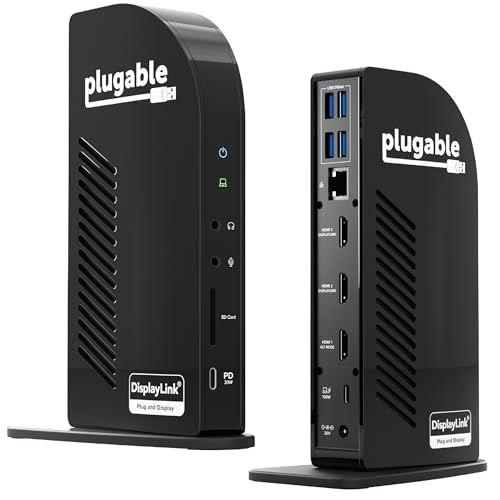
- Three extended HDMI displays
- 100W laptop and 20W accessory charging
- Mac multi-display use requires DisplayLink Manager
Best For: Standardized office and home-office desks
Best Triple-Display Charging Dock – WAVLINK WL-UG63PD25
Among displaylink docking stations, this WAVLINK model suits a desk that needs three extended monitors and laptop charging through one dock. It supports an Alt Mode HDMI display up to 4K at 60Hz, plus two HDMI or DisplayPort displays up to 2K at 60Hz.
Best For: Mac or Windows productivity setups that need three external screens and up to 100W laptop charging.
Pros:
- Supports three extended displays, including on compatible Apple Silicon Macs.
- Provides up to 100W laptop charging when the laptop supports USB-C charging.
- Includes six 10Gbps USB ports, Gigabit Ethernet, and a combination audio jack.
Cons:
- Requires DisplayLink driver installation; it is not plug-and-play.
- Not recommended for gaming and does not support HDCP-protected content.
- Not supported on Linux.
Pick this one when the third screen and charging matter more than driver-free setup. Check your laptop’s USB-C charging support before relying on the power-delivery feature.
Best Dual-4K USB-A Dock – WAVLINK WL-UG69DK1
If you need two sharp monitors but use a laptop with USB-A rather than USB-C, this is one of the more flexible displaylink docking stations in the roundup. It supports two displays up to 4K at 60Hz, with HDMI and DisplayPort connections available for either screen.
Best For: Dual-4K office setups shared between laptops with USB-A, USB-C, or Thunderbolt connections.
Pros:
- Supports two 4K-at-60Hz monitors through dual HDMI, dual DisplayPort, or mixed connections.
- Works with USB-A, USB-C, USB4, and Thunderbolt laptops on supported operating systems.
- Offers six USB 3.0 Type-A ports, Gigabit Ethernet, and a 3.5mm audio jack.
Cons:
- Does not charge the laptop.
- Requires DisplayLink driver installation for video output and does not support Linux.
- Not intended for gaming or DRM-protected streaming.
Its appeal is monitor resolution and host-port flexibility, not power delivery. Plan to keep your laptop’s charger connected.
Best Classic Dual-HDMI Dock – Plugable UD-3900
For a straightforward two-monitor desk, the Plugable UD-3900 covers the essentials without aiming for 4K. Among displaylink docking stations, its hybrid USB-A/USB-C host cable is useful when you switch between older and newer laptops.
Best For: Everyday office work on two HDMI monitors at up to 1920×1200 each.
Pros:
- Runs two HDMI displays up to 1920×1200 at 60Hz.
- Includes a hybrid USB-A/USB-C host cable, six USB ports, Gigabit Ethernet, and separate headphone and microphone jacks.
- Offers a two-year warranty and lifetime support.
Cons:
- Does not support 4K, DisplayPort monitors, or laptop charging.
- macOS 14 or later requires manual DisplayLink driver installation.
- Not suitable for gaming or HDCP-protected streaming content.
This is a practical choice if your monitors are HD rather than 4K. Check the display-resolution limits before buying for a higher-resolution setup.
Best Mixed-Fleet Office Dock – Plugable UD-3900Z
The Plugable UD-3900Z is geared toward repeatable, two-screen office setups. It stands out among displaylink docking stations for teams using a mix of USB-A and USB-C laptops across Windows, macOS, and ChromeOS.
Best For: Organizations setting up consistent dual-HDMI workstations for mixed laptop fleets.
Pros:
- Supports two HDMI displays up to 1920×1200, including expanded monitor support on M1–M3 and Neo Macs.
- Includes both USB-A and USB-C host cables, six USB ports, Gigabit Ethernet, and audio.
- Windows installs drivers via Windows Update; ChromeOS needs no additional setup.
Cons:
- Does not charge laptops or support DisplayPort monitors.
- macOS requires DisplayLink software installation.
- Does not support HDCP-protected content and is not recommended for gaming or full-screen video playback.
Choose this for standardized productivity desks rather than entertainment setups. Its included host cables make it easier to accommodate laptops with different USB connections.
Triple-Monitor Pick – WAVLINK 100W DisplayLink Dock
Among displaylink docking stations, this WAVLINK model stands out if you need three external screens: two outputs support up to 4K at 60Hz, while the third supports up to 2K at 60Hz. It also combines laptop charging and peripherals over one USB-C connection.
Best For: USB-C laptop users building a three-monitor home-office workstation.
Pros:
- Supports up to three external monitors for multitasking.
- Provides up to 100W laptop charging with its included 130W power adapter.
- Offers six individually rated 10Gbps USB ports and Gigabit Ethernet.
Cons:
- Mac users must install the DisplayLink driver; the USB-C host port must support video output.
- Does not support USB-A laptops and is not recommended for gaming or HDCP-protected 4K streaming.
Choose it for screen space and fast peripheral connections, but check your laptop’s USB-C capabilities before buying.
USB-A Compatibility Pick – Plugable Dual 4K Dock
This Plugable dock is a practical choice among displaylink docking stations when your workspace includes both USB-C and USB 3.0 laptops. It drives two external 4K monitors at 60Hz using HDMI or DisplayPort connections.
Best For: Dual-monitor office setups that need USB-A or USB-C host connectivity without laptop charging.
Pros:
- Supports two 4K 60Hz displays through HDMI or DisplayPort.
- Connects to either USB-C or USB 3.0 host ports.
- Adds six USB 3.0 ports, Gigabit Ethernet, and audio.
Cons:
- Does not charge the host laptop.
- Requires manual driver installation on Mac and does not support Linux.
- Not intended for gaming or HDCP-protected video playback.
Its host-port flexibility is the draw; plan on using your laptop’s separate charger at the desk.
Secure Desk Pick – Belkin 14-in-1 Dual Display Dock
For buyers comparing displaylink docking stations for a fixed workstation, this Belkin 14-in-1 dock pairs two 4K 60Hz displays with up to 100W laptop charging. VESA mounting and Kensington Lock compatibility offer useful placement and security options.
Best For: Dual-monitor USB-C desks that need charging, wired networking, and mountable hardware.
Pros:
- Supports two displays at up to 4K 60Hz via HDMI or DisplayPort.
- Delivers up to 100W USB-C power and offers 10Gbps data transfer.
- Includes Gigabit Ethernet, a USB-C-to-USB-A adapter, and three-year coverage.
Cons:
- macOS requires DisplayLink installation.
- Display support tops out at two external monitors.
It suits a tidy, permanent desk setup particularly well; confirm your preferred host connection and install the Mac driver if needed.
Flexible Display Connections – WAVLINK 15-in-1 Triple-Monitor Dock
Among displaylink docking stations, this WAVLINK dock suits a desk that needs multiple display connections, fast USB ports, and laptop charging in one place. It offers three HDMI and two DisplayPort connectors, though HDMI and DisplayPort on the same display channel cannot be used simultaneously.
Best For: Windows or Mac users building a multi-monitor workspace for spreadsheets, dashboards, and everyday office tasks.
Pros:
- Supports expanded multi-display setups, including up to dual 2K at 60Hz through the Display 1/2 HDMI or DisplayPort connections.
- Provides up to 100W laptop Power Delivery with the included 130W adapter.
- Includes two 10Gbps USB-C ports, three 5Gbps USB-A ports, Gigabit Ethernet, and SD/TF readers.
Cons:
- Requires a DisplayLink driver; it is not plug-and-play.
- HDMI Alt Mode requires a host USB-C port that supports video output.
Choose it for office-focused display flexibility rather than gaming or professional video editing. Check your laptop’s USB-C video and Power Delivery capabilities before buying.
For shoppers comparing displaylink docking stations with smaller expansion hubs, this Giq model offers two HDMI connections and everyday ports in a compact, 3.6-ounce body. Its supplied specifications describe display mirroring or extension, but do not clearly establish DisplayLink driver requirements, so confirm your intended multi-monitor setup before purchase.
Best For: Travelers who want a lightweight hub for HDMI displays, USB accessories, and wired networking.
Pros:
- Compact design is easy to pack for work or travel.
- Offers three USB 3.0 ports rated up to 5Gbps and Gigabit Ethernet.
- Includes SD and microSD card slots alongside its HDMI connections.
Cons:
- Its USB-C charging port does not charge a laptop.
- SD and microSD slots cannot be used simultaneously.
This is the portable option when desk space and packability matter more than laptop charging. Verify the display modes you need, since the supplied notes leave its exact dual-monitor behavior unclear.
Of these displaylink docking stations, the Plugable 13-in-1 is the clearest fit for a standardized office desk. It connects up to three extended HDMI displays and pairs 100W laptop charging with a broad selection of workplace ports.
Best For: Home offices or IT-managed desks needing triple HDMI displays, USB-C laptop charging, and wired connectivity.
Pros:
- Supports up to 4K at 30Hz on HDMI 1 and 1920×1200 at 60Hz on HDMI 2 and 3.
- Delivers up to 100W to a laptop and 20W from its front USB-C charging port.
- Includes four 5Gbps USB-A ports, Gigabit Ethernet, an SD reader, and audio connections.
- Offers TAA, NDAA, and Section 889 compliance plus lifetime support.
Cons:
- Mac users need DisplayLink Manager for multiple displays.
- Does not support protected-content playback such as Netflix or Hulu.
Its fixed HDMI layout and deployment-oriented features make it practical for business use. Check the per-port resolution limits if your setup calls for three high-resolution displays.
How We Picked These Displaylink Docking Stations
We chose 10 options spanning compact dual-monitor docks, triple-monitor setups, USB-A-compatible models, and USB-C docks with laptop charging. The comparison focuses on the specifications that affect daily use: display outputs, stated resolution support, host connection, power delivery, and peripheral ports. Treat advertised maximums as configuration-dependent, and confirm the current specifications for the exact model you purchase.
Quick Comparison: Which Type Fits Your Desk?
- Dual 1080p docks: A practical starting point for email, documents, and browser windows when 4K sharpness is not a priority.
- Dual 4K docks: Better suited to two high-resolution screens; check that the stated resolution and refresh rate apply to both monitors at once.
- Triple-monitor docks: Useful for larger workspaces, provided their supported display modes match your three monitors.
- USB-C docks with charging: Can simplify a desk setup, but only if the dock’s power delivery meets your laptop’s needs.
- USB-A or USB 3.0 docks: Worth considering for older laptops; they may not provide laptop charging through the dock cable.
Key Buying Factors for Displaylink Docking Stations
Monitor Support and Connections
Count the screens you want to connect and match their HDMI or DisplayPort inputs to the dock’s outputs. Check supported resolution and refresh rate for each display simultaneously, not just the highest number in the product name. An adapter may solve a connector mismatch, but it cannot increase the dock’s supported display bandwidth.
Laptop Compatibility and Software
DisplayLink requires a driver or app; a USB connection alone does not guarantee that extra monitors will work. Verify support for your specific macOS or Windows version, especially after an operating-system update. On a Mac, check the dock’s stated support for your chip and follow any screen-recording permission prompts needed for DisplayLink Manager. Also distinguish displays driven by DisplayLink from any video output that relies on your laptop’s native USB-C display capability.
Charging, Ports, and Desk Space
If you want one cable for power and peripherals, compare the dock’s stated USB-C power delivery with your laptop charger’s wattage. Review USB port count and speed, Ethernet, and audio connections against the devices you use every day. Check whether the dock needs its own power adapter and whether that adapter is included.
Workload Expectations
DisplayLink is well suited to productivity tasks such as spreadsheets, messaging, and research. Because it processes video over USB, a native video connection may be preferable for latency-sensitive gaming, color-critical work, or protected-video workflows. Check application compatibility if those uses matter to you.
Who Should Buy Which Displaylink Docking Stations?
Choose a dual 1080p model for an affordable office setup, or a dual 4K model if screen sharpness matters. Pick a triple-monitor dock only after verifying its three-display resolution limits. If your laptop has USB-C charging, prioritize adequate power delivery; if it has only USB-A, look for a compatible USB 3.0 option and plan to keep using your laptop charger. Before ordering any of these Displaylink Docking Stations, confirm the exact model’s driver support and return policy.
