
Compact Thunderbolt audio interfaces are a smart choice when you want pro-level latency, reliable performance, and a smaller footprint on your desk or in your mobile rig.
From solo singer-songwriters to growing project studios, the right model depends on your I/O needs, DSP requirements, and computer compatibility.
Best 10 Compact Thunderbolt Audio Interfaces Picks for 2026
Premium DSP Workhorse

- Unison preamps with analog-style emulations
- 200+ UAD DSP and Native plug-ins included
- Monitor Correction and Auto-Gain streamline workflow
Best For: Compact studio setups that want DSP tracking and advanced monitoring
Portable Heritage Pick

- Bus-powered for easy portability
- UAD SOLO Core Processing for near-zero-latency tracking
- Includes 5 premium heritage plug-ins
Best For: Solo creators and portable recording setups
Budget Native Thunderbolt Choice
Zoom TAC-2 Thunderbolt Audio Interface

- Fully native Thunderbolt design
- 2-in/2-out with 24-bit/192kHz conversion
- Includes LED meters and MixEfx software
Best For: Simple low-latency recording on a compact budget
Expanded Desktop Studio Pick

- Next-generation conversion with wide dynamic range
- Unison preamps and 200+ UAD plug-ins
- Monitor Correction and Auto-Gain improve workflow
Best For: Small studios needing a more flexible Thunderbolt desktop interface
Flagship networked rack interface
MOTU 16A 32x34 Thunderbolt 4/USB4 audio interface

- 32 in / 34 out with Thunderbolt 4 / USB4
- Front-panel metering and control room features
- 64-channel DSP mixing plus AVB networking
Best For: Large studios needing high channel count and expansion
DSP-powered recording rack
Antelope Discrete 8 Synergy Core USB audio interface

- Eight mic/line inputs and eight outputs
- 121 dB conversion with 64-bit clocking
- 36 real-time plugins and Auto-Tune Synergy
Best For: Small studios wanting onboard FX and strong clocking
Flexible studio hub
MOTU 848 28x32 Thunderbolt 4/USB4 audio interface
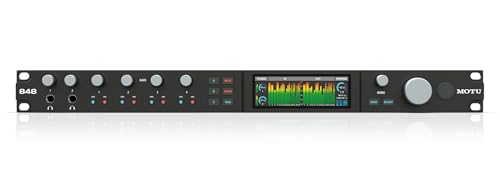
- 28 in / 32 out with Thunderbolt 4 / USB4
- 3.9-inch display and advanced mic controls
- 64-channel DSP mixing plus AVB networking
Best For: Growing studios that need flexible I/O and monitoring
DSP Expansion Pick
UAD 2 Satellite OCTO Core Thunderbolt 3 DSP Expansion

- 8 SHARC processors for heavier plug-in loads
- Thunderbolt 3 with daisy-chaining support
- Includes Analog Classics Plus bundle
Best For: Engineers who need more UAD plug-in power in a Thunderbolt setup
High-I/O Studio Choice
Antelope Orion 32+ Gen 4 32x32 Thunderbolt 3 Interface

- 32x32 analog I/O with 130dB dynamic range
- Thunderbolt 3 streams up to 128 channels
- Routing matrix plus MADI, ADAT, and S/PDIF
Best For: Large studios needing flexible routing and lots of channels
Modern All-Rounder
MOTU 10pre 26x28 Thunderbolt 4/USB4 Interface
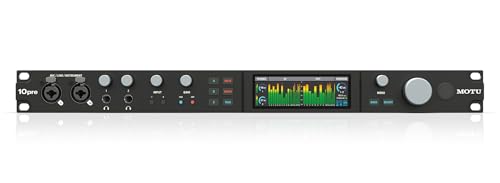
- 10 mic inputs and 26x28 channel count
- Thunderbolt 4 / USB4 with low-latency performance
- 64-channel DSP mixing and AVB networking
Best For: Project studios wanting a versatile Thunderbolt 4 interface with many mic inputs
Premium DSP Workhorse – Apollo Twin X DUO Gen 2
Universal Audio Apollo Twin X DUO Gen 2 with UAD Analog Classics Thunderbolt 3 Audio Interface
Check Price On AmazonIf you’re shopping for compact Thunderbolt audio interfaces, the Apollo Twin X DUO Gen 2 is built for creators who want high-end conversion, real-time tracking, and deep plugin integration in a small desktop footprint. Its Unison preamps, Apollo Monitor Correction, and Auto-Gain tools make it a strong fit for practical studio work where speed and monitoring accuracy matter.
Best For: Home studios and project rooms that want a compact Thunderbolt 3 interface with DSP-powered tracking and monitoring tools.
Pros:
- Unison preamps let you track through authentic emulations of Neve, API, Avalon, Manley, Fender, and more.
- Includes access to 200+ UAD DSP and Native plug-ins for tracking and mixing.
- Apollo Monitor Correction powered by Sonarworks helps with speaker or headphone mixing.
- Auto-Gain speeds up level setting across multiple inputs.
Cons:
- Requires Thunderbolt 3 connectivity.
- Designed around the UAD ecosystem, so its strengths are biggest if you plan to use those plug-ins.
Overall, this is one of the most feature-rich compact Thunderbolt audio interfaces here if you want premium onboard tools in a desktop-sized unit. It is especially compelling for users who value low-friction tracking and monitoring workflow.
Portable Heritage Pick – Apollo Solo Heritage Edition
The Apollo Solo Heritage Edition is a practical option if you want a small Thunderbolt interface with premium recording tools and easy portability. For users comparing compact Thunderbolt audio interfaces, it stands out for bus-powered operation, a strong headphone amp, and the included UAD plug-in bundle.
Best For: Solo recording, portable setups, and smaller rigs that need UA processing in a compact form.
Pros:
- Bus-powered connection helps keep cable clutter down and improves portability.
- UAD SOLO Core Processing supports near-zero-latency tracking through compressors, EQ, tape, preamps, and amp plug-ins.
- Includes a premium suite of 5 award-winning plug-in titles from Teletronix, Pultec, and UA.
- Best-in-class headphone amplifier is designed for loud, detailed, low-noise monitoring.
Cons:
- It is a smaller system with fewer channels than larger Apollo models.
- Luna Recording System is Mac only.
This model makes sense if you want UA sound and workflow in a travel-friendly interface. It is especially attractive when a simple, high-quality solo recording setup is the priority.
Budget Native Thunderbolt Choice – Zoom TAC-2 Thunderbolt Audio Interface
The Zoom TAC-2 is a straightforward pick for buyers who want compact Thunderbolt audio interfaces without extra complexity. Its 2-in/2-out design, 24-bit/192kHz conversion, and very low latency focus on the basics, which makes it a sensible fit for lean recording setups.
Best For: Small recording setups that need a simple Thunderbolt interface with low latency and high-resolution conversion.
Pros:
- Fully native Thunderbolt audio interface with extremely low latency.
- 2-in/2-out design keeps the workflow simple.
- Supports 24-bit/192kHz ADA conversion.
- LED gain meters and included MixEfx software add basic monitoring control.
Cons:
- Limited to a 2-in/2-out layout.
- Feature set is much more basic than the Apollo interfaces in this roundup.
If you mainly need a no-frills Thunderbolt interface for direct recording, the TAC-2 delivers the essentials cleanly. It is the most stripped-down option here, but that simplicity may be exactly what some users want.
Expanded Desktop Studio Pick – Apollo x4 Gen 2
Universal Audio Apollo x4 Gen 2 with UAD Analog Classics Thunderbolt 3 Audio Interface
Check Price On AmazonThe Apollo x4 Gen 2 is a strong option for users who want compact Thunderbolt audio interfaces with more room to grow than a smaller desktop model. It combines next-generation conversion, Unison preamps, Apollo Monitor Correction, and Auto-Gain in a format suited to larger home-studio workflows.
Best For: Small studios that want a Thunderbolt 3 interface with premium conversion and more flexibility than a two-channel desktop unit.
Pros:
- Next-generation audio conversion with the widest dynamic range and lowest distortion of any Apollo.
- Unison preamps support real-time emulations of Neve, API, Avalon, Manley, Fender, and more.
- Access to 200+ UAD DSP and Native plug-ins expands tracking and mixing options.
- Apollo Monitor Correction and Auto-Gain support smoother setup and monitoring.
Cons:
- Weighs 5.7 pounds, so it is less travel-friendly than smaller compact interfaces.
- Requires Thunderbolt 3 and a UAD-oriented workflow to get the most from its features.
For buyers who want a desktop interface with more headroom in their workflow, this model offers a very capable balance of size and performance. It is a better fit than a tiny solo interface when you need more expansion potential and the same Apollo feature set.
Flagship networked rack interface – MOTU 16A 32×34 Thunderbolt 4/USB4 audio interface
If you need a compact Thunderbolt audio interface with serious I/O and networking, the MOTU 16A is built for large sessions without giving up desktop-friendly convenience. It combines Thunderbolt 4/USB4 connectivity, 32 inputs and 34 outputs, and AVB networking in a 1U-style rack design with front-panel metering and control.
Best For: Producers and engineers who want a high-channel-count interface with low-latency performance, DSP mixing, and AVB expansion.
Pros:
- 32 x 34 Thunderbolt 4 / USB4 audio interface with broad Mac, Windows, and iOS support
- Two 3.9-inch TFT displays provide detailed metering and hardware status at a glance
- ESS Sabre32 conversion, up to 192 kHz sample rates, and reported 1.8 ms round-trip latency at 96 kHz
- 64-channel DSP mixing, effects, patchbay routing, and AVB networking for scalable setups
Cons:
- More interface than most small-project studios need
- Requires rack space rather than a portable desktop footprint
- Advanced routing and networking may be overkill for simple recording tasks
For users who want one interface that can anchor a serious studio, the 16A stands out for routing depth, conversion quality, and expansion options. It is a strong choice when your priority is flexibility first, size second.
DSP-powered recording rack – Antelope Discrete 8 Synergy Core USB audio interface
The Antelope Audio Discrete 8 Synergy Core is a compact Thunderbolt audio interface alternative for users who want rackmount flexibility, eight mic/line inputs, and built-in processing. Its USB connectivity, clocking focus, and real-time effects make it appealing for recording setups that value conversion quality and tracking tools.
Best For: Musicians and producers who want an 8-input rack interface with onboard FX, mic modeling support, and strong clocking.
Pros:
- Eight mic/line inputs and eight DC-coupled outputs for flexible studio routing
- 121 dB A/D and D/A conversion with 130 dB monitor converter dynamic range
- 64-bit Acoustically Focused Clocking for low-jitter performance
- 36 real-time plugins and Auto-Tune Synergy support for tracking and mix work
Cons:
- USB connectivity is listed in the details, so it is not as straightforwardly Thunderbolt-first as some alternatives
- Eight inputs may be limiting for larger multi-mic sessions
- Most advanced features depend on Antelope software and ecosystem tools
This model makes sense if your priority is sound quality plus built-in processing rather than sheer channel count. It offers a focused recording workflow in a rack format, with enough I/O for small to mid-size productions.
Flexible studio hub – MOTU 848 28×32 Thunderbolt 4/USB4 audio interface
For buyers comparing compact Thunderbolt audio interfaces, the MOTU 848 lands in the sweet spot between high-channel-count flexibility and a manageable rack footprint. It offers Thunderbolt 4/USB4 connectivity, strong metering, advanced mic control, and AVB networking for studios that expect to grow.
Best For: Studios that want a versatile rack interface with excellent conversion, multiple headphone outputs, and scalable networking.
Pros:
- 28 inputs and 32 outputs with Thunderbolt 4 / USB4 support across Mac, Windows, and iOS
- 3.9-inch TFT display with high-resolution metering and quick access to hardware settings
- Advanced mic channels with +74 dB gain, pad, phantom power, phase invert, and remote control
- 64-channel DSP mixing, AVB networking, and two front-panel headphone outputs
Cons:
- Still a rack interface, so it is not a grab-and-go portable unit
- Feature set is extensive enough that basic users may not use everything
- Best value comes from taking advantage of the DSP and networking tools
The 848 is a strong fit if you want one interface that can handle tracking, monitoring, and future expansion. It feels aimed at serious studios that need lots of connectivity but still want fast computer integration and clean front-panel control.
DSP Expansion Pick – UAD 2 Satellite OCTO Core Thunderbolt 3 DSP Expansion
Universal Audio UAD 2 Satellite OCTO Core Thunderbolt 3 DSP Interface MAC or PC
Check Price On AmazonFor compact Thunderbolt audio interfaces and hybrid studio rigs, the Universal Audio UAD 2 Satellite OCTO Core is a straightforward way to add serious DSP headroom over Thunderbolt 3. It doesn’t record audio by itself, but it can relieve your main interface and computer by running UAD plug-ins externally, which is useful when you want to keep mixes responsive while stacking processors.
Best For: Producers and engineers who already use UAD plug-ins and want more processing power over Thunderbolt.
Pros:
- Eight SHARC processors provide a large DSP boost for big sessions.
- Thunderbolt 3 connectivity is backwards compatible with Thunderbolt 1 and 2 devices.
- Works with Pro Tools, Logic Pro X, Cubase, Live, and more.
- Includes the Analog Classics Plus bundle with legacy-style compressors and EQs.
Cons:
- Not a standalone audio interface for recording inputs and outputs.
- Best value depends on whether you already use UAD-powered plug-ins.
This is a practical add-on for users who need more plug-in processing without changing their main interface. Dual Thunderbolt 3 ports also make it easy to daisy-chain other peripherals in a compact setup.
High-I/O Studio Choice – Antelope Orion 32+ Gen 4 32×32 Thunderbolt 3 Interface
If you’re shopping for compact Thunderbolt audio interfaces with serious routing capacity, the Antelope Orion 32+ Gen 4 is aimed at large studio workflows rather than small solo recording. It delivers 32×32 analog I/O, Thunderbolt 3 streaming, and extensive digital expansion, making it a strong fit for complex tracking, mixing, and monitoring setups.
Best For: Studios that need lots of I/O, flexible routing, and Thunderbolt-based low-latency performance.
Pros:
- 32×32 analog I/O with 130dB dynamic range.
- Thunderbolt 3 supports up to 128 channels at 192kHz.
- Built-in routing matrix and monitoring calibration for custom workflows.
- MADI optical, ADAT, and S/PDIF expand integration options.
Cons:
- Large channel count may be more than a simple home setup needs.
- Uses USB for one mode and Thunderbolt 3 for full high-channel streaming.
This is a feature-rich interface for studios that want both scale and precision. Its clocking, routing, and expansion options make it better suited to advanced production environments than minimalist desktop use.
Modern All-Rounder – MOTU 10pre 26×28 Thunderbolt 4/USB4 Interface
MOTU 10pre 26x28 Thunderbolt 4/USB4 audio interface for Mac, Windows and iOS with 10 mic inputs
Check Price On AmazonFor buyers comparing compact Thunderbolt audio interfaces, the MOTU 10pre stands out as a modern all-rounder with Thunderbolt 4/USB4 connectivity, 10 mic inputs, and a clear front-panel display. It’s built for users who want a flexible interface that can handle recording, monitoring, and basic mixing without sacrificing low-latency performance.
Best For: Recording musicians and project studios that want a modern Thunderbolt 4 interface with lots of mic inputs.
Pros:
- 26×28 Thunderbolt 4 / USB4 interface with wide device compatibility.
- 10 mic/line/instrument inputs plus two headphone outputs.
- ESS Sabre32 conversion and up to 192kHz support.
- 64-channel DSP mixing with EQ, compression, gate, and reverb.
Cons:
- More elaborate than a basic two-channel desktop interface.
- Some expansion and iPad connection options require extra accessories.
Overall, this is a strong choice if you want a modern interface that balances input count, monitoring tools, and fast connectivity. The second Thunderbolt port and AVB networking also give it room to grow with a larger setup.
How We Picked These Compact Thunderbolt Audio Interfaces
We focused on Compact Thunderbolt Audio Interfaces that balance size, channel count, preamp quality, monitoring flexibility, and driver stability. Priority also went to models that suit real-world recording needs, not just spec-sheet appeal.
Because buyers use these interfaces in different ways, we looked for options that cover solo tracking, small band sessions, hybrid DSP workflows, and expandable studio setups.
Quick Comparison
In this group, a few models are clearly aimed at simple desktop recording, while others are better for higher channel counts or advanced studio routing. Apollo units tend to appeal to users who want integrated UAD processing. MOTU options lean toward flexible I/O and modern Thunderbolt 4/USB4 connectivity. Antelope models are attractive for built-in effects and broader mixing features.
Key Buying Factors for Compact Thunderbolt Audio Interfaces
I/O Count and Mic Preamps
Start by matching the interface to your actual recording workflow. A solo vocal chain may only need two inputs, while drum tracking, live band recording, or hardware integration calls for more analog inputs and outputs. If you record multiple microphones often, prioritize preamp count before extras.
Latency, DSP, and Monitoring
One major reason people choose Compact Thunderbolt Audio Interfaces is low-latency performance. If you monitor through plug-ins or want near-zero-latency cue mixes, look for onboard DSP, mixer software, or strong direct-monitoring tools. That matters most for vocalists, guitarists, and producers who track while performing.
Computer and Connectivity Compatibility
Check whether the interface supports Thunderbolt 3, Thunderbolt 4, USB4, or multiple connection modes. That is especially important if you move between Mac and Windows systems, or expect to upgrade computers later. For some buyers, a flexible connection standard is worth more than extra onboard features.
Workflow, Expansion, and Software Ecosystem
Think about how the interface fits your broader studio setup. Some users need simple plug-and-play operation, while others want digital mixing, effects, or networked expansion. If you plan to grow your studio, choose a model that leaves room for future routing and more inputs.
Who Should Buy Which Compact Thunderbolt Audio Interfaces?
If you want a compact desktop interface for vocals, guitars, and overdubs, a smaller Apollo or Solo-style model is often the most practical fit. If you need more inputs for bands, drum miking, or multi-instrument sessions, step up to a higher-channel-count MOTU or Apollo unit. If your priority is built-in processing and flexible software tools, Antelope and UAD-based options may be the better match.
For most buyers, the best choice is the one that matches today’s recording needs without forcing you into a bigger rack setup than you actually want. That balance is what makes Compact Thunderbolt Audio Interfaces so useful in modern home and project studios.
