
The best compact single-board computer kits make it easier to build, learn, and deploy without sourcing every component separately. This roundup compares Raspberry Pi systems, Jetson AI platforms, x86 boards, Arduino kits, and compact development computers.
Whether you need a beginner-friendly starter bundle, a Linux mini PC, an edge-AI platform, or a portable coding system, the right kit depends on processing power, included accessories, operating-system support, and expansion options.
Best 10 Compact Single-Board Computer Kits Picks for 2026
Top-Tier Pi Kit
Raspberry Pi 5 Starter Kit PRO
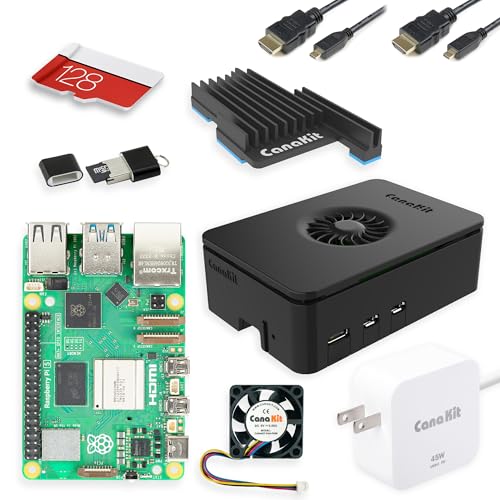
- 8GB Raspberry Pi 5 board
- 128GB preloaded Raspberry Pi OS card
- Case, cooling, power supply, and cables included
Best For: Ready-to-use Raspberry Pi projects and desktop setups
Embedded AI Pick
reComputer J4012B Edge AI Computer

- Jetson Orin NX 16GB platform
- Up to 100 TOPS for edge AI
- Extensive I/O and Linux BSP included
Best For: Embedded AI development and connected production devices
Value Pi Starter
Raspberry Pi 4 4GB Starter PRO Kit

- 4GB Raspberry Pi 4 Model B
- 32GB preloaded microSD card
- Case, cooling, power, cable, and PiSwitch included
Best For: Beginner projects and lightweight Raspberry Pi applications
Windows SBC Option

- Celeron N5095 x86 processor
- Windows and Linux support
- Dual 4K output, M.2, GPIO, and PoE support
Best For: Compact Windows/Linux systems and x86 development
Best for Guided Arduino Learning

- Integrated Nano R4 board, modules, and humidity sensor
- More than 20 guided programming and electronics tutorials
- Portable case with Crowtail expansion ports
Best For: Beginners, STEM classrooms, and Arduino DIY projects
Best All-in-One Compact PC
Pi 500 Portable Keyboard Computer

- Computer hardware is integrated into a portable keyboard
- 8GB RAM, quad-core Arm processor, and dual 4K display support
- Kit includes microSD card, mouse, power supply, HDMI cable, and adapters
Best For: Compact Linux desktops, portable computing, and home projects
Best for x86 Edge Projects

- Intel N100 x86 processor with Windows and Linux support
- Dual 4K display output, dual Gigabit Ethernet, and Wi-Fi 6
- Industrial I/O, NFC, and optional M.2 storage expansion
Best For: IoT edge computing, industrial control, and embedded development
AI Powerhouse

- Up to 34–67 TOPS AI performance
- NVIDIA Ampere GPU with Tensor Cores
- Ubuntu, CUDA, TensorRT, and ROS2-ready ecosystem
Best For: Edge AI, robotics, and computer-vision development
Quiet Office Essential

- Passive cooling for quiet operation
- Triple-display support with 4K output
- Wi-Fi 6E, 2.5G LAN, and VESA mounting
Best For: Small-office, retail, classroom, and embedded deployments
Beginner Maker Pick

- Pre-installed Debian and Python environment
- Built-in touchscreen and multiple sensors
- Wi-Fi, Bluetooth, and broad hardware expansion
Best For: STEM learning, Python beginners, and IoT prototypes
Top-Tier Pi Kit – Raspberry Pi 5 Starter Kit PRO
CanaKit Raspberry Pi 5 Starter Kit PRO - Turbine Black (128GB Edition) (8GB RAM)
Check Price On AmazonFor shoppers comparing compact single-board computer kits, this Raspberry Pi 5 bundle is a well-equipped starting point. It pairs the 8GB board with 128GB preloaded storage, active cooling, power delivery, a case, and display cables, reducing the need to source core accessories separately.
Best For: Raspberry Pi desktop projects, media setups, and demanding general-purpose Linux applications.
Pros:
- Includes the 8GB Raspberry Pi 5 with a 2.4GHz 64-bit quad-core CPU.
- Comes with a 128GB microSD card preloaded with 64-bit Raspberry Pi OS.
- Includes a case, low-noise fan system, heat sink, 45W PD power supply, and two display cables.
Cons:
- The bundle is less compact to transport than a bare board because it includes numerous accessories.
- Its storage is microSD-based rather than an included SSD.
This is a strong all-in-one Raspberry Pi 5 package for buyers who want higher memory capacity and a ready-to-use setup. The included cooling and 45W power supply are especially useful for sustained workloads.
Embedded AI Pick – reComputer J4012B Edge AI Computer
Among compact single-board computer kits, the reComputer J4012B is aimed at embedded AI rather than basic desktop use. Its NVIDIA Jetson Orin NX 16GB platform offers up to 100 TOPS and combines development-friendly I/O with a pre-installed JetPack and Linux BSP.
Best For: Edge AI development, embedded vision, and production-oriented connected devices.
Pros:
- Compatible with the Jetson Orin NX module and rated for up to 100 TOPS.
- Provides USB 3.2, HDMI, Ethernet, M.2, mini-PCIe, and 40-pin GPIO connectivity.
- Includes pre-installed JetPack 5.1.3 and a Linux OS BSP ready for development.
Cons:
- The listing does not specify included storage or a broad accessory bundle.
- Its specialized AI focus may be more than needed for simple home computing.
This system makes the most sense when accelerated AI and expansion options matter more than a turnkey consumer desktop. Its I/O selection also gives developers room to connect storage, wireless modules, and peripherals.
Value Pi Starter – Raspberry Pi 4 4GB Starter PRO Kit
This Raspberry Pi 4 bundle gives buyers a practical entry point into compact single-board computer kits. It includes the 4GB Model B, preloaded 32GB storage, case, cooling, power, display cable, and a physical power switch for a more complete out-of-box setup.
Best For: Learning Linux, GPIO projects, lightweight home servers, and general Raspberry Pi experimentation.
Pros:
- Includes a Raspberry Pi 4 Model B with 4GB RAM and a 1.5GHz 64-bit quad-core CPU.
- Comes with a 32GB Samsung EVO+ microSD card and USB card reader.
- Includes a case, fan, heat sinks, USB-C power supply, micro-HDMI cable, and PiSwitch.
Cons:
- It has less RAM and processing speed than the Raspberry Pi 5 option.
- The included storage is smaller at 32GB.
For beginners and budget-conscious makers, this kit covers the essentials without requiring a separate accessory hunt. It is a sensible choice for lighter projects where Raspberry Pi 4 performance is sufficient.
Windows SBC Option – youyeetoo X1s X86 Mini PC
For buyers seeking compact single-board computer kits with conventional PC compatibility, the youyeetoo X1s uses an x86 Celeron N5095 platform. This 8GB/128GB variant supports Windows and Linux, offers multiple video outputs, and provides expansion through M.2, GPIO, and wireless interfaces.
Best For: Small Windows or Linux systems, 4K media use, business deployments, and x86 development.
Pros:
- Celeron N5095 processor reaches up to 2.9GHz and supports Windows 10/11 and Linux distributions.
- Supports dual 4K and three-way video output through HDMI, micro-HDMI, and MIPI.
- Offers M.2 storage expansion, Gigabit Ethernet, optional wireless connectivity, and PoE support.
Cons:
- The listing identifies the product as being in pre-sale status.
- Wi-Fi and Bluetooth features are described as optional or variant-dependent.
- The included package is relatively basic, with a power supply and heat sink listed alongside the board.
This is the most PC-like option in the group, particularly appealing when Windows support, 4K output, and x86 software compatibility are priorities. Confirm the selected memory, storage, and wireless configuration before ordering.
Best for Guided Arduino Learning – Nano R4 Starter Kit
For beginners comparing compact single-board computer kits, the ELECROW Nano R4 starter kit emphasizes hands-on learning without extensive wiring. Its integrated modules, humidity sensor, guided tutorials, and Crowtail expansion ports make it a practical platform for exploring Arduino programming and basic electronics.
Best For: Students, educators, makers, and beginners building STEM, robotics, and DIY electronics projects.
Pros:
- Combines an Arduino Nano R4 board, 16 commonly used modules, and a humidity sensor on one board.
- Includes more than 20 tutorials progressing from basic to advanced topics.
- Two Crowtail ports support additional compatible sensors and modules.
- Includes a compact carrying case for organized storage and portability.
Cons:
- It is focused on Arduino-based electronics learning rather than general-purpose desktop computing.
- Its expansion options are centered on Crowtail-compatible hardware.
This is a strong choice when structured lessons and reduced wiring complexity matter more than operating-system flexibility or desktop performance. The one-year manufacturer warranty is an additional convenience for new learners.
Best All-in-One Compact PC – Pi 500 Portable Keyboard Computer
Among compact single-board computer kits, the Pi 500 stands out by building the computer into a full-size keyboard. With an 8GB quad-core Arm platform, 32GB microSD card, wireless connectivity, and included setup accessories, it is designed to become a compact computer when paired with a monitor and mouse.
Best For: Users wanting a portable Linux mini PC, compact home computer, or Raspberry Pi-style desktop setup with minimal assembly.
Pros:
- Keyboard-integrated design keeps the main computer compact and portable.
- Uses a 2.4GHz quad-core 64-bit Arm Cortex-A76 processor with 8GB LPDDR4X memory.
- Supports dual 4K displays through two micro-HDMI outputs.
- Six-item kit includes a 32GB microSD card, mouse, power supply, HDMI cable, card reader, and GPIO adapter board.
Cons:
- A monitor is still required, and the included setup is completed with a separately paired mouse.
- Storage is limited to the supplied 32GB microSD card unless expanded separately.
- The operating system details are specified as Linux rather than a broad multi-OS bundle.
The Pi 500 is a practical pick for a tidy, ready-to-use desktop-style setup. Its built-in heatsink, Wi-Fi, Bluetooth, Ethernet, and dual-display support give it broader everyday-computing appeal than a bare development board.
Best for x86 Edge Projects – K1 N100 Single-Board Computer
For buyers seeking compact single-board computer kits with x86 compatibility, the youyeetoo K1 pairs an Intel N100 processor with Windows or Linux support and extensive expansion options. Its small core board, dual networking, multiple displays, storage flexibility, and industrial interfaces suit more demanding embedded and edge-computing builds.
Best For: AI and IoT edge projects, industrial control, embedded development, multi-display setups, and x86 software environments.
Pros:
- Intel N100 processor offers four cores, four threads, and turbo speeds up to 3.4GHz.
- Supports Windows 10/11 and Linux, with configurable LPDDR5 memory and eMMC storage.
- Provides two HDMI 2.0 ports for independent 4K 60Hz displays, plus MIPI/eDP display support.
- Includes dual Gigabit Ethernet, Wi-Fi 6, Bluetooth 5.2, USB ports, NFC, and numerous industrial interfaces.
Cons:
- The listed SBC kit configuration has 8GB RAM and 128GB eMMC, while other capacities are optional configurations.
- Some capabilities, including additional M.2 storage and expanded ports, may require separate hardware or a baseboard.
- Its broad industrial feature set may be more complex than needed for basic beginner projects.
The K1 is the most capable option here for users who need x86 software compatibility and substantial connectivity in a small platform. Its independent core-board operation provides flexibility, while an optional baseboard can add further storage, networking, and I/O capabilities.
AI Powerhouse – Jetson Orin Nano AI Kit
For buyers seeking compact single-board computer kits for edge AI, robotics, and computer-vision work, this Yahboom Jetson Orin Nano kit emphasizes accelerated performance and expansion potential. It combines an NVIDIA Ampere GPU, LPDDR5 memory, an M.2 Key M slot for external NVMe storage, and a carrier board designed to support the module’s higher-power mode.
Best For: Developers building AI, ROS2, vision, voice-interaction, and embodied-robotics projects.
Pros:
- Up to 34–67 TOPS of AI performance with a 1024-core NVIDIA Ampere GPU and 32 Tensor Cores.
- Supports Ubuntu 22.04 with CUDA 12.6, TensorRT 10.7.0, cuDNN 9.6.0, and OpenCV 4.10.0.
- Includes an upgraded carrier board with 25W power-mode support and an added power switch.
- Camera and AI voice-interaction capabilities support multimodal prototypes.
Cons:
- Its advanced AI hardware is likely more than needed for simple coding or basic electronics projects.
- External NVMe storage is required if you want to use the M.2 storage expansion.
- The supplied notes contain conflicting memory listings, identifying both 4GB and 8GB.
This is the most performance-focused option in the roundup, but its value depends on whether your projects can use GPU-accelerated AI. It is a strong fit for technically ambitious edge-computing builds rather than casual desktop use.
Quiet Office Essential – ASUS NUC 14 N150 Barebone
This ASUS NUC 14 is a practical choice among compact single-board computer kits when you want a small, quiet mini PC for office work, embedded deployments, or everyday computing. Its passive cooling, VESA mounting hardware, 2.5G LAN, Wi-Fi 6E, and triple-display support make it easy to integrate into space-constrained setups.
Best For: Lightweight office productivity, retail counters, classrooms, embedded applications, and small workspaces.
Pros:
- Compact 5.31 x 4.53 x 1.42-inch design with included VESA screws.
- Passive cooling supports quiet operation.
- Supports up to three displays, including 4K output, with HDMI and DisplayPort connectivity.
- Offers Wi-Fi 6E, Bluetooth 5.3, 2.5G LAN, and seven USB ports.
Cons:
- This is a barebones kit, so buyers should confirm the included memory and storage configuration before purchasing.
- Intel N150 integrated graphics and the listed 16GB maximum RAM target lightweight workloads rather than demanding content creation.
- Passive cooling and low-power hardware may not suit sustained, intensive processing.
The ASUS NUC 14 prioritizes easy deployment, low noise, and connectivity over enthusiast-level performance. It is a sensible compact workstation or embedded computer when your workload is centered on productivity, displays, networking, and peripheral support.
Beginner Maker Pick – UNIHIKER M10 Touchscreen Kit
For beginners comparing compact single-board computer kits, the UNIHIKER M10 stands out as an all-in-one Python learning and IoT platform. Pre-installed Debian, a built-in 2.8-inch touchscreen, integrated sensors, wireless connectivity, and ready-made programming tools reduce setup friction for classroom and maker projects.
Best For: STEM education, Python beginners, interactive IoT prototypes, and sensor-based maker projects.
Pros:
- Pre-installed Debian and Python support allow coding through Jupyter Notebook or VS Code with minimal setup.
- Integrated touchscreen, microphone, gyroscope, accelerometer, light sensor, and buzzer reduce the need for extra modules.
- Supports Mind+ block programming and a transition to standard Python 3.
- Built-in Wi-Fi, Bluetooth, micro:bit-compatible expansion, and Gravity interfaces broaden project options.
Cons:
- Its 512MB of RAM and 1.2GHz quad-core ARM processor are intended for learning and IoT tasks, not demanding desktop workloads.
- The 2.8-inch display and small form factor may feel limiting for projects needing a larger interface.
- The listed warranty period is 90 days.
The UNIHIKER M10 is the easiest option here to start using quickly, particularly for learners who want immediate feedback from a touchscreen and onboard sensors. Choose it for hands-on programming and IoT experimentation rather than high-performance computing.
How We Picked the Best Compact Single-Board Computer Kits
We focused on complete or near-complete kits that offer a clear use case and meaningful value beyond the board alone. Selection criteria included processor capability, memory and storage, operating-system compatibility, connectivity, expansion potential, included accessories, and suitability for the intended audience.
The list spans entry-level learning systems, general-purpose ARM boards, x86 Windows/Linux computers, robotics platforms, AI development kits, and portable STEM devices. Because these products serve very different roles, the “best” option depends on your workload rather than benchmark speed alone.
Quick Comparison
| Best For | Recommended Type | What to Prioritize |
|---|---|---|
| First Linux projects | Raspberry Pi starter kit | Included storage, power supply, case, and cooling |
| Edge AI and robotics | NVIDIA Jetson kit | GPU acceleration, RAM, camera support, and software compatibility |
| Windows or Linux desktop use | x86 single-board computer | CPU performance, RAM, storage, display outputs, and Wi-Fi |
| Electronics and Arduino learning | Arduino development kit | Sensors, wiring, documentation, and GPIO access |
| Portable STEM projects | Integrated touchscreen or keyboard computer | Built-in controls, battery options, portability, and ease of setup |
Key Buying Factors for Compact Single-Board Computer Kits
Processor and Workload
ARM boards are efficient and well suited to coding, home automation, servers, and educational projects. x86 models are generally more flexible for Windows, desktop Linux, and conventional PC software. Jetson systems are the stronger choice when CUDA, computer vision, robotics, or local AI inference is central to the project.
Memory, Storage, and Cooling
More RAM helps with multitasking, containers, development tools, and AI workloads. Check whether storage is included and whether it uses a microSD card, eMMC, or an M.2 drive. Sustained workloads also require adequate heatsinks, fans, or an actively cooled case; compact hardware can throttle when poorly cooled.
Connectivity and Expansion
Review USB type and count, Ethernet speed, Wi-Fi and Bluetooth availability, display outputs, camera interfaces, GPIO headers, and expansion slots. Optional wireless modules or accessories can change the total cost and setup time.
Software Support and Accessories
Confirm that the board supports your preferred operating system and development tools. A kit with a power supply, case, cooling, storage, cables, or sensors can be more convenient than a cheaper bare board, especially for beginners.
Who Should Buy Which Compact Single-Board Computer Kits?
Choose a Raspberry Pi kit for approachable Linux learning, home servers, retro projects, media applications, and general maker work. The Pi 5 is the better performance choice, while a Pi 4 kit can suit simpler and budget-conscious builds.
Choose a Jetson kit for robotics, computer vision, and edge-AI experimentation. Match the model’s memory and GPU capability to the frameworks and models you plan to run.
Choose an x86 board or NUC-style kit if Windows compatibility, desktop applications, virtualization, or conventional PC performance matters most. Choose an Arduino or UNIHIKER-style kit for hands-on electronics, sensors, Python, and classroom-friendly experimentation. Finally, integrated keyboard or touchscreen systems are ideal when portability and minimal setup matter more than maximum expansion.
