
Indoor air can change quickly with cooking, cleaning, poor ventilation, wildfire smoke, and everyday occupancy. The best compact air quality monitoring systems turn those invisible changes into readable measurements and timely alerts.
We compare 10 compact options, from simple CO2 meters to connected monitors that track particles, VOCs, radon, temperature, and humidity. Use the guide below to match the right sensors, smart-home features, and display style to your space.
Best 10 Compact Air Quality Monitoring Systems Picks for 2026
Best Alexa-Integrated Pick

- Tracks five key indoor air factors
- Shows an easy Alexa air quality score
- Supports alerts and smart-home routines
Best For: Alexa households wanting simple monitoring and automation
Best Detailed Data Pick

- Monitors eight indoor air factors
- Stores 90 days of app history
- Supports alerts and CSV data export
Best For: Users needing detailed pollutant tracking and trends
Best Sidewalk-Connected Pick

- Tracks CO, PM2.5, humidity, and temperature
- Offers actionable air-quality suggestions
- Needs no separate Sidewalk base station
Best For: Amazon Sidewalk users wanting simple connected guidance
Best CO2 Spot-Check Pick

- Uses an NDIR CO2 sensor
- Measures CO2 up to 9,999 ppm
- Includes audible and visual alarms
Best For: Portable CO2 and ventilation checks
Most Versatile
10-in-1 Portable Air Quality Monitor

- Tracks particles, gases, AQI, temperature, and humidity
- Color-coded display with 1.2-second sampling
- Up to 96 hours of battery-powered monitoring
Best For: Broad offline monitoring around home, office, kitchen, and car
Best Connected Option
Airthings View Plus Radon Monitor

- Adds radon detection to PM2.5, CO2, VOC, and climate readings
- App provides notifications and historical trend analysis
- Cable-free battery operation with customizable eInk display
Best For: Connected homes needing radon and long-term air tracking
Best for Simple Readability
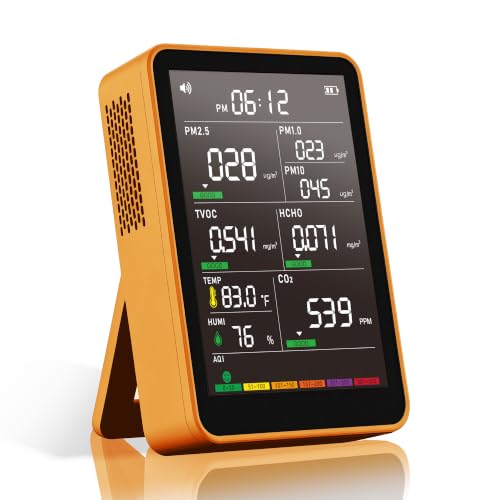
- Color display shows real-time particle and gas readings
- One-button controls and quiet sampling mode
- Portable design includes Type-C cable and AC adapter
Best For: Simple room, office, bedroom, and vehicle checks
Best Overall
AirGradient ONE Indoor Air Quality Monitor
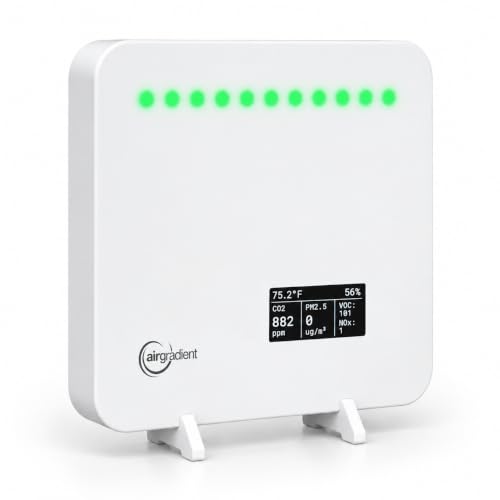
- Measures PM2.5, CO2, TVOCs, NOx, temperature, and humidity.
- Subscription-free dashboard, API access, and Home Assistant support.
- Calibrated PM2.5 monitoring with display and flexible mounting.
Best For: Comprehensive connected monitoring at home, work, or school
Best Connected Value
Smart WiFi Air Quality Monitor

- Monitors particles, CO2, TVOC, HCHO, temperature, and humidity.
- Works with Smart Life and Tuya Smart for remote data access.
- 3000mAh battery supports approximately 7–15 hours of use.
Best For: App-connected household monitoring with portable operation
Best Portable Particle Monitor
Rechargeable PM2.5/PM10 Detector

- Measures PM2.5 and PM10 in real time.
- Shows temperature and humidity on a color LCD.
- Pocket-size rechargeable design with audible threshold alarms.
Best For: Cordless particulate checks around the home or on the go
Best Alexa-Integrated Pick – Smart Air Quality Monitor
For shoppers seeking compact air quality monitoring systems with smart-home integration, the Amazon Smart Air Quality Monitor offers a straightforward way to track five indoor conditions. Its color-coded LED and Alexa app score make readings easy to understand, while Alexa notifications and routines can help you respond to changes.
Best For: Alexa households that want simple monitoring and connected device automation.
Pros:
- Tracks PM2.5, VOCs, carbon monoxide, humidity, and temperature.
- Provides a color-coded LED and an air quality score in the Alexa app.
- Can send alerts and trigger Alexa routines for purifiers, fans, and dehumidifiers.
- Temperature readings can support comfort adjustments with the Amazon Smart Thermostat.
Cons:
- Requires Alexa-enabled devices and ecosystem features for its connected automation benefits.
- Does not provide the broader pollutant and historical-data coverage of more specialized monitors.
This is a practical choice when ease of use and Alexa control matter more than detailed data analysis. It fits buyers who want basic readings and actionable smart-home responses in one compact system.
Best Detailed Data Pick – BREATHE Airmonitor Plus Gen 2
The BREATHE Airmonitor Plus Gen 2 is one of the more comprehensive compact air quality monitoring systems for buyers who want pollutant detail and historical context. It combines NDIR CO2 measurement with particle, TVOC, and formaldehyde sensing, then adds app alerts, graphs, 90-day history, and CSV export.
Best For: Home, office, classroom, or bedroom users who want detailed readings and trend analysis.
Pros:
- Measures CO2, PM1, PM2.5, PM10, TVOC, formaldehyde, temperature, and humidity.
- Offers 90 days of app history, graphs, and data export.
- Includes configurable CO2 and PM2.5 alerts through the app.
- Rechargeable design supports up to six hours of portable use and USB-C operation.
Cons:
- App connectivity uses 2.4 GHz Wi-Fi, which adds setup requirements.
- Its extensive readings may be more than buyers need for basic everyday checks.
Choose this model if you want to connect indoor-air changes with activities such as cooking, cleaning, occupancy, or ventilation. Its combination of multiple sensors and exportable history makes it especially useful for ongoing investigation rather than occasional spot checks.
Best Sidewalk-Connected Pick – Ring Air Quality Monitor
The Ring Air Quality Monitor is a compact air quality monitoring system for users who want simple readings and practical prompts throughout the home. It tracks temperature, carbon monoxide, humidity, and PM2.5, then offers suggestions such as opening a window or running a purifier through Amazon Sidewalk connectivity.
Best For: Ring and Amazon Sidewalk users who want connected alerts and straightforward actions.
Pros:
- Monitors temperature, CO, humidity, and PM2.5.
- Provides actionable suggestions related to ventilation, purification, and appliance service.
- Connects through Amazon Sidewalk without requiring a separate base station.
- Offers flexible coverage throughout the home and beyond, where Sidewalk coverage is available.
Cons:
- Requires Amazon Sidewalk, and coverage may vary.
- Does not measure CO2 or radon.
- It is not a certified carbon monoxide alarm or detector and has no microphone or speaker for an alarm.
This monitor makes sense for buyers who value connected guidance over extensive data logging. Keep in mind that its CO reading complements, rather than replaces, a certified carbon monoxide alarm.
Best CO2 Spot-Check Pick – TEKCOPLUS Portable CO2 Meter
For buyers focused primarily on ventilation and carbon dioxide, this portable TEKCOPLUS meter is a straightforward option among compact air quality monitoring systems. Its NDIR CO2 sensor measures levels up to 9,999 ppm, while the large backlit display also shows temperature and humidity in real time.
Best For: Offices, classrooms, grow rooms, and homes needing portable CO2 and ventilation checks.
Pros:
- Uses a non-dispersive infrared sensor for CO2 measurement.
- Measures CO2 from 0 to 9,999 ppm, plus temperature and humidity.
- Includes audible and visual alarms when CO2 exceeds a chosen threshold.
- Large backlit LCD displays readings together for easy viewing.
Cons:
- Focuses on CO2, temperature, and humidity rather than particles or VOCs.
- Does not offer the app history, remote alerts, or data export described for some other monitors.
This is a sensible pick when elevated CO2 and ventilation are your main concerns. Its portable, battery-powered design and threshold alarm make it useful for checking changing conditions across different indoor spaces.
Most Versatile – 10-in-1 Portable Air Quality Monitor
For shoppers comparing compact air quality monitoring systems, this 10-in-1 model offers broad coverage without requiring Wi-Fi, Bluetooth, or an app. It tracks particles, gases, temperature, and humidity on a color display, making it practical for quick checks around the home, office, kitchen, or car.
Best For: Users who want wide-ranging readings, simple controls, and portable monitoring.
Pros:
- Measures PM0.3, PM2.5, PM10, CO2, CO, HCHO, TVOC, AQI, temperature, and humidity.
- Color-coded levels make changes easier to recognize at a glance.
- Samples every 1.2 seconds and includes an audible alert with one-button operation.
- Rechargeable 2000mAh battery provides up to 96 hours of continuous monitoring.
Cons:
- Does not offer Wi-Fi, Bluetooth, or app-based tracking.
- The supplied package includes the monitor, charging cable, and manual, but no listed carrying case.
This is a strong all-around choice when measurement breadth and offline portability matter most. Its long battery claim and straightforward interface make it especially convenient for moving between rooms and vehicles.
Best Connected Option – Airthings View Plus Radon Monitor
Among compact air quality monitoring systems, the Airthings View Plus stands out for combining radon detection with connected, long-term tracking. Its battery-powered design supports cable-free placement, while the Airthings app provides live readings, notifications, and trend analysis from compatible locations.
Best For: Households prioritizing radon monitoring, remote access, and historical air-quality trends.
Pros:
- Monitors radon, PM2.5, CO2, VOCs, humidity, temperature, and air pressure.
- Wi-Fi connectivity and app support enable remote checks, notifications, and cloud-based trend tracking.
- Battery-powered operation offers cable-free placement, with an advertised battery life of up to two years.
- Customizable eInk screen and optional extended five-year warranty after registration.
Cons:
- Requires the Airthings app, an account, and internet access to function.
- Uses six AA batteries rather than a built-in rechargeable battery.
This model is better suited to continuous, connected monitoring than quick offline spot checks. Choose it when radon data and remote trend visibility outweigh the need for app-free operation.
Best for Simple Readability – 16-in-1 Color Screen Monitor
This compact air quality monitoring system combines a high-definition color screen with single-tap controls and a portable design. It monitors core particle, gas, temperature, and humidity indicators, making it useful for quick checks in bedrooms, offices, vehicles, and other indoor spaces.
Best For: Users who value an easy-to-read display, simple operation, and flexible placement.
Pros:
- Tracks PM1.0, PM2.5, PM10, TVOC, HCHO, temperature, and humidity.
- High-definition color display and color-coded readings improve at-a-glance readability.
- Single-tap operation includes Celsius/Fahrenheit switching and an option to disable audio prompts.
- Includes a Type-C cable, AC adapter, and 12-month full-unit warranty.
Cons:
- Continuous run time is listed at only 4-5 hours per full charge.
- The supplied notes do not list CO2 or carbon monoxide measurement.
This is a practical pick for portable, easy-to-read testing rather than extended battery operation. Its included adapter and quiet sampling option help it fit comfortably into everyday indoor routines.
Best Overall – AirGradient ONE Indoor Air Quality Monitor
For shoppers seeking compact air quality monitoring systems with broad pollutant coverage, the AirGradient ONE tracks PM2.5, CO2, TVOCs, NOx, temperature, and humidity. Its open-source design, subscription-free dashboard, OLED display, and Home Assistant support make it a flexible choice for connected indoor monitoring.
Best For: Homes, offices, classrooms, and smart-home users who want comprehensive, connected air-quality data.
Pros:
- Measures particulate matter, CO2, TVOCs, NOx, temperature, and humidity.
- Includes a subscription-free dashboard, free API access, and Home Assistant compatibility.
- Offers an OLED display, color indicator bar, wall mounting, and tabletop placement.
- Each unit is individually calibrated for PM2.5 and includes a digital test report.
Cons:
- Its wider feature set may be more than needed for shoppers focused only on particulate monitoring.
- Requires USB power rather than offering cordless operation.
The AirGradient ONE is the strongest all-around pick here for buyers who want detailed indoor measurements and integration flexibility rather than a basic standalone detector.
Best Connected Value – Smart WiFi Air Quality Monitor
This compact air quality monitoring system combines broad readings with app-based tracking. It monitors AQI, CO2, PM1.0, PM2.5, PM10, TVOC, HCHO, temperature, and humidity, while WiFi connectivity enables remote viewing and historical data through the Smart Life or Tuya Smart app.
Best For: Households that want a portable, battery-powered monitor with remote app access and extensive readings.
Pros:
- Tracks AQI, multiple particle sizes, CO2, TVOC, HCHO, temperature, and humidity.
- Supports 2.4GHz WiFi, Smart Life, and Tuya Smart app data storage.
- Built-in 3000mAh battery provides approximately 7–15 hours of continuous use.
- Color-coded HD display, auto-brightness, screen-off monitoring, and wall mounting support.
Cons:
- WiFi setup may require compatibility mode on WiFi 6 or newer routers.
- Long-term data recording is recommended while the device remains plugged in.
- Only one phone can be connected at a time when pairing a new phone.
This Sacnahe monitor is a practical choice when app history and remote checks matter, although its connectivity setup may take more attention than a display-only unit.
Best Portable Particle Monitor – Rechargeable PM2.5/PM10 Detector
For buyers who primarily need particulate readings, this compact air quality monitoring system focuses on PM2.5 and PM10 while also showing temperature and humidity. Its pocket-size rechargeable design and audible threshold alarm make it convenient for checking conditions across rooms, vehicles, workshops, and travel locations.
Best For: Portable PM2.5 and PM10 checks in homes, offices, workshops, vehicles, and travel settings.
Pros:
- Provides real-time PM2.5 and PM10 measurements.
- Displays particulate readings, temperature, and humidity together on a color LCD.
- Rechargeable 1000mAh battery supports cordless use.
- Audible alarms can alert you when preset particle thresholds are exceeded.
Cons:
- Does not measure CO2, TVOC, HCHO, or NOx according to the supplied specifications.
- Offers fewer air-quality parameters than the other monitors in this roundup.
The FABISENSE PTH-26PM is a straightforward fit for particulate-focused monitoring and portability, but shoppers wanting ventilation or chemical indicators should consider a broader-sensor model.
How We Picked These Compact Air Quality Monitoring Systems
We focused on compact monitors that provide useful indoor-air data without requiring bulky equipment or professional installation. The selected models cover different priorities: basic CO2 awareness, particulate tracking, broader multi-sensor coverage, radon detection, portable use, and smart-home integration.
We also considered sensor types, measurement range, display readability, alert options, power source, connectivity, and whether the device supports data logging or integrations. A higher sensor count is not automatically better; accuracy, relevance, and ease of interpreting the readings matter more.
Quick Comparison
| Best For | Look For | Typical Sensor Coverage |
|---|---|---|
| Ventilation awareness | NDIR CO2 sensor | CO2, temperature, humidity |
| Smoke and dust monitoring | PM2.5 or PM10 sensor | Fine and coarse particles |
| Broad indoor tracking | Multi-parameter monitor | CO2, particles, VOCs, temperature, humidity |
| Radon concerns | Dedicated radon sensor | Radon plus supporting air metrics |
| Smart-home use | Wi-Fi, app, or platform compatibility | Remote readings and alerts |
Key Buying Factors for Compact Air Quality Monitoring Systems
Choose the Right Sensors
CO2 is especially useful for judging ventilation and occupancy. PM2.5 helps identify fine particles from smoke, cooking, candles, and outdoor pollution. TVOC readings can indicate changes from cleaning products, paints, furnishings, and other sources, but they are usually best used for trends rather than identifying a specific chemical. If radon is a concern, choose a monitor with a dedicated radon sensor rather than relying on a general air-quality score.
Check Accuracy and Measurement Method
For CO2, an NDIR sensor is generally preferable to less direct estimation methods. Look for stated accuracy, calibration guidance, warm-up requirements, and an averaging period. Readings are more useful when the monitor is placed away from windows, vents, kitchens, and direct sunlight.
Consider Alerts, Connectivity, and Power
A bright local display is convenient for quick checks, while app access is valuable when you want historical trends or remote notifications. Battery operation improves portability but may require more frequent charging. Confirm compatibility with your preferred smart-home platform before buying.
Who Should Buy Which Compact Air Quality Monitoring Systems?
Choose a basic CO2 monitor if your main goal is knowing when to ventilate a bedroom, office, classroom, or meeting space. Select a PM-focused model for wildfire smoke, household dust, or cooking-related particles. A multi-sensor system is a better fit when you want one dashboard for CO2, particles, VOCs, temperature, and humidity.
Buy a radon-capable monitor when long-term radon awareness is a priority, but remember that local testing guidance may still recommend a certified test. Smart-home users should favor models with dependable app support or compatible integrations. For renters, travelers, and people who move a monitor between rooms, prioritize compact dimensions, battery power, and a clear display over an oversized feature list.
