
The right enclosure can make a compact 3D printer easier to use in a home office, workshop, or bedroom. It helps contain dust, reduce drafts, improve temperature consistency, and provide a more controlled printing environment.
We compared 10 compact 3D printer enclosures for popular Creality, Bambu Lab, Prusa, and resin printers, with attention to fit, ventilation, lighting, materials, and everyday usability.
Best 10 Compact 3D Printer Enclosures Picks for 2026
Best Overall
Creality Fireproof 3D Printer Enclosure

- Roomy 18.89 × 23.62 × 28.34-inch interior
- Flame-resistant, dustproof, folding design
- Fits many Ender and other popular printers
Best For: Creality Ender owners seeking broad compatibility
Best for Bambu A1 Mini
YOOPAI A1 Mini Enclosure with LED

- Dedicated fit for Bambu Lab A1 Mini setups
- Built-in LED and large clear viewing window
- Reserved opening for optional exhaust
Best For: A1 Mini owners wanting a neat, quieter setup
Best for Resin Ventilation
Filtered Resin Printer Enclosure

- Adjustable fan and three-layer filter kit
- UV-blocking window for resin printing
- Stainless-steel frame and fire-resistant fabric
Best For: Small resin printers needing airflow management
Best for Quiet Printing
Medium LED Constant-Temperature Enclosure

- Built-in LED strip for clearer monitoring
- Six-sided cover helps reduce printing noise
- Fits many popular filament printers
Best For: Desktop users prioritizing lighting and quieter operation
Best for Resin Odor Control
YOOPAI Resin Printer Enclosure

- Carbon filter helps reduce resin odor
- Exhaust fan and pipe support ventilation
- Clear window and enclosed six-sided design
Best For: Resin printer users prioritizing odor control and print visibility
Best Flexible Tent Enclosure
YOOPAI Dustproof 3D Printer Cover

- Broad compatibility with popular FDM printers
- Quick installation and easy disassembly
- Ports support exhaust kits and external filament feeding
Best For: FDM users wanting dust, noise, and temperature protection
Best DIY Cabinet Kit

- Includes plexiglass panels and LED lighting
- Ventilation-ready with fan and duct options
- Modular design supports printable accessories
Best For: DIY makers building a customizable IKEA Lack printer enclosure
Versatile Resin Tent
VEVOR Ventilated 3D Printer Enclosure
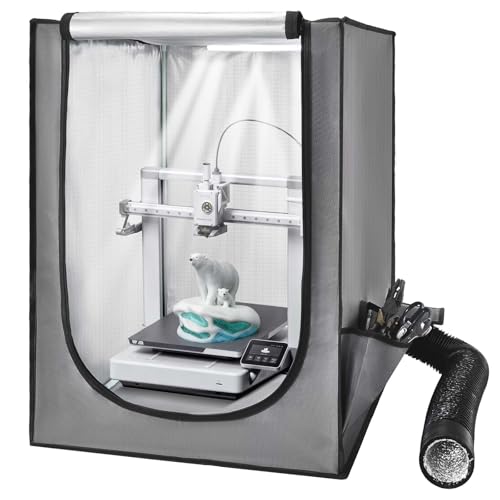
- Ventilation helps expel smoke and dust
- LED and clear window aid monitoring
- Fits small FDM and many LCD resin printers
Best For: Small FDM and compatible LCD resin printers
Large A1 Combo Shelter
VEVOR 600D Oxford Cloth Enclosure

- Designed for the Bambu Lab A1 Combo
- Includes thermohygrometer and ventilation
- LED window supports easy print monitoring
Best For: Indoor A1 Combo printing with PLA, TPU, or ABS
Best Overall – Creality Fireproof 3D Printer Enclosure
For a broadly compatible option among compact 3D printer enclosures, this Creality tent offers a spacious 18.89 × 23.62 × 28.34-inch interior, a stable frame, and a folding design. Its flame-resistant construction and temperature-buffering design make it practical for enclosed filament printing.
Best For: Creality Ender owners who want a roomy, portable enclosure for more stable printing and dust protection.
Pros:
- Compatible with many Ender, Anycubic Kobra, and ELEGOO Neptune models.
- Flame-resistant materials and an aluminum-film interior add protection.
- Folding structure includes tool pockets and multiple viewing sides.
- Helps maintain a steadier printing environment for high-temperature filaments.
Cons:
- Its relatively large footprint may not suit very small desks.
- The enclosure does not include an integrated ventilation or filtration system.
This is a versatile choice when compatibility and enclosure space matter most. Check your printer’s complete dimensions before ordering, particularly if using a taller setup.
Best for Bambu A1 Mini – YOOPAI A1 Mini Enclosure with LED
Designed specifically for the Bambu Lab A1 Mini and A1 Mini Combo, this compact 3D printer enclosure combines a dedicated fit with useful desktop features. A clear viewing window, built-in LED, and reserved exhaust opening make it convenient for everyday monitoring and future airflow upgrades.
Best For: Bambu Lab A1 Mini users who want quieter, cleaner, better-lit desktop printing.
Pros:
- Made for the Bambu Lab A1 Mini and A1 Mini Combo.
- Built-in LED lighting improves visibility inside the enclosure.
- Helps contain dust, particles, odors, and printing noise.
- Reserved vent opening supports an optional external exhaust kit.
Cons:
- AMS Lite should remain outside the enclosure for Combo users.
- External exhaust equipment is sold separately.
- Its dedicated design is less suitable for unrelated printer models.
The YOOPAI is a focused solution rather than a universal tent. It makes the most sense when you own an A1 Mini and value integrated lighting, easy access, and a tidy desktop setup.
Best for Resin Ventilation – Filtered Resin Printer Enclosure
Among compact 3D printer enclosures for resin machines, this ventilated tent stands out for its adjustable fan and three-layer filter system. A UV-blocking viewing window, fire-resistant fabric, and stainless-steel frame support a more controlled resin-printing workspace.
Best For: Small LCD or resin printer users who prioritize adjustable airflow and odor-management features.
Pros:
- Includes a 12V fan-filter kit with adjustable speed control.
- Three-layer filtration is designed to capture dust and harmful gases.
- UV-blocking window allows monitoring while helping protect resin prints.
- Compatible with several Photon, ELEGOO, and Creality resin printer series.
Cons:
- The printer is not included.
- Fit varies, so measuring the complete printer setup is essential.
- The enclosure is not water resistant.
This is the most ventilation-focused option in the group. Its feature set is particularly useful for resin printing, but buyers should verify dimensions and be prepared to print the required plastic adapter for the fan bracket.
Best for Quiet Printing – Medium LED Constant-Temperature Enclosure
This medium enclosure is a strong all-purpose pick for users who want compact 3D printer enclosures with lighting, temperature buffering, and noise reduction. Its 21.7 × 25.6 × 30.7-inch interior accommodates a wide range of popular printers while the six-sided cover helps shield the machine from dust and accidental contact.
Best For: Desktop users seeking a spacious, illuminated enclosure with a quieter printing experience.
Pros:
- Built-in LED strip improves visibility during printing.
- Constant-temperature design can support more consistent print conditions.
- Fire-resistant, dustproof construction helps protect the printer.
- Fits many Ender, ELEGOO Neptune, PRUSA, and AnkerMake models.
Cons:
- The medium-size enclosure requires substantial desk or floor space.
- It does not list an integrated fan, filter, or exhaust system.
- Compatibility still depends on checking the printer’s full dimensions.
Choose this model if visibility and noise isolation are higher priorities than built-in ventilation. Its broad compatibility and quick setup make it a practical enclosure for several common filament printers.
Best for Resin Odor Control – YOOPAI Resin Printer Enclosure
For shoppers comparing compact 3D printer enclosures for resin printing, the YOOPAI Multifunctional Resin 3D Printer Enclosure emphasizes odor control, visibility, and a more contained workspace. Its 28 × 18 × 17-inch design fits compatible resin printers smaller than those dimensions.
Best For: Resin printer users who want built-in filtration, exhaust routing, and a clear viewing window.
Pros:
- Built-in carbon filter sheet helps adsorb resin odors.
- Exhaust fan and expandable pipe support ventilation to the outside.
- Six-sided enclosure helps keep out dust and contain resin splashes.
- Large transparent front window allows printing to be monitored without opening the cover.
Cons:
- Compatibility depends on keeping the printer smaller than 28 × 18 × 17 inches.
- The enclosure is designed for resin printers rather than being a universal printer cabinet.
Choose this model when fumes, dust, and uninterrupted print monitoring are higher priorities than maximum enclosure capacity. Its insulation-focused design may also help support a steadier printing temperature.
Best Flexible Tent Enclosure – YOOPAI Dustproof 3D Printer Cover
This YOOPAI enclosure is a practical option among compact 3D printer enclosures for users who need broad printer compatibility and a quick-to-install protective cover. It measures 29.5 × 25.6 × 21.6 inches, so measure your printer—including spool-holder height—before ordering.
Best For: FDM printer owners seeking dust protection, temperature consistency, noise reduction, and openings for accessories.
Pros:
- Supports many Creality, Anycubic, and ELEGOO printer models.
- Designed for installation in about five minutes and easy disassembly.
- Right-side opening supports fan-based exhaust kits, while the left port supports external filament feeding.
- Six-sided construction helps reduce transmitted printing noise and dust entry.
Cons:
- It is not water resistant.
- Its relatively large footprint may not suit very small workspaces.
- Printer dimensions must be checked carefully, including spool-holder height.
This is a strong fit for a flexible, fabric-style setup where installation speed and accessory access matter. It provides enclosure support without including a built-in ventilation system, so exhaust components may need to be added separately.
Best DIY Cabinet Kit – DELACK IKEA Lack Enclosure
For makers building around an IKEA Lack table, the DELACK kit offers a compact 3D printer enclosure with plexiglass panels, lighting, and ventilation-ready hardware. The 21.65 × 19.13 × 17.72-inch enclosure is intended for setups such as the Bambu Lab A1 Mini, Prusa MK4, MK3, and Mini.
Best For: DIY users who want a customizable IKEA Lack enclosure with included lighting and expansion options.
Pros:
- Includes plexiglass panels, hardware, and an LED light strip with 5V adapter.
- Supports optional 120mm fans, HEPA filtration systems, and external venting through a 4-inch duct adapter.
- Modular design includes a removable top panel and access for MMU3 upgrades.
- Downloadable accessories support customization, including camera mounts and cable organizers.
Cons:
- This is a kit only; printed parts and an IKEA Lack table are not included.
- Assembly and customization require a DIY-oriented setup.
- Ventilation fans and filtration systems are optional rather than included.
The DELACK stands out when you want a tailored printer cabinet rather than a ready-made tent. Its included lighting improves visibility, while the modular structure leaves room for future ventilation and accessory upgrades.
Versatile Resin Tent – VEVOR Ventilated 3D Printer Enclosure
For shoppers comparing compact 3D printer enclosures, this VEVOR tent combines a dust-resistant enclosed workspace with ventilation, temperature control, and visibility features. Its 21.65 x 25.59 x 29.53-inch size is suited to small 3D printers and many LCD resin models, but measure your setup first.
Best For: Small FDM and LCD resin printers, including compatible Photon Mono and Mars 3 models.
Pros:
- Ventilation system helps expel smoke and dust after printing.
- Enclosed design supports a more consistent temperature and helps limit dust.
- Transparent viewing window and built-in LED improve print monitoring.
- Flame-retardant materials and a stable structure add practical protection.
Cons:
- Compatibility depends on the printer’s dimensions, so measuring is necessary.
- The listed enclosure footprint may be too large for very tight workspaces.
This is a practical all-rounder for users who want an enclosed, illuminated setup for resin or smaller FDM printing without moving to a rigid cabinet.
Feature-Rich Ender Cover – YOOPAI Enclosure with LED and Monitoring
Among compact 3D printer enclosures, the YOOPAI stands out for pairing an enclosed printing area with an LED strip, temperature and humidity monitoring, and noise isolation. It supports printers smaller than 21.6 x 25.6 x 29.5 inches, including many Creality Ender models, so check the full printer height with the spool holder.
Best For: Creality Ender 3 owners and users who want environmental monitoring and reduced printing noise.
Pros:
- Built-in LED strip improves visibility in low-light conditions.
- Temperature and humidity readings help users monitor the printing environment.
- Six-sided enclosure helps reduce noise, dust, and accidental contact.
- Designed for quick installation and disassembly, with a sturdy structure.
Cons:
- Printer compatibility is limited by the stated 21.6 x 25.6 x 29.5-inch maximum size.
- Users must account for spool-holder height before ordering.
Choose this model if monitoring conditions and containing noise matter as much as temperature stability. Its broad listed compatibility makes it especially appealing for Ender-series setups.
Large A1 Combo Shelter – VEVOR 600D Oxford Cloth Enclosure
For larger machines, this VEVOR model is one of the more spacious compact 3D printer enclosures, measuring 31.5 x 22.83 x 22.83 inches. It is designed for the Bambu Lab A1 Combo and includes ventilation, a thermohygrometer, flame-retardant 600D Oxford cloth, and an LED-lit viewing window.
Best For: Bambu Lab A1 Combo owners printing with PLA, TPU, or ABS indoors.
Pros:
- Large dimensions are designed around the Bambu Lab A1 Combo.
- Thermohygrometer helps monitor temperature and humidity.
- Ventilation system helps expel smoke and dust after printing.
- LED and transparent window make the print easier to observe.
Cons:
- Its larger footprint requires more desk or floor space than smaller tents.
- Compatibility is specifically emphasized for the A1 Combo, so other printers require careful measurement.
This enclosure is a sensible match for A1 Combo users who need extra room and want basic environmental monitoring, ventilation, and print visibility in one setup.
How We Picked These Compact 3D Printer Enclosures
We focused on enclosures designed for small-format FDM and resin printers, prioritizing practical features rather than appearance alone. Our comparison considers stated printer compatibility, enclosure dimensions, frame and cover materials, access points, visibility, ventilation options, included lighting, and how easily each unit can fit on a desk, shelf, or dedicated stand.
Because printer sizes and operating requirements vary, compatibility claims should be checked against your machine’s actual dimensions before ordering. An enclosure should leave enough clearance for the print bed, spool holder, cables, and moving components.
Quick Comparison
- Best for Creality Ender models: Look for model-specific Creality or YOOPAI options with suitable clearance and cable openings.
- Best for Bambu Lab A1 Mini: Choose an enclosure designed around the A1 Mini’s footprint, including options with integrated LED lighting.
- Best for resin printing: Prioritize ventilation, filtration, and a design that can direct fumes away from the room.
- Best for flexible placement: Oxford-cloth tents are generally lighter and easier to move than rigid cabinets.
- Best for larger printers: Measure carefully before considering the large VEVOR-style enclosure; extra room is useful only if it fits your workspace.
Key Buying Factors for Compact 3D Printer Enclosures
Size and Printer Compatibility
Measure the printer with its spool, cable connections, and full bed movement included. A tight enclosure can restrict airflow or interfere with moving parts. Model-specific designs are convenient, but universal tents may offer more flexibility for future upgrades.
Ventilation and Odor Control
Ventilation matters particularly for resin printing and materials that produce noticeable odors. Look for a duct port, fan compatibility, included filter, or ventilation kit. A vent should exhaust safely rather than simply recirculate air inside the enclosure.
Temperature and Fire Safety
Fabric enclosures can reduce drafts and help maintain a steadier environment, but they are not a substitute for supervision, smoke detection, or safe printer operation. “Fireproof” product claims should be treated as material-resistance features, not permission to leave a printer unattended.
Access, Visibility, and Lighting
Clear viewing panels, front openings, cable ports, and LED lights make monitoring and maintenance easier. Lighting is especially helpful when inspecting first layers or checking prints in a dim workspace.
Construction and Workspace Fit
Check the frame strength, zipper quality, waterproof or dust-resistant fabric, and available shelf space. Also account for ventilation hoses and power cables when measuring the enclosure’s required footprint.
Who Should Buy Which Compact 3D Printer Enclosures?
Creality Ender owners should start with an enclosure listed for their exact Ender generation. Bambu Lab A1 Mini users will benefit from a compact model-specific design, particularly one with lighting and accessible cable routing. Resin users should choose a ventilation-focused enclosure with filtration or a compatible exhaust setup. Buyers who want a simple, portable solution should consider a lightweight fabric tent, while users with multiple printers or larger machines may prefer a larger enclosure with room for accessories. If temperature control, fumes, and safety are major concerns, prioritize ventilation and fit over decorative features or the lowest price.
