
Commercial-grade USB power meters help technicians, engineers, repair professionals, and serious enthusiasts verify charging performance instead of relying on advertised wattage alone. The right tester can reveal voltage, current, power delivery behavior, cable capability, and battery capacity across USB-A and USB-C connections.
We selected 10 models spanning high-power USB-C PD analyzers, compact diagnostic testers, and versatile meters with broader voltage and current ranges. Use the guide below to match measurement capability, connector support, and safety features to your workflow.
Best 10 Commercial-Grade USB Power Meters Picks for 2026
Top Precision Pick

- PD3.2 and QC5.0 support
- Up to 50V, 6A, and 240W PD
- Protocol, E-marker, and PC analysis
Best For: Advanced USB-C testing and development
Most Versatile Analyzer

- USB-A, Micro-USB, and USB-C interfaces
- Broad fast-charge trigger support
- Waveforms, ripple, capacity, and app tools
Best For: Mixed-device charging and cable diagnostics
Best High-Power Value

- Supports USB-C testing up to 240W
- Bidirectional charger and power-bank testing
- Compact metal-shell design
Best For: High-power USB-C charging checks
Best Display and Graphing

- 1.77-inch full-color rotating display
- Broad fast-charge protocol triggering
- Recording, waveform, ripple, and app support
Best For: Readable diagnostics and charging trend analysis
Best Overall
Plugable 240W USB-C Power Meter

- Measures USB-C power up to 240W
- Bidirectional with rotating OLED display
- Supports data pass-through and Alt Mode video
Best For: High-power USB-C charging and connection checks
Best for IT Troubleshooting
StarTech 240W USB-C Power Tester

- Measures voltage, current, and wattage
- Supports 240W PD 3.1 EPR
- Passes USB 10Gbps data and DP Alt Mode
Best For: Diagnosing USB-C ports, cables, docks, and chargers
Best for Protocol and Cable Testing
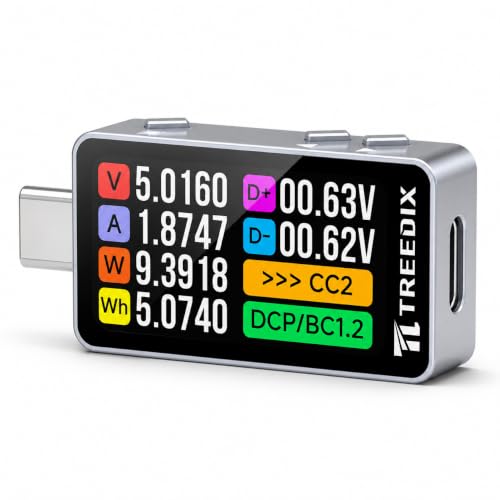
- Detects multiple fast-charging protocols
- Reads detailed E-Marker cable information
- Graphs power changes and stores test data
Best For: Detailed charger, cable, and power-bank analysis
High-Current Type-C Tester

- Measures 4–30V and up to 12A
- Supports multiple PD and fast-charge protocols
- Records real-time voltage and current curves
Best For: Higher-current USB-C charging diagnostics
Multi-Connector Test Station
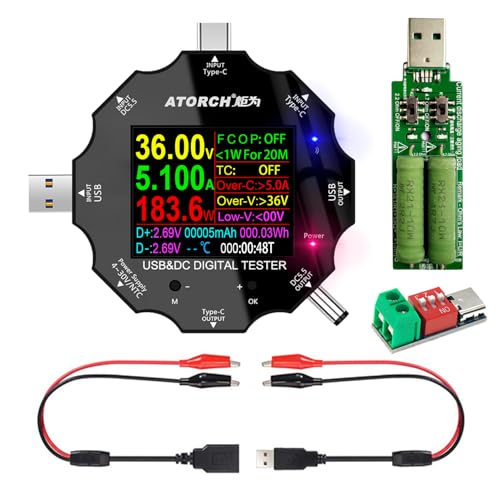
- Supports USB, USB-C, DC5.5, and micro USB
- Adds load testing and app data viewing
- Includes multiple electrical protection features
Best For: Mixed-connector electronics workbenches
Portable Charging Analyzer

- Measures up to 32V and 8A
- Tracks charging and power-bank capacity data
- Supports USB-A, USB-C, PD, QC, and BC1.2
Best For: Charger and power-bank performance checks
Top Precision Pick – ChargerLAB KM003C
For buyers seeking commercial-grade USB power meters for advanced USB-C testing, the ChargerLAB Power-Z KM003C combines broad measurement coverage with high stated limits. It supports PD3.2, up to 50V and 6A, and includes PC analysis features for detailed bench work.
Best For: USB-C engineers, repair technicians, and users who need protocol, E-marker, capacity, and energy testing.
Pros:
- Supports PD3.2, QC5.0, and USB PD protocol analysis.
- Measures up to 50V and 6A, with up to 240W PD support.
- Offers voltage/current, capacity, energy, E-marker, PDO, and protocol tests.
- Uses a 1.54-inch rotating display and supports PC data analysis.
Cons:
- Designed for USB-C rather than a broad mix of legacy connector types.
- Advanced features may be more than casual users need.
- PC software and the manual must be obtained from the official website.
The KM003C is the strongest choice here when accuracy-oriented analysis and newer USB-C power standards matter more than simplicity. Its larger display, high measurement ceiling, and software support make it well suited to professional troubleshooting and development work.
Most Versatile Analyzer – FNIRSI FNB58
The FNIRSI FNB58 is a versatile option for commercial-grade USB power meters, especially if you work across USB-A, Micro-USB, and USB-C equipment. It combines fast-charge triggering, cable checks, capacity testing, waveform functions, and app connectivity in one tester.
Best For: Technicians and hobbyists testing mixed USB devices, charging protocols, cables, ripple, and startup behavior.
Pros:
- Includes USB-A, Micro-USB, and USB-C interfaces.
- Supports QC, FCP/SCP, AFC, PD2.0/3.0, VOOC/WARP, and Super VOOC triggers.
- Monitors voltage, current, power, resistance, capacity, temperature, and D+/D- voltage.
- Provides app software, parameter recording, waveform drawing, and ripple analysis.
Cons:
- Maximum stated operating range is 28V and 7A.
- The manual is accessed digitally through the package QR code.
- Incorrect protocol or input-port settings can leave the tester at 5V output.
The FNB58 stands out for connector variety and protocol coverage. It is a practical all-around tester, provided you take time to select the correct port and enable the PD function when required.
Best High-Power Value – ChargerLAB C240
The ChargerLAB Power-Z C240 is a straightforward choice among commercial-grade USB power meters for high-power USB-C checks. Its 240W rating, bidirectional current measurement, color screen, and metal shell make it useful for chargers, laptops, and power banks.
Best For: Buyers who want a compact USB-C meter for high-power charging and discharge checks.
Pros:
- Supports USB-C power testing up to 240W and PD3.1/QC5.0.
- Displays voltage, current, power, direction, energy, timer, D+/D-, and CC information.
- Measures both charger performance and power-bank discharge.
- Uses a durable metal shell in a compact, lightweight design.
Cons:
- It has fewer advanced analysis features than the KM003C.
- USB-A testing requires a USB-C-to-USB-A adapter, which is not included.
- The smaller 1.14-inch display may show less information at once.
The C240 is a sensible fit when high-power USB-C measurement is the priority and you do not need the KM003C’s deeper professional analysis. Its bidirectional testing also makes it useful for checking both charging and discharge behavior.
Best Display and Graphing – FNIRSI FNB48P
The FNIRSI FNB48P adds a large color display and recording functions to the commercial-grade USB power meters category. It covers common fast-charge protocols while also providing cable resistance, E-marker, temperature, capacity, waveform, and ripple measurements.
Best For: Users who want clear on-device readings, fast-charge triggering, and basic trend or ripple analysis.
Pros:
- Uses a 1.77-inch full-color display with automatic gravity-based orientation.
- Supports QC, FCP/SCP, AFC, PD2.0/3.0, VOOC/WARP, and Super VOOC triggers.
- Measures voltage, current, power, resistance, capacity, temperature, and D+/D- voltage.
- Offers recording, app/PC software, waveform drawing, and ripple analysis.
Cons:
- Its stated limit is 24V and 6.5A, below the KM003C and C240 ratings.
- Its protocol support is centered on PD2.0/3.0 rather than PD3.2.
- Advanced readings and graphs may require more setup than simple power checks.
The FNB48P is a strong middle ground for users who value screen readability and diagnostic graphs. Choose it for broad protocol triggering and visual monitoring rather than the highest USB-C power ceiling.
Best Overall – Plugable 240W USB-C Power Meter
For buyers seeking commercial-grade USB power meters, the Plugable USB C Power Meter combines 240W USB-C monitoring with a compact, durable design. It measures voltage and amperage, shows current direction, and supports USB data pass-through and DisplayPort Alt Mode.
Best For: USB-C troubleshooting, charging checks, and monitoring high-power USB-C connections.
Pros:
- Supports USB-C Power Delivery up to 240W and a 4.5V-50V, 50mA-6.5A operating range
- Bidirectional design works in either connection orientation
- OLED display includes improved readability and screen rotation
- Passes through USB data and USB-C Alt Mode video
Cons:
- Not compatible with Thunderbolt 3 devices
- Designed specifically for USB-C connections
This is a well-rounded option when you want high-power measurement, everyday USB-C compatibility, and a reinforced construction in one compact tester.
Best for IT Troubleshooting – StarTech 240W USB-C Power Tester
The StarTech USB-C Power Tester is one of the more practical commercial-grade USB power meters for diagnosing charging and connectivity problems. It measures voltage, current, and wattage while preserving USB data pass-through up to 10Gbps and DisplayPort Alt Mode.
Best For: IT professionals testing USB-C cables, docks, chargers, hubs, and device ports.
Pros:
- Measures voltage, current, and wattage bidirectionally
- Supports USB PD 3.1 EPR up to 240W
- Provides USB 10Gbps data pass-through and DP Alt Mode support
- 180-degree display rotation helps with at-a-glance readings
Cons:
- Not compatible with Thunderbolt 3 devices
- Its feature set is focused on USB-C testing rather than general-purpose measurement
Choose this model if port, cable, and Power Delivery diagnostics are the priority, especially in a mobile IT toolkit. Its two-year warranty is an additional practical benefit.
Best for Protocol and Cable Testing – Treedix USB-C Tester
The Treedix USB-C Tester stands out among commercial-grade USB power meters for its protocol detection and E-Marker cable analysis. Along with voltage and current readings, it displays charging standards, cable capabilities, power trends, capacity, and accumulated energy.
Best For: Users who need detailed USB-C charger, cable, fast-charging protocol, and power-bank testing.
Pros:
- Measures 4V-32V and 0-6A with stated accuracy up to ±1%
- Detects PD, QC, FCP, AFC, AVS, and other listed charging protocols
- Reads E-Marker information including data rate, EPR support, cable type, and ratings
- Offers dynamic voltage/current curves and power-off data storage
Cons:
- Its maximum stated voltage is 32V, below the 50V range of the other listed testers
- Its USB-C feature set may be more involved than needed for simple voltage checks
This is the strongest choice for deeper USB-C investigation. The color display and cable metadata make it especially useful when identifying protocol support or comparing cable capabilities.
High-Current Type-C Tester – 12A USB-C Power Meter
For shoppers comparing commercial-grade USB power meters, the KWS-2303C stands out with a 4–30V range, current measurement up to 12A, and broad fast-charging protocol support. Its color display and curve function make it useful for monitoring charging behavior over time.
Best For: Electronics enthusiasts and digital-device users testing USB-C chargers, power banks, cables, and fast-charging performance.
Pros:
- Measures 4–30V and up to 12A.
- Supports PD, QC, FCP, SCP, AFC, DASH, VOOC, and Super VOOC protocols.
- Displays voltage, current, power, capacity, energy, time, and temperature data.
- Offers selectable five-minute to two-hour real-time voltage and current curves.
Cons:
- Designed around USB-C and compatible charging protocols rather than a broad range of connector types.
- The advanced readings may be more than casual charging checks require.
The 12A terminal and wide voltage range make this the strongest choice here for higher-current USB-C diagnostics. Choose it when protocol detection and trend monitoring matter as much as basic voltage and current readings.
Multi-Connector Test Station – 3-in-1 USB Power Meter
This 3-in-1 tester is a versatile option among commercial-grade USB power meters, supporting USB, USB-C, DC5.5, and micro USB connections. It combines color-screen monitoring with load testing, app connectivity, and built-in protection features.
Best For: Users testing varied DC-powered equipment such as notebooks, routers, desk lamps, set-top boxes, chargers, and power supplies.
Pros:
- Supports USB, Type-C, DC5.5, and micro USB interfaces.
- Measures voltage, current, power, capacity, resistance, temperature, and charging time.
- Supports PD2.0/3.0 and QC2.0/3.0 fast-charge recognition.
- Includes over-voltage, over-current, and low-voltage protection plus auto-off.
Cons:
- The temperature probe is not included.
- Its minimum operating voltage is 3.6V, so it is not intended for lower-voltage testing.
- The feature-rich interface may take time to learn.
Choose the UD18 when connector flexibility and safety functions are priorities. Its broad interface support makes it particularly practical for a mixed electronics workbench rather than USB-C-only troubleshooting.
Portable Charging Analyzer – YOJOCK USB-C Power Meter
The YOJOCK FT-ut003 is a practical pick for commercial-grade USB power meters when you want detailed charging and power-bank data in a compact tester. It measures 3.6–32V and up to 8A while tracking capacity, energy, resistance, temperature, and charging time.
Best For: Checking USB-A and USB-C chargers, cables, solar or car chargers, power banks, and compatible fast-charging devices.
Pros:
- Measures 3.6–32V and 0–8A.
- Tracks voltage, current, capacity, energy, power, resistance, temperature, and charging time.
- Supports PD2.0/3.0, QC2.0/3.0, BC1.2, USB-A, and USB-C.
- Includes over-voltage, over-current, under-voltage, and low-energy protection.
Cons:
- Its 8A current limit is lower than the 12A limit of the KWS-2303C.
- Accurate power-bank capacity testing requires following the stated full-charge, discharge, and data-clearing procedure.
- The included setup is centered on the USB tester rather than a broader accessory kit.
The YOJOCK offers a strong balance of measurement range, fast-charge compatibility, and safety monitoring. It is a good fit for everyday charger evaluation and power-bank capacity checks, especially when both USB-A and USB-C support are useful.
How We Picked These Commercial-Grade USB Power Meters
We focused on meters with useful diagnostic ranges, clear displays, USB-C Power Delivery support, and practical compatibility with modern chargers, cables, power banks, phones, tablets, and laptops. Models supporting PD 3.1, QC protocols, E-Marker reading, or measurements approaching 240W received particular attention because they are better suited to current high-power USB-C systems.
We also considered connector flexibility, current and voltage limits, portability, display readability, and whether a tester is designed for straightforward monitoring or deeper troubleshooting. Always confirm the manufacturer’s specifications before testing a new charger, cable, or device.
Quick Comparison
| Best For | What to Prioritize |
|---|---|
| USB-C laptop and high-power charger testing | 240W capability, PD 3.1 support, accurate voltage and current readings |
| Cable and E-Marker diagnostics | E-Marker reading, USB-C compatibility, protocol visibility |
| General electronics troubleshooting | Broad voltage/current range, readable display, USB-A and USB-C support |
| Power-bank testing | Capacity measurement, stable logging, suitable current range |
| Field service and portability | Compact construction, simple controls, and a clear screen |
Key Buying Factors for Commercial-Grade USB Power Meters
Measurement Range and Power Ceiling
Check the maximum voltage, current, and wattage before buying. A meter rated for 5A may be adequate for everyday charging but unsuitable for higher-power laptops or USB-C PD 3.1 equipment. Higher limits provide more headroom, but they do not automatically guarantee laboratory-level accuracy.
Protocol and E-Marker Support
PD and QC visibility helps identify which charging mode a source and device negotiate. E-Marker support is valuable for checking electronically marked USB-C cables, especially when validating high-current or high-wattage connections.
Connector Layout and Compatibility
Some testers are USB-C inline meters, while others include USB-A, DC, or multiple connector options. Choose a layout that fits your chargers and test setup, and verify whether adapters are required. Avoid forcing connectors or using a meter beyond its stated direction and port limitations.
Display, Logging, and Protection
A color display can make live voltage, current, power, resistance, and capacity readings easier to interpret. For repeated service work, look for stable readings, data logging, calibration options, and protection against overvoltage or excessive current where specified.
Who Should Buy Which Commercial-Grade USB Power Meters?
Choose a high-power PD 3.1 meter if you test USB-C laptop chargers, docks, cables, or power banks at modern wattage levels. A model with E-Marker analysis is the better choice for cable verification and troubleshooting charging failures. For general bench work, a broader-range USB-A/C tester offers more flexibility than a USB-C-only design.
Buy a meter with capacity measurement if power-bank performance is a priority. Technicians who work away from a bench should favor a compact tester with a readable screen and minimal setup. If you need dependable measurements for repeated commercial or repair use, prioritize published specifications, suitable safety limits, and a design that matches your test equipment rather than choosing solely by the highest advertised wattage.
