
The right overhead camera rig turns top-down shooting from a precarious setup into a repeatable workflow. These commercial-grade options cover compact desk mounts, adjustable boom arms, and heavier studio-style stands for cameras, phones, lights, and microphones.
We compare the most important differences—load capacity, reach, adjustment range, mounting hardware, and desk or floor stability—so you can choose a rig that fits your equipment and shooting space.
Best 10 Commercial-Grade Overhead Camera Rigs Picks for 2026
Best Tabletop Studio Rig

- 27–34-inch adjustable overhead height
- Multiple 1/4-20 accessory mounts
- Supports up to 6 pounds
Best For: Tabletop cooking, art, and stop-motion filming
Best Heavy-Duty Tripod
SmallRig CT200 Overhead Tripod

- 33-pound tripod load capacity
- 180° tilt and 360° horizontal rotation
- Converts to a monopod
Best For: Flexible overhead, panoramic, and low-angle shooting
Best Long-Reach Pole Mount

- Six-foot overhead pole
- 15-pound maximum payload
- Works with 1–2-inch poles or rails
Best For: Large tabletop, vehicle, and studio overhead scenes
Best Desk-Mounted Arm

- 30–73 cm adjustable main pole
- 360° adjustable secondary arm
- Supports up to 2 kilograms
Best For: Indoor streaming and tabletop content creation
Best Heavy-Duty Clamp Rig
NEEWER NK002 Dual Ball Head Overhead Mount

- Supports up to 26.5 pounds
- Adjustable crossbar and dual ball heads
- Includes phone holder and accessory mounting points
Best For: High-capacity tabletop overhead shooting in limited spaces
Best Articulating Arm
DImotliyor Three-Section Overhead Camera Mount
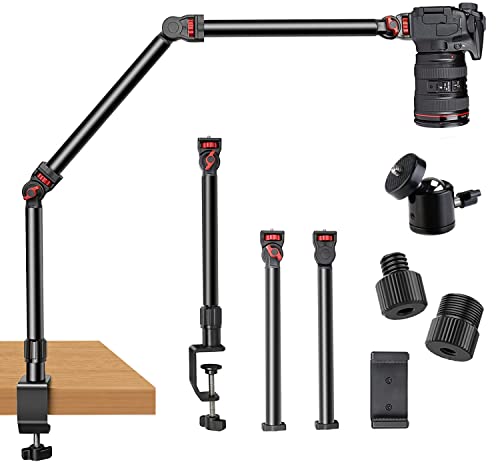
- Three adjustable sections for flexible angles
- Supports up to 4.5 pounds horizontally
- Includes multi-thread adapters and phone holder
Best For: Flexible, lightweight desktop filming and streaming setups
Best Stable Platform
NEEWER ST100 Heavy-Duty Overhead Camera Rig

- Steel frame supports up to 10 pounds
- Spring-loaded height adjustment from 24 to 39 inches
- 12 crossbar mounting points for expansion
Best For: Stable flat-lay and overhead production stations
Best Expandable Rig
JUSMO LS15 Pro Overhead Camera Mount

- 22-pound aluminum load capacity
- DIY height and length adjustment
- Expandable multi-device design
Best For: Dedicated desktop studios and multi-device overhead shooting
Best Heavy-Duty Span
EMART Adjustable Overhead Camera Rig

- Supports up to 26.5 pounds
- Telescoping width and height
- Includes phone and camera mounting options
Best For: Large overhead scenes and equipment-heavy desktop studios
Best Multi-Arm Setup
NEEWER ST008 Overhead Camera Desk Rig

- Center column plus two boom arms
- Multiple swivel and tilt adjustments
- Includes broad mounting adapter set
Best For: Streaming and compact multi-device desktop setups
Best Tabletop Studio Rig – Glide Gear OH100
The Glide Gear OH100 is a practical choice for creators seeking commercial-grade overhead camera rigs in a compact tabletop format. Its aluminum-and-steel construction, adjustable 27- to 34-inch height, and multiple mounting points support cooking videos, stop-motion, art demonstrations, and similar projects.
Best For: Tabletop overhead filming with cameras, phones, monitors, or accessory lights.
Pros:
- Adjustable height from 27 to 34 inches for varied overhead angles.
- Multiple 1/4-20 mounting points support customized accessory setups.
- Lightweight 8-pound aluminum-and-steel construction is portable yet sturdy.
- Camera sled can mount above or below the crossbar.
Cons:
- Maximum recommended load is 6 pounds.
- Its 34-inch width and tabletop design are less suited to very large scenes.
- Not water resistant.
The OH100 is especially appealing when you need a stable, adjustable tabletop platform rather than a full-height floor stand. Keep its 6-pound capacity in mind when selecting your camera and accessories.
Best Heavy-Duty Tripod – SmallRig CT200 Overhead Tripod
The SmallRig CT200 is a versatile option among commercial-grade overhead camera rigs, combining a horizontal center column with a 33-pound maximum tripod load. Its rotating column, reversible setup, and broad height range make it useful for overhead, panoramic, low-angle, and macro-oriented work.
Best For: Photographers and videographers who need a high-capacity, portable overhead tripod with flexible positioning.
Pros:
- Horizontal column tilts 180 degrees and rotates 360 degrees.
- Supports up to 33 pounds in tripod mode, with a 22-pound head limit.
- Height adjusts from 26 centimeters to 200 centimeters.
- Includes a counterweight bag, carrying bag, smartphone holder, and accessory thread holes.
Cons:
- Its 4.4-pound weight may be less convenient than smaller tabletop mounts.
- Maximum capacity depends on the tripod head’s 22-pound limit.
- Requires more setup space than a desk-mounted arm.
Choose the CT200 when load capacity and positioning flexibility matter more than the smallest footprint. The counterweight bag and adjustable feet add practical stability for varied shooting environments.
Best Long-Reach Pole Mount – Glide Gear OH75 Overhead Rig
The Glide Gear OH75 is designed for expansive top-down setups where a six-foot span is more useful than a compact desk mount. This commercial-grade overhead camera rig supports up to 15 pounds and works with C-stands, making it suitable for tables, drum sets, vehicles, food photography, and assembly videos.
Best For: Large overhead scenes and creators who already use compatible C-stands.
Pros:
- Six-foot pole provides reach for large setups.
- Supports cameras up to 15 pounds.
- Compatible with poles or rails measuring 1 to 2 inches in diameter.
- Includes clamps, baby pin posts, and a camera sled for a complete mounting kit.
Cons:
- C-stands are required but not included.
- Offers less self-contained support than a complete tripod.
- Not water resistant.
The OH75 is a strong fit for studio users who need broad top-down coverage and already have suitable stands. Its modular pole compatibility also leaves room to tailor the reach to the production space.
Best Desk-Mounted Arm – SmallRig DTCK001 Desk Mount
The SmallRig DTCK001 is a compact desk-mounted choice for commercial-grade overhead camera rigs used in streaming, video calls, and tabletop photography. Its adjustable main pole and secondary arm provide flexible positioning, while the widened base supports up to 2 kilograms on a desk 1 to 6 centimeters thick.
Best For: Indoor desk setups using a camera, phone, light, or microphone.
Pros:
- Main pole adjusts from 30 to 73 centimeters and the arm from 30 to 50 centimeters.
- Secondary arm provides 360-degree angle adjustment.
- Supports up to 2 kilograms and can accommodate two devices.
- Includes 1/4-20 and 3/8-16 mounting options plus a detachable ball head.
Cons:
- 2-kilogram capacity limits heavier camera and accessory combinations.
- Requires a compatible desk edge between 1 and 6 centimeters thick.
- Designed for indoor desktop use rather than large studio scenes.
The DTCK001 makes sense for creators who want fast, repeatable overhead positioning without a floor stand. Its main limitation is the modest load rating, so verify the combined weight of both devices and accessories.
Best Heavy-Duty Clamp Rig – NEEWER NK002 Dual Ball Head Overhead Mount
For creators comparing commercial-grade overhead camera rigs, the NEEWER NK002 stands out as a high-capacity desktop option. Its aluminum construction supports up to 26.5 pounds, while the adjustable crossbar and dual ball heads make it practical for top-down cameras, phones, lights, microphones, and other accessories.
Best For: Tabletop streaming, unboxing, still-life photography, online meetings, and overhead shooting in compact workspaces.
Pros:
- Supports up to 26.5 pounds with a padded 2.6-inch desktop C-clamp.
- Adjustable height from 27.2 to 48 inches and width from 25.2 to 47.2 inches.
- Dual 360-degree ball heads and included phone holder provide flexible camera positioning.
- Includes mounting points for additional lights and compatible accessories.
Cons:
- The crossarms and some expansion accessories are sold separately.
- The dual ball head assembly is rated for up to 3.3 pounds.
The NK002 is a strong choice when load capacity and expandability matter. Its clamp-based design saves desk space, though users planning a fully accessorized setup should budget for additional mounting hardware.
Best Articulating Arm – DImotliyor Three-Section Overhead Camera Mount
The DImotliyor three-section arm is a flexible option among commercial-grade overhead camera rigs for creators who need adjustable positioning without a large crossbar. Its 360-degree rotating base, articulating sections, and multiple thread sizes support cameras, phones, microphones, projectors, and lights.
Best For: YouTube videos, live streaming, online lessons, baking demonstrations, vlogging, and portable desktop setups.
Pros:
- Three detachable sections can be adjusted through 180 degrees for varied shooting angles.
- 360-degree rotating base and included 1/4-inch, 3/8-inch, and 5/8-inch screw compatibility.
- Supports up to 4.5 pounds horizontally and up to 6 pounds maximum when suspended.
- Padded aluminum desk clamp helps protect the work surface.
Cons:
- Its 2-kilogram horizontal load rating is lower than the maximum suspended rating.
- The clamp accommodates desks up to approximately 2.4 inches thick.
This mount favors flexibility and portability over maximum capacity. It is well suited to lightweight camera and accessory combinations, but heavier rigs should stay within the lower horizontal-load specification.
Best Stable Platform – NEEWER ST100 Heavy-Duty Overhead Camera Rig
The NEEWER ST100 is a freestanding steel platform designed for creators seeking commercial-grade overhead camera rigs with a stable, expandable structure. Its T-shaped base, spring-loaded height adjustment, and accessory-ready crossbar make it particularly useful for flat lays and larger tabletop productions.
Best For: Flat-lay photography, cooking videos, drawing, crafts, unboxing, tutorials, frame animation, and overhead lighting.
Pros:
- Steel construction supports up to 10 pounds.
- Height adjusts from 24 to 39 inches using spring-loaded positioning points.
- Crossbar provides 12 mounting points for additional accessories.
- T base and nonslip rubberized feet improve stability while protecting surfaces.
Cons:
- Requires a flat desk at least 39.4 inches wide for tabletop use.
- Super clamps, phone clamp, backdrop, and some accessories are sold separately.
- Its freestanding design is heavier at approximately 5.7 kilograms.
The ST100 is a compelling choice for repeatable overhead work where stability and expansion are more important than portability. Its broad footprint demands more room, but that tradeoff helps support a dedicated production station.
Best Expandable Rig – JUSMO LS15 Pro Overhead Camera Mount
For creators who need commercial-grade overhead camera rigs with room to grow, the JUSMO LS15 Pro offers a sturdy aluminum structure, flexible segmented assembly, and a generous 22-pound maximum load. Its expanded C-clamps and included super clamp make it well suited to desktop studios with multiple devices.
Best For: Overhead recipe videos, product photography, crafts, streaming, stop-motion, and multi-device desktop setups.
Pros:
- Supports up to 22 pounds of equipment.
- Adjustable length and height through its segmented pole design.
- Includes a super clamp for adding cameras, lights, or microphones.
- Large C-clamps fit desktops up to 3.54 inches wide.
Cons:
- Additional poles and expansion accessories are sold separately.
- The setup is less compact than a simple single-arm mount.
- Warranty coverage is listed as three months.
The LS15 is a strong choice when stability and expandability matter more than minimal setup size. Its high load rating and multi-device design make it especially practical for a dedicated tabletop studio.
Best Heavy-Duty Span – EMART Adjustable Overhead Camera Rig
The EMART rig is a practical pick among commercial-grade overhead camera rigs for users who need both reach and load capacity. Its telescoping frame adjusts from 27.2 to 48 inches in height and 25.2 to 47.2 inches in width, while the aluminum alloy construction supports up to 26.5 pounds.
Best For: Flat-lay photography, cooking demonstrations, unboxing videos, studio lighting, podcasts, and top-down content.
Pros:
- Highest stated load capacity in this group at 26.5 pounds.
- Telescoping height and width allow precise positioning.
- Includes a phone holder, dual 1/4-inch screws, and a 5/8-inch stud.
- Rubber-padded C-clamp fits desks up to 3.5 inches thick.
Cons:
- Magic arms and tablet holders for expansion are sold separately.
- The larger frame may require more storage space when disassembled.
- Its broad adjustment range may be more than compact setups need.
Choose the EMART when maximum reach and payload are priorities. The telescoping frame is particularly useful for larger shooting surfaces or setups that combine a camera with lighting and other accessories.
Best Multi-Arm Setup – NEEWER ST008 Overhead Camera Desk Rig
The NEEWER ST008 brings a flexible, tree-like layout to commercial-grade overhead camera rigs, combining a center column with two adjustable boom arms. It supports cameras, phones, lights, microphones, and related accessories while providing multiple angle adjustments for compact home-office or studio setups.
Best For: Live streaming, broadcasts, webcams, ring lights, microphones, compact cameras, and organized multi-device workspaces.
Pros:
- Center column supports up to 11 pounds, with 5.5 pounds per arm.
- Offers 360-degree swivel and multiple tilt adjustments.
- Includes adapters for 1/4-inch, 3/8-inch, and 5/8-inch connections.
- Folds down and includes cable ties for easier storage and organization.
Cons:
- Overall joint load should not exceed 11 pounds with multiple devices.
- Each arm has a lower capacity than the center column.
- The multi-joint design may require careful tightening to prevent movement.
The ST008 is the most versatile option here for creators who want several accessories mounted around one workspace. Its adapters and articulated arms make repositioning easy, though heavier cameras are better placed on the center column.
How We Picked These Commercial-Grade Overhead Camera Rigs
We focused on rigs designed for repeatable overhead shooting rather than casual selfie mounts. Our selection includes desk-mounted arms, clamp-based systems, horizontal tripods, and freestanding overhead stands. We considered advertised load capacity, construction materials, reach, adjustment points, compatibility with DSLR and mirrorless cameras, phone support, and the practicality of positioning lights or accessories.
Because stability depends on the entire setup, not just the arm, we also looked at clamp design, base footprint, counterbalance or support structure, and how easily each rig can be adjusted without disturbing the camera.
Quick Comparison
| Best For | Look For | Most Suitable Design |
|---|---|---|
| Product photography | Rigid support and precise positioning | Heavy-duty desk mount or freestanding stand |
| Crafts and tutorials | Fast height and angle changes | Articulating arm with ball head |
| Phones and webcams | Compact size and simple setup | Desk clamp with phone holder |
| Camera plus accessories | Higher capacity and extra mounting points | Dual-boom or reinforced overhead rig |
| Portable studio work | Quick assembly and low storage needs | Detachable arm or folding-style system |
Key Buying Factors for Commercial-Grade Overhead Camera Rigs
Load Capacity and Balance
Check the maximum supported weight, but do not treat it as a target operating weight. Add the camera, lens, cage, monitor, microphone, light, and any adapters. A generous margin improves safety and reduces sag. Long arms create more leverage, so a rig rated for a given weight may feel less stable at full extension.
Reach, Height, and Adjustment
Measure your table or shooting surface before buying. Confirm that the arm can place the lens over the center of the work area while leaving room for lights and hands. Ball heads offer quick angle changes, while multi-joint arms provide more positioning options but may require tighter locking knobs.
Mounting and Stability
A strong clamp needs a compatible desk edge and enough contact area. Protect finished surfaces with padding and verify that the clamp remains clear of cables or drawers. Freestanding models need adequate floor space and a broad, stable base. For heavier cameras, avoid relying on a lightly built boom at maximum reach.
Camera and Accessory Compatibility
Look for standard 1/4-inch or 3/8-inch mounting points, included ball heads, and phone holders if you switch devices. Additional arms can support lights, microphones, or monitors, but spreading accessories across the rig increases torque and may require a sturdier base.
Who Should Buy Which Commercial-Grade Overhead Camera Rigs?
Choose a heavy-duty or freestanding model if you use a DSLR or mirrorless camera with a substantial lens, shoot for long sessions, or need consistent framing. A rigid horizontal stand is especially useful for product photography and stop-motion work.
Choose a desk-mounted articulating arm for crafts, cooking demonstrations, livestreams, and tutorials where you regularly change height or angle. Compact phone-oriented mounts are a better fit for casual creators, webcams, and small workspaces.
If you need lights and microphones alongside the camera, prioritize a dual-arm or accessory-friendly design and leave extra capacity in reserve. Before recording, tighten every joint, test the rig at full reach, secure cables, and confirm that the camera cannot rotate or drift into the subject.
