
Choosing the right scanner can save hours every week, especially when your team handles invoices, forms, receipts, and multi-page documents at scale.
Below, we’ve rounded up 10 commercial-grade document scanner systems that balance speed, image quality, connectivity, and day-to-day reliability for busy offices and hybrid workspaces.
Best 10 Commercial-Grade Document Scanner Systems Picks for 2026
Production Workhorse

- 110 ppm/220 ipm scanning
- 500-page feeder capacity
- Feeding and stacking controls
Best For: Mid-volume production scanning with large batch handling
Smart Receipt Scanner

- Up to 45 ppm duplex scanning
- Wi-Fi and USB connectivity
- AI-ready receipt and document extraction
Best For: Wireless receipt and document capture with cloud-ready workflows
Easy Office Pick
- Up to 45 ppm duplex scanning
- 60-sheet feeder for mixed documents
- Simple setup with bundled software
Best For: Straightforward office scanning with mixed document support
Desktop Streamliner
One-Touch Color Document Scanner
- Up to 45 ppm scanning speed
- 100-sheet feeder capacity
- Automatic cleanup and organization
Best For: Desktop users who want simple one-touch scanning
Wireless High-Capacity Office Scanner

- Wireless scanning to cloud and USB
- 100-sheet ADF
- 35 ppm duplex scanning
Best For: Busy offices that want fast batch scanning and wireless file delivery
Space-Saving Dual-Mode Scanner

- Compact, space-saving design
- 30 ppm duplex scanning
- USB and Wi-Fi connectivity
Best For: Users with limited desk space who still want fast, simple scanning
Ultra-Compact Desk-Saver
Epson WorkForce ES-C220 Compact Document Scanner

- Saves up to 60% of desk space
- 30 ppm/60 ipm duplex scanning
- 20-page ADF for mixed document types
Best For: Small desks and portable everyday scanning
Fast Wireless Hub
ScanSnap iX2500 Wireless or USB Scanner

- 45ppm duplex scanning with large touchscreen
- 100-sheet feeder and Wi-Fi 6/USB-C
- Profiles and cloud support streamline workflows
Best For: Teams and power users needing fast, flexible scanning
Wireless Workhorse
Epson WorkForce ES-500W II Desktop Scanner

- Wireless scanning to cloud and devices
- 35 ppm/70 ipm with 50-sheet ADF
- OCR and image cleanup tools included
Best For: Small offices needing dependable wireless batch scanning
Production Workhorse – Mid-Volume Production Scanner
For commercial-grade document scanner systems that need real throughput, the Fujitsu fi-7800 is built around speed, capacity, and feeding control. It scans up to 110 ppm/220 ipm at 300 dpi in color and pairs that with a 500-page feeder, making it a strong fit for steady production workloads.
Best For: Mid-volume teams that need high-speed scanning with a large feeder and reliable batch handling.
Pros:
- Fast 110 ppm/220 ipm scanning at 300 dpi color
- 500-page feeder supports large scan jobs
- Paper handling features include lag detection, skew reducer, and multi-feed control
- Stacking control and elevator stacker help gather batches quickly
Cons:
- USB connection only
- Large 71-pound footprint
- Designed around Windows 7 minimum requirements
Overall, the fi-7800 is the most production-oriented option here, especially if feeder capacity and batch consistency matter more than desktop convenience. Its operational controls are aimed at keeping scanning jobs moving with less interruption.
Smart Receipt Scanner – Wireless AI Document Scanner
If you want a flexible commercial-grade document scanner system for receipts and office paperwork, the Epson RapidReceipt RR-620W focuses on speed, wireless convenience, and smart data extraction. It scans double-sided documents at up to 45 ppm and adds AI-ready processing plus cloud and software integration.
Best For: Small offices and finance workflows that need fast receipt scanning with wireless and cloud options.
Pros:
- Up to 45 ppm double-sided scanning
- 100-sheet auto document feeder
- Wi-Fi plus USB connectivity for flexible setup
- AI PRO Technology helps extract and convert receipt and document data
Cons:
- Lower feeder capacity than larger production scanners
- Best suited to receipt and desktop workflows rather than heavy-duty production use
- Maximum speed is below the fastest scanner in this roundup
The RR-620W stands out when you want scanning that connects easily to everyday tools like QuickBooks, TurboTax, Excel, and cloud storage. It is more of a smart office capture device than a high-volume production machine, but it offers strong convenience for day-to-day document handling.
Easy Office Pick – Duplex USB Document Scanner
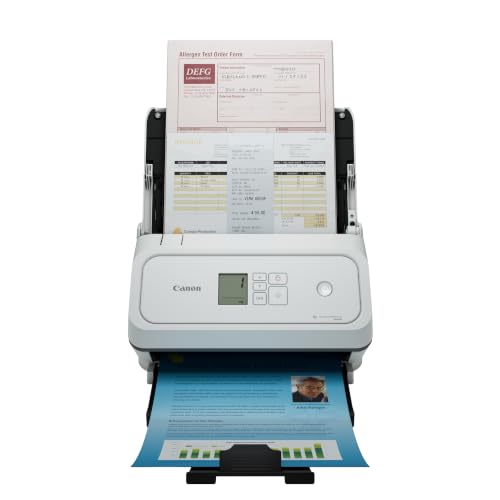
Among commercial-grade document scanner systems, the Canon imageFORMULA R40II is built for straightforward office use with fast duplex scanning, a compact feeder, and easy setup. It handles a wide variety of document types and scans to cloud through Canon’s bundled software.
Best For: Offices that want a simple USB document scanner with broad media handling.
Pros:
- Scans both sides at up to 45 ppm in color
- 60-sheet automatic feeder handles multiple document types
- Includes Canon CaptureOnTouch software for easy operation
- Scans receipts, business cards, reports, contracts, and long documents
Cons:
- TWAIN and ISIS drivers are not supported
- USB connection only
- Monochrome LCD is basic compared with touchscreen-equipped models
The R40II is a practical choice if you want reliable scanning without a complicated setup. Its strength is versatility across document types, though buyers needing advanced driver support will want to note its software limitations.
Desktop Streamliner – One-Touch Color Document Scanner
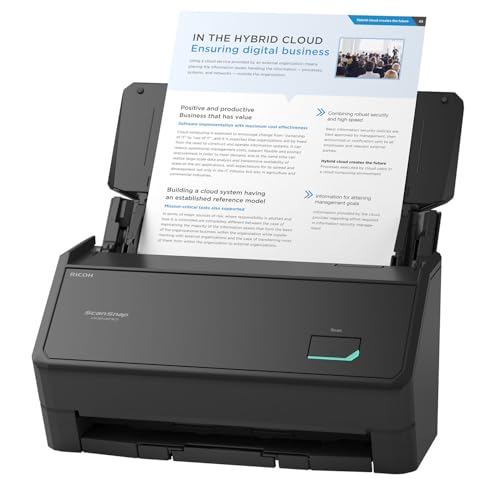
The ScanSnap iX2400 is a streamlined option for commercial-grade document scanner systems that prioritize simplicity and consistent desktop performance. It scans up to 45 pages per minute, uses a 100-sheet feeder, and leans on software automation to clean up and organize documents, receipts, and more.
Best For: Users who want one-touch scanning with easy document organization on a wired USB setup.
Pros:
- Up to 45 pages per minute with one-touch operation
- 100-sheet feeder supports longer scan runs
- Automatically de-skews, rotates, and removes blank pages
- Handles business cards, receipts, photos, and envelopes
Cons:
- Wired USB connection only
- No mention of advanced cloud-first hardware controls
- Best suited to desktop organization rather than high-volume production scanning
The iX2400 is a strong fit when ease of use matters more than enterprise-scale throughput. Its clean-image features and ScanSnap Home software make it especially appealing for people who want paper under control without a steep learning curve.
Compact Plug-and-Scan Office Starter – Canon imageFORMULA R30
If you want commercial-grade document scanner systems behavior without a complicated setup, the Canon imageFORMULA R30 is a straightforward desktop option. It handles duplex scanning at up to 25 pages per minute, includes a 60-sheet automatic feeder, and works with the built-in software already on the device.
Best For: Small offices or solo users who want a simple USB scanner for mixed document batches and fast everyday digitizing.
Pros:
- Plug-and-scan USB connection with no software installation required
- Duplex scanning at up to 25 pages per minute
- 60-sheet automatic feeder handles documents, invoices, contracts, and business cards
- Built-in scanning software updates automatically
Cons:
- USB-only connection, so it lacks wireless convenience
- 60-sheet feeder is smaller than higher-capacity office scanners
- Minimum system requirements list Windows 7
This is a practical choice when you want a reliable, easy-to-launch scanner for organized paper-to-digital workflows. It is less about advanced networking and more about fast, simple document capture from a compact machine.
Wireless High-Capacity Office Scanner – Epson WorkForce ES-580W
The Epson WorkForce ES-580W fits the commercial-grade document scanner systems category well if you want speed, wireless flexibility, and a larger feeder. It scans both sides with Single-Step Technology, reaches up to 35 pages per minute, and can send files directly to cloud services, email, or USB without needing a computer.
Best For: Busy home offices and workgroups that need wireless scanning, OCR, and high-volume batch handling.
Pros:
- Wireless scanning to smartphone, tablet, computer, cloud, email, or USB
- 100-sheet ADF supports larger batch jobs
- Up to 35 pages per minute with duplex scanning
- OCR creates searchable PDFs and editable Word or Excel files
Cons:
- Uses a 300 dpi resolution, which is lower than some competitors
- Desktop footprint is larger than compact scanners
- May be more scanner than you need for light occasional use
This model stands out for flexible file routing and strong document handling in a desk-friendly package. It is a better fit when speed and workflow convenience matter more than minimalist size.
Space-Saving Dual-Mode Scanner – ScanSnap iX1300
The ScanSnap iX1300 is a compact choice in commercial-grade document scanner systems for users who need quick duplex scanning in a small footprint. It handles documents, photos, cards, and thick items, and it offers USB or Wi-Fi connectivity for sending scans to computers, mobile devices, and cloud services.
Best For: Small desks, shared workspaces, and users who want a compact scanner with simple one-touch operation.
Pros:
- Space-saving design that stays out of the way
- Up to 30 ppm duplex scanning with automatic de-skew and blank page removal
- USB and Wi-Fi connectivity for Mac, PC, mobile devices, and cloud services
- ScanSnap Home software helps manage documents, receipts, business cards, and photos
Cons:
- 20-sheet feeder is smaller than some office-focused scanners
- Best suited to lighter batch sizes than high-capacity workgroup models
- May not appeal to users who want a larger ADF for big jobs
This scanner is ideal when desk space is tight but you still want dependable, automated document organization. It balances speed, flexibility, and simplicity better than many bulkier desktop models.
Ultra-Compact Desk-Saver – Epson WorkForce ES-C220 Compact Document Scanner
If you want commercial-grade document scanner systems in a smaller footprint, the Epson WorkForce ES-C220 is built for tight desks and mixed document jobs. It scans both sides in a single pass at up to 30 ppm/60 ipm and still keeps the workflow simple with a 20-page ADF and automatic image cleanup tools.
Best For: Small offices, home workstations, and mobile users who need a compact scanner that handles everyday batches, cards, and passports.
Pros:
- Ultra-compact design saves up to 60% of desk space.
- Single-step duplex scanning reaches up to 30 ppm/60 ipm.
- 20-page ADF supports batches of varying paper sizes.
- Flexible scan path handles standard paper, cards, and passports.
Cons:
- USB connection only, so it is less flexible than wireless models.
- 20-sheet feeder is smaller than larger office scanners.
Overall, the ES-C220 is a practical choice when space is limited but you still need reliable duplex scanning and solid image corrections. It focuses on portability, speed, and simple day-to-day document capture rather than big-volume office throughput.
Fast Wireless Hub – ScanSnap iX2500 Wireless or USB Scanner
The ScanSnap iX2500 is aimed at buyers who want commercial-grade document scanner systems with fast throughput, flexible connectivity, and easy file handling. With a large touchscreen, 45ppm double-sided scanning, a 100-sheet feeder, and Wi-Fi 6 plus USB-C, it is designed to keep scanning sessions organized and efficient.
Best For: Busy teams and power users who want fast duplex scanning, wireless convenience, and profile-based workflows.
Pros:
- Fast 45ppm double-sided scanning speeds up large jobs.
- 100-sheet document feeder supports longer scan runs.
- Wi-Fi 6 and USB-C provide flexible connection options.
- Touchscreen profiles and Quick Menu simplify recurring workflows.
Cons:
- Advanced feature set may be more than casual users need.
- Best value depends on making use of cloud and profile workflows.
In practice, the iX2500 stands out for organizations that want speed plus ease of use. Its feeder capacity, automatic optimization features, and multi-device support make it a strong fit for active scanning environments that need a streamlined system.
Wireless Workhorse – Epson WorkForce ES-500W II Desktop Scanner
The Epson WorkForce ES-500W II is a strong fit for commercial-grade document scanner systems when you want wireless scanning, dependable paper handling, and straightforward file management. It scans up to 35 ppm/70 ipm, uses a 50-sheet ADF, and adds tools like OCR and image cleanup to keep routine office workflows moving.
Best For: Small offices and shared workspaces that need wireless duplex scanning with dependable batch handling.
Pros:
- Wireless scanning to phones, tablets, computers, and cloud accounts.
- 35 ppm/70 ipm duplex speed supports fast everyday use.
- 50-sheet ADF handles stacks of mixed document sizes.
- OCR, auto cropping, and blank-page skip improve file organization.
Cons:
- Desktop design is less portable than compact travel scanners.
- Wireless features may be unnecessary if you only scan to one PC.
For offices that want a practical balance of speed, connectivity, and document cleanup tools, the ES-500W II is easy to recommend. It is built to scan a lot without overcomplicating the workflow, while still offering the kind of paper protection and software integration that businesses value.
How We Picked the Best Commercial-Grade Document Scanner Systems
We focused on Commercial-Grade Document Scanner Systems that are practical for real office use: consistent duplex scanning, dependable paper handling, strong OCR and cloud support, and setup that won’t slow down a busy workflow. We also favored models with wireless or USB flexibility, compact footprints where relevant, and features that reduce rescans and manual cleanup.
Quick Comparison
Not every team needs the same scanner. High-volume departments should prioritize feeder capacity, speed, and durability. Small offices and home offices may value one-touch scanning, wireless convenience, and easy integration with cloud destinations. Receipt-heavy workflows benefit from models tuned for mixed document types, while shared office environments often need broader compatibility and simple plug-and-scan operation.
Key Buying Factors for Commercial-Grade Document Scanner Systems
Scan Speed and Duty Cycle
Look at pages per minute and the scanner’s recommended workload. Faster is not always better if the device can’t sustain your daily volume. For commercial use, reliable throughput matters more than peak specs alone.
Duplex and Feeder Performance
Automatic duplex scanning is essential for most offices. A dependable ADF helps reduce hands-on feeding, while better paper handling lowers the risk of jams, skewed scans, and damaged originals.
Connectivity and Workflow Support
USB is still valuable for direct, stable connections, but wireless and cloud-ready options can streamline shared environments. If your team scans to email, network folders, or cloud apps, make sure the software and destinations fit your workflow.
Software, OCR, and Ease of Use
Good scanning hardware is only half the story. OCR accuracy, file naming options, and simple presets can save significant time. For Commercial-Grade Document Scanner Systems, intuitive operation is often the difference between frequent use and a device that sits idle.
Document Variety and Space Constraints
Think about what you scan most often: standard letter pages, receipts, cards, mixed-size stacks, or fragile originals. Compact scanners work well in tight spaces, while larger production units are better for teams with heavier daily demand.
Who Should Buy Which Commercial-Grade Document Scanner Systems?
Choose a production-style scanner if your office processes large batches every day and needs maximum efficiency. Pick a wireless desktop model if multiple users need convenient, shared access. If your workflow is lighter but still professional, a compact duplex scanner may offer the best balance of cost, speed, and convenience. For receipt-heavy or mixed-document work, prioritize cloud tools, OCR quality, and flexible media handling over raw speed alone.
In short, the best option depends on volume, space, and workflow—not just brand or headline scan speed. Matching those needs correctly will get you the most value from your scanner investment.
