
If you need reliable scan data for design, inspection, reverse engineering, or 3D printing, the right scanner matters more than the biggest feature list. Commercial-grade 3D scanners are built to deliver the precision, speed, and repeatability professionals expect.
This roundup focuses on 10 strong options for buyers who want serious performance without guessing which specs actually translate into better results.
Best 10 Commercial-Grade 3D Scanners Picks for 2026
Industrial Precision Pick
Revopoint MetroX Pro 3D Scanner, Advanced

- 0.01 mm single-frame precision
- Four scan modes plus auto turntable
- Works on shiny or dark surfaces without spray
Best For: Precision modeling and industrial measurement
Metrology-Grade Workhorse
Creality Sermoon S1 Handheld Laser Scanner

- 0.02 mm metrology-grade accuracy
- Single-line and 34-line laser modes
- Up to 90 FPS and 1,428,000 points/sec
Best For: Engineering projects and detailed handheld scanning
All-Weather Pro Pick
Revopoint POP 4 Premium 3D Scanner
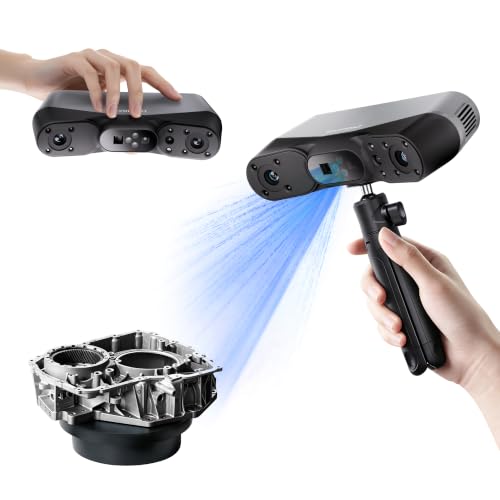
- Up to 0.03 mm single-frame accuracy
- Five scan modes for indoor and outdoor use
- WiFi and battery grip support wireless scanning
Best For: Versatile scanning in studio and field environments
Auto-Body Specialist
Creality Raptor Pro Automotive Scanner

- 22 cross lines and 7 parallel laser lines
- Up to 0.02 mm accuracy in laser mode
- Anti-shake design for handheld stability
Best For: Automotive and engineering scans of medium to large parts
Metrology-Ready Laser Scanner

- 0.01 mm single-frame precision
- Five scan modes for different part types
- Scans dark and shiny surfaces without spray
Best For: Inspection, reverse engineering, and portable industrial scanning
Dual-Laser Metrology Scanner

- 0.02 mm metrology-grade accuracy
- 660,000 points/s scan speed
- Blue laser plus IR structured light
Best For: Automotive, reverse engineering, and mixed-size object scanning
Compact Detail Scanner

- 0.01 mm precision for fine detail
- Optimized for 10 mm to 300 mm objects
- Stable indoor scanning with anti-shake features
Best For: Small parts, tabletop scanning, and 3D printing models
Flagship Speed Pick
Raptor Pro Wireless Blue Laser Scanner

- 0.02mm lab accuracy with 60FPS capture
- Wireless scanning with Scan Bridge support
- Marker alignment for multi-scan stitching
Best For: Users who need fast, detailed scans across small and medium objects
All-in-One Engineering Choice
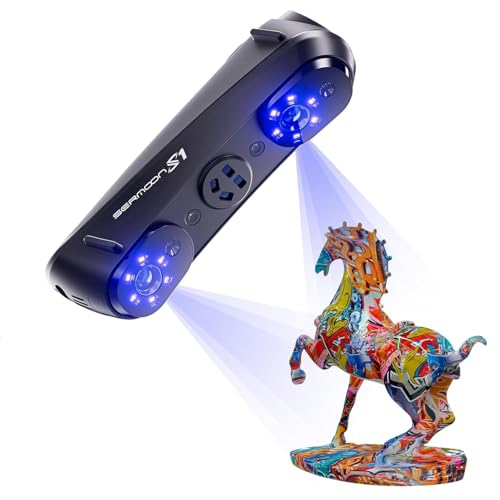
- 5mm to 4000mm range for tiny to huge objects
- Triple blue laser modes for flexible capture
- AI-assisted software for cleanup and alignment
Best For: Engineers and fabricators scanning everything from jewelry to large structures
Material Versatility Pick
CR-Scan Raptor Pro Full-Color Scanner

- Scans black, metallic, and transparent surfaces powder-free
- 0.02mm accuracy with 660,000 points per second
- 24-bit RGB color capture plus wireless support
Best For: Professionals scanning difficult materials and needing true-color results
Industrial Precision Pick – Revopoint MetroX Pro 3D Scanner, Advanced
If you need commercial-grade 3D scanners for precision modeling, inspection, or reverse engineering, the MetroX Pro is built around accuracy-first capture. Its blue laser system, multiple scan modes, and automated turntable workflow make it a strong fit for detailed parts, shiny surfaces, and repeatable measurement tasks.
Best For: Precision-focused users who want metrology-style scanning for industrial measurement, 3D printing, and prototyping.
Pros:
- Up to 0.01 mm single-frame precision and 0.02 mm accuracy for detailed work.
- Four scanning modes, including cross-line lasers, parallel lines, structured light, and auto turntable scanning.
- Handles shiny or dark surfaces without scanning spray in laser modes.
- Revo Metro software supports scanning, editing, and merging for downstream workflows.
Cons:
- Revo Design and Revo Measure are sold separately.
- Those paid tools support Windows only.
Overall, this is the most measurement-oriented option in the group, with flexible capture modes that suit both industrial inspection and creative production. If your priority is fine detail and workflow efficiency, the MetroX Pro is positioned as a serious professional tool.
Metrology-Grade Workhorse – Creality Sermoon S1 Handheld Laser Scanner
For commercial-grade 3D scanners aimed at engineering projects, the Sermoon S1 stands out with its laser depth capture and wide-area NIR mode. It’s designed to handle everything from recessed mechanical details to larger objects, while the CrealityScan software keeps the workflow approachable with guided processing and editing tools.
Best For: Engineers and makers who want high-accuracy handheld scanning for parts, large objects, and mixed workflows.
Pros:
- Metrology-grade 0.02 mm accuracy with a blue laser setup designed for detail.
- Single-line mode helps capture deep holes, narrow gaps, and recessed areas.
- 34 cross laser lines improve coverage on larger items.
- Up to 90 FPS scanning and 1,428,000 points per second for fast capture.
Cons:
- Best hardware recommendations are fairly demanding for PC and Mac users.
- Some advanced workflows depend on Windows-oriented inspection integrations.
As a practical engineering scanner, the Sermoon S1 balances speed, accuracy, and software support well. It’s especially appealing if you need a handheld tool that can move from small complex parts to larger bodies or structures without switching systems.
All-Weather Pro Pick – Revopoint POP 4 Premium 3D Scanner
If you want commercial-grade 3D scanners that can move between indoor studio work and outdoor field capture, the POP 4 offers a broad feature set. It combines fine accuracy, multiple scan modes, wireless operation, and AI-assisted cleanup, making it a flexible choice for users who need more than basic object scanning.
Best For: Users who need a versatile scanner for small parts, large objects, and outdoor environments.
Pros:
- Up to 0.03 mm single-frame accuracy for precision-focused projects.
- Five scanning modes cover small parts, large objects, dark surfaces, and high-reflectivity materials.
- Outdoor-friendly performance with support for bright ambient light conditions.
- Built-in WiFi and battery grip support untethered scanning and live cross-screen preview.
Cons:
- AI object segmentation is Windows only.
- Professional software features may add workflow complexity for casual users.
The POP 4 is best viewed as a flexible all-rounder with strong field usability. If your workflow includes both small precision work and larger site-based scanning, its mode variety and wireless design make it especially practical.
Auto-Body Specialist – Creality Raptor Pro Automotive Scanner
For commercial-grade 3D scanners built around automotive and engineering work, the Raptor Pro focuses on practical coverage and stability. Its cross-line and parallel blue laser setup is tuned for different object sizes, while the anti-shake design and CrealityScan software help keep scans manageable in real-world use.
Best For: Automotive modifiers and engineering users scanning medium to large parts with handheld flexibility.
Pros:
- 22 cross laser lines and 7 parallel blue laser lines support different object sizes.
- Single 7-line blue laser captures up to 0.02 mm accuracy.
- Up to 60 FPS in blue laser mode and 660,000 points per second.
- Anti-shake One-Shot 3D imaging helps reduce tracking loss during handheld use.
Cons:
- NIR mode runs slower than blue laser mode at 30 FPS.
- Software features may feel geared more toward professional workflows than quick casual scans.
This model is a strong fit when your work centers on vehicle parts, larger components, or mixed-size engineering captures. It emphasizes stable data collection and adaptable lighting support rather than a minimalist consumer experience.
Metrology-Ready Laser Scanner – Revopoint MetroY Ultra
If you need commercial-grade 3D scanners for tight-tolerance work, the Revopoint MetroY Ultra is built around high precision, fast capture, and flexible scan modes. Its blue laser system and marker-free structured-light option make it a practical choice for reverse engineering, inspection, and detailed part digitizing.
Best For: Industrial users who want a portable scanner for inspection, reverse engineering, and small-to-medium part capture.
Pros:
- Up to 0.01 mm single-frame precision with 0.015 + 0.04 mm x L(m) volumetric accuracy
- Five scanning modes cover cross-line, parallel-line, single-line, structured light, and turntable workflows
- Up to 90 FPS scanning with an NVIDIA GPU for faster data capture
- Handles dark, shiny, and metallic surfaces without scanning spray and works outdoors up to 100,000 lux
Cons:
- Best performance requires a strong PC, including a recommended RTX 3060-class GPU on Windows
- Battery grip is rated for about 2.5 hours, so longer field sessions may need planning
- Optimized more for small to medium parts than large-scale environments
Overall, the MetroY Ultra is a strong fit when precision and workflow flexibility matter more than price simplicity. It combines industrial inspection features with portable operation, making it a capable option for serious scanning tasks.
Dual-Laser Metrology Scanner – Creality Raptor Pro
The Creality Raptor Pro stands out among commercial-grade 3D scanners for its mix of blue laser and IR structured-light scanning. With metrology-grade accuracy, high point capture speed, and no-marker scanning on feature-rich objects, it is aimed at demanding reverse engineering and industrial digitizing work.
Best For: Users who need a versatile scanner for automotive parts, molds, body scans, and reverse engineering.
Pros:
- Metrology-grade accuracy up to 0.02 mm + 0.08 mm/m
- Captures up to 660,000 points/s for fast industrial workflows
- Dual blue laser mode and NIR structured light expand the range from small parts to large objects
- No markers needed for feature-rich workpieces, with dedicated face and body scanning support
Cons:
- Windows users need fairly strong hardware, with i7-class CPU, 32 GB RAM, and an 8 GB GPU recommended
- Best setup guidance is more demanding than simpler consumer scanners
- Although wireless support is included, the device is still geared toward technical users
In practice, the Raptor Pro is a serious all-rounder for teams that need one scanner to handle many object sizes and scan types. Its accuracy and mixed-sensor design make it especially compelling for inspection and reverse engineering.
Compact Detail Scanner – 3DMakerpro Seal
For buyers comparing commercial-grade 3D scanners for small objects, the 3DMakerpro Seal focuses on fine detail in a compact package. Its blue LED projection, tight working range, and stable indoor scanning performance make it a practical option for tabletop parts and 3D printing prep.
Best For: Small-object scanning, tabletop workflows, and detailed models for 3D printing.
Pros:
- Claims 0.01 mm precision for capturing delicate dents and sharp edges
- Optimized for small objects from 10 mm to 300 mm
- Includes scan-back and anti-shake functions for steadier scans up to 10 fps
- JMStudio software supports real-time tracking, auto-alignment, and common export formats
Cons:
- Designed for indoor use, so it is less flexible than scanners built for outdoor work
- Slower at up to 10 fps compared with faster industrial scanners
- Best results require keeping within the recommended 180–280 mm working distance
The Seal is a focused choice rather than a do-everything scanner, but that can be a strength if your work is mostly small parts. It emphasizes detail, stability, and straightforward software support for printing-oriented projects.
Flagship Speed Pick – Raptor Pro Wireless Blue Laser Scanner
If you need a commercial-grade 3D scanner for detailed parts and fast turnaround, the Creality Raptor Pro is built for high-precision work. It combines 0.02mm accuracy, 60FPS scanning, and a wide 5mm to 2000mm range, making it practical for everything from small components to larger objects in a 3D printing or reverse-engineering workflow.
Best For: Professionals who want a wireless-ready scanner with strong detail capture and quick alignment for mixed-size projects.
Pros:
- 0.02mm accuracy in laboratory conditions for fine-detail capture.
- Up to 60FPS scanning and 660,000 points per second for faster sessions.
- Supports wireless scanning with the included Scan Bridge accessory.
- Marker-based alignment helps stitch multiple scans together cleanly.
Cons:
- Maximum accuracy is stated in laboratory conditions, so real-world results may vary.
- Best suited to users who can benefit from a more technical, workflow-focused scanner.
This is a strong fit if your priority is speed without giving up precision. The Raptor Pro’s range and wireless support make it especially useful for shops that need one scanner to handle many different object sizes.
All-in-One Engineering Choice – Sermoon S1 Blue Laser Scanner
For commercial-grade 3D scanners that can cover both tiny parts and very large objects, the Creality Sermoon S1 offers a broad 5mm to 4000mm scanning range. Its triple blue laser modes and 0.02mm accuracy make it a practical option for engineering, prototyping, restoration, and other jobs where workflow flexibility matters as much as detail.
Best For: Engineering and production users who need one handheld scanner for everything from small parts to large structures.
Pros:
- Ultra-wide 5mm to 4000mm range covers both micro and large-scale scanning.
- Three blue laser modes support fast, detail, and deep-hole capture.
- Up to 0.02mm accuracy and 90FPS scanning improve productivity.
- AI-assisted software helps with alignment, mesh generation, and cleanup.
Cons:
- Requires fairly capable systems, especially for recommended Windows or Mac setups.
- Heavier and more workstation-oriented than a basic hobby scanner.
The Sermoon S1 stands out as a flexible workhorse for professional scanning tasks. If you want one device that can handle fine parts, large assemblies, and difficult geometries, this model is designed for that kind of mixed-use environment.
Material Versatility Pick – CR-Scan Raptor Pro Full-Color Scanner
Among commercial-grade 3D scanners, the Creality CR-Scan Raptor Pro is aimed at users who need accuracy on difficult surfaces as well as broad object coverage. It pairs 22 crossed blue lasers, 7 parallel blue lasers, and NIR structured light with 0.02mm accuracy, making it useful for reverse engineering, inspection, and full-color scanning workflows.
Best For: Users who scan black, metallic, or translucent objects and want strong texture capture in a professional workflow.
Pros:
- Handles black, metallic, and 71% transparent glass surfaces without spray powder.
- Supports 0.02mm accuracy with 660,000 points per second.
- Full-color 24-bit RGB capture for realistic textures.
- Wireless support and outdoor-ready scanning expand where you can work.
Cons:
- Best performance depends on a capable Windows, Mac, or Android setup.
- Feature depth may be more than casual users need.
This scanner is especially compelling if your projects involve challenging materials or a mix of indoor and outdoor work. Its combination of powder-free scanning, color capture, and software compatibility makes it a versatile choice for professional pipelines.
How We Picked These Commercial-Grade 3D Scanners
We prioritized models that balance accuracy, scan speed, surface capture, workflow flexibility, and practical usability. For Commercial-Grade 3D Scanners, we looked for features that matter in real jobs: metrology-level precision, stable handheld scanning, support for difficult surfaces, and hardware/software combinations suited to repeated professional use.
Quick Comparison
Use the list below as a fast filter rather than a spec race. Some scanners are better for tight-tolerance parts and inspection work, while others are more versatile for larger objects, faster capture, or general 3D printing prep. If you need the highest precision, focus first on stated accuracy and scan stability; if you work across varied object sizes, weigh range, frame rate, and surface handling more heavily.
Key Buying Factors for Commercial-Grade 3D Scanners
Accuracy and Repeatability
Accuracy is the starting point, but repeatability is what makes a scanner useful in a professional workflow. Look for clear accuracy claims, stable tracking, and dependable alignment when scanning edges, holes, and mechanical surfaces.
Scanning Technology
Blue laser, structured light, and hybrid systems each have trade-offs. Blue laser scanners often shine in precision work and feature-rich geometry capture, while hybrid systems can offer broader versatility for mixed materials and object sizes.
Object Size and Working Distance
Match the scanner to the parts you actually handle. Small engineering components, medium product parts, and larger assemblies all benefit from different working ranges, capture speeds, and field-of-view characteristics.
Surface Handling and Ease of Use
Dark, shiny, or low-texture surfaces can slow many scanners down. Features like anti-shake tools, AI segmentation, better tracking, and strong lighting or laser support can reduce rescans and cleanup time.
Who Should Buy Which Commercial-Grade 3D Scanners?
Choose a high-precision model if your work centers on inspection, reverse engineering, or parts that need tight dimensional fidelity. Pick a more versatile handheld scanner if you want a better balance of portability, speed, and general-purpose 3D printing prep. For teams, shops, and engineering users, the best choice is usually the one that fits your part sizes, accuracy target, and daily workflow—not just the highest headline spec.
